Agni Finance (Mantle) Crypto Exchange Review: Truth About TVL, Trading, and Why It’s Growing Fast
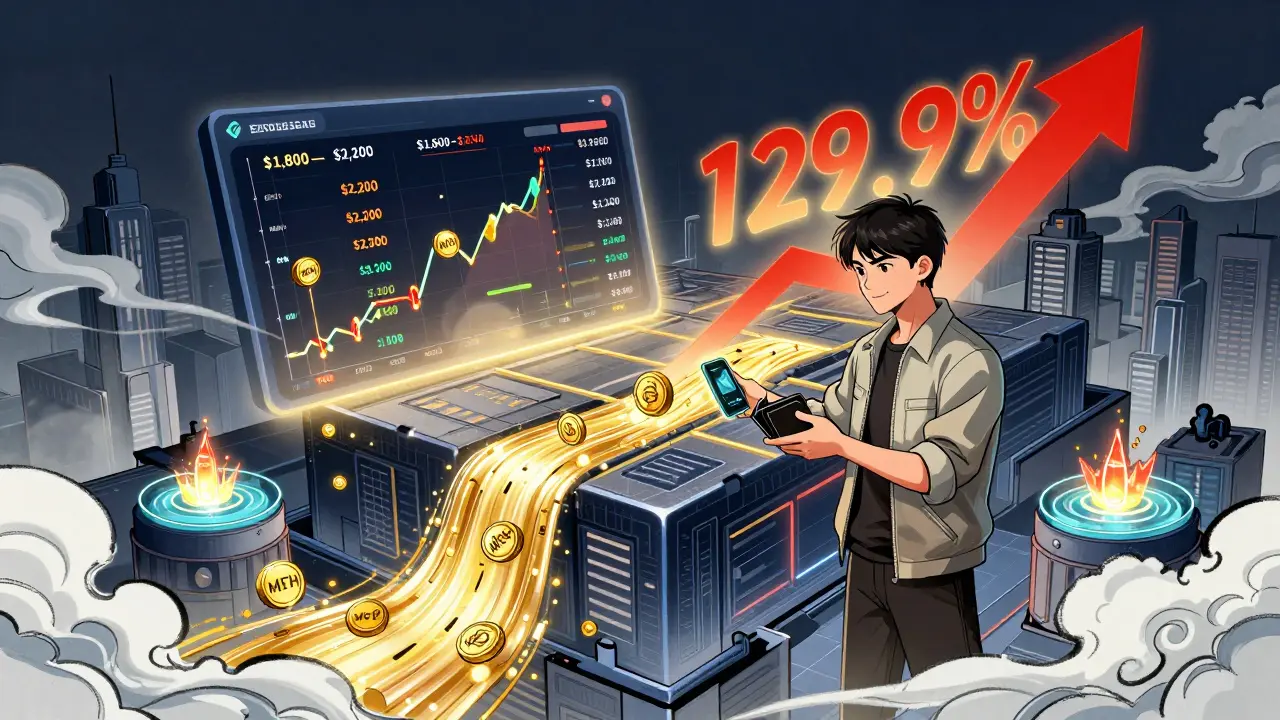
When you hear "crypto exchange," you probably think of Binance, Coinbase, or even Uniswap. But what if the next big thing isn’t on Ethereum or Solana - it’s on Mantle, an Ethereum Layer 2 that’s quietly stealing the spotlight? And at the heart of that surge is Agni Finance, a decentralized exchange that’s not just keeping up - it’s driving the entire network forward.
What Exactly Is Agni Finance?
Agni Finance isn’t your average crypto exchange. It’s a decentralized exchange (DEX) built directly on the Mantle Network, using an Automated Market Maker (AMM) model with concentrated liquidity. That means instead of spreading your money across every possible price range like Uniswap does, you pick where you want your funds to work - between $1,800 and $2,200 for ETH, for example. This cuts down wasted capital and boosts returns for liquidity providers. It’s also a launchpad. New projects on Mantle don’t just list on Agni - they often debut there. That gives early users access to tokens before they hit bigger platforms. Think of it like a hybrid between Uniswap and CoinList, but optimized for speed and low fees.Why Agni Finance Is Growing So Fast
In Q3 2025, Agni Finance’s Total Value Locked (TVL) jumped 129.9% quarter-over-quarter. That’s not a typo. It didn’t just grow - it exploded. And that growth wasn’t isolated. It pushed Mantle Network’s overall TVL from $212.5 million to $242.3 million, accounting for nearly all of its 14% increase that quarter. By early 2026, Agni Finance was sitting at around $117 million in TVL, making it the top protocol on Mantle - even beating out Merchant Moe, which had held the title with $78.4 million. That’s huge. In DeFi, TVL isn’t just a vanity metric. It’s trust. It’s capital flowing in because people believe the system works. And it’s not just about numbers. Mantle’s ecosystem saw a 334.6% spike in daily active addresses during that same period. People weren’t just holding - they were trading, staking, swapping. Agni Finance was the main engine.How It Works: No Fluff, Just the Mechanics
If you’ve used Uniswap before, the interface will feel familiar. Connect your wallet - MetaMask, Rainbow, or any EVM-compatible one. Make sure you’re on the Mantle Network. If you’re not, you’ll need to add it manually:- Network Name: Mantle
- New RPC URL: https://rpc.mantle.xyz
- Chain ID: 5000
- Symbol: ETH
- Block Explorer: https://explorer.mantle.xyz

Who’s Competing? And Who’s Winning?
Agni Finance isn’t the only game in town on Mantle. There’s Merchant Moe - still the largest DEX by some metrics - built on Trader Joe’s Liquidity Book. Then there’s INIT Capital, with $146.9 million in TVL, focused on structured liquidity pools. And Puff’s Penthouse, which gamifies staking with NFT rewards. But here’s the thing: Agni Finance doesn’t just compete - it complements. While Merchant Moe is great for passive LPs, and INIT Capital targets institutional-grade liquidity, Agni Finance wins on two fronts: simplicity and launchpad access. If you’re a new project on Mantle, you don’t just want liquidity. You want visibility. Agni Finance gives you both. Compared to Uniswap or PancakeSwap, Agni Finance trades less volume overall - but it’s faster, cheaper, and more capital-efficient. On a chain like Ethereum, you need millions in liquidity to make a pool viable. On Mantle, you can do it with $500,000 and still get tight spreads. That’s why DeFi builders are shifting.What’s Missing? The Downsides
No platform is perfect. Agni Finance has a few real limitations. First - it’s still small in the grand scheme. Compared to Uniswap’s $10 billion+ TVL, $117 million looks tiny. That means fewer trading pairs, less depth for large orders. If you’re trying to swap $50,000 of mETH, you might get slippage. Second - it’s tied to Mantle. If Mantle’s growth stalls, so does Agni. That’s not a weakness in isolation, but it’s a single point of failure. You’re betting on one Layer 2, not the whole crypto market. Third - no derivatives. No leverage. No options. No complex trading tools. This isn’t a professional trader’s platform. It’s for swap-and-stake users, DeFi newbies, and project launchers. And yes - user reviews are scarce. There’s no Reddit thread with 2,000 comments. No detailed YouTube breakdown. FxVerify claims to have a review, but no actual ratings are public. That’s not a red flag - it’s a sign this is still early-stage. The community is growing, but it’s not loud yet.
Why This Matters for the Bigger Picture
Agni Finance isn’t just a DEX. It’s a signal. Mantle Network’s treasury is worth $5.6 billion - all community-owned. Its MNT token surged 199.8% in Q3 2025. It’s integrated with EigenLayer for restaking, Chainlink SCALE for reliable oracles, and even partnered with Bybit to bring centralized liquidity into its DeFi ecosystem. Agni Finance is the beating heart of that strategy. Mantle’s goal? To become the "liquidity chain of the future." That means attracting Real World Assets (RWA), staking protocols, and AI-driven DeFi tools. Agni Finance is the testing ground. The launchpad. The proving ground. If you’re looking for the next Ethereum killer, you’re looking in the wrong place. But if you’re looking for the next *liquidity hub* - the place where capital flows fastest, cheapest, and most efficiently - then Agni Finance on Mantle is already there.Should You Use It?
Here’s the simple breakdown:- Use Agni Finance if: You’re already on Mantle, you want low fees and fast trades, you’re into early-stage token launches, or you’re a liquidity provider looking to maximize capital efficiency.
- Avoid it if: You need deep liquidity for big trades, you want leverage or derivatives, or you’re not ready to bridge assets to a Layer 2.
What’s Next?
Mantle’s roadmap includes AI-powered trading tools, a crypto index fund similar to an S&P 500 for digital assets, and deeper RWA integrations. Agni Finance will be the first to test them. That means features like automated liquidity rebalancing based on AI predictions could arrive in 2026. This isn’t speculation. It’s on Mantle’s public Q1 2025 roadmap. Agni Finance isn’t just riding the wave - it’s helping build the wave.Is Agni Finance safe to use?
Yes, as long as you follow basic DeFi safety rules. Agni Finance is built on Mantle, which uses Optimistic Rollup technology secured by Ethereum. The code is open-source, and while no platform is immune to exploits, Agni hasn’t had any major security incidents. Always double-check the official contract address before connecting your wallet.
How do I get started with Agni Finance?
First, install a Web3 wallet like MetaMask. Add the Mantle Network using its RPC details. Then bridge ETH or USDC from Ethereum to Mantle using the official Mantle Bridge. Once your assets are on Mantle, go to Agni Finance’s website, connect your wallet, and start swapping or providing liquidity.
What’s the difference between mETH and wETH on Agni Finance?
mETH is Mantle’s native liquid staking token - it represents staked ETH on the Mantle chain and earns yield. wETH is wrapped ETH, the standard version used across Ethereum and its Layer 2s. Agni Finance’s mETH/wETH pair lets you trade between staked and wrapped ETH without leaving the Mantle ecosystem, making it ideal for yield-focused traders.
Can I earn rewards just by holding tokens on Agni Finance?
No, Agni Finance doesn’t offer simple holding rewards. You earn fees only by providing liquidity to trading pairs. If you just hold $AGNI or MNT tokens in your wallet, you won’t earn anything. To make money, you need to actively add liquidity.
Is Agni Finance better than Uniswap?
It depends. If you want the deepest liquidity and widest range of tokens, Uniswap wins. But if you care about speed, low fees, and capital efficiency - especially within the Mantle ecosystem - Agni Finance is superior. It’s not a replacement for Uniswap. It’s a better tool for a specific use case: fast, cheap swaps on a growing Layer 2.
Steven Dilla
February 1, 2026 AT 11:32Aaron Poole
February 2, 2026 AT 04:54Richard Kemp
February 3, 2026 AT 04:09Brianne Hurley
February 4, 2026 AT 22:24christal Rodriguez
February 5, 2026 AT 14:51Calvin Tucker
February 6, 2026 AT 14:31Gustavo Gonzalez
February 6, 2026 AT 17:00Mark Ganim
February 7, 2026 AT 20:38mary irons
February 8, 2026 AT 03:50Rob Duber
February 9, 2026 AT 19:09Gary Gately
February 11, 2026 AT 03:16Katie Teresi
February 11, 2026 AT 06:10Jeremy Dayde
February 13, 2026 AT 02:37Tom Sheppard
February 13, 2026 AT 14:45Sunil Srivastva
February 14, 2026 AT 00:31