AI and Blockchain Use Cases: Real-World Examples for 2026

Imagine a world where your medical records are completely secure, your supply chain is impossible to fake, and financial transactions happen instantly without hidden fees. That isn't science fiction anymore-it’s the reality of AI and blockchain use cases, which combine the analytical power of artificial intelligence with the unchangeable security of blockchain technology. As we move through 2026, this combination has stopped being just a buzzword and started solving real problems that neither technology could handle alone.
You might wonder why these two tech giants need each other. It comes down to trust and speed. Blockchain gives us a ledger that no one can tamper with, but it struggles to process massive amounts of data quickly. Artificial Intelligence (AI) can crunch numbers at lightning speed, but it often operates like a 'black box,' making decisions that are hard to verify. When you merge them, you get systems that are both incredibly fast and fully transparent. This guide breaks down exactly how this works, where it’s used today, and what you need to know if you’re looking to implement it.
Why Combine AI and Blockchain?
The core problem in modern digital infrastructure is balancing security with efficiency. Traditional databases are fast but vulnerable to hacks and insider threats. Pure blockchain networks are secure but slow and expensive to run. The integration of these technologies creates a symbiotic relationship. Blockchain provides the 'ground truth'-data that cannot be altered-while AI provides the 'intelligence' to analyze that data and automate responses.
Think of it like a bank vault with a super-smart guard. The vault (blockchain) ensures nothing gets stolen or changed without permission. The guard (AI) watches thousands of cameras simultaneously, predicting suspicious behavior before it happens. In technical terms, blockchain solves the 'black-box' issue of AI by providing verifiable audit trails for every decision made by an algorithm. Meanwhile, AI optimizes blockchain operations, such as predicting network traffic to lower transaction costs.
- Data Integrity: Blockchain ensures the data feeding into AI models hasn’t been tampered with, preventing biased or corrupted outcomes.
- Transparency: You can trace exactly how an AI reached a conclusion because every step is recorded on the immutable ledger.
- Efficiency: AI algorithms optimize gas fees and network load on blockchains, making transactions faster and cheaper.
Top Industries Using AI-Blockchain Integration
This technology isn’t just for crypto enthusiasts. Major industries are adopting it to solve critical pain points. Here are the most impactful areas where you’ll see this convergence in action during 2026.
1. Healthcare and Patient Data Security
Healthcare handles some of the most sensitive data on the planet. Hospitals and clinics face constant risks from ransomware attacks and privacy breaches. By using Hyperledger Fabric is an enterprise-grade blockchain framework designed for private, permissioned networks, medical institutions can store patient records securely. AI then analyzes this data to spot disease patterns or recommend treatments without ever exposing the raw identity of the patient.
In practice, this means a doctor can access a complete, verified history of a patient’s treatments from different hospitals, all encrypted and stored on a decentralized network. AI tools can flag potential drug interactions in real-time. According to recent industry analyses, this setup reduces data breach incidents significantly while maintaining compliance with regulations like HIPAA.
2. Supply Chain Management and Logistics
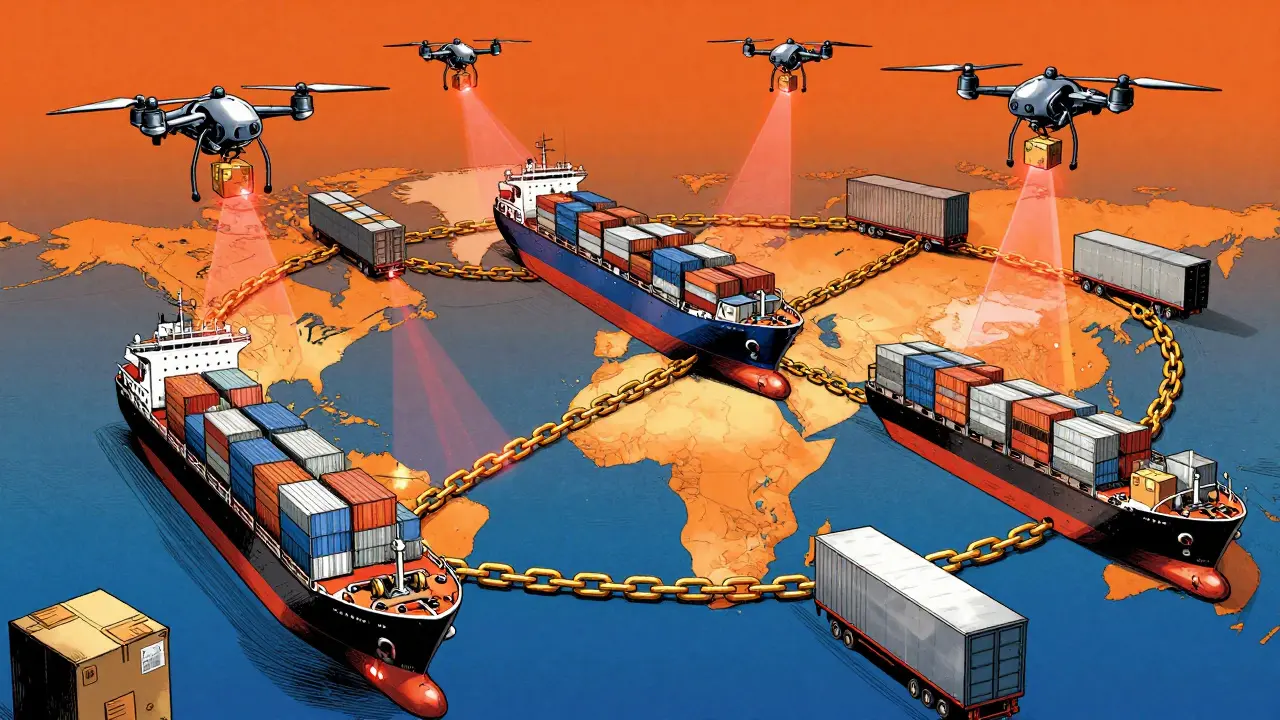
Fake goods and opaque supply chains cost businesses billions annually. Companies now use AI-blockchain solutions to track products from factory to doorstep. Every time a product changes hands, a record is added to the blockchain. AI monitors these records to predict delays, identify bottlenecks, and even detect fraud.
For example, a luxury watch brand can prove its authenticity. If a serial number appears twice in the system, the AI flags it immediately as a potential counterfeit. Shippers report up to a 52% reduction in fraud incidents when using these verification systems. You get total visibility, and customers get proof that their purchase is genuine.
3. Finance and Decentralized Banking
The financial sector was the first to adopt blockchain, and AI is taking it further. Traditional banks rely on complex, manual checks for loans and insurance claims. With AI-enhanced smart contracts, these processes become automatic. The AI evaluates creditworthiness based on historical data stored on the blockchain, ensuring the criteria haven’t been manipulated.
High-frequency trading firms use this combo to execute trades with millisecond precision while keeping an auditable trail for regulators. This eliminates human error and bias in lending decisions, creating a fairer and more efficient market.
How the Technology Works Together
Understanding the mechanics helps you grasp why this is so powerful. It’s not just slapping an AI model on top of a blockchain. It requires specific architectural choices.
Most implementations use platforms like Ethereum is a leading public blockchain platform known for its flexibility and extensive developer ecosystem. Ethereum allows developers to write 'smart contracts'-self-executing code that runs when conditions are met. By integrating machine learning models into these contracts, you create autonomous agents that can make decisions based on real-world data.
However, running heavy AI computations directly on the blockchain is too expensive and slow. So, experts use a hybrid approach. The AI does the heavy lifting off-chain (using standard cloud servers or specialized GPUs), and only the final result or hash of the computation is written to the blockchain. This keeps costs low while preserving security.
| Feature | Standalone AI | Standalone Blockchain | AI + Blockchain Integration |
|---|---|---|---|
| Data Trust | Low (Data can be faked) | High (Immutable) | Very High (Verified + Immutable) |
| Processing Speed | Fast | Slow | Moderate (Optimized via AI) |
| Transparency | Opaque (Black Box) | Transparent | Explainable (Auditable Logic) |
| Cost Efficiency | Variable | High Gas Fees | Reduced Costs (Predictive Optimization) |

Challenges and Limitations to Watch For
It’s not all smooth sailing. Implementing these systems is complex and expensive. If you’re considering this for your business, you need to be aware of the hurdles.
First, there’s the cost. Enterprise-grade implementations can range from $250,000 to $500,000 initially. You aren’t just buying software; you’re hiring a team that understands both distributed ledger technology and machine learning. The talent pool for this dual expertise is still small, driving up salaries.
Second, latency remains an issue. While AI speeds up processing, the blockchain verification step adds a delay of 200 to 500 milliseconds per transaction. For most applications, this is fine. But for ultra-high-frequency trading or real-time gaming, it might be a bottleneck.
Finally, regulatory uncertainty persists. Laws around data privacy (like GDPR) clash with the 'immutable' nature of blockchain. How do you 'delete' user data if it’s permanently recorded? Developers are working on zero-knowledge proofs to solve this, but legal frameworks are still catching up.
Future Trends: What’s Next in 2026 and Beyond?
The landscape is evolving rapidly. One major trend is the rise of 'Zero-Knowledge Machine Learning' (zkML). This allows companies to prove that their AI model produced a correct result without revealing the proprietary model itself. This is huge for intellectual property protection.
Another area is Decentralized Autonomous Organizations (DAOs). These are internet-native companies owned by their members. AI is increasingly used to scan proposals and vote on behalf of stakeholders, identifying scams or inefficient spending automatically. This makes governance more democratic and less prone to manipulation.
We’re also seeing a shift toward sustainability. Older blockchains consumed massive amounts of energy. Newer protocols, combined with AI-driven optimization, are drastically reducing carbon footprints, making green tech a viable option for eco-conscious brands.
Is AI-blockchain integration safe for small businesses?
Currently, it is challenging due to high implementation costs and technical complexity. Small businesses should look for SaaS platforms that offer pre-built AI-blockchain solutions rather than building custom infrastructure. However, pilot projects in specific niches like supply chain tracking can yield high returns.
Which blockchain is best for AI integration?
For public, open applications, Ethereum is the leader due to its mature ecosystem and developer support. For private, enterprise needs requiring strict privacy and compliance, Hyperledger Fabric is the preferred choice. Solana is also gaining traction for high-speed applications.
Can AI replace blockchain entirely?
No, they serve different purposes. AI focuses on prediction and automation, while blockchain focuses on trust and consensus. AI cannot guarantee data integrity on its own, which is why it needs blockchain to provide a verifiable source of truth.
What skills do I need to build AI-blockchain systems?
You need a mix of traditional programming and specialized knowledge. Key skills include Solidity or Rust for blockchain development, Python for AI/ML modeling (using libraries like TensorFlow or PyTorch), and understanding of distributed systems architecture.
How does this help with data privacy laws like GDPR?
It helps by creating an immutable audit trail of who accessed data and when. Combined with encryption techniques and emerging zero-knowledge proofs, it allows organizations to prove compliance without exposing sensitive personal data on the public ledger.