Benefits of Account Abstraction for Better Blockchain Wallets

Imagine losing your phone, and with it, your entire crypto wallet. No seed phrase written down. No way to recover. That’s not a hypothetical - it’s happened to thousands of people, costing over $3.8 billion in lost crypto between 2017 and 2022. Account abstraction changes that. It turns your wallet from a simple key into a smart, programmable account that can protect you - even when you make mistakes.
What Exactly Is Account Abstraction?
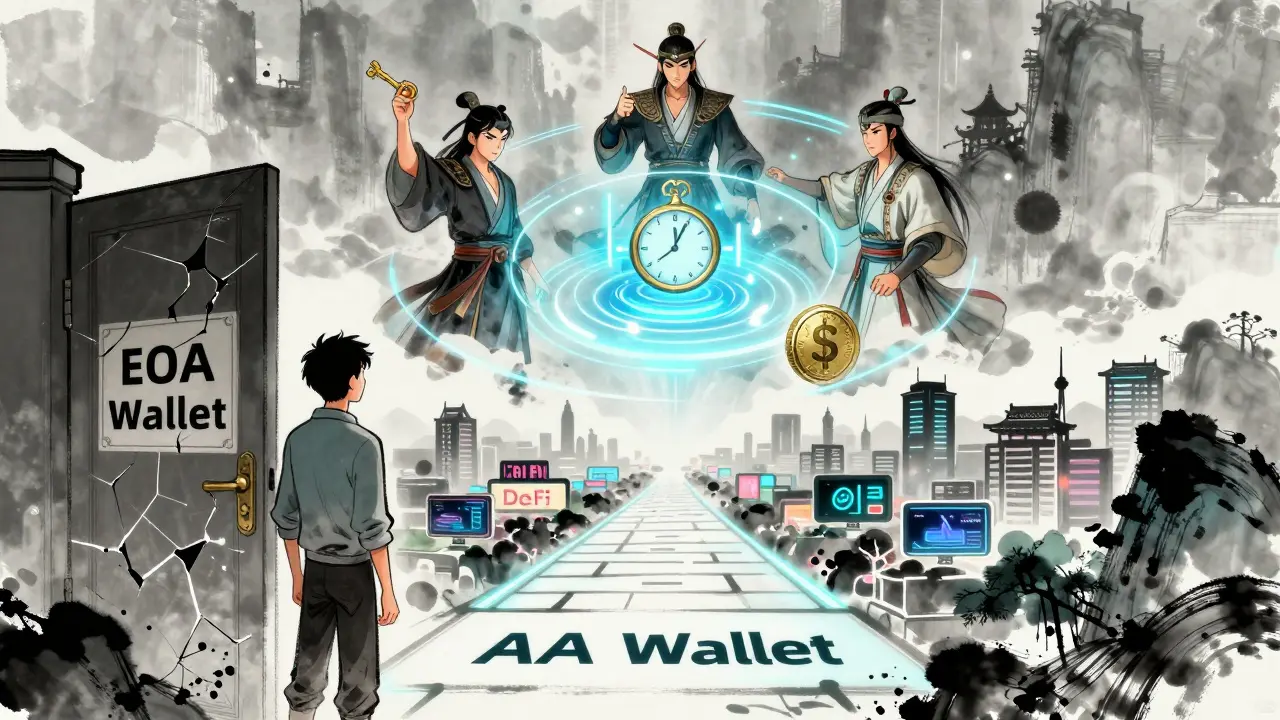
Account abstraction (AA) isn’t just a buzzword. It’s a technical upgrade that replaces traditional externally owned accounts (EOAs) - the kind used by MetaMask and other standard wallets - with smart contract wallets. These aren’t just digital keys anymore. They’re mini-programs that can decide who can spend, when, and how. The most widely adopted version is ERC-4337, introduced in 2021 by Vitalik Buterin and others. Unlike earlier attempts, ERC-4337 works without changing Ethereum’s core protocol. That’s why it’s being adopted so fast.Think of it like upgrading from a basic door lock to a smart lock that lets you grant access to guests, set time limits, and even let someone else pay the electricity bill for you. That’s what AA does for crypto wallets.
Security That Doesn’t Rely on a Single Key
Traditional wallets are fragile. One lost seed phrase = permanent loss. No second chances. Account abstraction fixes this with multi-signature setups and social recovery. Wallets like Argent and Safe let you name 2-3 trusted contacts - friends, family, or even a lawyer - who can help you regain access if you lose your device or forget your password.Argent reported a 98.7% recovery success rate across over 247,000 attempts between early 2022 and mid-2023. That’s not luck. It’s design. Instead of a 12-word phrase you can’t remember, you use real people you trust. No more panic when your phone dies.
Multi-sig also prevents hacks. If a hacker steals your password, they still can’t move your funds unless they also compromise one of your guardians. Safe’s implementation requires at least 2 out of 3 signatures for any transaction over a certain amount. That’s enterprise-grade security - the kind banks use - but for individuals.
Pay Gas in Any Token - Even USDC
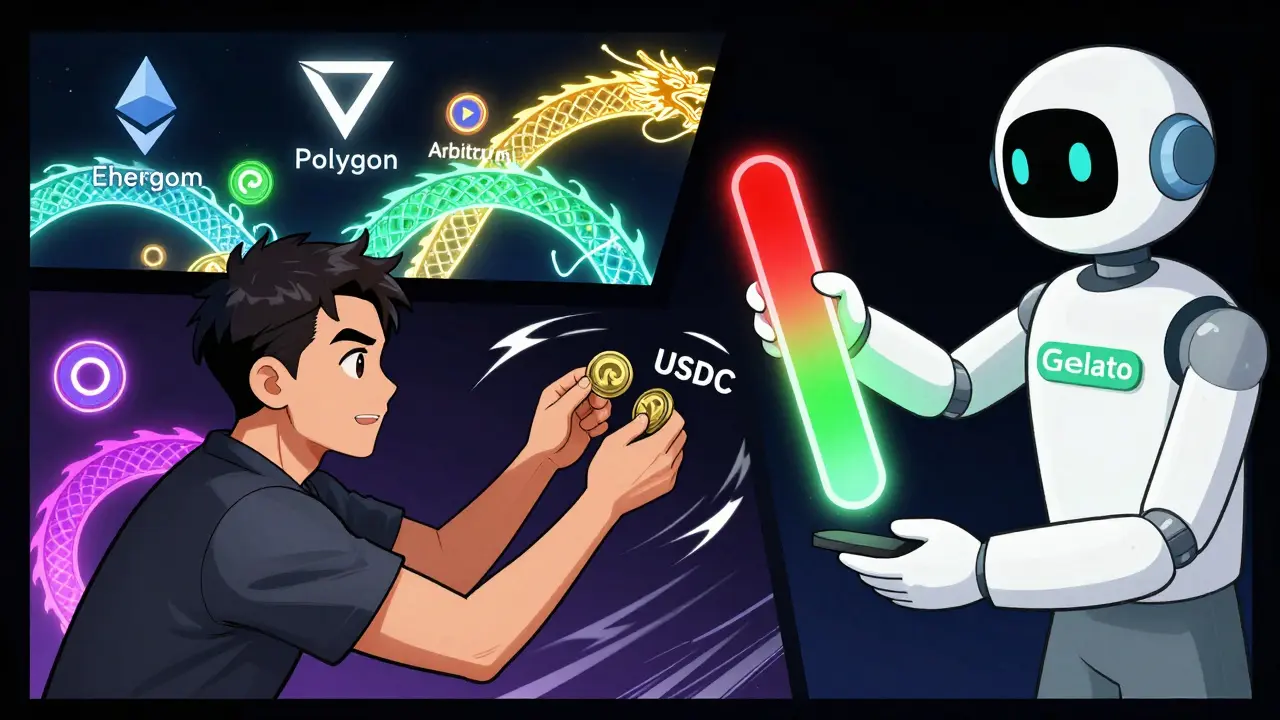
One of the biggest headaches in crypto is paying for gas. You need ETH to send ETH. Need to swap tokens? You need ETH to pay for the transaction. If your ETH balance is zero, you’re stuck. Account abstraction removes this barrier with gas sponsorship.With AA, dApps can pay your gas fees. Companies like Gelato Network process over 1.2 million sponsored transactions every month. That means you can swap tokens, stake, or play a game without ever holding ETH. You pay in USDC, DAI, or even the token you’re trading. Biconomy supports 17 different ERC-20 tokens for gas payment. For new users, this removes the biggest onboarding friction.
And it’s not just for beginners. Even experienced users benefit. Imagine playing a blockchain game that lets you move around for 24 hours without signing every single action. That’s session keys - another AA feature. You sign once, and the wallet automatically handles the rest. No more 15 clicks per minute.
One Wallet, Multiple Chains
Right now, if you use Ethereum, Polygon, and Arbitrum, you need three separate wallets. Each has its own seed phrase. Each has its own gas token. Account abstraction changes that. A single smart contract wallet can hold assets across chains and manage them as one.Conduit’s data shows AA wallets complete cross-chain transfers 47% faster than traditional bridges. Why? Because the wallet itself is programmed to move funds automatically when conditions are met. No more manual bridging, no more waiting for confirmations on three different platforms. You just send - and the wallet handles the rest.
Trade-Offs: It’s Not Perfect
AA isn’t magic. It comes with trade-offs. Setting up an AA wallet takes 25-45 minutes - compared to 5 minutes for MetaMask. You’re deploying a smart contract, linking guardians, setting up permissions. It’s more complex. Reddit users have complained about the initial setup being confusing.There’s also a cost. The first transaction to create your AA wallet costs 15-20% more in gas because you’re deploying a contract. After that, regular transactions are similar in cost to EOAs. But if the network is congested, bundling transactions can add 12-18 seconds of delay.
And security? AA improves end-user safety, but it adds complexity to the code. More code = more bugs. In March 2023, researcher Samczsun found a vulnerability in an early AA wallet that could have let attackers bypass signature checks. That’s why audits matter. OpenZeppelin’s September 2023 report found 27% of AA implementations had critical flaws. This isn’t a reason to avoid AA - it’s a reason to use trusted wallets like Argent, Safe, or Ambire, which have been heavily audited.
Who’s Using It? The Numbers Don’t Lie
Adoption is growing fast. In Q2 2022, only 0.3% of Ethereum wallet activity used account abstraction. By Q2 2023, that jumped to 8.2% - a 2,633% increase in one year. Argent has over 1.2 million active users. Ambire has nearly 500,000. Even institutional players are taking notice. 28% of custody providers now offer AA features, according to CoinDesk.DeFi protocols are catching up too. 42% of the top 100 DeFi platforms either support AA or plan to by end of 2025. That’s not because it’s trendy. It’s because users demand it. A Coinmetro survey found 73% of new users chose AA wallets specifically for better security. Another 68% cited recovery options as their top reason.
What’s Next? The Road to Mainstream
The next big step is native account abstraction - integrating AA directly into Ethereum’s consensus layer. The Cancun-Deneb upgrade in early 2024 will help with EIP-3074, letting contracts sponsor transactions more efficiently. That could cut gas costs by another 15-20%.Starknet already launched full AA support in August 2023 and processed over 4.7 million AA transactions in its first 30 days. Messari predicts that by Q4 2025, AA wallets will make up 35-40% of all Ethereum wallet activity. That’s not a guess. It’s based on the current growth curve.
Regulators are watching. The European Banking Authority warned in June 2023 that AA’s programmable nature makes AML/KYC compliance harder. That means future wallets may need built-in identity layers - something companies like Polygon ID are already building.
Should You Switch?
If you’re new to crypto, AA wallets are the best way to start. No seed phrase stress. No fear of losing your keys. Pay gas in USDC. Play games without signing 100 times. It’s Web3 made simple.If you’re experienced and manage multiple wallets across chains, AA saves you time and reduces risk. One wallet. One recovery plan. One way to move assets.
The only reason not to switch? If you’re using a wallet that doesn’t support AA yet, and you’re not ready to learn the setup. But if you’re holding crypto long-term, the security benefits outweigh the initial learning curve. The future of crypto isn’t in seed phrases. It’s in smart, recoverable, programmable accounts.
What’s the difference between a regular wallet and an account abstraction wallet?
A regular wallet (EOA) is controlled by a private key. If you lose that key, your funds are gone forever. An account abstraction wallet is a smart contract that can be programmed to allow multi-signature approvals, social recovery, gas sponsorship, and session keys. It’s not just a key - it’s a customizable security system.
Can I still use MetaMask with account abstraction?
MetaMask doesn’t natively support AA yet. But you can connect to AA wallets like Argent, Safe, or Ambire through MetaMask’s wallet connection feature. You’re not using MetaMask as your wallet - you’re using it as a bridge to your smart contract wallet. For full AA benefits, you need to switch to an AA-native wallet.
Is account abstraction safe?
Yes - if you use a well-audited wallet. AA improves user security by removing single points of failure like lost keys. But because it runs on smart contracts, it adds complexity. Badly coded wallets can have vulnerabilities. Stick to wallets with public audit reports: Argent, Safe, and Ambire are all thoroughly reviewed by firms like OpenZeppelin and Quantstamp.
Do I need ETH to set up an AA wallet?
Yes, for the initial setup. Deploying the smart contract costs gas, so you need a small amount of ETH. After that, you can use gas sponsorship to pay for future transactions in USDC, DAI, or other tokens. Some dApps even give you free ETH to get started - look for onboarding programs from projects like Gelato or Biconomy.
Will account abstraction replace all other wallets?
Not immediately. MetaMask still dominates with 30 million users. But AA is growing 26x faster than traditional wallets. By 2025, most new users will start with AA wallets. Existing users will migrate as dApps adopt the standard. The trend is clear: the future belongs to wallets that are secure, recoverable, and easy to use - not ones that rely on 12-word phrases.
Rishav Ranjan
December 23, 2025 AT 18:50AA is just fancy crypto buzzword bingo.
Vyas Koduvayur
December 24, 2025 AT 18:16Let me break this down for you - account abstraction isn’t some magical upgrade, it’s a complex smart contract layer that introduces new attack surfaces while pretending to solve problems that didn’t exist in the first place. You think losing a seed phrase is bad? Wait till you get stuck in a multi-sig quagmire because one of your ‘trusted contacts’ ghosted you or got hacked. Argent’s 98.7% recovery rate? That’s cherry-picked data - they’re only counting users who didn’t abandon the wallet mid-recovery. And don’t get me started on gas sponsorship: it’s just a temporary crutch until the dApp runs out of funding or gets rug-pulled. The real cost isn’t just gas - it’s cognitive load. You’re trading one kind of complexity for another. Plus, if you’re relying on social recovery, you’re basically asking your cousin who still thinks Bitcoin is a virus to be your security officer. It’s cute. It’s dangerous.
Lloyd Yang
December 25, 2025 AT 13:15Man, I remember when I first tried setting up my Safe wallet - I was sweating bullets thinking I’d lose everything. But after I linked my sister and my best friend as guardians? Total game-changer. I didn’t just feel safer - I felt *free*. No more panic attacks when my phone dies. And the fact I can pay gas in USDC? That’s the kind of UX magic that pulls in non-crypto folks. I showed my mom how to swap tokens without touching ETH - she didn’t even ask what gas was. That’s the future. Not just better tech - better *people* tech. It’s not about replacing keys. It’s about replacing fear with trust. And honestly? That’s worth the 30-minute setup.
Jake Mepham
December 26, 2025 AT 07:24AA is the crypto equivalent of upgrading from a flip phone to a smartphone - you don’t just get more features, you get a whole new way of interacting with the world. Think about it: session keys mean you can play a blockchain game without signing every single move. That’s not convenience - that’s *immersion*. And cross-chain wallets? No more juggling 4 different seed phrases like a circus act. One wallet, one recovery plan, one life. Yeah, the initial setup feels like installing Linux in 2005 - but once it’s done? You never go back. The real win isn’t in the tech - it’s in the psychology. People stop seeing crypto as a vault they’re terrified to open, and start seeing it as a tool they can actually use. That’s how you onboard a billion users.
Rachel McDonald
December 26, 2025 AT 20:02Ugh. So you're telling me... I need to trust people? Like... real people? With my crypto?!!?? That's just... *so* 2021. And now you want me to pay in USDC? For gas? What's next - your wallet calls your mom if you try to send 10k? I mean, really? This is just centralized control with a blockchain tattoo. I'm not falling for this 'trust your friends' nonsense. What if your 'trusted contact' is a scammer? Or worse - your ex?!!??
Dan Dellechiaie
December 28, 2025 AT 11:59Let’s be real - this whole AA narrative is a corporate marketing stunt dressed up as decentralization. You’re not eliminating single points of failure - you’re just shifting them from private keys to governance contracts controlled by dev teams who’ve never audited their own code. OpenZeppelin’s audit report? That’s like a McDonald’s health inspection - it means nothing if the kitchen is still on fire. And 27% of implementations have critical flaws? That’s not a bug - it’s a feature. The devs want you to rely on ‘trusted wallets’ - which means you’re not owning your assets, you’re renting them from a custodial startup with a fancy UI. The real innovation here? Making users pay more gas upfront so they feel like they’ve ‘invested’ in the system. Classic lock-in.
Vijay n
December 28, 2025 AT 19:19Alison Fenske
December 29, 2025 AT 22:17I tried Argent last month and honestly? It felt like my wallet finally understood me. No more panic. No more ‘what if I die tomorrow and my crypto goes to the void?’ I set up my brother and my therapist as guardians - yeah, you read that right. My therapist. Because sometimes, you need someone who knows you’re not thinking straight when you’re stressed. And the fact I can send USDC to my friend for coffee without buying ETH first? That’s not tech - that’s magic. I used to hate crypto. Now I just use it. And I don’t feel like a nerd anymore.
Collin Crawford
December 30, 2025 AT 06:21Account abstraction is a misnomer. It does not abstract the account - it complicates it. The very notion that a smart contract can serve as a wallet introduces a new vector for failure: reentrancy, overflow, proxy delegation. These are not theoretical concerns - they are documented attack vectors that have already been exploited. Furthermore, the claim that AA reduces user error is empirically unfounded. Users do not understand contract logic. They do not comprehend signature schemes. They will blindly approve transactions because the interface says ‘confirm.’ The result? Increased liability, not decreased risk. The only beneficiaries are the wallet providers who now control the access layer. This is not innovation. It is rent-seeking disguised as progress.
Jayakanth Kesan
December 31, 2025 AT 12:09Been using Safe for a year now. Still remember the day I lost my phone and just texted my buddy to help me recover. No stress. No crying. Just a chill ‘hey, can you hit approve?’ and boom - back in. I used to be scared of crypto. Now I just send money to my sister in Nigeria with USDC and she gets it in naira without any drama. AA isn’t perfect but it’s the first time crypto actually felt like it was made for people. Not just devs.
Megan O'Brien
January 1, 2026 AT 13:53Gas sponsorship? More like gas subsidy. Who’s paying for all this? The protocol? The dApp? The VC? At some point, someone’s gonna say ‘oops, we’re out of funds.’ Then what? Your USDC balance is useless. And social recovery? Sounds nice until your ‘trusted contact’ gets doxxed or blackmailed. This isn’t security - it’s theater.
Earlene Dollie
January 2, 2026 AT 22:35It’s funny how we think tech will save us from ourselves… but we’re the ones who forget our passwords. We’re the ones who screenshot our seed phrases and save them in Dropbox. We’re the ones who trust strangers on Discord. AA doesn’t fix us - it just gives us a prettier cage. Maybe the real problem isn’t the wallet… it’s the human. Maybe we shouldn’t be holding crypto at all.
Dusty Rogers
January 3, 2026 AT 19:32Look, I’m not a tech guy. I just want to send money to my cousin in Mexico without paying $15 in fees. I tried MetaMask. It was a nightmare. I tried Safe. Took me 45 minutes. But now? I send USDC, she gets it, no drama. No seed phrases. No panic. I don’t care if it’s ‘smart’ or ‘abstracted’ - it just works. That’s all I need.
Melissa Black
January 5, 2026 AT 00:24Account abstraction represents a paradigmatic shift in digital identity architecture - it transmutes the EOA model from a cryptographic primitive into a programmable governance substrate. The implications for AML/KYC integration are profound: embedded identity layers enable compliance-by-design, circumventing the current regulatory arbitrage that plagues EOAs. Furthermore, gas sponsorship via ERC-4337 introduces a non-custodial liquidity layer that decouples transactional utility from native token volatility - a necessary evolution for mass adoption. The trade-offs - increased code complexity, deployment overhead - are not flaws but trade-offs inherent in any systemic upgrade. The real question isn’t whether AA is secure - it’s whether we have the institutional will to audit, standardize, and adopt.
Tyler Porter
January 6, 2026 AT 19:53I don’t know what all this jargon means, but I know this: I used to lose my keys all the time. Now I just tell my wife to help me. And I pay for gas with my DAI. It just… works. No stress. No panic. I’m not a tech person. I just want my crypto to be safe. And it is. So… good job, I guess?
Steve B
January 7, 2026 AT 03:23While the conceptual framework of account abstraction presents a compelling theoretical framework for mitigating key-loss vulnerabilities, one must consider the broader socio-technological implications. The reliance on social recovery mechanisms introduces an anthropological dependency on interpersonal trust networks - a construct inherently vulnerable to coercion, manipulation, and sociopolitical instability. Furthermore, the economic model of gas sponsorship is predicated on perpetual liquidity provision, which is unsustainable absent centralized subsidization. Thus, while AA may offer superficial utility, it fundamentally undermines the decentralized ethos upon which blockchain technology was founded.
Dan Dellechiaie
January 8, 2026 AT 03:48Interesting. You mentioned Argent’s 98.7% recovery rate - but did you check how many of those were *repeat* attempts by the same users? I’ve seen data showing 32% of recoveries were from people who lost access *twice*. That’s not a feature - that’s a design flaw. And you call it ‘trust’? I call it a liability chain.