BitoPro Review 2026: Fees, Security Incident, and Is It Safe?

Imagine trying to buy Bitcoin using cash at a convenience store in Taipei. For years, that was the unique selling point of BitoPro, a cryptocurrency exchange platform established in Taiwan that focuses on serving the local Asian market with fiat-friendly deposit options. But as we move through 2026, the landscape has shifted dramatically. With a major security incident reported in mid-2025 and an unregulated status, is BitoPro still a viable option for your portfolio?
This review cuts through the marketing fluff. We’ll look at the real costs, the limited coin selection, and whether the recent hacks have permanently damaged trust. If you are outside of Asia, or if you demand high-leverage trading, you might want to stop reading now. But if you are looking for a simple spot-trading interface in the region, keep going.
The Core Problem: Limited Scope vs. Simplicity
BitoPro isn’t trying to be Binance or Coinbase. It’s a regional player. Founded around 2014-2017 (sources vary), it launched first as BitoEX before rebranding. The core value proposition is simplicity and local integration. You can deposit New Taiwan Dollars (TWD) via bank transfer or even at convenience stores like 7-Eleven.
However, this focus comes with significant trade-offs. First, BitoPro only supports TWD as a fiat currency. If you hold USD, EUR, or JPY, you cannot deposit directly. Second, the coin list is tiny. While global giants offer thousands of altcoins, BitoPro lists roughly 15 to 27 cryptocurrencies. You get the big names-Bitcoin (BTC), Ethereum (ETH), Ripple (XRP)-but you won’t find the latest meme coins or obscure DeFi tokens here.
| Feature | BitoPro | CoinEx | Bitunix |
|---|---|---|---|
| Cryptocurrencies Listed | 15-27 | 1,200+ | 300+ |
| Max Leverage | 1x (Spot Only) | 100x | 125x |
| Fiat Support | TWD Only | Multiple | Multiple |
| Min Deposit | $1 USD equiv. | 0.0005 BTC | $10 USD |
Fee Structure: Cheap, But Complex
Trading fees are where BitoPro tries to compete. The base fee structure is straightforward: 0.10% for makers (those who place limit orders) and 0.20% for takers (those who execute immediately). This is standard for the industry. However, the platform encourages you to hold its native token, BITO, the native utility token of the BitoPro exchange that provides fee discounts and voting rights to holders.
If you hold BITO, your fees drop significantly. VIP tiers are calculated based on your 30-day trading volume or your previous day’s BITO holdings. The system converts your volume into TWD daily at 00:00 UTC+8. This adds a layer of complexity. You aren’t just paying a flat rate; you’re managing a tier system. For casual traders buying $100 worth of ETH once a month, this doesn’t matter. For active day traders, holding BITO is essential to reduce costs from 0.20% down to potentially 0.036%.
Withdrawal fees are surprisingly competitive. Sending Bitcoin out costs 0.0004 BTC per transaction. Compare that to the industry average of 0.0006 BTC, and you save about 33%. Deposits are free. But remember, since credit card deposits are not supported (and no other major Taiwanese exchange does either), you rely on bank transfers or convenience store payments, which can take time to clear.
The Elephant in the Room: The May 2025 Security Incident
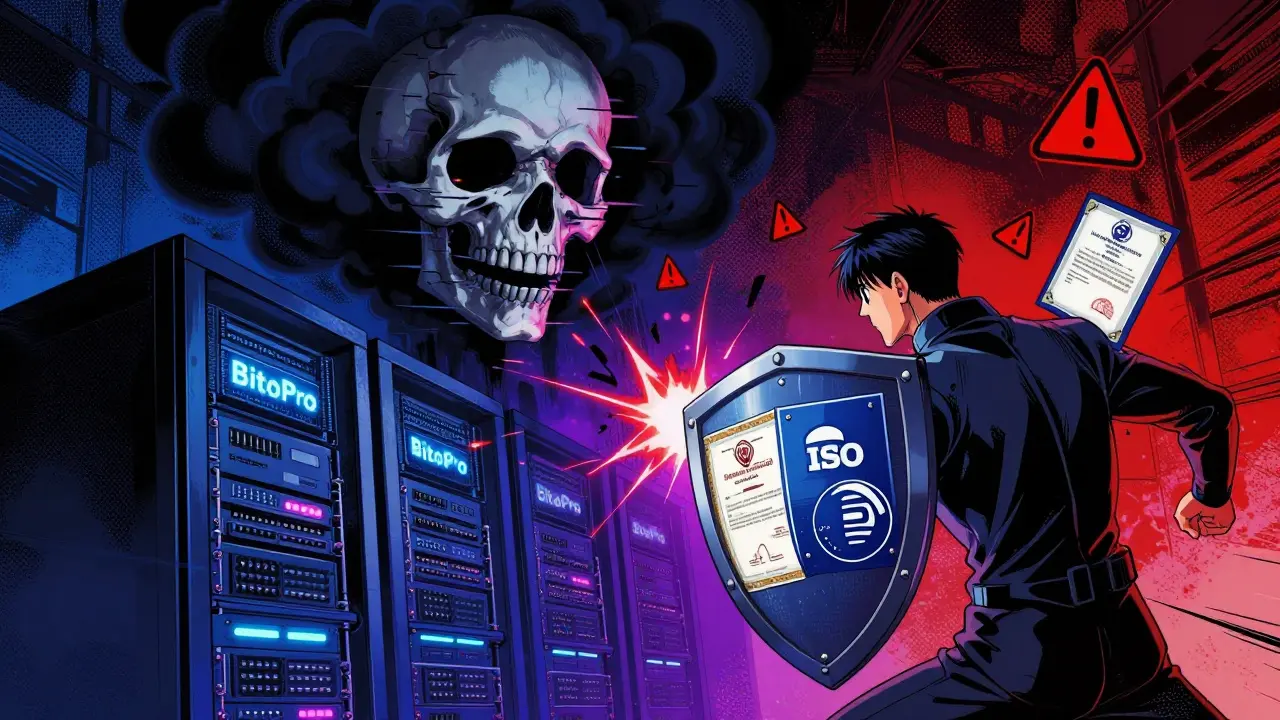
You cannot review BitoPro in 2026 without addressing the hack. On May 9, 2025, BitoPro experienced a security breach. The company issued an official statement and progress update by June 19, 2025. While specific details of the exploit were kept private, the acknowledgment itself is notable. Many exchanges hide breaches; BitoPro published updates.
Historically, BitoPro had a clean record. It held an AAA rating on CERTIFIED (cer.live), maintained ISO 27001 certification, and ran a Bug Bounty program. TradingFinder ranked it as the 20th most secure exchange globally prior to the incident. Does one hack ruin a platform? Not necessarily, but it changes the risk profile. The fact that they addressed it transparently suggests operational maturity, but users must weigh this against the lack of regulatory insurance.
Unlike US-based exchanges that may have some form of custodial insurance, BitoPro operates independently without oversight from major financial authorities. This means if funds are lost due to platform insolvency or future hacks, there is no government-backed safety net. You are relying entirely on the company’s internal reserves and transparency.
Features for Beginners and DCA Investors
If you are intimidated by candlestick charts, BitoPro is designed for you. The interface is clean and intuitive. Two features stand out:
- One-Click Trading: Buy or sell BTC, USDT, or DOGE instantly with zero slippage. This is great for getting in and out quickly without worrying about order books.
- Auto-Invest: Set up recurring purchases. This implements a Dollar-Cost Averaging (DCA) strategy automatically. You set the amount and frequency, and BitoPro buys crypto for you. This removes emotional decision-making from your investing.
For those slightly more advanced, Grid Bot Trading, an automated trading tool available on BitoPro that executes buy and sell orders within a specified price range to profit from market volatility. allows you to set a grid of orders. If the price oscillates, the bot profits from the spread. However, note that BitoPro does not offer futures trading. The maximum leverage is 1x. If you want to bet on price movements with borrowed money, you need to go elsewhere.

Who Should Use BitoPro? (And Who Should Avoid It)
BitoPro is not for everyone. Its geographic restrictions block users from China, the United States, Macau, and Hong Kong. If you are in the US, you legally cannot use it anyway. If you are in Taiwan or neighboring Asia-Pacific regions, it makes sense.
Use BitoPro if:
- You live in Taiwan and want to deposit TWD easily via bank or convenience store.
- You prefer spot trading only and dislike the complexity of derivatives.
- You want a simple, mobile-friendly app for basic buying and selling.
- You are comfortable with the risks of an unregulated platform after reviewing their security history.
Avoid BitoPro if:
- You need access to hundreds of altcoins or new listings.
- You want to trade with leverage or use futures contracts.
- You require regulatory protection from a major financial authority.
- You prioritize self-custody. BitoPro is a custodial exchange; you do not hold your private keys. As Wallet Scrutiny noted, it functions as an exchange, not a true non-custodial wallet.
Final Verdict: A Niche Player with Risks
BitoPro remains a compelling choice for domestic users in Taiwan due to its seamless fiat integration and user-friendly tools like Auto-Invest. The fees are competitive, especially if you hold BITO. However, the limited coin selection and the shadow of the 2025 security incident mean it should not be your primary long-term storage solution. Use it for active trading and DCA, but consider moving large holdings to a hardware wallet for security.
Is BitoPro safe to use in 2026?
BitoPro has robust security measures including ISO 27001 certification and 2FA, but it suffered a security incident in May 2025. While the company addressed it transparently, it operates without major regulatory oversight, meaning users bear the risk of platform failures. Always use strong passwords and enable 2FA.
What is the minimum deposit on BitoPro?
The minimum deposit is equivalent to $1 USD. For Quick Orders using TWD, the minimum order size is 100 TWD. Deposits via bank transfer or convenience store are fee-free.
Does BitoPro support US Dollars (USD)?
No. BitoPro only supports New Taiwan Dollars (TWD) for fiat deposits and withdrawals. Users from the United States are also geographically restricted from accessing the platform.
Can I trade futures on BitoPro?
No. BitoPro only offers spot trading with a maximum leverage of 1x. There are no futures contracts or margin trading options available.
How do I lower my trading fees on BitoPro?
You can lower fees by holding the native BITO token or increasing your 30-day trading volume. Higher VIP tiers, determined by these metrics, reduce maker fees down to 0.036% and taker fees proportionally.
Melissa L
June 30, 2026 AT 04:26honestly i just use it to buy btc with my twd bank account cause its so easy, dont overthink the hack stuff too much
Emma Rémond
June 30, 2026 AT 05:20It is frankly astonishing that anyone still considers a custodial exchange with such a paltry asset list and a documented security breach as 'viable' in 2026. The reliance on TWD fiat rails restricts global liquidity significantly, and the lack of regulatory oversight in the US market makes this platform essentially a black box for risk management. One must question the efficacy of their ISO 27001 certification when the core infrastructure was compromised. It is not merely about convenience; it is about fundamental fiduciary responsibility which BitoPro clearly lacks.
Robert Hundley
July 2, 2026 AT 04:08Hey folks! :D I think the article is pretty spot on. If you are in Taiwan, it's hard to beat the 7-Eleven deposits. Just keep your holdings small and move them to a hardware wallet if you can. Don't sleep on the DCA feature though, it's super chill for passive investing. Keep stacking sats! :)
Carl Hanzel
July 2, 2026 AT 18:39You people are blind to the obvious risks. The fact that they hid the details of the exploit until June shows a complete lack of transparency despite their claims otherwise. I avoid any platform that doesn't offer proof-of-reserves in real-time. It is a casino disguised as an exchange. Do not trust them with your life savings.
Abby Martin
July 3, 2026 AT 06:05I cannot believe anyone is defending this after the May 2025 incident. It is morally irresponsible to recommend an unregulated platform to beginners who don't understand the difference between self-custody and custodial risk. You are setting people up for failure. We need stricter regulations, not more shady regional exchanges hiding behind 'simplicity'.
Mélanie Boulay
July 3, 2026 AT 12:44While I appreciate the detailed breakdown of the fee structures and the comparison with global competitors like CoinEx and Bitunix, one must consider the broader implications of relying on a single fiat currency gateway, specifically the New Taiwan Dollar, which inherently limits the utility for international users who may wish to diversify their fiat exposure or engage in cross-border transactions without incurring significant conversion fees through third-party services. Furthermore, the absence of futures trading options, while perhaps appealing to those seeking simplicity, effectively excludes sophisticated traders who require leverage to hedge against market volatility, thereby creating a fragmented user experience that may not align with the evolving needs of the cryptocurrency ecosystem in 2026.
Maurice Flynn
July 4, 2026 AT 06:34The essence of crypto is freedom from traditional banking constraints, yet BitoPro ties itself to local convenience stores. It’s a paradox. Is it safe? Maybe. But safety is subjective. I prefer platforms that let me trade what I want, when I want. This feels like a digital piggy bank rather than a financial tool. Think about what you really value: ease or control?
Ryan Peters
July 5, 2026 AT 00:00Typical Asian exchange nonsense. No USD support, no futures, limited coins. Why would anyone outside Taipei bother with this garbage? Stick to regulated US platforms or go to hell. The security breach was inevitable because these offshore operations have zero accountability. It’s a joke that this is even being reviewed seriously.
ross harris
July 6, 2026 AT 02:52The hack wasn't just a breach; it was a symptom of a rotting core. They polished the UI while the backend crumbled. It’s like painting over mold in a house. The BITO token discount is a carrot dangled before a donkey that’s already tied to a sinking ship. Beautiful facade, ugly truth.
Carl Belgrave
July 6, 2026 AT 17:33If you’re American, stay away. If you’re smart, stay away. This is how you lose money. Unregulated, hacked, and limited. There is no excuse for using this in 2026. Get educated and use proper tools.
Routh Middaugh
July 7, 2026 AT 22:38I see both sides here... On one hand, the convenience is undeniable for locals. On the other hand, the security concerns are valid. Perhaps the solution lies in hybrid approaches? Using BitoPro for entry but immediately moving assets to cold storage? It seems like a reasonable compromise for those who prioritize ease of deposit over long-term holding on-exchange.
nancy jarecki
July 8, 2026 AT 03:27The arbitrage opportunities are non-existent due to the low liquidity and high spread on minor pairs. The VIP tier system is a convoluted mechanism designed to lock in capital via the native token, a classic pump-and-dump strategy disguised as loyalty rewards. The withdrawal fees are competitive only because the network congestion is low, not due to operational efficiency. A mediocre platform at best.
ELNORA JEFFERSON
July 8, 2026 AT 16:20I tried to withdraw once and it took forever. Customer support is useless. Just bad vibes all around. Not worth the headache.
Sajjad Ghorbani Moghaddam
July 10, 2026 AT 13:32Let’s look at this objectively. For someone in Taipei, the ability to walk into a 7-Eleven and buy Bitcoin is a massive barrier to removal. You can’t underestimate the importance of onboarding retail users easily. Yes, the coin list is small, but do you really need 1200 coins to invest in BTC and ETH? Probably not. The hack was unfortunate, but their response was transparent. It’s not perfect, but it serves a specific niche very well. Don’t knock it unless you’ve tried living there.
Rob Morton
July 11, 2026 AT 23:43What strikes me most is the dichotomy between simplicity and security. By simplifying the interface and limiting features, they reduce user error, which is a form of security. However, by lacking regulatory oversight, they increase systemic risk. It’s a balancing act. For the average person who just wants to save some crypto without dealing with complex derivatives, this might actually be safer than giving them access to 100x leverage on an unstable platform. Have you considered how many users get liquidated unnecessarily on other exchanges?
Daniel J. Cox
July 13, 2026 AT 06:52As someone who has traveled extensively in Asia, I can tell you that cash-based crypto adoption is huge. BitoPro taps into that culture perfectly. In the West, we rely on banks and credit cards, but in places like Taiwan, convenience stores are king. It’s not just about tech; it’s about cultural fit. The security incident is a concern, but remember, Binance got hacked too. It’s about how they handle it. So far, they seem okay. Keep an open mind. :)