Blockchain Transaction Fees in 2026: A Complete Cost Comparison

Have you ever sent a simple cryptocurrency transfer and watched your wallet balance shrink by more than the amount you intended to send? It is a frustrating experience that happens all too often. You want to move $10 worth of tokens, but the network fee eats up $5 of it. Or worse, you try to trade during a busy market hour, and the fee spikes to $50 or even $55. This is not just bad luck; it is how blockchain economics work. Every action on a public ledger requires computational power, and someone has to pay for that power.
In May 2026, the landscape of blockchain transaction costs is more diverse than ever. We are no longer stuck with one-size-fits-all pricing. The market has segmented into high-security networks for large transfers, high-speed chains for gaming, and middle-ground solutions for everyday finance. Understanding these differences is no longer optional-it is essential for anyone holding digital assets. Let’s break down exactly where your money goes when you click 'send,' why fees spike, and how you can keep more of your capital in your pocket.
Why Do Blockchain Networks Charge Fees?
Before comparing prices, we need to understand what we are actually paying for. It is not a tax collected by a government or a service charge taken by an exchange. In decentralized systems like Bitcoin and Ethereum, there is no central authority processing your payment. Instead, you are paying network validators-miners or stakers-to include your transaction in a block and secure the ledger.
Think of it like renting space on a billboard. The billboard (the blockchain) has limited space (block size). If everyone wants to post an ad at the same time, they have to bid against each other. The highest bidder gets their message included first. These fees serve two critical functions:
- Compensation: Validators spend electricity, hardware, and time to verify transactions. Fees reward them for this work.
- Spam Prevention: If sending a transaction were free, malicious actors could flood the network with junk data, crashing the system. Fees ensure that only legitimate, value-bearing transactions get processed.
The cost varies because different networks handle this validation differently. Some rely on energy-intensive mining, while others use stake-based verification. Some process thousands of transactions per second, while others handle fewer but with higher security guarantees. This architectural difference is the primary driver of the price tags you see on your screen.
The Heavyweights: Bitcoin and Ethereum Mainnet Costs
When people talk about crypto fees, they usually start with the two biggest networks: Bitcoin and Ethereum. These are Layer-1 blockchains, meaning they settle transactions directly on their main ledgers. They offer the highest level of decentralization and security, but that comes at a premium.
Bitcoin is the original blockchain network designed primarily for secure value storage and transfer. As of mid-2026, Bitcoin transaction fees typically range from $1 to $20+ depending on network congestion. During normal periods, you might pay around $1-$5 for a standard transfer. However, during peak times-such as when many users are trying to cash out simultaneously-fees can spike dramatically. Historical data shows spikes up to $55 per transaction during extreme congestion events.
Bitcoin calculates fees based on transaction size in bytes. A simple transfer with one input and one output is small and cheap. But if you are consolidating hundreds of tiny outputs into one address, that transaction becomes large, occupying more block space, and costing significantly more. This is why Bitcoin remains ideal for large-value, infrequent transfers where the fee represents a tiny fraction of the total amount moved.
Ethereum is a programmable blockchain platform that supports smart contracts, DeFi applications, and NFTs. Ethereum uses a different metric called "gas." Every computational step-from a simple token transfer to a complex algorithmic trade-consumes a specific amount of gas. The total fee is calculated by multiplying the gas limit by the gas price (denominated in gwei).
Following the EIP-1559 upgrade, Ethereum’s fee structure includes a base fee that is burned (destroyed) and a priority tip paid to validators. In 2026, Ethereum mainnet fees generally range from $0.50 to $50+. Simple ETH transfers might cost under $2 during quiet hours. However, interacting with decentralized exchanges, minting NFTs, or executing complex DeFi strategies can easily trigger fees exceeding $50 during peak usage. Ethereum remains the hub for financial innovation, so its high demand keeps fees volatile but justified by the liquidity and utility available on-chain.
The Efficiency Leaders: Solana and High-Throughput Chains
If Bitcoin is a armored truck moving gold, and Ethereum is a bustling stock exchange floor, then networks like Solana are high-frequency trading terminals. These chains were built from the ground up to prioritize speed and low cost over maximum decentralization.
Solana is a high-performance blockchain known for its ultra-low transaction costs and rapid confirmation times. Solana achieves this through a unique consensus mechanism called Proof of History, which allows nodes to agree on the order of events without constant communication. The result is staggering efficiency. As of May 2026, the average transaction cost on Solana is approximately $0.00025. Yes, that is less than a tenth of a cent. With confirmation times often under one second, Solana is the go-to choice for microtransactions, high-frequency trading bots, and blockchain gaming where frequent, small interactions are necessary.
Other networks follow a similar philosophy. Binance Smart Chain (now BNB Chain) offers a familiar Ethereum-compatible environment but with much lower fees, averaging $0.10 to $0.30 per transaction. XRP Ledger also maintains extremely low costs, typically charging less than $0.01 per transaction. These networks sacrifice some degree of decentralization compared to Bitcoin or Ethereum to achieve these economies of scale, but for many users, the trade-off is worth it.
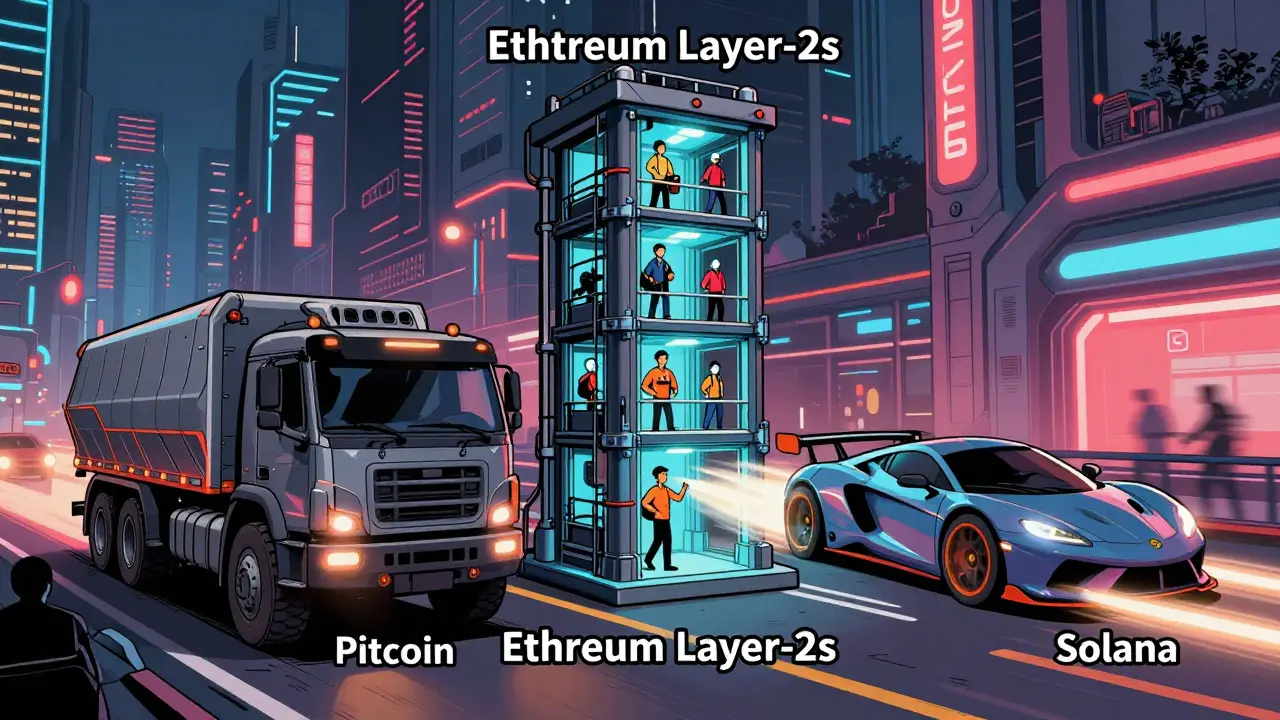
The Middle Ground: Layer-2 Solutions and Sidechains
What if you want Ethereum’s security and developer ecosystem but cannot afford its mainnet fees? Enter Layer-2 solutions. These networks sit on top of Ethereum, processing transactions off-chain and then settling the final results back on the mainnet. This batching process drastically reduces the computational load on Ethereum itself.
Arbitrum is a leading Layer-2 scaling solution for Ethereum that uses optimistic rollup technology. Arbitrum allows users to access Ethereum-compatible apps with fees ranging from $0.05 to $0.30. Confirmation times are fast, usually around 5 seconds. It is the preferred home for many DeFi protocols that want to remain close to Ethereum’s liquidity without passing prohibitive costs onto users.
Polygon is a multi-chain ecosystem that originally started as a sidechain to Ethereum. Polygon charges approximately $0.01 per transaction with confirmation times around 2 seconds. It has become a powerhouse for gaming, social media integrations, and everyday payments. Its low cost makes it viable for merchants accepting crypto, something that would be impossible on Ethereum mainnet due to fee volatility.
These Layer-2 options provide the best of both worlds: the security inheritance of Ethereum combined with the cost efficiency closer to Solana. For most retail users engaging with DeFi or Web3 applications in 2026, starting on a Layer-2 is often the most economical choice.
Fee Comparison Table: May 2026 Snapshot
| Network | Avg. Fee (USD) | Confirmation Time | Best Use Case |
|---|---|---|---|
| Solana | $0.00025 | < 1 second | Trading, Gaming, Microtransactions |
| Polygon | $0.01 | ~2 seconds | Payments, Gaming, Social Apps |
| Arbitrum | $0.05 - $0.30 | ~5 seconds | DeFi, Ethereum-Compatible Apps |
| BNB Chain | $0.10 - $0.30 | ~3 seconds | General Purpose, DeFi |
| Ethereum | $0.50 - $50+ | ~12 seconds | High-Value DeFi, NFTs, Security |
| Bitcoin | $1.00 - $20+ | ~10 minutes | Large Value Transfers, Store of Value |
Note that these are averages. Fees fluctuate constantly based on network demand. A "quiet" day on Ethereum might bring fees down to $1, while a viral NFT drop could push them past $100. Always check real-time estimators before signing transactions.

How to Optimize Your Transaction Costs
You do not have to accept whatever fee the network demands. There are several strategies to minimize your spending, regardless of which blockchain you use.
- Time Your Transactions: Network congestion follows patterns. Weekends and late-night hours in major financial hubs (New York, London, Tokyo) often see lower activity. Sending a non-urgent Bitcoin or Ethereum transfer during these off-peak windows can reduce fees by 50% to 90%.
- Use Layer-2 Solutions: If you are interacting with Ethereum-based apps, always look for a Layer-2 alternative. Bridges allow you to move assets from Ethereum mainnet to Arbitrum or Polygon cheaply. Once there, your daily interactions cost pennies instead of dollars.
- Batch Your Transactions: If you are sending multiple payments, combine them into a single transaction where possible. On Bitcoin, using SegWit addresses reduces the byte size of transactions, lowering the fee. On Ethereum, some wallets allow you to bundle multiple approvals or swaps into one interaction, saving on gas overhead.
- Adjust Gas Limits Carefully: On Ethereum, you set a gas limit (maximum computation you will pay for) and a gas price. If you set the gas price too high, you overpay. Most modern wallets automatically suggest competitive rates. Avoid manually setting excessively high tips unless you are in a hurry.
- Leverage Replace-by-Fee (RBF): If you send a Bitcoin transaction and realize the fee was too low and it is stuck, you can use RBF to broadcast a replacement transaction with a higher fee. This prevents you from losing the original fee entirely.
Future Trends: Where Are Fees Heading?
The trajectory of blockchain fees is clear: they are going down, but not uniformly. The industry is moving toward a modular architecture. Base layers (like Bitcoin and Ethereum) will focus purely on security and settlement, keeping their fees relatively high due to scarcity and demand. Execution layers (Layer-2s, App-Chains) will handle the heavy lifting of computation, driving user-facing costs toward zero.
Ethereum’s roadmap includes "Danksharding," a scaling upgrade expected to further reduce the cost of data availability for Layer-2s, potentially pushing L2 fees below $0.01 permanently. Bitcoin’s Lightning Network continues to grow, enabling instant, near-zero fee payments for small amounts, though adoption hurdles remain for mainstream retail use. Meanwhile, high-throughput chains like Solana continue to optimize their hardware requirements to maintain sub-cent fees indefinitely.
Regulatory pressures may add complexity. Compliance checks, privacy-preserving technologies, and cross-chain interoperability standards will introduce new computational steps. However, protocol optimizations are likely to outpace these added costs, ensuring that the barrier to entry for using blockchain technology continues to fall.
Why are Ethereum fees so high compared to Solana?
Ethereum prioritizes decentralization and security, allowing any node to validate transactions, which creates high competition for block space. Solana sacrifices some decentralization for speed, using specialized hardware and a unique consensus mechanism (Proof of History) to process thousands of transactions per second, resulting in negligible fees.
Can I avoid transaction fees entirely?
Not completely. Someone must always pay for the computational resources required to record a transaction. However, you can minimize fees to fractions of a cent by using high-efficiency networks like Solana or Layer-2 solutions like Polygon. Additionally, some platforms subsidize fees for users, but the underlying network still incurs a cost.
What is the best blockchain for everyday payments in 2026?
For everyday payments, Polygon and Solana are currently the most cost-effective options. Polygon offers Ethereum compatibility with ~$0.01 fees, making it widely supported by merchants. Solana offers even lower fees (~$0.00025) and faster speeds, ideal for microtransactions and high-frequency use cases.
How does network congestion affect my fees?
Blockchains have limited space per block. When many users submit transactions simultaneously, they compete for inclusion by offering higher fees. This causes prices to spike. During off-peak hours, competition decreases, and fees drop significantly. Monitoring network activity dashboards helps you time transactions for lower costs.
Are Layer-2 solutions safe?
Yes, reputable Layer-2 solutions like Arbitrum and Polygon inherit the security of their base layer (Ethereum). They process transactions off-chain but periodically post proofs or batches to Ethereum mainnet. While they introduce additional technical complexity, they are considered secure for most users and hold billions of dollars in value.
Ruben Michel
May 16, 2026 AT 00:33One must acknowledge the inherent inefficiency of relying on such rudimentary economic models for modern financial infrastructure. The notion that a decentralized ledger requires such exorbitant computational overhead is, frankly, an embarrassment to the field of computer science. We are witnessing the triumph of ideological purity over practical utility, and it is rather disheartening to see so many participants blindly accepting these archaic constraints as inevitable truths rather than solvable engineering challenges.
Samara McCallum
May 17, 2026 AT 14:35honestly i think people just dont get the point of all this complexity
its like buying a golden spoon to eat soup with when a plastic one works fine but sure lets keep paying fifty bucks to move ten dollars around because we want to feel special about our digital hoarding habits
Gavin Wonnacott
May 18, 2026 AT 13:22You absolute moron. Your inability to grasp the fundamental security guarantees provided by Proof of Work is not my burden to carry. I do not have time to explain basic cryptography to someone who clearly lacks the intellectual capacity to understand why your cheap Solana coins are worthless dust in the wind. Stick to your gaming tokens and leave the real value storage to those of us who actually read whitepapers instead of watching YouTube tutorials.
Samara McCallum
May 19, 2026 AT 04:23wow okay big words mr smart pants
i guess if you need to yell at strangers online to feel important then maybe the fees are worth it for your ego but for the rest of us who just want to buy coffee without paying more than the coffee itself this whole elitist attitude is just sad really
Jan Gilmore
May 20, 2026 AT 19:42Let me break this down for everyone who missed the memo. Layer-2 solutions are not a bug; they are the feature. Arbitrum and Optimism are essentially batching transactions to reduce the load on Ethereum mainnet. It’s elementary economics. If you’re still complaining about gas fees in 2026, you’re either using your wallet wrong or you’re holding onto outdated information from 2021. Educate yourself before you comment.
Sheldon Friesen
May 22, 2026 AT 18:13Oh, bravo! Another know-it-all strutting his stuff. How utterly charming. Do you perhaps enjoy the sound of your own voice? Because I certainly don’t. You’ve stated the obvious with the confidence of a man who has never made a mistake, which is statistically impossible. Let’s try something new: humility. It might be cheaper than your Ethereum fees, though I doubt it.
Caique Muniz
May 24, 2026 AT 11:02lol another tech bro explaining how the world works
yeah yeah layer 2s are great until they get hacked or rug pulled then its back to square one
but sure keep telling yourself that its all smooth sailing now
robert Whitehead
May 25, 2026 AT 01:05The moral decay of this industry is evident in the prioritization of speed over security. By outsourcing validation to centralized sequencers in Layer-2 solutions, we are effectively reintroducing the very points of failure that blockchain was designed to eliminate. This is not progress; it is a regression disguised as innovation. Those who advocate for such compromises are morally bankrupt, sacrificing the integrity of the ledger for the sake of convenience. One should ask themselves: at what cost does efficiency become unethical?
Tricia Alach
May 25, 2026 AT 20:27i mean its nice to have options right?
like if you are doing small stuff solana is super fast and cheap
but if you want to store big money bitcoin feels safer even if it costs more
so maybe its not black and white just depends on what you need
Bradley Geldenhuys
May 26, 2026 AT 14:44Look man, we gotta stop fighting and start building. The future is modular. Bitcoin for security, L2s for speed, Solana for scale. Its all about finding the right tool for the job. Lets keep the vibes positive and focus on how we can make this tech accessible to everyone, not just the rich folks who can afford $50 tx fees. We got this!
Kiran CS
May 28, 2026 AT 00:56How quaint. To suggest that 'accessibility' is the primary metric for success is to misunderstand the entire premise of digital scarcity. The high fees are not a barrier; they are a filter. They ensure that only those with genuine intent and sufficient capital participate in the network. Your desire for 'vibes' is irrelevant to the mathematical certainty of consensus. Please refrain from diluting the discourse with your populist sentimentality.
Michael Berggren
May 29, 2026 AT 22:45I totally agree with the breakdown here! 🚀 The table comparing fees is super helpful. I’ve been moving most of my DeFi activity to Arbitrum lately and the savings are real. 💰 Just remember to check the bridge times though, sometimes it takes a bit longer than expected. Keep learning and stay safe out there! 👍✨