Can Businesses in China Accept Crypto Legally in 2026?

As of 2026, businesses in mainland China cannot legally accept cryptocurrency under any circumstances. It’s not a gray area. It’s not a matter of waiting for rules to change. It’s a full criminal prohibition. If a business in Beijing, Shanghai, or Guangzhou takes Bitcoin, Ethereum, or any other digital asset as payment, it’s breaking the law-and the penalties are severe.
It’s Not Just Illegal-It’s a Crime
In May 2025, China passed new legislation that made owning or transacting in any cryptocurrency a criminal offense. This wasn’t an update to an existing rule. It was a complete overhaul. Before this, the government had banned crypto mining, trading platforms, and bank services tied to digital assets. But now, even holding crypto in a personal wallet is illegal. That means any business accepting crypto isn’t just violating financial regulations-it’s committing a crime under national law.The government’s goal is clear: eliminate any alternative to the digital yuan. The People’s Bank of China has spent over a decade building its own central bank digital currency (CBDC), known as e-CNY. Unlike Bitcoin or Ethereum, the digital yuan gives the state full visibility into every transaction. Every dollar spent, every supplier paid, every employee paid-tracked, recorded, and controlled. Cryptocurrencies, by design, undermine that control. They’re anonymous, decentralized, and borderless. For a government that prioritizes financial sovereignty, that’s unacceptable.
What Exactly Is Banned?
The ban covers every possible way a business could interact with crypto:- Accepting crypto as payment for goods or services
- Using crypto to pay suppliers or employees
- Storing crypto in any company wallet or account
- Partnering with crypto payment processors or gateways
- Even advertising that you accept crypto
Financial institutions are required to monitor all transactions for signs of crypto activity. If a business tries to move money through a crypto exchange-even if it’s overseas-the bank must freeze the transaction and report it to authorities. Non-bank payment providers like Alipay and WeChat Pay are also under strict orders to block any crypto-linked activity. There’s no loophole. No exception for small businesses. No exemption for tech startups. No mercy for foreign-owned companies operating in China.
How Enforcement Works
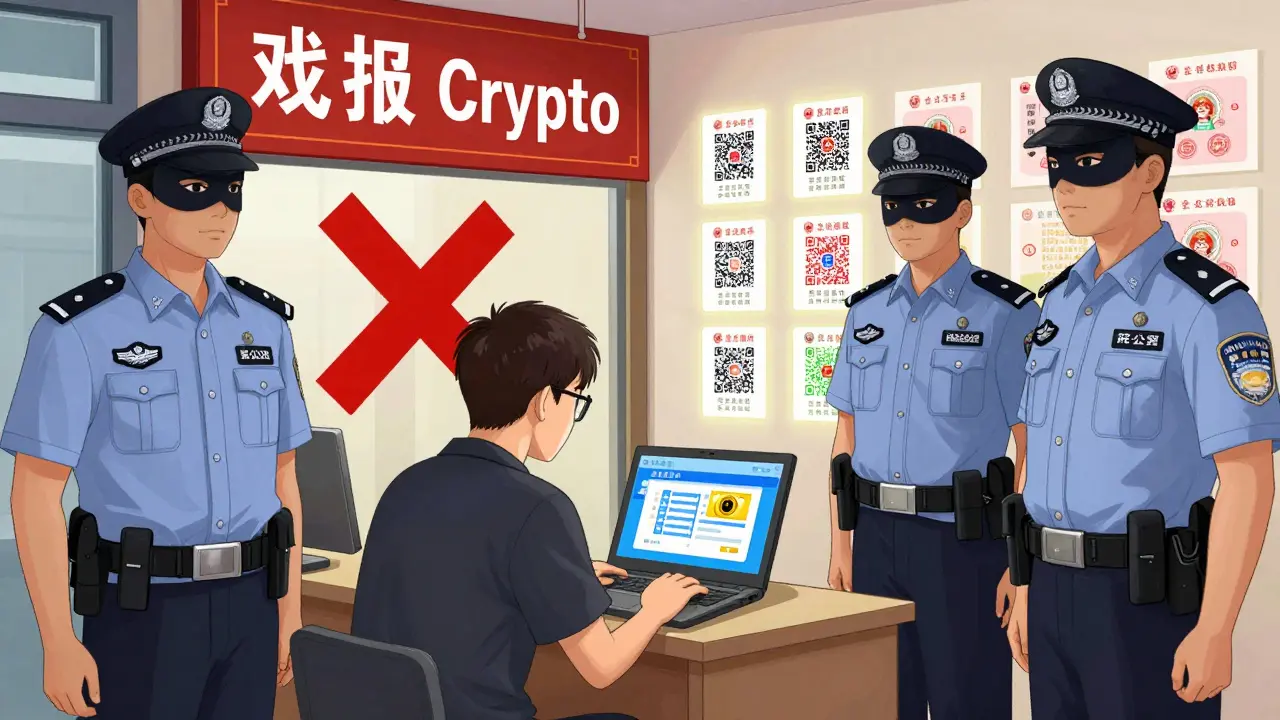
China doesn’t rely on luck to catch violators. It uses a coordinated, multi-agency surveillance system. The Ministry of Public Security, the Cyberspace Administration, and the People’s Bank of China all work together. They monitor online activity, track bank transfers, and inspect business records. If a company’s accounting shows unusual cash inflows with no clear source, investigators will dig deeper. If they find even one crypto transaction, the business could face fines, asset seizures, or criminal charges against its owners.Since 2024, there have been dozens of publicized cases where business owners were arrested for running crypto-related operations. Some were running crypto-to-fiat exchange services. Others were simply accepting Bitcoin to pay for web hosting or cloud servers. All were prosecuted under the 2025 law. The message is unmistakable: if you touch crypto in a business context, you’re a target.
Hong Kong Is the Exception-Not the Rule
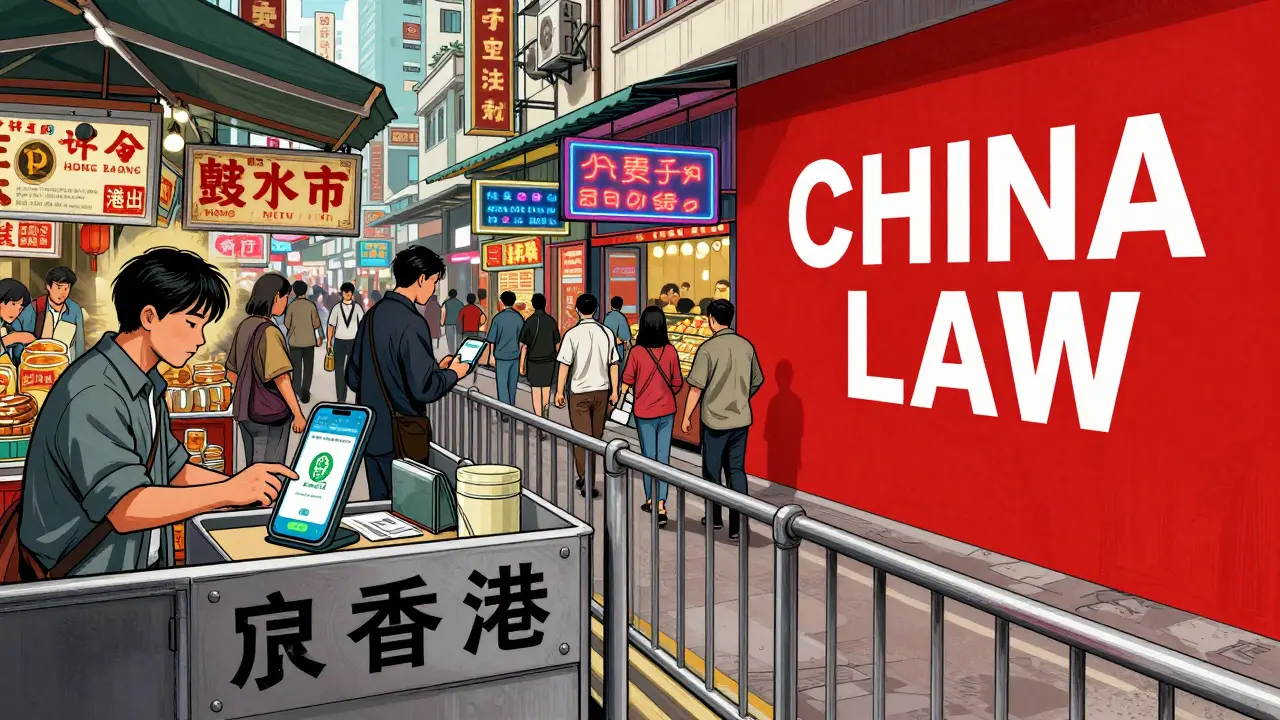
You might hear about Hong Kong allowing crypto exchanges and licensing crypto firms. That’s true. Hong Kong, as a Special Administrative Region, has its own financial laws. It’s building a regulated crypto market with licensed exchanges, stablecoin rules, and custody services. But that’s not mainland China. A business in Shenzhen can’t use Hong Kong’s rules as a workaround. If a mainland company tries to accept crypto through a Hong Kong-based payment processor, it’s still violating Chinese law. The government treats cross-border crypto activity as a serious threat to capital controls.Some mainland investors buy shares in Hong Kong-listed crypto firms to get indirect exposure. But that’s investment, not commerce. It doesn’t let a restaurant in Chengdu accept Bitcoin for dumplings. The legal firewall between Hong Kong and mainland China is real-and strictly enforced.
Why Does China Care So Much?
The answer lies in control. Cryptocurrencies let people move money outside the state’s reach. They enable capital flight. They bypass sanctions. They let individuals store value without government oversight. For a country that tightly controls its currency, foreign exchange, and banking system, that’s a direct challenge to its authority.Meanwhile, the digital yuan is being rolled out across the country. It’s already used in public transport, utility payments, and government subsidies. It integrates with mobile wallets, tax systems, and social credit scores. The government doesn’t just want to replace cash-it wants to own every digital financial interaction. Crypto can’t compete with that. So it’s being erased.
How This Compares to the Rest of the World
While China bans crypto outright, other countries are building frameworks. The U.S. is moving toward clear rules for crypto businesses. Singapore has licensed exchanges and regulated stablecoins. Even countries like Bahrain and South Africa are creating legal pathways for crypto payments.China is the outlier. It’s the only major economy that has chosen total prohibition over regulation. There’s no sign this will change. The digital yuan is too central to China’s economic future. The state won’t risk losing control of its financial system.
What Happens If a Business Tries It Anyway?
The consequences are immediate and harsh:- Bank accounts are frozen
- Business licenses are revoked
- Assets (cash, property, equipment) are seized
- Owners face criminal charges, possible jail time
There’s no warning. No grace period. No negotiation. Once authorities detect crypto activity, enforcement begins. And with China’s surveillance infrastructure, detection is almost guaranteed.
The Future? No Change in Sight
There’s no indication the ban will be lifted. The 2025 law was the final step in a 12-year progression-from warnings in 2013, to ICO bans in 2017, to mining shutdowns in 2021, to full criminalization in 2025. This wasn’t a sudden crackdown. It was a calculated, long-term strategy. The government has built the infrastructure, trained the enforcement teams, and locked in the legal framework.For any business operating in mainland China, the message is simple: stick to the digital yuan. Use bank transfers, QR codes, or mobile payments. Anything involving Bitcoin, Ethereum, or altcoins is a legal risk with no upside. There’s no gray zone. No workaround. No future where crypto becomes legal in mainland China under the current system.
Can a foreign company operating in China accept cryptocurrency?
No. Foreign companies operating in mainland China must follow the same rules as local businesses. The 2025 law applies to all entities conducting business within China’s borders, regardless of ownership. Even if a company is registered in the U.S. or Singapore, accepting crypto as payment while operating in China is illegal and subject to prosecution.
Is using crypto for payroll legal in China?
Absolutely not. Paying employees in cryptocurrency is treated the same as accepting it as payment-it’s a criminal offense under the 2025 law. All wages must be paid in renminbi (RMB), either through bank transfer or the digital yuan. Any attempt to pay in crypto, even with employee consent, triggers legal action.
Can I use crypto to buy from Chinese suppliers?
If you’re outside China and trying to pay a Chinese supplier in crypto, the supplier cannot legally accept it. Chinese businesses are forbidden from receiving crypto payments. Even if the supplier agrees, their bank will flag the transaction, and authorities will investigate. The supplier risks criminal charges.
What about blockchain technology? Is that banned too?
No. China actively promotes blockchain technology-for non-crypto uses. The government supports blockchain for supply chain tracking, digital certificates, and public records. But any application that involves cryptocurrencies, tokens, or decentralized ledgers tied to digital assets is prohibited. The tech is allowed. The money isn’t.
Is there any way to legally accept crypto in China through a third party?
No. There are no legal third-party services in mainland China that facilitate crypto payments. Any company claiming to offer crypto payment processing within China is operating illegally. Using such a service-even if it claims to be “compliant”-exposes your business to criminal liability under the 2025 law.
Trenton White
February 27, 2026 AT 18:20China’s move makes sense if you think about it long-term. They’re not just banning crypto-they’re building a financial ecosystem where every transaction serves the state’s goals. The digital yuan isn’t just a currency, it’s a surveillance tool wrapped in convenience. No more anonymous cash flows, no more capital flight, no more shadow economies. It’s control, but it’s also stability. And for a country with 1.4 billion people, that’s worth something.
Cheryl Fenner Brown
February 28, 2026 AT 17:21so like… if i pay my barber in btc in shanghai… he goes to jail?? 😱 that’s wild. i mean, i get it but also… who even uses crypto there anymore??
kati simpson
March 1, 2026 AT 00:53the government just wants people to use their own system. that’s not that weird. every country wants control over money. the us does it with banks and taxes. china just does it with tech. it’s not about being evil. it’s about being organized. people act like this is some dystopia but it’s just… government doing its job.
Colin Lethem
March 2, 2026 AT 10:19wait so if i’m a u.s. company and i hire a chinese dev and pay them in usdc, is that illegal? what if they’re living in shanghai? what if they’re on a visa? what if they’re just sitting in a co-working space in guangzhou? this is so messy. how do you even enforce this? do they have a crypto police unit running around checking qr codes?
lori sims
March 2, 2026 AT 20:45i think what’s fascinating is how china turned a threat into a tool. crypto was supposed to be the people’s money, free from control. but china just said ‘fine, we’ll make our own version that’s even more controlling.’ it’s like they took the idea of decentralization and inverted it into hyper-centralization. and honestly? it’s working. the digital yuan is everywhere now. buses, groceries, even public restrooms have QR codes for e-CNY. the people aren’t rebelling. they’re just… using it. it’s weirdly peaceful.
Reggie Fifty
March 4, 2026 AT 14:05china is a dictatorship and this is why it works. no one in america would ever accept this level of control. we’re too soft. we let people do whatever they want with their money. that’s why we’re falling behind. if we had a government that actually enforced rules like this, we wouldn’t have inflation, crime, or crypto scams. this is leadership. the west is just a bunch of whiny toddlers.
Ryan Burk
March 5, 2026 AT 23:51lol this post is so over the top. ‘full criminal prohibition’? really? so if i buy a coffee with bitcoin in beijing i get 15 years? that’s not even true. the law is vague, enforcement is patchy, and everyone knows it. you think the government cares if some guy in hangzhou pays for his lunch in usdt? they’ve got bigger fish to fry. this whole thing is fearmongering. also, blockchain is still being used everywhere. just not for money. duh.
Ifeanyi Uche
March 7, 2026 AT 15:51you think china is harsh? what about the west? they let people get rich off scams, pump and dumps, rug pulls. china is protecting its people. crypto is a scam. it was made by anarchists to destroy nations. the digital yuan is the future. the west is clinging to ghosts. you think your freedom is real? you’re just a data point in a corporate machine. china at least has the courage to build something real.
Jeff French
March 8, 2026 AT 05:34the blockchain vs crypto distinction is critical here. china isn’t anti-innovation. they’re anti-decentralized finance. they’re investing billions in blockchain for supply chains, land registries, healthcare records. they just don’t want the monetary layer to be out of state control. it’s not about fear of tech-it’s about sovereignty. the digital yuan is a sovereign tool. crypto is a transnational tool. those are fundamentally incompatible goals. this isn’t irrational. it’s strategic.
Elana Vorspan
March 9, 2026 AT 17:23it’s kind of beautiful how they just… moved on. no drama, no protests, no hashtags. they built something better and let the old thing fade. no one’s screaming about it. no one’s trying to ‘free’ crypto. they just use e-CNY. it’s seamless. it’s fast. it’s integrated. maybe the real lesson isn’t about bans-it’s about offering a better alternative and letting people choose it naturally. that’s how you win.
Kenneth Genodiala
March 10, 2026 AT 17:20while the chinese state’s centralized digital currency architecture is undoubtedly a sophisticated exercise in techno-authoritarian governance, one must contextualize this within the broader historical trajectory of monetary sovereignty in post-colonial nation-states. the digital yuan represents not merely a payment mechanism but a hermeneutic reconfiguration of financial epistemology-where value is no longer emergent but ontologically prescribed by the state apparatus. this is not unique to china; it is merely the most coherent manifestation of a global trend toward algorithmic fiscal control.
Tanvi Atal
March 12, 2026 AT 01:00they banned it. end of story. no one cares about your blockchain tech. if you can’t pay in rmb, you’re out. simple.
Sony Sebastian
March 13, 2026 AT 08:08the digital yuan is a masterstroke. while the west fiddles with regulatory sandboxes and stablecoin debates, china has already deployed a fully integrated, real-time, AI-monitored monetary layer across its entire economy. this isn’t policy-it’s infrastructure. the u.s. can’t even digitize its unemployment checks without a 6-month delay. china doesn’t just lead. it obsoletes.
Brian Lemke
March 13, 2026 AT 13:04what’s wild is how this mirrors the early internet. back in the 90s, governments freaked out about anonymity and encryption. now we use end-to-end encryption daily. but china didn’t go down that road. they said, ‘we’ll build our own internet.’ same thing here. they didn’t ban the tech-they built a better version. and guess what? most people don’t even miss the old one. the digital yuan is faster than cash, cheaper than cards, and more reliable than any crypto. why would you fight it?
Megan Lavery
March 14, 2026 AT 10:29imagine being able to pay for your subway ride and your groceries with one app that also tracks your taxes and social credit. sounds creepy? maybe. but also… kinda convenient? i’d use it. no more lost receipts or waiting for bank transfers. china just made money boring. and honestly? that’s the win.
Mae Young
March 14, 2026 AT 16:33ohhh so china is ‘protecting financial sovereignty’? how noble. next they’ll tell us they’re banning bitcoin to save the environment from mining energy waste. meanwhile, they’re building coal plants and monitoring every toilet flush. it’s not about control-it’s about power. and they’re not hiding it. they’re waving a flag that says ‘we own your money now.’ and you’re all like ‘wow, what a visionary leader.’
Michael Teague
March 14, 2026 AT 23:05tbh i don’t get the hype. no one in china i know uses crypto. it’s not like they’re all out there hodling btc. they’re using wechat pay. they’re using alipay. they’re using e-cny. crypto is just… not a thing there anymore. the ban didn’t kill it. it was already dead. this post feels like someone trying to make a mountain out of a molehill.