CBSN BlockSwap Network StakeHouse NFT Airdrop: What You Need to Know

Everyone loves free money, right? But in the crypto world, "free" usually comes with a catch. If you've been hearing whispers about a CBSN or StakeHouse NFT airdrop from BlockSwap Network, you're probably wondering if it's real, how to get it, and why nobody is talking about it loudly. Here’s the deal: as of late 2026, there is no confirmed, large-scale public NFT airdrop campaign currently active for BlockSwap Network that guarantees an NFT drop for every user. Most of what you see online is either outdated news from their earlier token launch phases or speculative hype.
But don't close the tab just yet. BlockSwap Network has a history of rewarding early community members, and understanding how their ecosystem works might help you position yourself for future rewards. Let's break down exactly what CBSN is, what StakeHouse does, and how you can actually engage with the project instead of just chasing ghosts.
What Is BlockSwap Network (CBSN)?
BlockSwap Network is a permissionless web3 infrastructure layer designed to make multichain composable ETH and modular Ethereum blockspace accessible. Think of it as the plumbing behind the scenes of Ethereum's Proof of Stake ecosystem. Their native token, CBSN, had its Token Generation Event back on April 26, 2021. That's five years ago now. The project raised $7 million across four funding rounds, aiming to onboard everyday users into DeFi by providing stable yield without the usual complexity.
The core mission here isn't just to create another token; it's to simplify Ethereum staking. Normally, staking requires locking up assets and dealing with technical hurdles. BlockSwap wants to remove those barriers. They offer liquid staking solutions where you can earn rewards while keeping your assets usable. This approach targets mainstream adoption, trying to bridge the gap between complex DeFi protocols and regular investors who just want to grow their holdings.
Understanding StakeHouse and SHB Tokens
At the heart of BlockSwap's utility is StakeHouse. It’s a decentralized liquid staking platform that uses smart contracts to coordinate staked ETH2 liquidity. Instead of locking your ETH away forever, StakeHouse issues ERC20 tokens that represent your staked position. This means you can trade, lend, or use these tokens in other DeFi applications while still earning staking rewards.
You might have heard of SHB (StakeHouse Batch) tokens. These are specific to the Blockswap CommunityNet. SHB tokens act as batch minters, allowing users to mint batches within Stakehouse that simulate a 32 ETH deposit. This mechanism helps stress-test the protocol in real-time environments. However, keep this in mind: SHB tokens are not widely traded on major exchanges like Binance or Coinbase. They serve more of an internal utility function for testing and community engagement rather than being a primary investment vehicle for most people.
The Truth About the "NFT Airdrop" Rumors
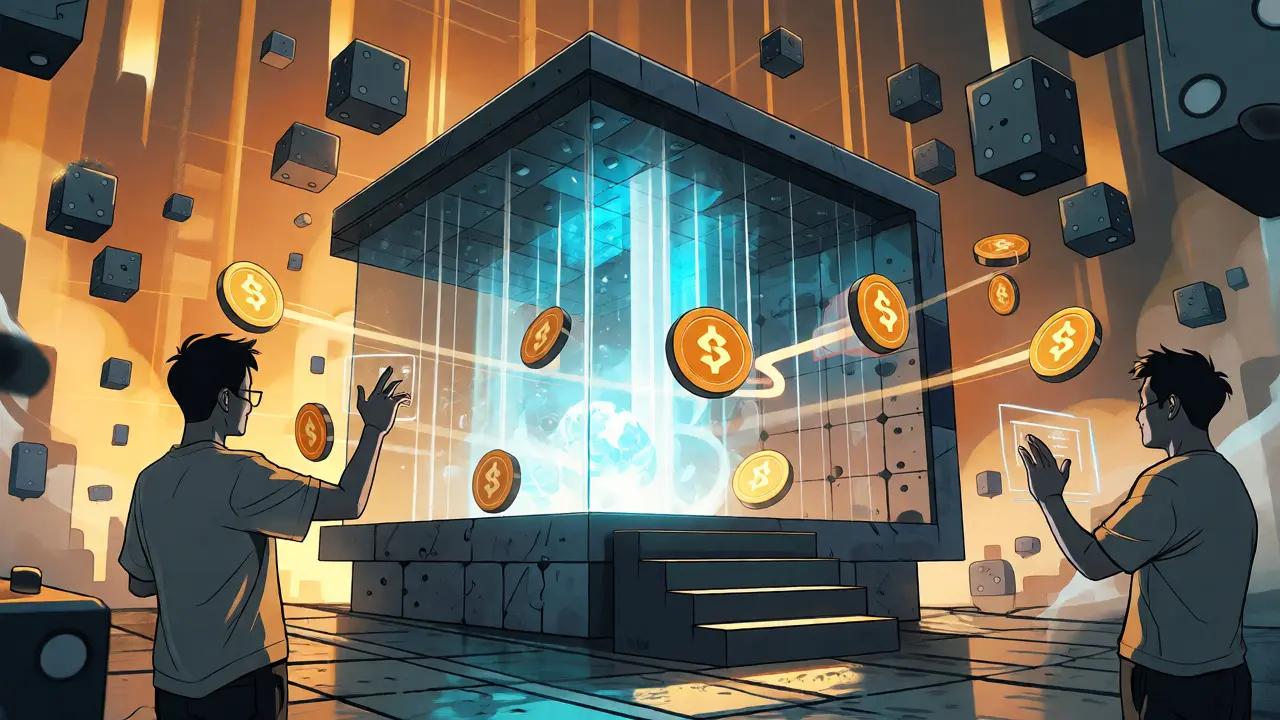
So, where did the idea of a StakeHouse NFT airdrop come from? Often, crypto projects release NFTs as part of marketing campaigns, loyalty programs, or to grant access to exclusive features. For BlockSwap, past incentives have focused heavily on fungible tokens rather than non-fungible ones. Historical data shows prize pools worth around $2,500 in cBSN tokens for CommunityNet participants. There was also a small campaign offering 100 coins via ICOmarks, but these were negligible in value.
Currently, there is no official announcement detailing a mass distribution of NFTs to all StakeHouse users. If you saw a headline promising a "big NFT drop," it likely referred to these smaller, targeted community rewards or was misinterpreted speculation. Always check the official BlockSwap channels before assuming you'll receive a valuable asset. In crypto, if something sounds too good to be true-like getting a rare NFT just for holding a wallet-it usually is.
How to Participate and Earn Rewards
If you want to be in the loop for any future drops, whether they are tokens or NFTs, you need to be active. Passive holding rarely gets rewarded in modern DeFi. Here is how you can engage with the BlockSwap ecosystem:
- Join the CommunityNet: Early participation in testnets and community networks often leads to retroactive rewards. Keep an eye on their Discord or Telegram for tasks.
- Use Liquid Staking: Stake your ETH through the StakeHouse protocol. Even if there isn't an immediate NFT, you earn yield. Some protocols later reward active stakers with governance tokens or NFT badges.
- Engage with Developers: If you code, use their SDKs to build apps. Developer grants and bounties are common ways to earn extra income in this space.
- Monitor Official Announcements: Follow BlockSwap Network on Twitter/X and read their blog. Airdrops are almost always announced officially first.
Security and Risks: Don't Ignore the Fine Print
Before you connect your wallet to any new protocol, look at the security track record. BlockSwap has undergone audits by reputable firms like Halborn, Solidified, Runtime Verification, and Certora. These audits check for smart contract vulnerabilities, which is crucial because bugs in DeFi can lead to total loss of funds.
Despite these audits, risks remain. Smart contract vulnerabilities, market volatility, and regulatory changes are constant threats. Also, consider the tokenomics. CBSN has a total supply of 500 million tokens, but the circulating supply has been low relative to the max potential supply of 5 billion. Low circulation can mean high price volatility once more tokens unlock or enter the market. Never invest more than you can afford to lose, especially in niche infrastructure projects.

Comparison: BlockSwap vs. Other Liquid Staking Protocols
To understand where BlockSwap fits, let's compare it to some established names in the liquid staking space. While Lido and Rocket Pool dominate headlines, BlockSwap positions itself differently by focusing on modular blockspace and universal basic saving mechanisms like OpenSaver.
| Feature | BlockSwap Network | Lido Finance | Rocket Pool |
|---|---|---|---|
| Primary Focus | Modular blockspace & UBS savings | Maximum liquidity & scale | Decentralization & node operators |
| Token Type | CBSN (Native), SHB (Utility) | LDO (Governance), stETH (Liquid) | RPL (Collateral), rETH (Liquid) |
| Audit Firms | Halborn, Certora, Solidified | Nethermind, ChainSecurity | Diligence, Trail of Bits |
| Accessibility | CommunityNet focus | Open to all wallets | Permissionless node operation |
This table highlights that BlockSwap is less about dominating the current TVL (Total Value Locked) race and more about building specialized infrastructure. If you are looking for massive liquidity, Lido might be safer. If you believe in modular blockchain futures, BlockSwap offers a unique angle.
Final Thoughts: Should You Chase the Drop?
Is the CBSN StakeHouse NFT airdrop worth your time today? Probably not if you expect immediate riches. The project is still in a growth phase, focusing on technical robustness and community building. The "airdrop" narrative is often a lagging indicator in crypto; by the time everyone knows about it, the best returns are gone.
Your best strategy is to treat BlockSwap as a long-term infrastructure play. Use their tools, participate in the community, and stay alert for official announcements. If an NFT drop does happen, it will likely reward those who were already active, not those who showed up just for the freebie. Keep your expectations realistic, do your own research, and never trust a link sent to you in DMs claiming you won an airdrop.
Is there a confirmed CBSN NFT airdrop in 2026?
As of September 2026, there is no officially confirmed mass NFT airdrop for all CBSN holders. Past incentives were primarily token-based. Always verify claims through official BlockSwap Network social media channels.
What is the StakeHouse SHB token?
SHB (StakeHouse Batch) is a utility token used within the Blockswap CommunityNet to mint batches representing simulated 32 ETH deposits. It is used for stress-testing the protocol and is not widely traded on major exchanges.
How many CBSN tokens are there?
The total supply of CBSN is 500 million tokens, with a maximum potential supply of 5 billion. Circulating supply varies based on unlocks and community distributions.
Is BlockSwap Network audited?
Yes, BlockSwap Network has undergone multiple security audits by reputable firms including Halborn, Solidified, Runtime Verification, and Certora to ensure smart contract security.
Can I stake ETH on StakeHouse?
Yes, users can stake ETH through the StakeHouse protocol to earn liquid staking rewards. This allows you to maintain liquidity while participating in Ethereum's Proof of Stake consensus.
musa farid
September 22, 2026 AT 07:21Bro are you serious right now?? 🤯 You just spent 10 minutes telling us there is NO airdrop and then asking us to stake ETH anyway?! That is pure madness! 😤 I have been farming these testnets for months thinking I was gonna get that rare NFT, and you're saying it's all just 'speculative hype'? 📉 My wallet is crying rn. 💸 If this isn't real, why did everyone in the Telegram group scream about it last week? 👀 This feels like a massive bait-and-switch to get our liquidity locked up while we wait for a ghost. 🐻 Don't play with my emotions like that, man. I need answers, not lectures on 'modular blockspace'. 🚫🧢
Harmony Davidson
September 22, 2026 AT 13:33it’s always the same story... they hype it up... drain the wallets... and then silence... 🕵️♀️ i bet they’re planning to dump those SHB tokens on retail investors once the volume picks up... or maybe it’s even deeper... what if the 'audits' by Halborn and Certora were just rubber stamps?? 🤨 nothing is free in crypto... nothing... 🌑 keep your eyes open... don’t let them fool you with pretty words about 'plumbing behind the scenes'... it’s all smoke and mirrors until proven otherwise... 🎭
Bruce Percival
September 24, 2026 AT 02:58Hey Harmony, I think you might be reading too much into the audit firms part. To be fair, Halborn has a pretty solid track record in DeFi security, so I wouldn't dismiss their work entirely. It does seem like BlockSwap is trying to position itself differently from Lido, focusing more on the modular aspect rather than just raw TVL. Do you think that niche focus is enough to sustain interest without a major token unlock event?
Harmony Davidson
September 25, 2026 AT 18:08track records can be bought... or manipulated... 🤷♀️ i’ve seen bigger projects fail despite audits... remember UST?? 📉 remember Luna?? 💥 the narrative is everything... and right now the narrative is 'wait patiently' which usually means 'we are buying time'... ⏳
Zach Evans
September 26, 2026 AT 02:08Actually, you're both missing the fundamental point here. The entire premise of liquid staking derivatives (LSDs) relies on trust minimization, not blind faith in audit firms. BlockSwap's approach with StakeHouse is technically superior because it decouples the consensus layer rewards from the execution layer liquidity via those ERC20 representations. Most people don't understand that SHB isn't meant to be traded; it's a simulation tool. If you treat it like a speculative asset, you're playing the wrong game. The real alpha is in the OpenSaver mechanism which acts as a universal basic saving protocol, something Lido completely lacks. Stop looking for quick flips and look at the infrastructure utility.
Bhanu Rokkam
September 28, 2026 AT 02:04You sound like you swallowed the whitepaper whole. Infrastructure utility doesn't pay the bills when the market bleeds. Nobody cares about your 'universal basic saving mechanism' if the token price is flatlining against ETH. The community wants liquidity, not philosophy. If they wanted to reward users, they would have dropped an NFT already instead of vague promises. This is just another project hiding behind jargon to delay the inevitable sell-off.
Tish Dalton
September 29, 2026 AT 18:51I appreciate the passion, Bhanu, but let's try to keep the energy positive! 🌟 It's totally valid to want immediate rewards, but sometimes the best gains come from being early to the tech before the hype cycle kicks in. Maybe the lack of an immediate NFT drop is actually a good sign that they aren't desperate for attention? We can definitely discuss the technical merits later, but for now, maybe check out their Discord to see what other active members are saying? Community vibes matter too! ✨
Emily Sue
September 29, 2026 AT 20:58ugh honestly im so tired of these half-baked announcements... its always 'soon tm' but never actually happens... i feel like i wasted so much gas fees trying to mint those shb things for no reason... 💸💸💸 also who even knows how to use sdk properly lol... i just wanna earn yield without breaking my brain... 🧠💥
Katherine Rosales Maza
September 29, 2026 AT 22:39To add some context to the SDK comment: the developer grants mentioned in the article are indeed quite competitive compared to other mid-cap protocols. However, regarding the SHB tokens, it is crucial to note that they are non-transferable in most contexts within the CommunityNet. This design choice prevents early speculation on the batch mints themselves, forcing engagement through actual usage rather than trading. While frustrating for short-term traders, this aligns with their long-term goal of stress-testing the protocol under realistic load conditions before mainnet expansion.
Diego Alamir
October 1, 2026 AT 17:38They're hiding something. Always are.
Manish Pahuja
October 3, 2026 AT 04:52Chill guys, let's not overreact. The post clearly states that past incentives were small ($2,500 prize pools). If you were expecting a Lamborghini-level NFT drop, yeah, disappointment is guaranteed. But if you view this as a way to learn about modular blockchains while earning yield, it's not bad. Just manage expectations. Keep grinding the testnets, stay active, and if a drop comes, great. If not, you still have staked ETH. Win-win mindset helps here. 🧘♂️
Charlotte Owen
October 4, 2026 AT 00:51The comparison table is misleading. Lido's accessibility is vastly superior due to integration across almost every major DeFi protocol. BlockSwap's 'CommunityNet focus' sounds nice, but in practice, it limits liquidity depth significantly. Without deep liquidity, those ERC20 tokens representing staked positions will suffer from high slippage during exit events. Until they solve the liquidity fragmentation issue, the 'modular' advantage is theoretical at best. Users should be cautious about locking capital into a siloed ecosystem with uncertain exit paths.