Crypto as Commodity Regulations in Indonesia: What Changed in 2025

Before January 2025, if you wanted to trade cryptocurrency in Indonesia, you did it under the same rules as buying soybeans or crude oil. The Commodity Futures Trading Regulatory Agency, or BAPPEBTI, handled it all. But that changed. On January 10, 2025, Indonesia stopped treating crypto as a commodity and started treating it like a financial asset. This wasn’t just a paperwork shift-it rewrote the entire rulebook for everyone trading, investing, or running a crypto exchange in the country.
Why Indonesia Changed the Rules
The old system had problems. BAPPEBTI was built to oversee physical commodities, not digital assets that move in milliseconds across borders. Crypto exchanges listed over 850 different tokens, many with no real use, no team, and no transparency. Investors lost money. Scams grew. And because crypto couldn’t be used as payment, the government saw it as a speculative asset-not a tool for the economy. Law No. 4 of 2023, called the PPSK Law, gave the Financial Services Authority (OJK) the power to take over. OJK already regulated banks, insurance, and stock markets. It had the tools to monitor money flows, enforce anti-money laundering rules, and protect consumers. The move wasn’t about banning crypto. It was about bringing it inside the system.Who Controls Crypto Now?
OJK is in charge. That means crypto trading platforms must now get a license from OJK, not BAPPEBTI. If you’re running a crypto exchange in Indonesia, you need to prove you have at least IDR 100 billion (about $6.5 million USD) in paid-up capital. You also need to keep at least IDR 50 billion in equity at all times. And here’s the catch: that money can’t come from illegal sources. OJK checks where the capital came from-no more anonymous funding. All platforms had to meet these requirements by July 2025. Many smaller exchanges couldn’t afford it. Some shut down. Others merged. Only the ones with real backing survived.What Tokens Can You Still Trade?
Under the old system, exchanges could list almost anything. Now, OJK requires every digital asset on a platform to be reviewed and approved. By February 2025, exchanges had to submit their lists. By April 2025, only the approved ones stayed live. If a token didn’t meet OJK’s criteria-like having a clear use case, a public team, or transparent code-it got delisted. This cut the number of tradable assets by more than half. Bitcoin and Ethereum? Still there. Thousands of obscure meme coins? Gone. The goal isn’t to pick winners. It’s to stop fraud before it happens.
How Crypto Is Taxed Now
The tax rules changed too. Before August 2025, crypto trades were taxed like commodity sales. You paid Value Added Tax (VAT) every time you bought or sold. That made trading expensive and messy. Minister of Finance Regulation No. 50 of 2025 (PMK 50) scrapped that. As of August 1, 2025, crypto trades are no longer subject to VAT. Instead, only income tax applies when you sell for a profit. The tax rate depends on your total annual income, just like salary or business profits. This was a huge win for traders. No more double taxation. No more confusing VAT calculations. The government now treats crypto like stocks or bonds-not like a bag of rice.What You Can’t Do With Crypto
Even with all these changes, one rule hasn’t budged: you still can’t use crypto to pay for coffee, rent, or groceries. Bank Indonesia (BI) still bans it as a payment method. That hasn’t changed since 2018. Some people hoped stablecoins-digital tokens pegged to the rupiah or dollar-would get special treatment. They didn’t. The government still sees them as risky for monetary stability. Until there’s a clear legal framework for digital payments, cash and bank transfers remain the only legal options.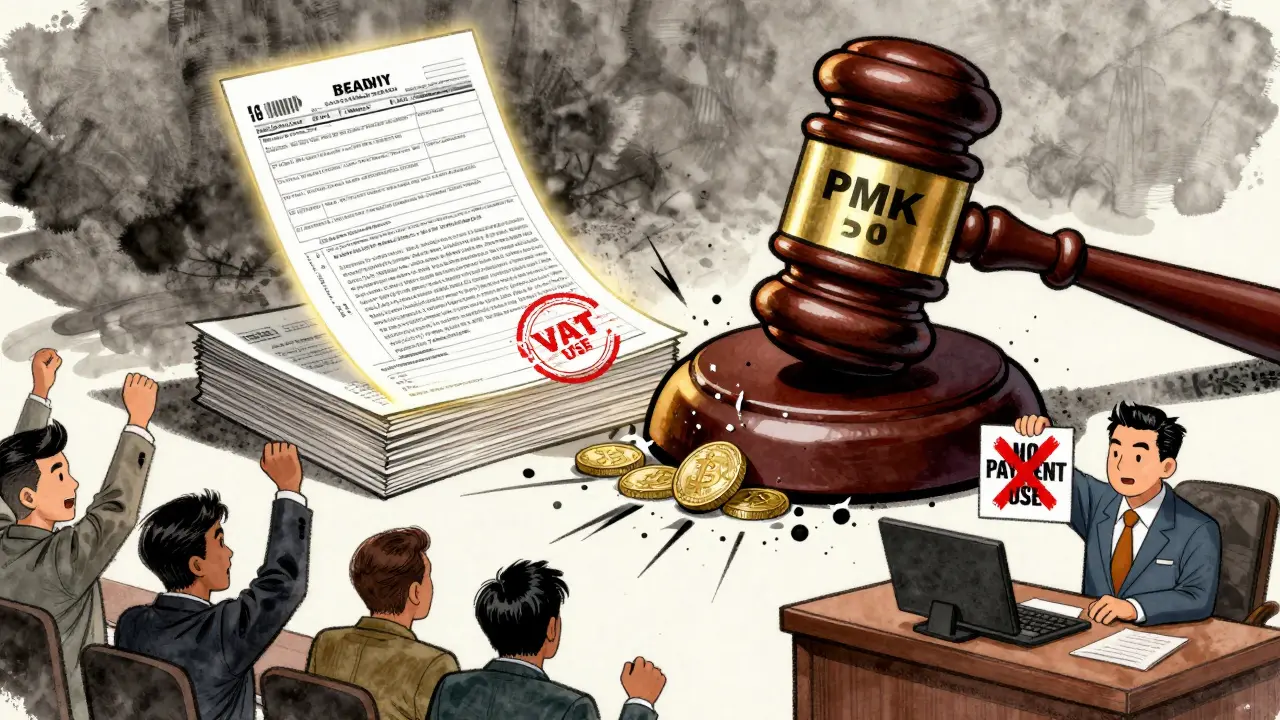
What Happens If You Break the Rules?
OJK doesn’t play around. If a crypto platform lies about its capital, hides user data, or lets illegal money flow through its system, the penalties are severe. Licenses can be revoked. Fines can reach billions of rupiah. Executives can face criminal charges. Even personal assets can be seized if they’re linked to money laundering. Platforms must report suspicious transactions to PPATK, Indonesia’s financial intelligence unit. OJK can track trades in real time. If you’re trying to hide large transfers or use fake IDs, you’re likely to get caught.What This Means for Investors
For regular users, the changes are mostly good. Platforms are more secure. Assets are vetted. Tax rules are simpler. If you’re holding Bitcoin or Ethereum on a licensed exchange, your money is less likely to vanish overnight. But there’s a trade-off. The high capital requirements mean fewer startups can enter the market. That reduces competition-and innovation. You’ll see fewer new apps, fewer features, and slower adoption of new tech like DeFi or tokenized assets. Still, Indonesia is now one of the few countries in Southeast Asia with a clear, centralized crypto regulatory system. That gives investors more confidence than the wild west of 2023.What’s Next?
The big question now is: will crypto ever be legal for payments? Industry groups are pushing hard for it, especially for stablecoins. They argue that digital rupiah-backed tokens could help unbanked communities and reduce remittance costs. For now, the government says no. But with digital currency trials already underway by Bank Indonesia, the door isn’t completely closed. The next big shift might not be about trading-it could be about spending. Until then, the rules are clear: trade only on licensed platforms. Keep your records. Pay your taxes. And never use crypto to buy anything. It’s still illegal.Is crypto legal in Indonesia?
Yes, but only as a traded digital financial asset. You can buy, sell, and hold cryptocurrency on licensed platforms. However, it is illegal to use crypto as payment for goods or services. The legal status changed in January 2025, when oversight moved from BAPPEBTI to OJK.
Do I have to pay tax on crypto profits in Indonesia?
Yes. Since August 1, 2025, you pay income tax on crypto profits, but not VAT. The tax rate depends on your total annual income. You must report gains from selling crypto, just like you would with stocks or rental income. Keep records of your trades for at least five years.
Can I use crypto to pay for things in Indonesia?
No. Bank Indonesia has banned the use of cryptocurrency for payments since 2018, and this rule remains unchanged. Even stablecoins cannot be used to buy coffee, rent, or services. Only rupiah and approved digital payment systems like QRIS are legal for transactions.
Which agencies regulate crypto in Indonesia now?
The Financial Services Authority (OJK) is the main regulator for crypto trading platforms. It handles licensing, capital requirements, and consumer protection. The Financial Transaction Reports and Analysis Center (PPATK) monitors for money laundering. Bank Indonesia (BI) controls payment rules and has banned crypto as currency.
What happens if a crypto exchange shuts down in Indonesia?
If an exchange loses its license or shuts down, users are protected under OJK’s investor safeguard rules. Licensed platforms must keep client funds separate from company assets. In case of failure, customer assets should be returned. However, you should only use platforms with active OJK licenses-unlicensed exchanges offer no legal protection.
Are there any limits on how much crypto I can buy?
There are no official limits on how much crypto an individual can buy. However, exchanges enforce KYC rules that require identity verification. Large purchases may trigger additional reporting to PPATK. If you’re buying over IDR 100 million in a single transaction, expect to provide extra documentation.
Can foreign investors trade crypto in Indonesia?
Yes, but only through OJK-licensed Indonesian platforms. Foreigners can open accounts and trade, but they must comply with local KYC rules. They cannot operate crypto exchanges in Indonesia unless they establish a local legal entity and meet the same capital requirements as Indonesian firms.
dayna prest
January 4, 2026 AT 19:07So let me get this straight-Indonesia just turned crypto into a Wall Street toy while banning it from buying coffee? Brilliant. Next they’ll tax your dreams and regulate your sighs. At this point, I’m just waiting for the government to issue a license to breathe air. 🤡
Brooklyn Servin
January 6, 2026 AT 13:37Finally. Someone got it right. 🙌 The old BAPPEBTI system was a dumpster fire with 850 meme coins floating like confetti at a funeral. OJK stepping in? Long overdue. Capital requirements? Good. Delisting trash tokens? Even better. And THANK GOD for scrapping VAT on trades-that was a nightmare for small traders. Now if only they’d let us use stablecoins to pay for nasi goreng… 😅
Phil McGinnis
January 8, 2026 AT 03:28This is not regulation. This is surrender. The state has chosen to embrace financialization over innovation. By centralizing control under OJK, Indonesia has merely replicated the very failures it claims to correct. Crypto was never meant to be a security. It was meant to be a rebellion. Now it’s just another regulated asset class, dressed in suits and tie-dyed with compliance forms.
Ian Koerich Maciel
January 9, 2026 AT 09:51It is, without question, a significant and commendable evolution in regulatory architecture. The transition from commodity-based oversight to financial-asset-based governance aligns Indonesia with global best practices. The capital requirements, KYC enforcement, and PPATK integration demonstrate a sophisticated understanding of systemic risk. One must acknowledge the deliberate, methodical pacing of implementation-from January to July-with appropriate grace periods. This is governance, not chaos.
Andy Reynolds
January 9, 2026 AT 18:25Big win for regular folks, honestly. I know a guy who lost his life savings on some ‘DogePunkZ’ token back in ’23. Now? He’s chillin’ with BTC and ETH on a licensed exchange, paying taxes like a responsible adult. Yeah, the market’s less wild-but safer. And honestly? I’d rather have fewer coins but sleep at night. Let the big players fight over the capital requirements. We’re just here to hodl.
Daniel Verreault
January 11, 2026 AT 15:31Brooo… OJK’s got the capital reqs? That’s wild. Only the deep pockets survive now. I mean, sure, it kills the indie platforms-but honestly? Most of ‘em were just fronting for rug pulls anyway. Still… feels like we’re trading decentralization for bureaucracy. At least the tax thing? Pure win. No more VAT chaos. 🤝
dina amanda
January 11, 2026 AT 23:29They're using OJK to track us. They're gonna use this to freeze our wallets next. Mark my words. This isn't about regulation-it's about control. The Fed is behind this. The IMF. The Bilderberg Group. They want your crypto. They want your money. They want to make sure you can't escape the system. You think they care about 'investor protection'? They care about power.
Prateek Chitransh
January 12, 2026 AT 07:08Oh, so now we're supposed to be impressed that Indonesia finally figured out crypto isn't a commodity? Took them long enough. Meanwhile, in India, we’ve had clear tax rules since 2022 and still let people trade freely. You don't need to kill innovation to add oversight. You just need to not be afraid of change. Or maybe you just like bureaucracy? 😏
Michelle Slayden
January 13, 2026 AT 18:22The structural coherence of this regulatory transition is, in many respects, exemplary. The bifurcation of responsibilities-OJK for licensing and investor protection, PPATK for financial crime, BI for monetary integrity-creates a tripartite governance model that is both functionally elegant and legally defensible. One might even argue that this represents a nascent form of digital constitutionalism.
christopher charles
January 15, 2026 AT 18:10Okay but real talk-why the hell did it take until 2025 to fix this? I remember trying to cash out in 2022 and getting ghosted by 3 different exchanges. Now at least if something goes sideways, I’ve got a regulator I can actually yell at. Still… 100B IDR in capital? That’s like… a whole damn country’s budget. Who’s even got that kind of cash? 🤔
Amy Garrett
January 17, 2026 AT 08:41YASSS! Finally someone gets it!! No more VAT?? I’m crying tears of joy!! 💸✨ I’ve been trading since 2021 and this is the first time I’ve felt like the gov actually gets me!! LET’S GOOOO!!
Haritha Kusal
January 19, 2026 AT 02:04So happy for the crypto community here! 😊 Even if some small exchanges shut down, it’s for the good of everyone. More safety, less scams. I know so many people who got burned before-now they’re actually sleeping well. Keep going, Indonesia! We believe in you! 🙏💛
Mike Reynolds
January 20, 2026 AT 17:48Honestly, the tax change is the real MVP here. VAT on every trade was ridiculous. Like, I get it-governments want their cut-but taxing the transaction itself? That’s like taxing the act of breathing. Income tax on profit? That’s fair. That’s normal. This feels like a step into adulthood for the market.
Alex Strachan
January 21, 2026 AT 12:41So we traded chaos for bureaucracy… and somehow that’s a win? 🤨 I mean, sure, the meme coins are gone-but now you need a lawyer just to open a wallet. And don’t even get me started on the ‘no payments’ rule. We’re in 2025 and you can’t buy a burrito with BTC? That’s not regulation. That’s a paradox.
Abhisekh Chakraborty
January 22, 2026 AT 19:44Y’all don’t get it. This is the beginning of the end. They’re not regulating crypto-they’re killing it slowly. First they take away the wild tokens, then they make it too expensive to run a platform, then they ban payments. Next thing you know, they’ll force everyone to use their own digital rupiah. And then? No more freedom. Just surveillance. I’m already pulling my coins out. You should too.
Jordan Fowles
January 24, 2026 AT 16:36There’s a quiet beauty in this transition. The government didn’t try to crush crypto. It didn’t pretend to understand it. It simply recognized that crypto, like electricity or the internet, needed a framework-not a ban, not a free-for-all, but a structured space. The capital requirements are steep, yes-but they’re not arbitrary. They’re thresholds, not walls. And the tax reform? That’s not policy. That’s pragmatism. This isn’t the end of crypto’s story in Indonesia. It’s just the first chapter where the adults showed up.