Double-Signing and Downtime Slashing: How PoS Validators Lose Money
Imagine waking up to find that a significant chunk of your staked crypto has vanished. You didn't sell it. You didn't get hacked in the traditional sense. The network simply took it because your server hiccuped or you accidentally signed two blocks at once. This isn't a bug; it's a feature called slashing. It is the economic enforcement mechanism in Proof-of-Stake (PoS) blockchains that penalizes validators for misbehavior.
If you are running a node on networks like Ethereum, Cosmos, or Polkadot, understanding double-signing and downtime slashing is not optional-it’s survival. These mechanisms align incentives, ensuring that being honest is more profitable than being lazy or malicious. But they also carry real financial risks. Let’s break down exactly how these penalties work, why they exist, and how you can avoid getting slashed.
What Is Slashing in Proof-of-Stake?
In Proof-of-Work (like Bitcoin), miners spend electricity to secure the network. If they act dishonestly, they waste their energy. In Proof-of-Stake, validators lock up capital (stake) as collateral. If they violate protocol rules, the network confiscates part or all of that stake. This process is known as slashing.
Slashing serves three main purposes:
- Enforcing Protocol Honesty: It makes cheating expensive.
- Maintaining Network Availability: It ensures nodes stay online.
- Aligning Economic Incentives: It ties the validator’s wealth to the network’s health.
While specific rules vary by chain, two offenses trigger the most common penalties: downtime (being offline) and double-signing (equivocation). Downtime is usually a minor slap on the wrist. Double-signing is often treated as treason against the consensus, resulting in severe penalties.
The Severity of Double-Signing
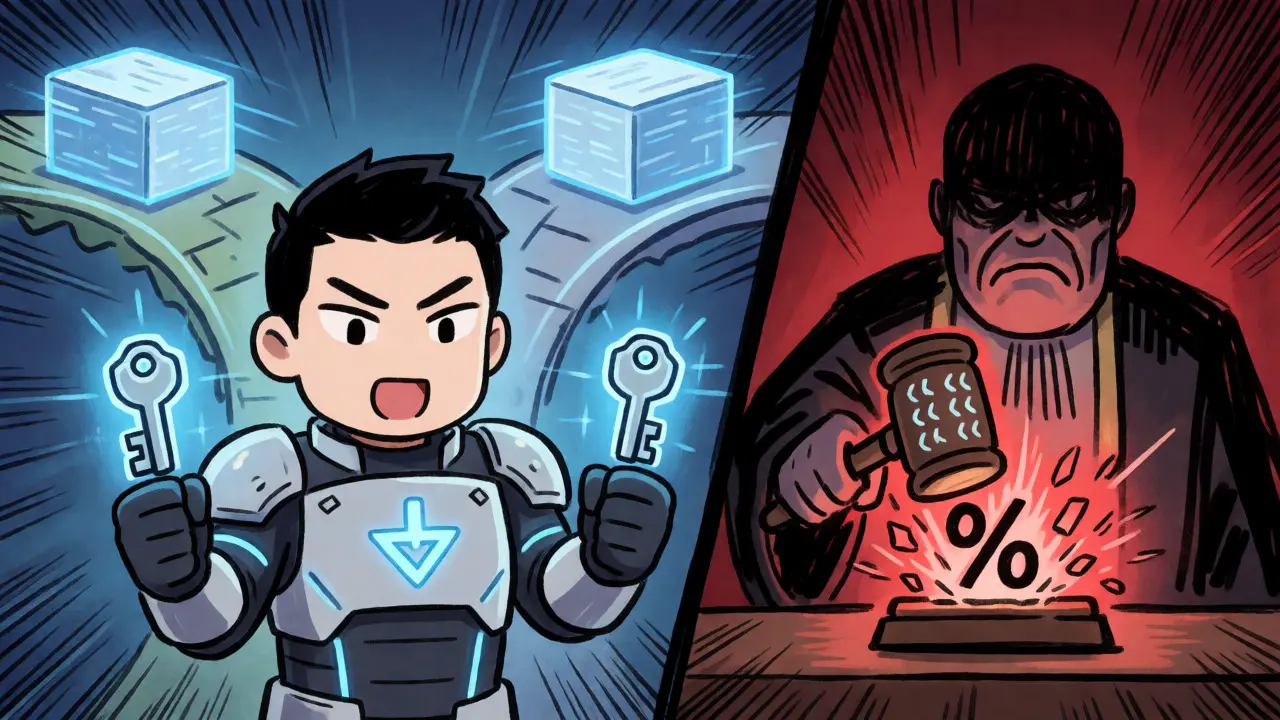
Double-signing occurs when a validator signs two different blocks at the same height using the same private key. Think of it as promising to pay someone with a check, then writing a second check for the same account balance before the first one clears. In a distributed system, this creates a fork-two conflicting versions of history.
Why is this so bad? Because if forks aren’t resolved quickly, the network loses finality. Users might send money based on one version of reality, only to have it reversed later. To prevent this, protocols impose harsh penalties.
On many chains, double-signing leads to immediate removal from the validator set (jail time) and a significant loss of stake. For example, on Cosmos, double-signing results in a 5% penalty of the total stake and permanent tombstoning (removal from the active set until governance intervenes). On Ethereum, the penalty is dynamic but can reach up to 100% of the validator’s effective balance, which is permanently burned.
It’s crucial to note that double-signing doesn’t always mean malice. It often happens due to technical errors, such as running two backup nodes simultaneously without proper coordination, causing both to sign the same block independently.
Downtime Slashing: The Cost of Being Offline
Downtime slashing is less severe than double-signing but still painful. Validators are expected to be online and responsive. If a validator fails to sign blocks within a specified window, they incur a penalty.
The rationale is simple: if too many validators go offline, the network becomes slow or halts entirely. Penalties ensure that validators maintain reliable infrastructure.
For instance, on BNB Chain, missing the minimum required blocks triggers a 10 BNB slash and a 2-day jail period. On Polkadot, isolated failures result in a small penalty (around 0.01%), while extended outages scale up significantly.
Unlike double-signing, downtime penalties are often proportional to the duration of the outage. Short blips might cost you a few dollars; a week-long outage could wipe out months of rewards.
Comparing Slashing Mechanisms Across Major Networks
Not all blockchains handle slashing the same way. Some burn tokens, others send them to a treasury. Some use fixed amounts, others use percentages. Here’s how the major players compare.
| Network | Double-Signing Penalty | Downtime Penalty | Fate of Slashed Funds | Reversibility |
|---|---|---|---|---|
| Ethereum | Up to 100% of effective balance (dynamic) | Small penalty per missed attestation | Burned (deflationary) | No (algorithmic) |
| Cosmos (SDK) | 5% of stake + Tombstone | 0.01% - 0.1% (varies by chain) | Burned | No (requires re-bonding) |
| Polkadot | Graduated (up to 100%) | Graduated (0.01%+) | Sent to Treasury | Potentially via Governance |
| BNB Chain | 200 BNB (~$44k) + 30-day jail | 10 BNB (~$2.2k) + 2-day jail | Burned | No |
Ethereum’s approach is strictly algorithmic. Once ETH is slashed, it’s gone forever. This creates strong disincentives but leaves no room for error correction. Polkadot’s model is more flexible. Since slashed DOT goes to the Treasury, the community can theoretically vote to return funds if the slashing was deemed unfair, though this is rare.
Who Pays the Price? Validators vs. Delegators
A common misconception is that only the validator operator suffers from slashing. In reality, the pain is shared. When a validator is slashed, delegators-people who staked their tokens with that validator-also lose a proportional amount of their stake.
This is critical for anyone using liquid staking protocols or staking pools. If you choose a validator with poor uptime or risky configurations, your returns take a hit. Studies show that a significant portion of negative reviews for staking services stem from unexpected slashing impacts. Delegators often remain unaware of the specific risks until the loss hits their wallet.
Therefore, choosing a validator isn’t just about yield; it’s about risk management. A validator offering 8% APY but prone to downtime might net you less than one offering 6% with perfect reliability.
How to Avoid Getting Slashed
Most slashing events are caused by human error or infrastructure failure, not malicious intent. Here are practical steps to protect your stake.
Implement Double-Signing Protection
Running high-availability setups (active-passive or active-active nodes) increases the risk of double-signing if keys aren’t locked properly. Services like Coinbase Cloud’s Double Signing Protection use hardware security modules or software locks to ensure that only one node can access the signing key at any given time. If the primary node fails, the backup takes over only after confirming the key is released. This reduces double-signing errors by nearly 99.8% in supported environments.
Maintain Robust Infrastructure
Downtime slashing punishes unreliability. Use redundant internet connections, multiple cloud providers (e.g., AWS and GCP), and automated monitoring systems. Set up alerts for missed blocks so you can intervene before penalties accumulate.
Keep Software Updated
Bugs in client software can lead to unintended double-signs or missed attestations. Always run the latest stable version of your node client. Join developer channels or forums to hear about critical patches immediately.
Understand Your Chain’s Specific Rules
Don’t assume knowledge transfers between chains. What works on Ethereum might fail on Cosmos. Read the official documentation for your specific network regarding jail periods, unbonding times, and penalty calculations.
The Future of Slashing: More Nuance Needed
Current slashing mechanisms are blunt instruments. They punish accidental mistakes almost as severely as deliberate attacks. As institutional adoption grows, there is pressure to refine these rules.
Upcoming upgrades, like Ethereum’s Dencun, aim to reduce false positives by refining slashing conditions. Other projects are exploring dynamic penalties that adjust based on network congestion or the severity of the offense. The goal is to maintain security without driving away competent operators who fear losing everything due to a momentary glitch.
For now, however, slashing remains a hard-coded reality. Treat your validator setup with the seriousness of a financial trading desk. Monitor it closely, secure your keys rigorously, and understand the stakes before you click "stake."
What is the difference between double-signing and downtime slashing?
Double-signing involves submitting two conflicting signatures for the same block height, threatening network consistency. It usually carries heavy penalties (e.g., 5-100% stake loss). Downtime slashing occurs when a validator is offline and misses signing duties. It typically incurs smaller, incremental penalties designed to encourage reliability rather than punish fraud.
Do delegators lose money if their validator gets slashed?
Yes. In most Proof-of-Stake networks, slashing penalties are applied to the total stake pool managed by the validator. This means both the validator operator and the delegators suffer proportional losses. If your validator is slashed, your staked principal decreases.
Can slashing be reversed?
Generally, no. On networks like Ethereum and Cosmos, slashed tokens are burned and cannot be recovered. On Polkadot, slashed funds go to the Treasury, where governance votes could theoretically reverse the decision, but this is an exception rather than the rule. Most slashing is final and automatic.
Why do validators double-sign if they don't want to lose money?
Double-signing is rarely intentional. It usually happens due to technical errors, such as running multiple backup nodes without proper key-locking mechanisms, software bugs, or network latency issues that cause a node to miss a heartbeat signal and restart incorrectly.
How much does downtime slashing cost on average?
Costs vary widely by network. On BNB Chain, a short downtime event costs 10 BNB (approx. $2,200). On Cosmos-based chains, it might be a fraction of a percent of the stake. On Ethereum, missed attestations result in small penalties that accumulate slowly. The exact cost depends on the chain's parameters and the duration of the outage.
Edward Ogunfolaju
September 2, 2026 AT 07:42Listen up! This is the wake-up call every validator needs to hear right now. You think you're safe because your node is running? Wrong. If you aren't using hardware security modules or proper key-locking software, you are one network blip away from losing your entire stake. Double-signing isn't just a technical glitch; it's financial suicide in PoS networks like Cosmos and Ethereum. Stop being lazy with your infrastructure. Set up redundant connections across different cloud providers immediately. If you don't monitor your missed blocks alert system, you will get slashed. It’s that simple. Protect your capital like your life depends on it because for many of us, it literally does. Get off your butt and audit your setup today.
liam & the bees
September 2, 2026 AT 09:49Great breakdown of the risks involved here. I’ve been running validators for a few years now, and I can tell you that the transition from PoW to PoS mindset is tricky. In Bitcoin, if you go offline, you just miss out on rewards. In PoS, going offline costs you actual money.
I always recommend beginners start with a managed service provider until they fully understand the slashing parameters of their chosen chain. It’s better to pay a small fee for safety than to lose 5% of your stake due to a configuration error. Also, don’t underestimate the importance of community support when things go wrong. Having a team or a reliable peer group can save you during those stressful moments when your node decides to act up.
Liam Grimes
September 3, 2026 AT 03:29yeah this is spot on. i lost some eth last year cause my vps had a memory leak and i didnt notice for 4 hours. painful but learned my lesson. use prometheus and grafana folks. dont trust your eyes, trust the graphs. also make sure your backup node is actually synced before you switch over or youll double sign. happened to me twice.
Matthew O'Neill
September 3, 2026 AT 19:34The article fails to address the systemic fragility introduced by centralized staking pools. When delegators blindly follow yield without analyzing validator infrastructure, we create single points of failure that threaten network consensus. Slashing is not merely an economic penalty; it is a necessary evolutionary filter for incompetent operators who lack the technical rigor required for distributed systems. The fact that Polkadot allows governance to potentially reverse slashing decisions introduces moral hazard, undermining the very concept of cryptographic finality. We must demand higher standards for validator qualification, not just rely on punitive measures after the fact.
Bill Patterson
September 4, 2026 AT 05:29too much jargon
just say keep ur server on
Dave Worth
September 4, 2026 AT 14:13They want you to think it's random but it's engineered volatility 📉🤯. Why do you think major exchanges push liquid staking so hard? They know most people won't check the uptime stats. It's a trap to centralize control while pretending it's decentralized. Watch closely... the next big slash event will be blamed on 'technical errors' but it'll be a coordinated attack on retail stakes. Keep your keys cold and your eyes open 👀🔒.
Ellie Brooks
September 6, 2026 AT 13:50This is such an incredibly important topic for anyone looking to dive into the world of cryptocurrency validation because so many newcomers really underestimate how volatile and unforgiving Proof-of-Stake mechanisms can be when compared to traditional mining operations where the worst case scenario is simply missing out on potential earnings rather than actively losing principal capital. I remember when I first started learning about this stuff I was terrified that I would accidentally double sign a block and lose everything overnight which kept me awake for weeks until I finally understood how the key management systems work and realized that with proper redundancy and monitoring tools like Grafana dashboards and automated alerts the risk becomes manageable and even predictable enough to sleep soundly at night knowing your investment is relatively secure against minor infrastructure hiccups that plague even the most experienced operators in the field.
Sean Dalton
September 8, 2026 AT 11:12Typical American oversimplification. You lot think buying a VPS makes you a tech wizard. Real infrastructure requires enterprise-grade redundancy that you probably can't afford. We've been doing this properly in Europe for years while you were still figuring out what a private key is. Don't lecture us on 'survival' when you're likely running your node on a home connection that drops every time it rains. Pathetic.
Valentine Okpala
September 8, 2026 AT 22:25it’s kinda funny how we treat these digital tokens like sacred relics yet panic when the code bites back 😅. maybe the harshness is exactly what keeps the humans honest though? chaos theory applied to finance 🌪️💸.
Kelechi Precious Nwachukwu
September 9, 2026 AT 20:36I respectfully disagree with the notion that downtime is merely a slap on the wrist. For small stakeholders in developing regions, a 2-day jail period represents a catastrophic loss of opportunity cost. The infrastructure gap means we cannot always guarantee 99.9% uptime due to power grid instability. Please consider implementing grace periods for validators in emerging markets. We are trying our best to participate in this global economy despite the hurdles. Respect the struggle.
Rajni Mathur
September 11, 2026 AT 17:32Respectfully submitted for consideration: The current model disproportionately penalizes those who lack access to premium institutional-grade hosting solutions. 🏢 Furthermore, the opacity surrounding specific slashing triggers often leads to undue anxiety among novice validators. 🧐 It is imperative that documentation remains accessible and clear. 📚 Thank you for bringing this critical issue to light. 🙏
Carey Thornton
September 12, 2026 AT 07:16Oh, look, another breathless article explaining basic cryptography to the masses as if discovering fire. The pretense that this is complex is adorable. Any competent engineer knows that state machines handle equivocation deterministically. But please, continue to marvel at the 'feature' called slashing. It’s charming how you all act surprised that rules apply to everyone equally. Truly poetic tragedy for the uninitiated.
Edward Ogunfolaju
September 12, 2026 AT 12:44@Bill Patterson You couldn't be more wrong if you tried. 'Keep ur server on' ignores the complexity of active-passive failovers. If you don't lock your keys, turning your server on causes double signing. That’s why experts exist. Do your homework before dismissing the mechanics.
Rachel Etheridge
September 12, 2026 AT 15:00omg yes!!! i was so scared to stake at first thinking i’d lose everything instantly!! but honestly once you set up the alerts its totally fine?? like its scary but exciting?? we got this!! 💪✨
Matthew O'Neill
September 13, 2026 AT 10:21@Sean Dalton Your nationalist posturing is irrelevant to protocol design. Consensus algorithms do not recognize borders. A validator in Dublin has the same responsibility as one in Dallas. If your infrastructure fails, you get slashed. Period. Stop confusing geopolitical identity with technical competence.