El Salvador Bitcoin Tax Rules: Zero Capital Gains & New Restrictions Explained

Imagine selling your Bitcoin is a decentralized digital currency that operates independently of a central bank for a massive profit and paying absolutely zero tax on it. For years, this was the headline promise of El Salvador is a country in Central America that adopted Bitcoin as legal tender in 2021. Since September 2021, under President Nayib Bukele, the nation has positioned itself as the world’s first Bitcoin-friendly jurisdiction with a radical policy: no capital gains tax on Bitcoin transactions.
But here is the catch. The landscape shifted dramatically in late 2024 and early 2025. While the core tax exemption remains, new restrictions and regulatory changes have reshaped what this actually means for investors and businesses. If you are looking to move money, start a business, or simply understand where your assets stand, you need to know more than just the "no tax" headline. You need to understand the rules, the licenses, and the recent political compromises that define the current reality.
The Core Policy: Zero Capital Gains Tax
At its heart, El Salvador’s appeal lies in its Digital Assets Law is legislation passed by El Salvador recognizing Bitcoin as legal tender and establishing tax exemptions. This law explicitly exempts Bitcoin transactions from capital gains tax. Whether you are a local resident or a foreign investor, if you realize a gain from buying and selling Bitcoin, that profit is not taxed by the Salvadoran government.
This isn't just a small perk. It positions El Salvador as a unique Bitcoin tax haven is a jurisdiction offering favorable tax treatment for cryptocurrency holdings and transactions in a global landscape where most countries aggressively tax crypto profits. For foreign investors, there is an even bigger incentive: if you invest over ₿3 (three Bitcoin) in the country, you become eligible for complete capital gains tax exemption on your Bitcoin profits. This threshold is designed to attract serious institutional players and high-net-worth individuals who want to park their digital assets in a stable, friendly environment.
However, "no capital gains tax" does not mean "no taxes at all." You still need to navigate the broader fiscal framework. While the gain itself is exempt, other financial activities might incur costs. Understanding the distinction between capital gains and other potential liabilities is crucial for compliance.
Regulatory Framework: CNAD and Licensing
You cannot operate freely without oversight. The National Commission of Digital Assets (CNAD) is the primary regulatory body in El Salvador overseeing cryptocurrency operations and issuing licenses serves as the gatekeeper for all crypto-related activities. To do business legally, you must obtain the correct license. There are two distinct types, and mixing them up can lead to significant legal headaches.
- Bitcoin Service Provider (BSP): This license is for companies dealing exclusively with Bitcoin. It covers payment processing, custodial wallets, non-custodial wallets, and Bitcoin exchanges. If your business only touches BTC, this is your path.
- Digital Asset Service Provider (DASP): This applies to businesses handling other cryptocurrencies or digital assets. This includes non-Bitcoin exchanges, wallets for altcoins, token issuance, NFTs, and investment services.
Getting licensed is not automatic. You must meet specific criteria established by the CNAD. This includes maintaining clear and accurate records, reporting all activities to both the CNAD and the Ministry of Finance, and preparing annual financial statements. Even though you pay no capital gains tax, you are still subject to strict transparency requirements. You must also fulfill Anti-Money Laundering (AML) and Know Your Customer (KYC) obligations. The government wants clean money; they don't want to be a haven for illicit funds, regardless of the tax benefits.
Business Incentives and the LEAD Program
For entrepreneurs, the tax breaks extend beyond individual capital gains. The LEAD program is an economic development initiative in El Salvador offering tax exemptions for innovative businesses provides substantial incentives for crypto businesses. Companies operating under this framework enjoy exemptions from corporate income tax, services transfer tax, and municipal taxes.
If you are a foreign investor, the perks stack up further. You benefit from exemptions on import duties for equipment and technology needed to run your operation. More importantly, you pay no income tax on earnings generated outside El Salvador. However, be careful: domestic earnings-money made within El Salvador's borders-are still subject to local tax regulations. The zero-tax promise is powerful, but it has geographic boundaries.
Looking ahead, the government’s ambitious Bitcoin City is a proposed geothermal-powered city in El Salvador dedicated entirely to Bitcoin mining and trading project promises an even deeper level of freedom. Once fully operational, it aims to be a complete tax haven with no taxes on income, property, purchasing, or emissions. Until then, current laws apply.

The IMF Agreement and Recent Restrictions
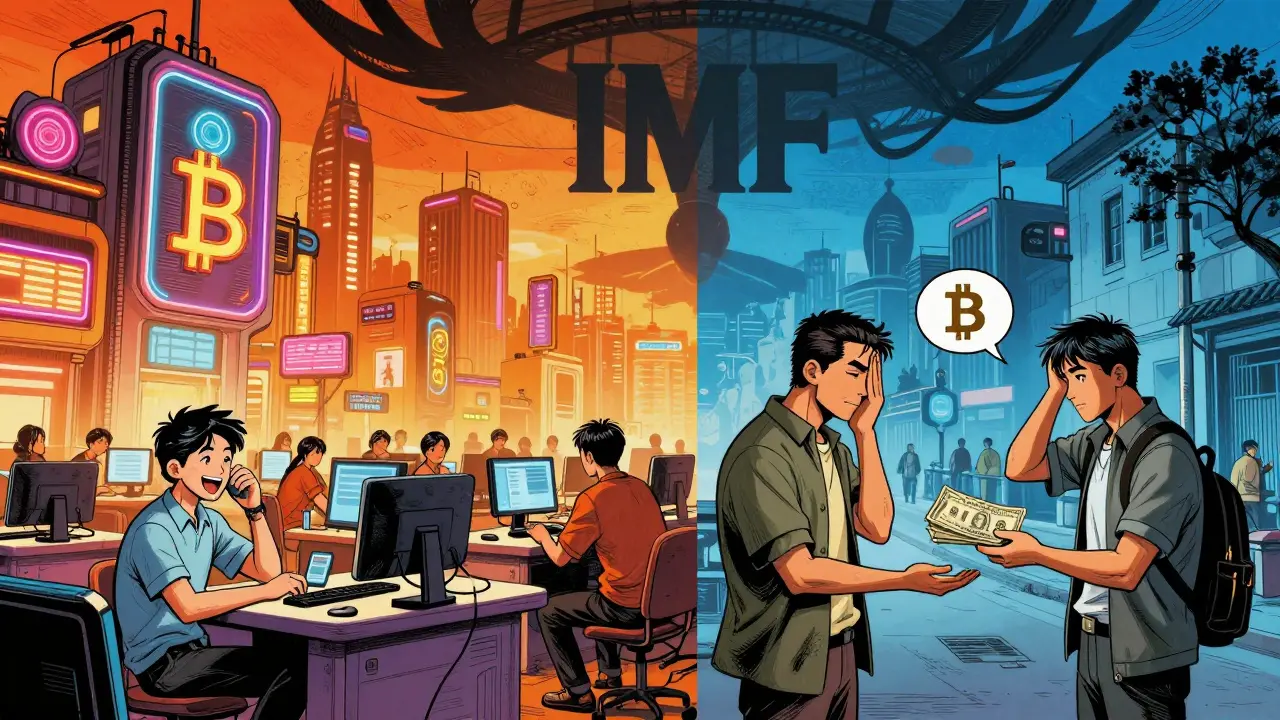
Here is where the story gets complicated. In December 2024, El Salvador entered into a $1.4 billion loan agreement with the International Monetary Fund (IMF) is an international organization working to foster global monetary cooperation and secure financial stability. This deal required significant concessions from the Bukele administration. An amendment to the Bitcoin law was passed in February 2025 to align with these conditions.
What changed? The government had to roll back several aggressive pro-Bitcoin mandates:
- Reduced Government Purchases: The state will buy fewer Bitcoin reserves than previously planned.
- No Mandatory Acceptance: Merchants are no longer legally forced to accept Bitcoin. They can choose to use US Dollars instead without penalty.
- No Tax Payments in Bitcoin: Citizens can no longer pay taxes using Bitcoin. All tax payments must be made in fiat currency.
- Chivo Wallet Wind-Down: The state-sponsored Chivo wallet app is being phased out of active promotion and support.
Despite these shifts, the core capital gains tax exemption on Bitcoin transactions remains intact. The IMF did not demand the removal of the tax break, likely because it attracts foreign capital. However, the removal of mandatory acceptance signals a retreat from forcing adoption onto the general population. For you, the investor, this means less friction in daily life but potentially less liquidity in local markets.
Adoption Reality: The Numbers Don't Lie
Policies look good on paper, but do people actually use Bitcoin? Data from the Instituto Universitario de Opinión Pública (Iudop) is a public opinion research institute at Universidad Centroamericana José Simeón Cañas (UCA) reveals a stark decline in domestic usage. When Bitcoin became legal tender in 2021, 25.7% of Salvadorans used it. By 2022, that dropped to 21%. In 2023, it fell to 12%, and by 2024, only 8.1% of the population was actively using Bitcoin.
Why the drop? Volatility, technical glitches with the Chivo wallet, and simple preference for the stability of the US Dollar (which has been El Salvador's official currency since 2001) play major roles. While the government’s own Bitcoin holdings saw a 50% profit by March 2024 when prices hit new highs above $69,000, the average citizen found the risk too high for daily grocery shopping.
This trend suggests that El Salvador’s Bitcoin strategy is increasingly focused on foreign investment and institutional adoption rather than mass retail usage among locals. For you, this means the ecosystem is maturing into a professional financial hub rather than a grassroots community experiment.
Global Context: How El Salvador Compares
El Salvador is not alone in offering tax-friendly environments, but its approach is unique. Here is how it stacks up against other jurisdictions known for crypto-friendliness in 2025:
| Country/Jurisdiction | Tax Treatment | Key Features | Best For |
|---|---|---|---|
| El Salvador | Zero capital gains on Bitcoin | Legal tender status, CNAD licensing, LEAD incentives | Bitcoin-only investors, long-term holders |
| Cayman Islands | No income, capital gains, or corporate tax | Strong privacy, established financial hub | Crypto funds, traders, wealth management |
| UAE | Zero tax on all crypto activity | Clear regulation across all emirates, modern infrastructure | Exchanges, Web3 startups, tech companies |
| Germany | Zero tax after 12-month holding period | EU member, strong legal protections | Long-term HODLers, European residents |
| Portugal | Tax-free for long-term gains (NHR program) | Expatriate-friendly, EU access | Digital nomads, remote workers |
Notice the difference? Germany and Portugal offer conditional exemptions based on time or residency status. The Cayman Islands and UAE offer broad exemptions for all crypto. El Salvador is distinct because it specifically targets Bitcoin as legal tender. If you hold Ethereum or Solana, El Salvador’s special legal tender status doesn't apply to them in the same way, though the DASP license allows you to trade them with similar tax benefits under the LEAD program.
Practical Steps for Investors and Businesses
If you are considering leveraging El Salvador’s tax framework, follow these steps to ensure compliance and maximize benefits:
- Determine Your License Type: Are you dealing only with Bitcoin? Apply for a BSP license. Handling other assets? You need a DASP license. Do not guess; consult with a local legal expert familiar with CNAD requirements.
- Set Up Accounting Systems: Even with zero capital gains tax, you must track every transaction. Maintain detailed records for AML/KYC compliance. Use software that can generate reports compatible with Salvadoran financial standards.
- Check Foreign Investment Thresholds: If you are a foreigner, consider reaching the ₿3 investment threshold to lock in the full capital gains exemption. This requires significant upfront capital but offers long-term tax efficiency.
- Monitor Regulatory Updates: The landscape is fluid. With the recent IMF agreement, expect further adjustments. Subscribe to updates from the CNAD and follow reputable news sources covering El Salvador’s economic policy.
- Evaluate Domestic vs. Foreign Income: Ensure you understand which income streams are taxable. Earnings generated outside El Salvador are tax-exempt for foreigners, but domestic revenue may face different rules.
Avoid the pitfall of assuming "no tax" means "no rules." The regulatory burden is real. Non-compliance with CNAD reporting can result in fines, license revocation, or worse. The tax break is a reward for playing by the book, not a loophole for ignoring it.
Future Outlook: Viability and Risks
Is El Salvador’s model sustainable? The long-term viability of the zero capital gains tax policy depends on evolving international relationships. The 2024-2025 IMF modifications show that the government is willing to compromise on operational aspects (like mandatory merchant acceptance) to preserve financial stability and maintain access to international credit. The fact that the capital gains exemption survived this negotiation suggests it is viewed as a valuable tool for attracting foreign direct investment.
Risks remain. Political changes, further pressure from international bodies, or a severe downturn in Bitcoin’s price could impact the government’s ability to maintain these incentives. Additionally, the declining domestic adoption rate indicates that the local economy has not fully integrated Bitcoin into daily life. The success of Bitcoin City will be a key indicator of whether the country can pivot successfully toward a specialized crypto-economy.
For now, El Salvador stands as a bold experiment in monetary sovereignty. It offers unparalleled tax advantages for Bitcoin holders, provided you are willing to navigate a complex regulatory environment and accept the inherent volatility of the asset class. It is not a get-rich-quick scheme, but a strategic location for those who believe in Bitcoin’s long-term future.
Is Bitcoin really tax-free in El Salvador?
Yes, specifically regarding capital gains. The Digital Assets Law exempts profits from Bitcoin transactions from capital gains tax. However, other taxes like VAT may apply depending on the service, and businesses must comply with strict reporting and licensing requirements through the CNAD.
Do I need a license to trade Bitcoin in El Salvador?
If you are operating a business, yes. You must obtain either a Bitcoin Service Provider (BSP) license for Bitcoin-only operations or a Digital Asset Service Provider (DASP) license for other cryptocurrencies. Individual personal trading does not require a license, but large-scale or commercial activities do.
How did the IMF agreement change Bitcoin rules in El Salvador?
The 2024 IMF agreement led to amendments in 2025 that removed the mandatory requirement for merchants to accept Bitcoin, stopped the government from buying Bitcoin aggressively, ended tax payments in Bitcoin, and wound down the Chivo wallet. Crucially, the zero capital gains tax exemption for investors remained unchanged.
Can foreigners benefit from El Salvador's Bitcoin tax laws?
Absolutely. Foreign investors are eligible for the zero capital gains tax on Bitcoin. Those investing over ₿3 receive complete exemption on Bitcoin profits. Additionally, foreign earners pay no income tax on money generated outside of El Salvador, making it attractive for international digital asset managers.
Why has Bitcoin adoption declined among Salvadorans?
Usage dropped from 25.7% in 2021 to 8.1% in 2024 due to factors like price volatility, technical issues with the state-sponsored Chivo wallet, and a strong cultural preference for the stability of the US Dollar. Most citizens prefer using dollars for daily transactions despite Bitcoin's legal tender status.
trisya hazriyana
May 30, 2026 AT 08:31look at this mess of regulatory theater. zero cap gains sure sounds nice until you realize the CNAD is basically a toll booth for your freedom. they want your money but not your soul apparently. or maybe just your compliance paperwork. typical state apparatus trying to co-opt decentralized tech into their little bureaucratic sandbox.
the irony is palpable when you consider they forced merchants to accept it then backed down because the IMF told them to stop being 'too radical'. now its just another tax haven with extra steps. dont get me started on the chivo wallet wind-down. that was always going to be a disaster waiting to happen.
but hey if you have three bitcoin to burn go ahead and play house in san salvador. just remember the rules change whenever bukele feels like making a deal with the devil. i mean the imf. same thing really.
Debbie Lewis
May 31, 2026 AT 06:23i read through the whole thing and honestly it seems pretty straightforward for those who know what they are doing. the key takeaway for me is that while the tax break is real the licensing requirements are no joke.
if you are thinking about moving there just make sure you understand the difference between a bsp and dasp license. getting that wrong could cost you more than any tax savings would cover. also good to see the adoption numbers dropping among locals which makes sense given the volatility. most people just want stability for buying groceries not gambling on daily transactions.
Eric Grosso
June 1, 2026 AT 02:03so wait does this mean i can just move there and pay no taxes on my crypto gains? or do i need to actually live there? the part about the 3 bitcoin threshold is kinda wild. thats like 200k+ right now. seems like a high barrier for entry for regular folks.
also why did they stop accepting btc for taxes? that seemed like the whole point of legal tender status. feels like a step back even if the imf forced their hand. curious how long this current setup will last before something else changes.
Edith Mair
June 1, 2026 AT 14:57stop acting surprised that the imf intervened. every country that tries to go rogue with monetary policy eventually gets put in its place by global financial institutions. el salvador thought they could bypass the system but debt is debt.
the fact that they had to roll back mandatory merchant acceptance proves that forcing adoption doesn't work. you cant mandate trust or utility. the drop from 25% to 8% usage shows exactly what happens when you ignore economic reality.
people still prefer dollars because dollars dont crash 20% overnight. until bitcoin solves the volatility issue it will remain a speculative asset not a currency. the tax breaks are irrelevant if the underlying asset is too risky for daily use. wake up.
Sam Dashti
June 2, 2026 AT 01:33oh come on edith lighten up a bit. yeah the imf stepped in but look at the bright side. we still have zero capital gains tax on bitcoin. that is huge! most countries treat crypto like a dirty secret but here it is openly embraced as legal tender.
sure the local adoption dropped but who cares? the goal was never really to buy avocados with satoshis anyway. it was about creating a hub for foreign investment and institutional players. and guess what? they are coming. the lead program incentives are fantastic for businesses.
plus imagine living in a city powered by geothermal energy dedicated entirely to mining. that sounds like a sci-fi dream come true. don't let the doom and gloom cloud the potential. innovation always faces resistance but history favors the bold.
Joe Clements
June 3, 2026 AT 13:48hey sam i totally get your excitement but i think edith has a valid point about the risks. it is important to balance the optimism with caution.
the regulatory framework is complex and changing fast. one day you are compliant the next day the rules shift because of an international loan agreement. for small investors this uncertainty can be scary.
that said i appreciate that the author laid out the steps clearly. knowing you need a bsp or dasp license helps avoid costly mistakes. maybe we should focus on how to navigate these changes rather than arguing about whether it is doomed or destined for greatness. both sides have merit.
Rosie Morris
June 4, 2026 AT 15:59i feel like everyone is missing the forest for the trees. yes the regulations are strict and yes the imf made them compromise but the core promise remains intact. zero tax on bitcoin gains. period.
for me the biggest win is the clarity around licensing. knowing exactly what i need to do to operate legally gives me peace of mind. i spent weeks researching this before deciding to set up my wallet business there.
it is not perfect but it is better than paying 30% in capital gains back home. i am willing to deal with the cnad reporting requirements for that benefit. just wish the chivo app worked better for everyday stuff but whatever. progress takes time.
lorna erni
June 5, 2026 AT 14:22listen up everyone. if you are serious about this you need to act now. the window of opportunity is closing fast. once other countries catch on and start taxing crypto aggressively el salvador will be flooded with applicants.
do not wait for the perfect moment because it will never come. get your license sorted. hit that 3 bitcoin threshold if you can. lock in those exemptions.
and stop complaining about the imf. they left the tax breaks alone because they know it brings in cash. use that leverage. be aggressive in your planning. consult experts. do not rely on reddit advice. take control of your financial destiny before someone else tells you what to do.
stalin brian
June 6, 2026 AT 04:08lorna is right about taking action but please dont rush into things without proper guidance. i have seen too many people lose money because they skipped due diligence.
the cultural aspect is also important. el salvador is a unique place with rich history and community spirit. integrating there means respecting local norms even if you are there for the crypto benefits.
my advice is to find a good local mentor or lawyer who understands both the cnad rules and the social landscape. they can help you navigate the nuances that articles like this might miss. patience and preparation will serve you better than haste.
kamal ifrani
June 7, 2026 AT 20:28this entire experiment is a moral failure disguised as financial innovation. el salvador is becoming a playground for wealthy elites to hide their assets while the average citizen suffers from inflation and instability.
the fact that domestic usage collapsed to 8% proves that the government failed its own people. instead of helping the poor they catered to foreign speculators.
and now they are bowing to the imf like puppets. where is the sovereignty? where is the dignity? it is all just smoke and mirrors. the so-called tax haven is built on the backs of vulnerable populations who were promised prosperity but got nothing but volatility. shame on anyone supporting this model.