EUNEX Crypto Exchange Review: Is It Real or a Scam? (2026 Analysis)

You’ve heard about EUNEX, maybe from a social media ad, a forum post, or a friend’s recommendation. The promise sounds good: low fees, fast trades, and easy access to your favorite coins. But when you actually try to find a solid, independent review of EUNEX, the internet goes quiet. That silence is not an accident. In the world of cryptocurrency, where trust is everything, a lack of information is often the biggest red flag you can see.
As of mid-2026, there is virtually no credible data on an exchange called "EUNEX." No regulatory filings in major jurisdictions like the US or EU, no presence on trusted tracking sites like CoinMarketCap or CoinGecko, and no substantial user reviews on platforms like Trustpilot. This doesn’t necessarily mean it’s a fake site right this second, but it does mean you are walking into uncharted territory with your hard-earned money. Before you deposit a single cent, we need to break down what might be happening here, look at similar-sounding exchanges that actually exist, and give you the tools to spot a potential scam before it spots you.
The Mystery of EUNEX: Why Can’t We Find It?
When you search for a well-established crypto exchange like Binance, Coinbase, or Kraken, you get millions of results. You see news articles, technical analyses, and community discussions. For EUNEX, the search results are sparse, confusing, or completely unrelated. This absence suggests three possibilities:
- It is brand new: Launched recently with zero marketing budget and zero user base. New exchanges have a high failure rate because they struggle with liquidity (enough buyers and sellers) and security audits.
- It is a clone or impersonator: Many scams copy the names of legitimate platforms or create slight variations (like EUNEX instead of YunEx) to catch users who aren’t paying close attention.
- It is a localized or niche platform: It might operate only in a specific region with very little English-language footprint, which limits its accessibility and reliability for global traders.
In any of these cases, the risk is high. Without a track record, you have no way to know if their servers will stay online during market volatility or if they actually hold your funds in cold storage. Let’s look at what happens when we dig deeper into the entities that sound like EUNEX.
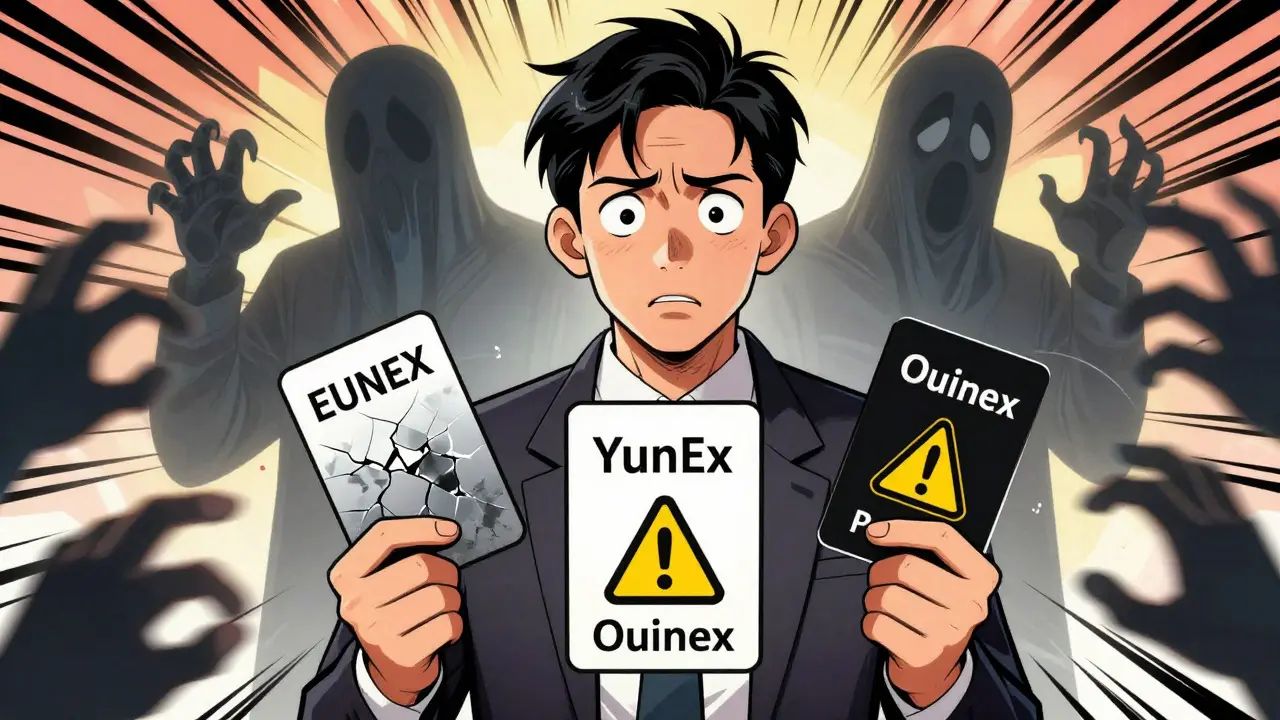
Don’t Confuse EUNEX with YunEx or Ouinex
A common trap for new investors is mistaking a obscure name for a known one. Two platforms share phonetic similarities with EUNEX: YunEx is a cryptocurrency exchange launched in January 2018 that offers trading in Bitcoin, Ethereum, Litecoin, Bitcoin Cash, USDT, and Snetwork. And Ouinex is a newer platform positioning itself as a leader in transparent fee structures and SocialFi rewards.
YunEx has been around since 2018. It charges a flat 0.20% trading fee, which is slightly better than the industry average of 0.25%. However, it has an unusual restriction: it supports credit card deposits but famously rejects wire transfers. For many serious traders, the inability to use bank wires is a dealbreaker because it limits how much capital you can move efficiently. YunEx also has a relatively small selection of assets compared to giants like Kraken or Binance.
Ouinex, on the other hand, is pushing hard in 2025 and 2026 with a different value proposition. They offer a flat 0.10% spot trading fee and a "no-CLOB engine" designed to reduce slippage. Slippage is the difference between the expected price of a trade and the price at which the trade is executed. High slippage eats into your profits, especially during volatile markets. Ouinex also allows you to trade stocks, forex, and crypto in one account without converting to fiat currency first. This multi-asset approach is becoming popular, but it adds complexity. Are you trusting one company with your entire financial portfolio? That’s a big ask.
| Platform | Launch Year | Trading Fee | Key Feature | Risk Level |
|---|---|---|---|---|
| EUNEX | Unknown | Unknown | Lack of transparency | High |
| YunEx | 2018 | 0.20% | No wire transfers | Medium |
| Ouinex | Recent | 0.10% | SocialFi rewards, Multi-asset | Medium-High |
| Kraken | 2011 | 0.16% - 0.26% | Regulated, High Security | Low |
Red Flags: How to Spot a Fake Exchange
If EUNEX is indeed a new or lesser-known entity, you need to treat it with extreme caution. Here are the specific signs that indicate an exchange might be fraudulent or unsafe:
- No Regulatory Licenses: Legitimate exchanges register with financial authorities. In the US, they file with the FinCEN as a Money Services Business (MSB). In Europe, they comply with MiCA regulations. If EUNEX claims to be "globally regulated" but lists no specific license numbers or issuing bodies, run away.
- Anonymity of Founders: Who runs the show? If the team page features stock photos and generic names like "John Smith" or "Alex Crypto," that’s a bad sign. Real companies have LinkedIn profiles, public speaking records, and verifiable histories.
- Guaranteed Returns: Crypto is volatile. If an exchange promises you fixed daily returns (e.g., "Earn 2% daily!"), it is almost certainly a Ponzi scheme. They pay early users with money from new users until the pool dries up.
- Poor Website Quality: Look for broken links, grammatical errors, and slow loading times. A professional financial institution invests heavily in UX/UI design. A scam site often looks rushed.
- Aggressive Marketing: If you’re being bombarded by DMs on Telegram or Instagram promising exclusive access to EUNEX, be skeptical. Legitimate brands build organic communities; scams buy fake followers.
Better Alternatives for Safe Trading in 2026
Why risk your capital on an unknown platform when established, audited, and regulated exchanges offer competitive services? The landscape in 2026 is crowded with options that prioritize security and transparency.
Kraken remains a top choice for security-conscious traders. Founded in 2011, it has never been hacked. Their fees are tiered based on volume, starting around 0.16% for makers. They offer extensive educational resources and robust customer support. If you want peace of mind, Kraken is a strong contender.
Coinbase Advanced Trade is ideal for beginners who want simplicity. While their basic interface has higher fees, the Advanced Trade section brings costs down significantly. Being publicly traded (NASDAQ: COIN) means they undergo strict financial reporting, adding a layer of accountability that private exchanges like EUNEX likely lack.
Binance still dominates in terms of liquidity and asset variety. Despite past regulatory hurdles, they have improved compliance globally. If you need to trade obscure altcoins or use advanced derivatives, Binance’s ecosystem is unmatched. Just ensure you are using the correct regional version (e.g., Binance.com vs. Binance.US).
Gemini is another excellent option, particularly for US-based users. Co-founded by the Winklevoss twins, Gemini holds licenses in multiple states and offers insurance on USD holdings. Their fee structure is straightforward, and their focus on institutional-grade security makes them a reliable partner for long-term holding.
Security Best Practices Regardless of Platform
Even if you decide to take a chance on a smaller exchange, or stick with a major one, your personal security habits matter most. The exchange is just a gateway; your wallet is your bank.
- Enable 2FA Immediately: Use an authenticator app like Google Authenticator or Authy. Avoid SMS verification if possible, as SIM-swapping attacks are common against high-balance accounts.
- Use Cold Storage: Don’t leave large amounts of crypto on any exchange. Transfer your long-term holdings to a hardware wallet like Ledger or Trezor. These devices keep your private keys offline, making them immune to online hacks.
- Verify URLs: Phishing sites mimic real exchanges. Always bookmark the official URL and type it in manually. Never click links from emails or messages claiming to be from your exchange.
- Start Small: If testing a new platform, deposit only what you can afford to lose. Withdraw it successfully before committing larger sums. This tests both the deposit and withdrawal processes.
Final Verdict on EUNEX
So, should you trade on EUNEX? Based on the current lack of information, regulatory visibility, and user feedback, the answer is a cautious no. The crypto market is mature enough in 2026 that you don’t need to gamble on obscurity. Established players like Kraken, Coinbase, and Binance offer lower risks, better liquidity, and proven security records. If EUNEX eventually gains traction, publishes its audit reports, and secures proper licensing, it might deserve a second look. Until then, protect your capital by sticking to platforms with a clear history and transparent operations.
Is EUNEX a scam?
While there is no definitive proof that EUNEX is a scam, the complete lack of verifiable information, regulatory licenses, and user reviews makes it highly suspicious. In the crypto world, anonymity often equals risk. Treat it as potentially fraudulent until proven otherwise.
What is the difference between EUNEX and YunEx?
They appear to be completely different entities. YunEx is a known exchange launched in 2018 with specific fee structures and supported coins. EUNEX has no clear digital footprint. Do not confuse the two, as investing in EUNEX carries significantly higher uncertainty than YunEx.
Which crypto exchange is safest in 2026?
Kraken and Coinbase are widely considered among the safest due to their long track records, regulatory compliance, and strong security measures. Kraken has never been hacked, and Coinbase is a publicly traded company subject to financial audits.
How do I check if a crypto exchange is legitimate?
Check for regulatory licenses (FinCEN, MiCA), read independent reviews on Trustpilot and Reddit, verify the identity of the founding team, and look for third-party security audits. If any of these are missing, proceed with extreme caution.
Can I withdraw my money from EUNEX easily?
Without user testimonials confirming successful withdrawals, it is impossible to say. Many scam exchanges allow small initial withdrawals to build trust before freezing larger amounts. Always test the withdrawal process with a small amount first.