FinCEN Registration Requirements for Crypto Exchanges: What You Need to Know in 2026
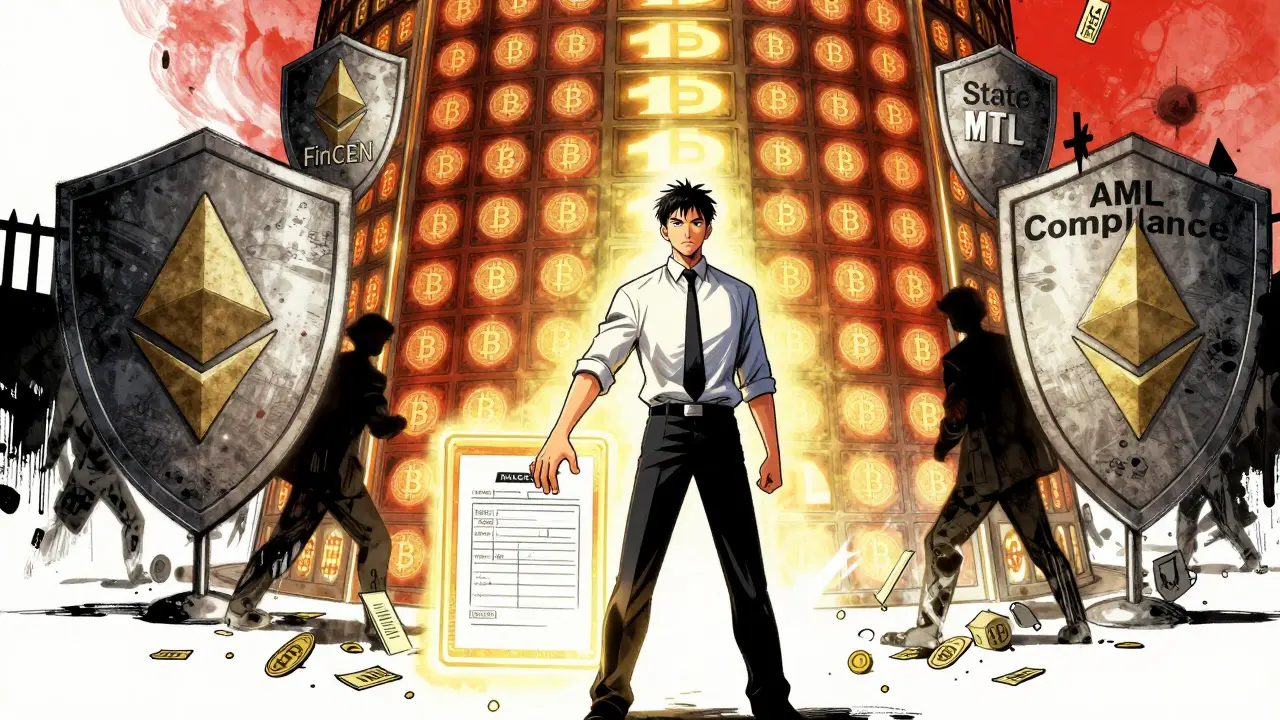
If you run a cryptocurrency exchange in the U.S., you’re not just running a tech platform-you’re running a financial institution. The FinCEN registration requirements for crypto exchanges aren’t optional. They’re mandatory, and failing to comply can mean fines, shutdowns, or even criminal charges. This isn’t about bureaucracy-it’s about survival in a regulated market.
Who Exactly Needs to Register?
Not every crypto business needs to register with FinCEN. But if your platform lets users trade Bitcoin for dollars, send Ether to another person, or hold funds on their behalf, you’re doing money transmission. That triggers the requirement. FinCEN classifies these businesses as Money Services Businesses (MSBs). This includes:- Centralized exchanges that convert crypto to fiat (like USD) or crypto to crypto
- Custodial wallet providers that hold users’ private keys
- Crypto payment processors that settle transactions in real time
- Any service that moves value on behalf of others, even if it doesn’t charge fees
Even if you restrict third-party deposits or block peer-to-peer transfers, you still need to register. The rule isn’t about what you allow-it’s about what you do. If your platform moves value that substitutes for currency, FinCEN sees you as a money transmitter.
FinCEN Registration Is Not a License
This is where most people get confused. FinCEN doesn’t issue licenses. It doesn’t give you a certificate you can hang on the wall. Instead, you register as an MSB through the FinCEN Electronic Filing System (FinCEN BSA E-Filing). You submit your business details, ownership structure, and compliance plan. Once approved, you’re on the public registry-but your work is just beginning.Registration is just the entry ticket. The real cost comes from what follows: ongoing AML and CFT compliance. You must have systems in place to:
- Verify customer identities (KYC)
- Monitor transactions for suspicious patterns
- Keep records of all transactions for five years
- File Suspicious Activity Reports (SARs) when something looks off
FinCEN doesn’t tell you how to build these systems. But if you get audited and can’t prove they work, you’re in trouble. In 2023, FinCEN fined a crypto exchange $10 million for failing to file SARs on over 1,200 suspicious transactions-even though the exchange claimed it didn’t know what to look for.
State Licenses Are Just as Important
Federal registration is only half the battle. Every state has its own rules. If you want to operate in California, you need a Money Transmitter License (MTL) from the DFPI. In New York, you need a BitLicense. In Texas, you need another MTL. And if you’re missing even one, you’re operating illegally in that state.There are 50 states, plus D.C. and U.S. territories. That means up to 53 different licenses. The fees range from $5,000 to $50,000 per state. The review process can take 6 to 18 months. Many small exchanges skip this entirely-and get shut down.
Some companies avoid this mess by partnering with licensed money transmitters. They use the partner’s license to operate under their umbrella. But that comes with trade-offs: you pay a cut of revenue, lose control over customer data, and can’t scale independently. It’s a workaround, not a solution.
What Happens If You Don’t Register?
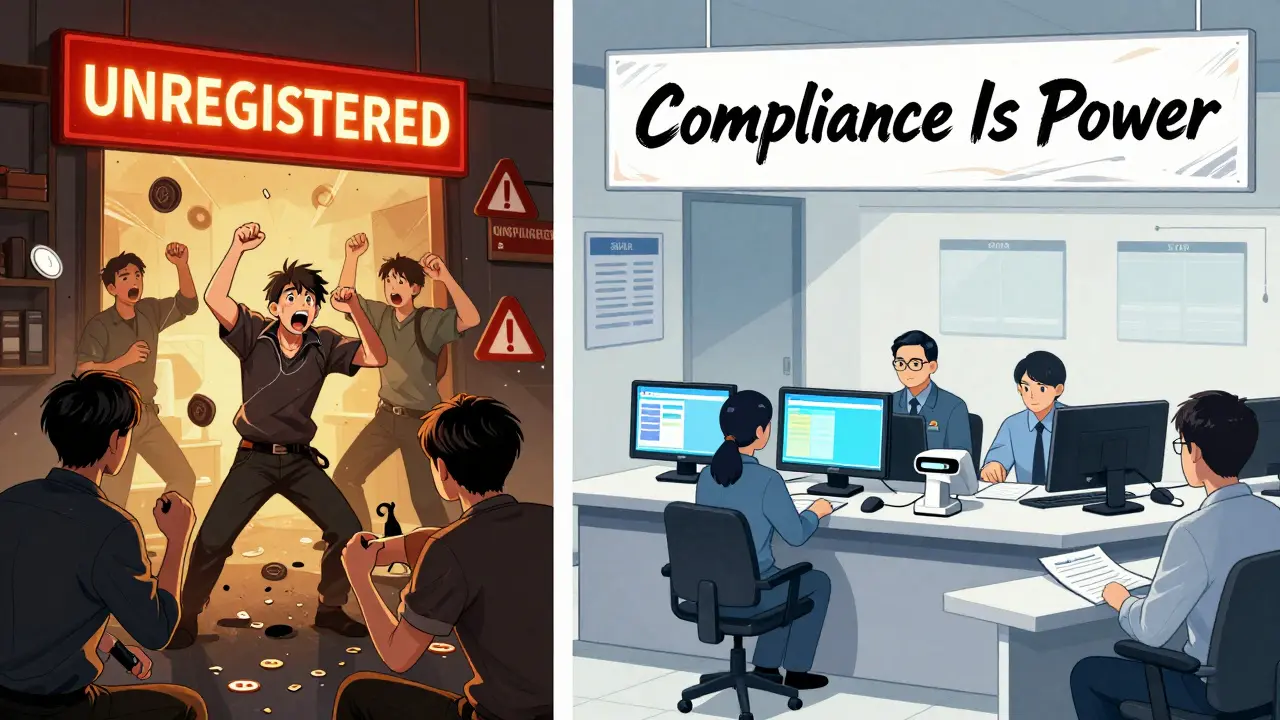
The penalties aren’t just financial-they’re personal. In 2022, the CEO of a crypto exchange that never registered with FinCEN was sentenced to 18 months in federal prison. The company processed $18 million in transactions without any KYC or AML controls. The court didn’t care that he thought crypto was “too new to be regulated.” He was held responsible under the Bank Secrecy Act, which has been around since 1970.FinCEN doesn’t warn you first. They don’t send a polite letter. They investigate, gather evidence, and file civil or criminal charges. Fines can hit millions. Personal liability is real. Executives, not just companies, can be prosecuted.
And it’s not just FinCEN. The SEC may come after you for unregistered securities. The CFTC may accuse you of violating commodity trading rules. The IRS may audit your tax filings. The state attorney general may sue you for consumer fraud. One unregistered exchange can face legal action from five different agencies at once.
The New Rules Coming in 2026
FinCEN isn’t slowing down. In late 2024, it finalized a proposed rule that expands its reach to unhosted wallets-wallets not controlled by any exchange or custodian. If you facilitate a transaction between a user’s wallet and an exchange, and that wallet is in a high-risk jurisdiction (like certain offshore crypto hubs), you now have to report it.This rule reclassifies convertible virtual currencies as “monetary instruments” under the Bank Secrecy Act. That means Bitcoin and Ethereum are now treated like cash in terms of reporting. Any transaction over $3,000 involving these assets must be documented. Over $10,000? You must file a Currency Transaction Report (CTR), just like a bank.
It’s a massive shift. Before, only fiat-to-crypto trades were heavily monitored. Now, even crypto-to-crypto trades involving unhosted wallets are under scrutiny. Exchanges that let users send crypto directly to personal wallets without KYC are now at high risk.

How to Build Real Compliance
You can’t just buy a KYC tool and call it done. Compliance is a system. Here’s what works:- Use a certified KYC/AML provider like Onfido, Jumio, or Trulioo. Don’t build your own.
- Integrate transaction monitoring software that flags unusual patterns-like rapid deposits followed by withdrawals to new addresses.
- Hire a compliance officer with FinCEN experience. Not a lawyer. Not a developer. Someone who’s filed SARs before.
- Train staff quarterly. New scams emerge every month. Your team needs to know them.
- Keep audit trails. Every decision, every alert, every report must be documented. If FinCEN asks, you must show proof.
Costs vary. A small exchange with 5,000 users might spend $150,000 a year on compliance. A medium-sized one with 100,000 users? $500,000 to $1 million. It’s not cheap. But it’s cheaper than getting shut down.
Why This Matters Beyond the Law
Compliance isn’t just about avoiding punishment. It’s about trust. In 2024, 28% of American adults owned cryptocurrency. But only 12% trusted exchanges to keep their money safe. The ones that registered with FinCEN and published their compliance reports saw user growth 3x faster than those that didn’t.Customers care about safety. Banks won’t work with unregistered exchanges. Payment processors like Stripe and PayPal block them. Investors won’t fund them. Without registration, you’re locked out of the real economy.
FinCEN’s rules are hard. They’re expensive. But they’re the price of legitimacy. The crypto industry doesn’t need more rebels. It needs reliable institutions. The exchanges that survive aren’t the ones that dodged regulation-they’re the ones that embraced it.
Do I need to register with FinCEN if I only trade crypto-to-crypto?
Yes. If your platform facilitates the exchange of one cryptocurrency for another and holds or transmits value on behalf of users, you’re providing money transmission services under FinCEN’s definition. Even without fiat involvement, you still need to register as an MSB.
Can I operate in the U.S. without a state money transmitter license?
No. FinCEN registration is federal, but state licenses are required to legally operate in each state. Operating without a state MTL is illegal, even if you’re registered with FinCEN. Some states like New York have additional requirements like the BitLicense.
What’s the difference between FinCEN registration and a BitLicense?
FinCEN registration is a federal requirement for money transmission. A BitLicense is a New York State-specific license that adds stricter controls over custody, cybersecurity, and consumer protection. You need both if you serve New York customers.
Are decentralized exchanges (DEXs) required to register with FinCEN?
Generally, no-if the DEX is truly decentralized and has no central operator controlling funds or user accounts. But if your DEX has a company behind it that collects fees, manages smart contracts, or holds user funds, FinCEN may treat it as a centralized service and require registration.
What happens if I register but don’t maintain AML systems?
Registration alone doesn’t protect you. FinCEN conducts random audits. If you’re found without proper KYC, transaction monitoring, or SAR filings, you can be fined, have your registration revoked, or face criminal charges-even if you were registered in the first place.
How often do I need to renew my FinCEN registration?
FinCEN MSB registration doesn’t expire, but you must update your information every two years. You also need to renew your state licenses annually in most cases. Compliance is continuous-you can’t set it and forget it.
What’s Next?
The crypto industry is moving toward regulation, not away from it. The U.S. government isn’t trying to kill crypto-it’s trying to bring it into the financial system. The exchanges that thrive in 2026 won’t be the ones that resisted rules. They’ll be the ones that built compliance into their DNA.If you’re starting a crypto business, don’t wait for the regulators to catch up. Get registered. Build your systems. Train your team. Document everything. The cost of compliance is high-but the cost of ignoring it is higher.
Danyelle Ostrye
January 7, 2026 AT 10:30This is the reality check crypto needed. I’ve seen too many founders think they’re above the law - until the feds knock on their door with subpoenas and handcuffs. No more pretending blockchain = freedom from rules. We’re part of the financial system now, whether we like it or not.
Compliance isn’t sexy, but neither is prison.
Jennah Grant
January 7, 2026 AT 18:55Let’s be clear - FinCEN’s MSB classification under the BSA is unambiguous. Any entity facilitating value transfer between parties, regardless of asset type (crypto or fiat), qualifies as a money transmitter. The 2026 rule extending CTR/SAR obligations to crypto-to-crypto transactions involving unhosted wallets is a logical extension of existing AML/CFT frameworks.
The real issue? Most founders lack operational maturity in regulatory engineering. They treat KYC like a checkbox, not a system. That’s why audits fail.
Dennis Mbuthia
January 9, 2026 AT 10:55Ohhh here we go again - the government wants to regulate crypto?!? Like, what? You think Bitcoin was invented so some bureaucrat in D.C. could make you file Form 107? NOPE. This is pure overreach. You wanna control money? Fine. But don’t call it innovation - call it control.
And don’t even get me started on state licenses - 53?!? We’re not running a chain of gas stations! This is America, not the EU with their 27 different tax codes!
Also - who the hell is FinCEN? Some agency no one’s ever heard of? And now they’re gonna shut down my DeFi app because I didn’t submit a 47-page compliance binder? NO THANK YOU.
They’re not protecting consumers - they’re protecting banks. And I’m not playing their game.
sathish kumar
January 11, 2026 AT 00:39It is imperative to recognize that the regulatory framework established by FinCEN is not an impediment to innovation, but rather a foundational pillar for sustainable growth in the digital asset ecosystem. The Bank Secrecy Act, enacted in 1970, was designed to combat illicit financial activity, and its application to cryptocurrency exchanges is neither arbitrary nor excessive.
Moreover, the requirement for state-level Money Transmitter Licenses is a necessary corollary to federal registration, given the federalist structure of the United States legal system. Compliance with these obligations enhances institutional credibility, facilitates banking relationships, and fosters investor confidence.
It is regrettable that some participants in the industry perceive regulation as adversarial, when in fact, it provides legal clarity and protects legitimate operators from unscrupulous actors.
One must not conflate decentralization with impunity. The absence of a central authority does not absolve an entity of its legal responsibilities when it functions as a financial intermediary.
Surendra Chopde
January 11, 2026 AT 17:00Big question: if a DEX has no company behind it, no team, no office, no CEO - just smart contracts - who gets fined? The devs? The users? The blockchain?
And if I send ETH from my MetaMask to someone else’s MetaMask through a DEX, and that DEX doesn’t store keys or collect fees… is that still money transmission?
Because if yes, then every Ethereum node operator is now a money transmitter. That’s insane.
Also - how do you monitor a transaction between two wallets you don’t control? That’s like requiring the postal service to track every letter’s content. It’s technically impossible. And morally wrong.
Tre Smith
January 12, 2026 AT 13:10Let’s not sugarcoat this - most crypto founders are amateurs who think they can bypass 50 years of financial regulation with a whitepaper and a Discord server.
And yet, here we are. The SEC, FinCEN, CFTC, IRS, and every state attorney general are now treating crypto like the Wild West - except the cowboys are coding in Solidity and thinking they’re above the law.
Fact: 90% of these ‘exchanges’ don’t have a compliance officer. Not even a fake one. They use a $200 KYC plugin from Gumroad and call it a day.
When FinCEN audits them, they panic. They beg. They claim ignorance. Then they get fined $10M and their CEO gets a federal mugshot.
Don’t cry about it. Build it right. Or get out.
Meenakshi Singh
January 13, 2026 AT 07:47Bro… 2026 is coming and we still don’t have a clear federal law? We’re stuck with this patchwork of state licenses and vague FinCEN guidance? That’s not regulation - that’s regulatory terrorism.
And don’t even get me started on the cost. $500K/year for compliance? That’s a startup killer. Only VCs with deep pockets can play. So now crypto is just another Wall Street club.
Meanwhile, the real anarchists are on Solana and Monero - and they’re laughing at us.
Regulation isn’t the answer. It’s the trap.
Kelley Ramsey
January 15, 2026 AT 04:56YES YES YES - this is so important!! I’ve been saying this for years!! Compliance isn’t optional, it’s the bridge to mainstream adoption!!
Think about it - if your grandma can trust your exchange because it’s registered and has real KYC? She’ll invest. And then her friends will too.
And banks? They’ll actually work with you!! Imagine that!!
Also - please, please, please hire a real compliance officer. Not a lawyer who does crypto on the side. Someone who’s actually filed SARs before. It makes ALL the difference.
And train your team. Every. Single. Month. Scams change fast!!
You got this!! 💪✨
Michael Richardson
January 16, 2026 AT 12:34So… we’re gonna turn Bitcoin into a bank account? Cool. Just don’t call it crypto anymore. Call it ‘Federal Reserve 2.0’.
Meanwhile, I’ll be over here using Monero.
Also - ‘trust’? Nah. People trust banks because they’re forced to. Not because they’re good.
Regulation = death of innovation.
Game over.
Sabbra Ziro
January 17, 2026 AT 15:06Hey everyone - I know this feels heavy. I’ve been there. I started my exchange in 2021 thinking I could wing it. I didn’t. Got audited. Got slapped with a $2M fine.
But here’s the good news - after I got compliant? My user growth tripled. Banks started calling ME. Investors showed up.
It’s not fun. It’s not quick. But it’s worth it.
And if you’re scared? Find a mentor. Talk to someone who’s been through it. You’re not alone.
We’re building something real here. Not just tech. Trust. And that’s worth the grind.
Keep going. You’re doing better than you think.
Krista Hoefle
January 18, 2026 AT 19:53FinCEN? More like FinCEN-ten. Like, 10% of my revenue just vanished into compliance hell.
Also - who even reads these rules? No one. They just make ‘em up as they go.
And state licenses? LOL. I’m not paying $50K to Texas just to let people trade ETH.
So I didn’t. And I’m still here. 😎
Y’all are stressing over ghosts.
Emily Hipps
January 19, 2026 AT 09:05THIS. THIS RIGHT HERE. I’ve been working with 3 crypto startups this year - all of them thought they could skip compliance.
Two got shut down. One got fined $4.2M.
The third? They hired a real compliance team. Trained everyone. Built real systems.
Now they’re talking to PayPal about integration.
It’s not about being ‘safe’ - it’s about being taken seriously.
Stop treating regulation like a hurdle. Treat it like your first customer.
They’re not the enemy. They’re the gatekeepers to the real world.
And you wanna play in the big leagues? Then show up dressed for it.
Jessie X
January 19, 2026 AT 11:40Registration isn’t the hard part. It’s the paperwork after. The logs. The reports. The audits.
And the worst part? No one ever thanks you for doing it right.
But when you get audited and you’ve got every email, every flag, every SAR filed? You breathe.
That’s the win.
Not the license.
The paper trail.
Kip Metcalf
January 20, 2026 AT 00:04I run a small exchange with 2k users. We spent $180k last year on compliance. Could’ve bought a Tesla with that. But we’re still open. Banks still talk to us. Users trust us.
My buddy who skipped it? Got raided by the feds. Laptop seized. No warning. Just ‘you’re done’.
Don’t be him.
Just do the work.
Dave Lite
January 21, 2026 AT 02:54Let me break this down like you’re 16 -
FinCEN = the IRS for money movers.
MSB = you’re handling cash (even if it’s Bitcoin).
KYC = you gotta know who your users are.
SAR = if someone’s acting sketchy, you gotta report it.
CTR = if someone sends $10k+ in crypto, you gotta tell the feds.
State licenses = you need one per state. Yes, even if you’re online.
Don’t build your own KYC. Buy it. It’s cheaper.
Hire a compliance officer. Not your cousin who did a Coursera course.
Document everything. Even the dumb stuff.
Do this, and you survive.
Don’t, and you become a headline.
Simple.
Now go do it.
Staci Armezzani
January 21, 2026 AT 23:37One thing no one talks about: the mental toll.
Being a crypto founder and trying to be compliant is exhausting.
You’re balancing innovation with bureaucracy. Passion with paperwork.
I’ve cried in my car after filing SARs at 2am.
But I also got a call from a bank last month saying, ‘We want to work with you’.
That’s the moment you realize - this grind? It’s worth it.
You’re not just building a business.
You’re building a bridge.
And bridges take time.
Keep building.
Don Grissett
January 23, 2026 AT 17:58So you’re telling me… I have to pay 50k to Texas… just to let people trade Dogecoin? And I need to hire some ‘compliance officer’ who’s never even held crypto? And file reports on every transaction? And train my devs every month? And keep 5 years of logs?
Bro… I just wanted to make a cool app.
Now I’m a bank.
And I hate it.
But I’m doing it.
Because I don’t wanna go to jail.
And I don’t wanna be the guy who lost his users’ money.
So… yeah.
Do the thing.
Danyelle Ostrye
January 23, 2026 AT 22:04@Dave Lite - you just summed it up better than the whole article. This is exactly why I started my compliance consultancy.
Most founders think they’re too small to matter.
They’re wrong.
FinCEN doesn’t care if you have 10 users or 100k.
If you move value? You’re regulated.
And if you ignore it? You’re the next headline.
Don’t wait for the raid.
Do it now.
Trust me - your future self will thank you.