Future of State Channels: How Off-Chain Scaling Will Shape Blockchain's Next Phase
State channels aren’t just a technical curiosity-they’re the quiet backbone of millions of daily blockchain transactions you’ve never seen. While everyone talks about rollups and sidechains, state channels are quietly handling the tiny, fast, repetitive payments that make real-world use cases possible: buying coffee with Bitcoin, paying for a streaming song, or letting your smart thermostat auto-pay for energy. And their future? It’s not about replacing Ethereum’s mainnet. It’s about making blockchain usable where it matters most-every second, every micropayment, every machine-to-machine handshake.
How State Channels Actually Work (No Jargon)
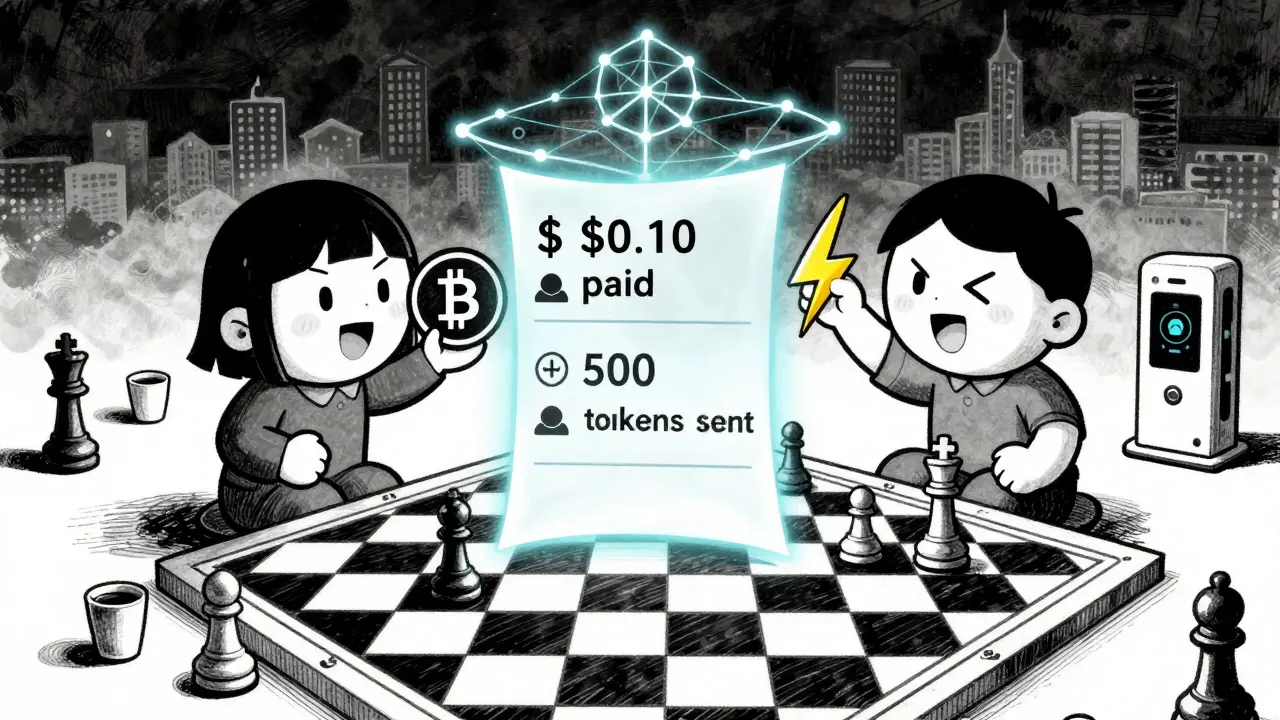
Imagine two people playing a game of chess over text. Instead of sending a message to a referee (the blockchain) every time they move, they just keep updating a shared score sheet. They sign each move, keep a copy, and only call the referee if one of them tries to cheat-or when they’re done playing. That’s a state channel.
On blockchain, this means two or more parties lock up a chunk of cryptocurrency in a smart contract. From there, they exchange signed updates-like “Alice pays Bob $0.10” or “Bob sends Alice 500 tokens”-off-chain. These updates are cryptographically secure, irreversible, and verifiable. Only the opening deposit and final balance ever hit the main chain. This cuts fees from dollars to fractions of a cent and speeds up settlement from minutes to milliseconds.
The Lightning Network, built on Bitcoin, is the most successful example. As of 2025, it handles over 4,200 transactions per second across 58,000 active nodes. Compare that to Ethereum’s mainnet, which struggles to hit 20 TPS under load. Lightning has processed over $200 million in total value since its launch. And here’s the kicker: average fees are under $0.001. On Ethereum, even simple transfers cost $1.50 or more during busy times.
Why State Channels Beat Rollups for Certain Jobs
Rollups like Optimism and StarkNet get all the hype. They process thousands of transactions per second and settle everything back to Ethereum. But they have a hidden cost: finality. Optimism takes an hour. StarkNet takes minutes. That’s fine for NFT trades or DeFi swaps-but useless for a vending machine that needs to unlock after a 10-cent payment.
State channels deliver instant finality. No waiting. No disputes. No 7-day challenge periods. That’s why they dominate in:
- Micropayments: 98% of Bitcoin transactions under $10 run through Lightning, according to Chainalysis.
- Gaming: Gods Unchained and Immutable X use state channel logic to let players trade NFTs in under 500ms-no gas fees, no lag.
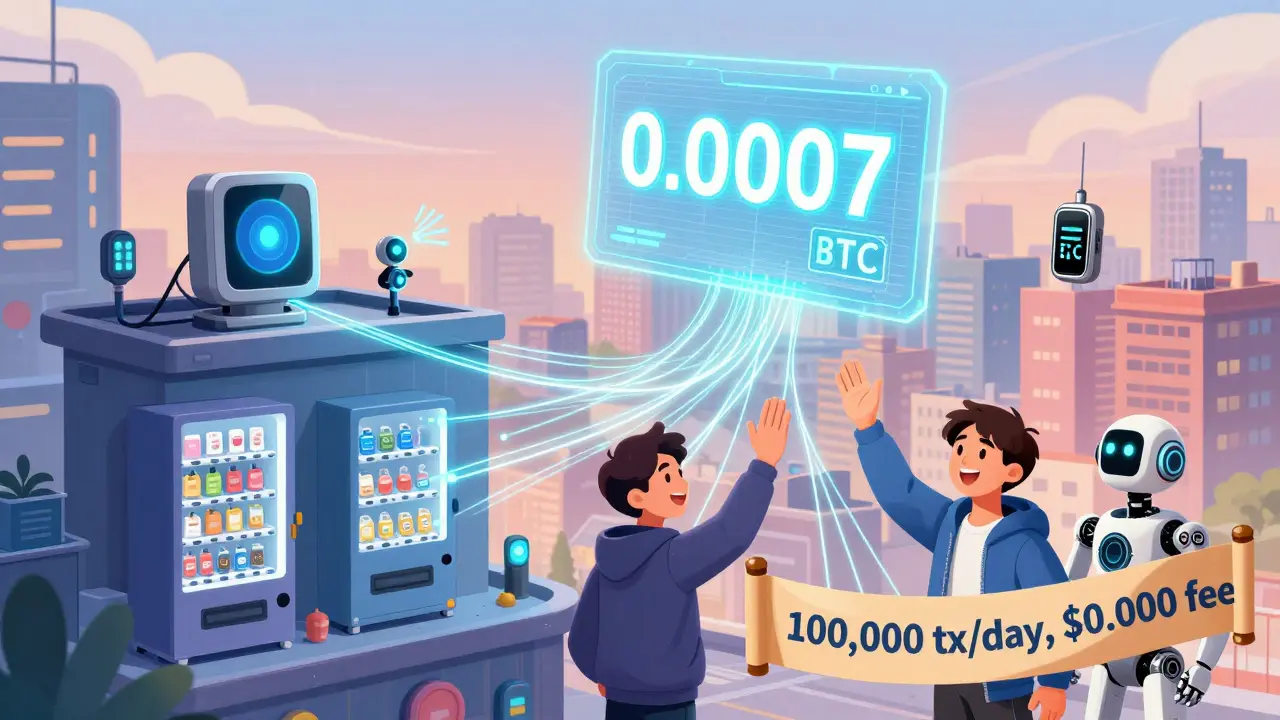
- IoT and machine payments: Aeternity and Bosch ran a pilot where 12,000 sensors auto-paid for energy usage every hour. That’s 100,000+ transactions daily, all off-chain.
Rollups are general-purpose. State channels are specialized. Think of it like this: rollups are freight trains. State channels are motorcycles. One moves bulk. The other moves fast, precisely, where it’s needed.
The Big Problems Holding State Channels Back
Here’s the uncomfortable truth: state channels still feel like a tool for engineers, not everyday users.
1. You have to stay online. If your phone dies or your node goes offline, you can’t validate updates. That’s why watchtowers exist-third-party services that monitor your channels for you. But they’re not foolproof. If a watchtower fails or gets hacked, you could lose funds. Research from Carnegie Mellon shows that 38% of users have experienced a channel disruption due to monitoring failures.
2. Locked-up cash. To open a channel, you lock up capital. If you want to send $10, you might need to lock $20. That’s 100% capital inefficiency. In contrast, rollups can process hundreds of transactions using the same locked collateral. Dr. Georgios Konstantopoulos of Paradigm calls this “the unsolved problem.”
3. Routing is a mess. Payments often need to hop through multiple channels. Lightning’s success rate? Only 68%. That means nearly a third of payments fail because one link in the chain is broke or underfunded. Users get frustrated. They blame the network. But it’s not the network-it’s the liquidity.
4. Developer hell. Building on state channels requires deep crypto knowledge. You need to understand timelocks, adaptor signatures, and HTLCs. The Lightning Development Kit cut setup time from 40 hours to 8-but that’s still too long for most startups. And documentation? Lightning’s BOLT specs are solid (4.2/5). Raiden’s? Barely 2.8/5.
What’s Changing in 2025 and Beyond
The future isn’t about making state channels into Ethereum killers. It’s about fixing their weaknesses.
Splicing: The New Liquidity Game
Joseph Poon, co-creator of Lightning, says the next big leap is “splicing.” This lets you add or remove funds from a channel without closing it. Imagine topping up your coffee wallet mid-day without shutting down your channel. Lightning Network v2, expected late 2025, will support this. It could cut capital requirements by 50%.
State Channel Hubs
Aeternity’s team introduced “hubs” in 2023. These are non-custodial liquidity pools that act like AMMs (automated market makers) for channels. Instead of locking your cash in one channel, you deposit into a hub. The hub dynamically allocates liquidity to users who need it. Early tests show a 40-60% drop in locked capital. That’s huge.
Multi-Path Payments v2
Lightning Labs is rolling out MPP v2 in early 2025. It splits one payment across 5-10 routes at once. Think of it like using 5 different Uber drivers to deliver one package. If one route fails, the others carry the load. Goal? Raise payment success from 68% to over 95%.
Quantum-Resistant Channels
MIT’s Digital Currency Initiative is testing state channels using lattice-based cryptography-designed to survive quantum computing attacks. Implementation isn’t until 2026-2027, but the research is live. This isn’t sci-fi. It’s insurance.
Enterprise Adoption
Telefónica and Ripple now use state channels for real-time mobile billing, handling 500,000 microtransactions daily. Siemens and Elblox process over 2 million kilowatt-hour energy settlements monthly. These aren’t crypto enthusiasts. They’re utilities and telecom giants. They chose state channels because they’re the only solution that works at scale, with zero latency, and zero fees.

Who Will Win-and Who Won’t
State channels won’t replace rollups. They don’t need to. They’re not for DeFi. They’re not for NFT marketplaces. They’re for:
- Every device that needs to pay another device (smart meters, EV chargers, wearables)
- Every app that charges per use (streaming, APIs, gaming microtransactions)
- Every business that wants to eliminate payment friction (coffee shops, tolls, parking, transit)
They’ll fail if they stay complicated. If UX doesn’t improve, they’ll remain a tool for developers, not consumers. But if splicing, hubs, and MPP v2 deliver on their promises? By 2027, state channels could handle over 30% of all Layer 2 transactions-mostly in non-crypto industries.
That’s the real win: when your toaster pays for its own electricity, and you never even notice.
Final Reality Check
State channels aren’t sexy. They don’t have flashy NFTs or billion-dollar token launches. But they solve the most boring, most important problem in blockchain: how to make transactions fast, cheap, and reliable at scale.
The future isn’t about one scaling solution to rule them all. It’s about the right tool for the job. Rollups for complex logic. Sidechains for high-throughput apps. And state channels for the endless stream of tiny, instant payments that keep the real world running.
If you’re building something that needs to pay, and pay instantly, without waiting or wasting money-you’re already in the state channel future. You just haven’t realized it yet.
Can state channels work on any blockchain?
Yes, but with limits. State channels were first built on Bitcoin via the Lightning Network. They’ve since been adapted to Ethereum (Raiden), Aeternity, and others. The core idea works on any blockchain that supports smart contracts and cryptographic signatures. But implementation varies. Bitcoin’s version is the most mature. Ethereum’s is less stable due to higher complexity and lower adoption. Newer chains like Polygon and Solana are experimenting with their own versions, but none have matched Lightning’s scale yet.
Are state channels safe if I lose my phone?
It depends. If you have a backup of your channel state and private keys, you can recover funds-even if your phone is gone. But if you don’t have backups and no watchtower is monitoring your channel, you risk losing funds if the other party tries to cheat by broadcasting an old state. That’s why services like Lightning Labs’ LND and Phoenix Wallet now auto-back up state data to encrypted cloud storage. Still, best practice is to always keep offline backups of your channel data.
Why don’t more people use state channels if they’re so cheap?
Two main reasons: liquidity and usability. Most users don’t know how to open a channel or fund it properly. And even if they do, payments often fail because the path to the recipient is underfunded. A 2023 Stackbit survey found 62% of Lightning users had at least one failed payment in the past month. Until payments work as reliably as sending a text, most people won’t switch. The new multi-path and hub systems aim to fix this-but they’re still rolling out.
Do state channels need a central server?
No. State channels are fully decentralized by design. All communication happens peer-to-peer between participants. Watchtowers are optional third parties that help monitor channels, but they can’t take your money. You don’t need to trust them. If a watchtower goes down, you can still settle on-chain using your signed state updates. The system is designed to work even if every external service fails.
What’s the difference between state channels and sidechains?
State channels are private, between two or more known parties. Sidechains are public blockchains connected to the main chain, with their own validators. State channels are fast, cheap, and private-but only work for pre-agreed participants. Sidechains can handle thousands of users and complex apps, but they have slower finality and need their own security model. Think of state channels as a private club meeting. Sidechains are like a whole new city with its own rules.