How Cryptocurrency and Stablecoins Are Changing Cross-Border Remittances

Remittance Cost Calculator
Cost Comparison Calculator
Estimated Costs
CalculatedWhy sending money across borders still costs too much
Every year, migrant workers send over $200 billion to their families in other countries. Most of that money still travels through banks, Western Union, or Wise-each step adding fees, delays, and paperwork. In 2024, the average cost to send $200 internationally was $13.24. That’s over 6.6% just to get cash into your sister’s hands in Nigeria or your dad’s account in the Philippines. And that’s if you’re lucky. In some corridors, fees hit 10% or more.
Meanwhile, the technology to fix this already exists. Blockchain-based stablecoins like USDC and USDT can move the same $200 across borders in under a minute-for less than a penny. No middlemen. No holding accounts. No days of waiting. Yet, only about 3% of global cross-border payments use this tech today. Why?
How stablecoins cut the cost and time of remittances
Traditional remittances work like a game of telephone with money. Your bank sends USD to its correspondent bank, which sends it to another bank, which finally credits the recipient’s account. Each step takes hours. Each bank charges a fee. Each message exchange adds risk.
Stablecoins skip all that. When you send USDC from your wallet in Los Angeles to your cousin’s wallet in Manila, the transaction is verified by nodes on a blockchain-usually within 30 seconds. The money isn’t moved from one bank to another. It’s digitally transferred on a global ledger. No intermediary banks. No foreign exchange markups. No hidden fees.
On Layer 2 networks like Polygon or Solana, transaction fees drop to $0.001 or less. That’s 99% cheaper than traditional methods. And settlement isn’t delayed by weekends or holidays. It works 24/7. In 2024, stablecoins moved $15.6 trillion in value-roughly matching Visa’s annual volume. That’s not speculation. That’s fact.
Where stablecoins are already working-real examples
Businesses are using this tech first. A manufacturing company in Ohio now pays its suppliers in Singapore using USDC. Before, payments took 3-5 days and cost $45 per transfer. Now, they’re done in 12 minutes, for $0.12. One executive said: “We stopped worrying about payment delays. Our supply chain runs smoother.”
Workers in the U.S. sending money home are catching on too. In the Philippines, cryptocurrency remittances grew 217% in 2024. In Nigeria, users on Reddit report receiving USDC from family abroad and using local exchanges like Yellow Card to convert it to naira within minutes. The catch? Converting crypto back to cash still costs 3-5%. That’s better than 10%, but it’s not free.
Companies like BVNK and Circle offer tools that auto-convert stablecoins to local currency. But these services aren’t available everywhere. In rural areas of Ghana or Guatemala, there’s no easy way to cash out. That’s the biggest barrier right now-not the tech, but the access.

The regulatory wall: Why banks aren’t rushing in
Stablecoins aren’t illegal. But they’re not fully legal either-not everywhere. The U.S. is still figuring out how to regulate them. The EU has MiCA, which sets clear rules for issuers. In Asia, countries like Singapore and Japan have licensing systems. But in many developing nations, there’s no framework at all.
That’s a problem for banks. If you’re a financial institution, you can’t risk processing a payment that might violate AML or KYC rules. That’s why most banks won’t touch crypto remittances unless the provider is licensed and compliant.
That’s where platforms like Yellow Card and Circle come in. They build compliance into the system. Every transaction passes originator and beneficiary info, follows the Travel Rule, and logs everything for regulators. But setting that up takes time. A 2025 survey found 63% of businesses using stablecoins said regulatory compliance was their biggest challenge.
And here’s the irony: traditional remittance firms have spent decades navigating those same rules. They’ve built relationships with regulators. Stablecoin companies are playing catch-up. Until there’s global alignment, adoption will stay uneven.
Can stablecoins replace Western Union?
No-not yet. And experts agree. J.P. Morgan’s blockchain team says blockchain won’t replace existing systems. It’ll complement them.
Why? Because most people still need cash. Most recipients don’t have wallets. Most governments don’t recognize crypto as legal tender. And most banks still control the final link to the real economy.
But the future isn’t about replacing. It’s about connecting. Imagine this: you send USDC from your phone. Your family receives it in their wallet. Then, they walk into a local shop that partners with a crypto-to-cash kiosk. They scan a QR code. In 60 seconds, they get naira or pesos in hand. No bank account needed. No ID verification beyond what’s already on the blockchain.
That’s not science fiction. It’s already happening in parts of Kenya and the Philippines. The infrastructure is being built. The question is whether regulators will let it scale.
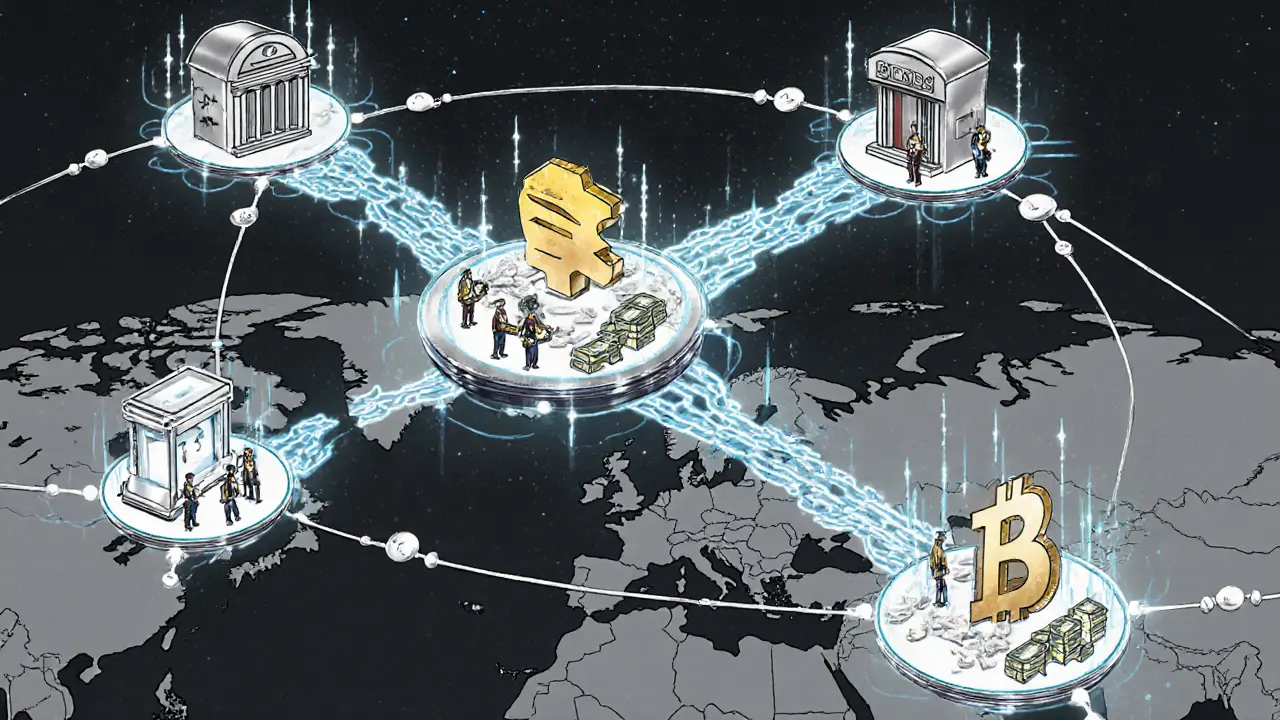
What’s next? CBDCs and the global payment overhaul
Central banks aren’t sitting still. Over 90% are working on Central Bank Digital Currencies (CBDCs). The Bank for International Settlements’ mBridge project already shows cross-border payments settling in seconds-not days-using digital versions of the Chinese yuan, UAE dirham, and Hong Kong dollar.
These aren’t cryptocurrencies. They’re digital versions of national currencies, controlled by governments. They’re not meant to replace stablecoins. They’re meant to work with them.
The real win? If CBDCs and stablecoins can connect through open protocols, we could have a global payment network that’s faster, cheaper, and more inclusive than anything we’ve ever had. The G20 and Financial Stability Board are pushing for this. But they’re also warning: without coordinated regulation, we’ll just end up with more silos-this time blockchain silos.
What you need to know if you’re sending remittances
If you’re sending money abroad and want to save on fees:
- Check if your recipient can receive crypto. Some services like Remitly and Wise now let you send USDC directly to wallets.
- Use platforms that auto-convert to local currency. Avoid manual conversions unless you’re familiar with exchanges.
- Compare total cost: crypto fee + cash-out fee vs. traditional fee. Sometimes the savings aren’t as big as you think.
- Only use licensed providers. Unregulated platforms are risky. Look for compliance with AML and KYC.
- Start small. Send $50 first. See how long it takes. See how easy it is for the recipient to cash out.
The bottom line? Cryptocurrency isn’t magic. It’s just better math. It removes the middlemen who charge you for doing nothing. But it still needs bridges to the real world. Until those bridges are built everywhere, the old system will stay around. But it won’t stay dominant.
Frequently Asked Questions
Can I send crypto remittances from the U.S. to any country?
You can send stablecoins from the U.S. to most countries with internet access, but the recipient must be able to receive and convert them. Some countries like Nigeria, the Philippines, and Vietnam have active crypto-to-cash networks. Others, like India or Brazil, have restrictions. Always check local laws before sending.
Are stablecoin remittances safe?
Yes-if you use a regulated provider. Platforms like Circle, BVNK, and Yellow Card follow strict AML and KYC rules. Transactions are recorded on public blockchains, making them tamper-proof. But if you send crypto to an unverified wallet or use an unlicensed exchange, you risk losing funds with no recourse.
Do I need a bank account to use crypto remittances?
No. You only need a smartphone and a crypto wallet. But if your recipient wants cash, they’ll need access to a cash-out point-like a local agent, exchange kiosk, or partnered merchant. These are growing fast in emerging markets, but still not universal.
How much can I save using stablecoins instead of Western Union?
For a $200 transfer, traditional services charge $13-$20. Stablecoin transfers cost under $0.10 on most networks. But if the recipient pays 3-5% to cash out, your total savings drop to 60-80%. Still, that’s $8-$12 saved per transfer. Over a year, that adds up.
Is it legal to use crypto for remittances?
In the U.S., sending crypto for remittances is legal if done through a licensed money transmitter. In most countries, it’s legal as long as you’re not evading taxes or laundering money. But some governments, like China and Egypt, ban crypto transfers entirely. Always check your country’s rules before sending.
What’s the difference between Bitcoin and stablecoins for remittances?
Bitcoin’s price swings too much for reliable remittances. If you send $200 in Bitcoin and its value drops 10% before cash-out, your family gets less. Stablecoins like USDC are pegged 1:1 to the U.S. dollar. They hold value. That’s why they’re used for payments-not speculation.
Can I use crypto remittances if I’m not tech-savvy?
Yes. Apps like Circle, Remitly, and Paxful have simple interfaces-just enter the amount, select the recipient’s phone number or wallet, and hit send. Many include step-by-step guides. The hardest part is getting your recipient to accept crypto. Once they do, the rest is easier than filling out a Western Union form.
Vijay Kumar
November 29, 2025 AT 11:41Vance Ashby
November 29, 2025 AT 15:06Casey Meehan
December 1, 2025 AT 09:24Evelyn Gu
December 2, 2025 AT 03:09Michael Fitzgibbon
December 4, 2025 AT 02:16Ben Costlee
December 4, 2025 AT 05:34Abby cant tell ya
December 4, 2025 AT 12:19Janice Jose
December 5, 2025 AT 05:50Savan Prajapati
December 6, 2025 AT 13:52Michael Labelle
December 8, 2025 AT 10:38Joel Christian
December 9, 2025 AT 18:29Ian Esche
December 11, 2025 AT 12:57Sierra Myers
December 13, 2025 AT 08:50SHIVA SHANKAR PAMUNDALAR
December 14, 2025 AT 23:21Shelley Fischer
December 15, 2025 AT 14:38Puspendu Roy Karmakar
December 16, 2025 AT 18:21Komal Choudhary
December 18, 2025 AT 03:46Tina Detelj
December 19, 2025 AT 08:38Tony spart
December 20, 2025 AT 08:21ola frank
December 20, 2025 AT 10:40