How Iranians Use Crypto to Survive Sanctions

When banks shut down, crypto becomes the lifeline
In Iran, you don’t use crypto because you want to get rich. You use it because you have no other choice. Since 2017, international sanctions have choked off Iran’s access to global banking. Wire transfers freeze. Foreign currency disappears. Paying for medicine, importing spare parts, or sending money to family abroad becomes impossible through normal channels. So millions turned to something the sanctions couldn’t touch: cryptocurrency.
By mid-2025, Iran had moved over $3.7 billion in crypto in just seven months-even as enforcement tightened. That’s not speculation. That’s survival. People aren’t buying Bitcoin to flip it. They’re buying USDT, DAI, or TRX to hold value, move money, and stay connected to the world outside their borders.
The government’s double game: ban, then monitor
The Iranian government doesn’t love crypto. But it can’t stop it. In December 2024, the Central Bank of Iran blocked all crypto-to-rial conversions online. Citizens panicked. Then, in January 2025, they unblocked it-but only if exchanges used government APIs that gave officials full access to every transaction. It wasn’t legalization. It was surveillance.
Domestic exchanges like Nobitex became the official gateway. They’re the only ones allowed to convert crypto to rials. But here’s the catch: miners must sell their coins directly to the Central Bank at fixed prices. The energy costs are so high, and the payouts so low, that most miners went underground. Today, an estimated 60% of Iran’s mining happens illegally, powered by stolen electricity and hidden rigs.
At the same time, the government banned foreign-mined crypto from being used domestically. But Iranians don’t care. They use VPNs to bypass the block and trade on Binance, Kraken, or Bybit. The state knows. They just can’t stop it.
How crypto flows out of Iran
Iran’s crypto system doesn’t just move money-it hides it. Here’s how it works: someone converts rials into USDT on Nobitex. Then, they send that USDT through 5 or 6 different wallet addresses, each owned by a different person or shell company. This is called layering. It breaks the trail. Then, the money gets off-ramped through exchanges in the UAE, Turkey, or Hong Kong that don’t ask questions.
Chainalysis and TRM Labs say this pattern is textbook sanctions evasion. It’s not unique to Iran, but no other sanctioned country does it at this scale. In 2024, Iran accounted for nearly 60% of all crypto used by sanctioned nations. That’s more than North Korea, Syria, and Venezuela combined.
The Islamic Revolutionary Guard Corps (IRGC) is deeply involved. U.S. Treasury officials confirmed crypto is now a core tool for buying weapons, drones, and military tech. Wallets linked to IRGC-affiliated entities show up repeatedly in transaction chains. When Tether froze 42 Iranian addresses in July 2025, over half were tied to Nobitex or known IRGC-linked wallets.

The great crypto switch: from USDT to DAI
After Tether froze those wallets, panic hit Iranian users. USDT was the go-to stablecoin. Now it was risky. Within days, Telegram groups and Reddit threads exploded with advice: “Sell USDT. Buy DAI. Use Polygon.”
DAI is a decentralized stablecoin, not controlled by any company. Polygon is a fast, cheap blockchain. Together, they’re harder to freeze. Iranians didn’t wait for instructions. They moved. Within 72 hours, DAI usage on Polygon jumped 300%. They knew the math: fewer fees, faster transfers, no single point of failure.
This isn’t luck. It’s learned behavior. Iranian crypto users are some of the most technically savvy in the world-not because they’re developers, but because they’ve had to become experts just to pay for groceries.
Bitcoin: the last resort
When everything else fails, Iranians turn to Bitcoin. Why? Because it doesn’t need permission. You don’t need a bank account. You don’t need a passport. You just need a seed phrase written on paper. If you’re forced to flee, you take that paper. You walk across the border. You find a local exchange in Turkey or Pakistan. You sell. You live.
Unlike gold or cash, Bitcoin can’t be seized at the border. Unlike foreign bank accounts, it can’t be frozen by a government decree. It’s censorship-resistant by design. For Iranians living under constant economic pressure, that’s not a luxury-it’s the only guarantee they have.
The tax trap: the state wants a cut
In August 2025, Iran passed a new law: capital gains tax on crypto. Yes, you read that right. The same government that bans foreign exchanges now wants to tax your profits. Crypto, gold, real estate, forex-all treated the same under the new Law on Taxation of Speculation and Profiteering.
It’s not about fairness. It’s about control. By taxing crypto, the government admits it’s real. It’s part of the economy. And now, they want their share. The tax isn’t enforced yet. It’s being rolled out slowly. Why? Because if they crack down too hard, people stop using exchanges. And if people stop using exchanges, the government loses visibility. They’d rather know who’s trading than lose all control.
What’s next? The cat-and-mouse game
Every time OFAC freezes a wallet, Iranians switch networks. Every time a new exchange is blocked, they find another. Every time the Central Bank raises mining fees, more rigs go dark. The government adjusts. The people adapt.
Iran’s crypto ecosystem isn’t growing because it’s trendy. It’s growing because the alternative is collapse. Millions rely on it to buy insulin, send remittances, or pay for internet access. The U.S. and its allies can freeze banks. They can sanction ships. But they can’t shut down a decentralized network that runs on millions of computers around the world.
What’s clear now: crypto in Iran isn’t a side effect of sanctions. It’s the main response. And as long as the banking system stays broken, crypto will keep rising-not as an investment, but as a necessity.
How Iranians really use crypto: real stories
A teacher in Shiraz uses Nobitex to convert her salary into DAI. She keeps it on her phone. When her son needs medicine from Germany, she sends the DAI to a friend in Istanbul, who converts it to euros and pays the pharmacy. No bank. No paperwork. No delay.
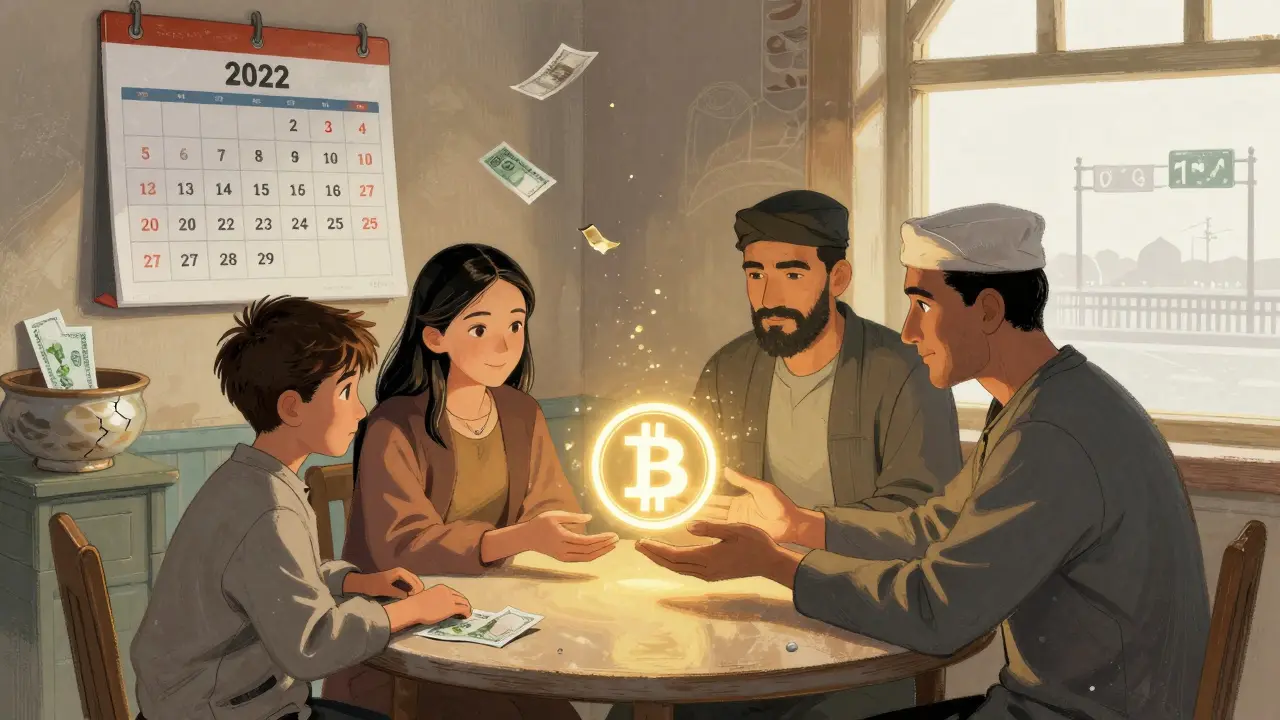
A family in Tabriz bought Bitcoin in 2022. They didn’t trade it. They held it. When inflation hit 50%, their rials lost half their value. Their Bitcoin? It held. They sold a fraction to pay rent. They still hold the rest.
A mechanic in Mashhad mines Ethereum on a hidden rig in his garage. He pays for electricity with cash. He sells his coins on a Telegram group. He doesn’t know who he’s selling to. He doesn’t care. He just needs to buy tools.
These aren’t outliers. They’re normal. In Iran, crypto isn’t a financial product. It’s infrastructure.
Richard Kemp
January 31, 2026 AT 15:18Jerry Ogah
February 1, 2026 AT 09:16Elle M
February 3, 2026 AT 03:52Rico Romano
February 4, 2026 AT 03:27Crystal Underwood
February 6, 2026 AT 01:18Raymond Pute
February 6, 2026 AT 04:41Freddy Wiryadi
February 7, 2026 AT 23:26Calvin Tucker
February 9, 2026 AT 11:08Gustavo Gonzalez
February 10, 2026 AT 13:37Brandon Vaidyanathan
February 12, 2026 AT 07:33Dahlia Nurcahya
February 12, 2026 AT 12:34Jeremy Dayde
February 13, 2026 AT 05:20Steven Dilla
February 14, 2026 AT 04:38josh gander
February 14, 2026 AT 17:55Akhil Mathew
February 15, 2026 AT 00:20Tom Sheppard
February 16, 2026 AT 01:22Christopher Michael
February 17, 2026 AT 07:47