How Many Cryptocurrencies Exist in 2025? The Real Number Behind the Noise
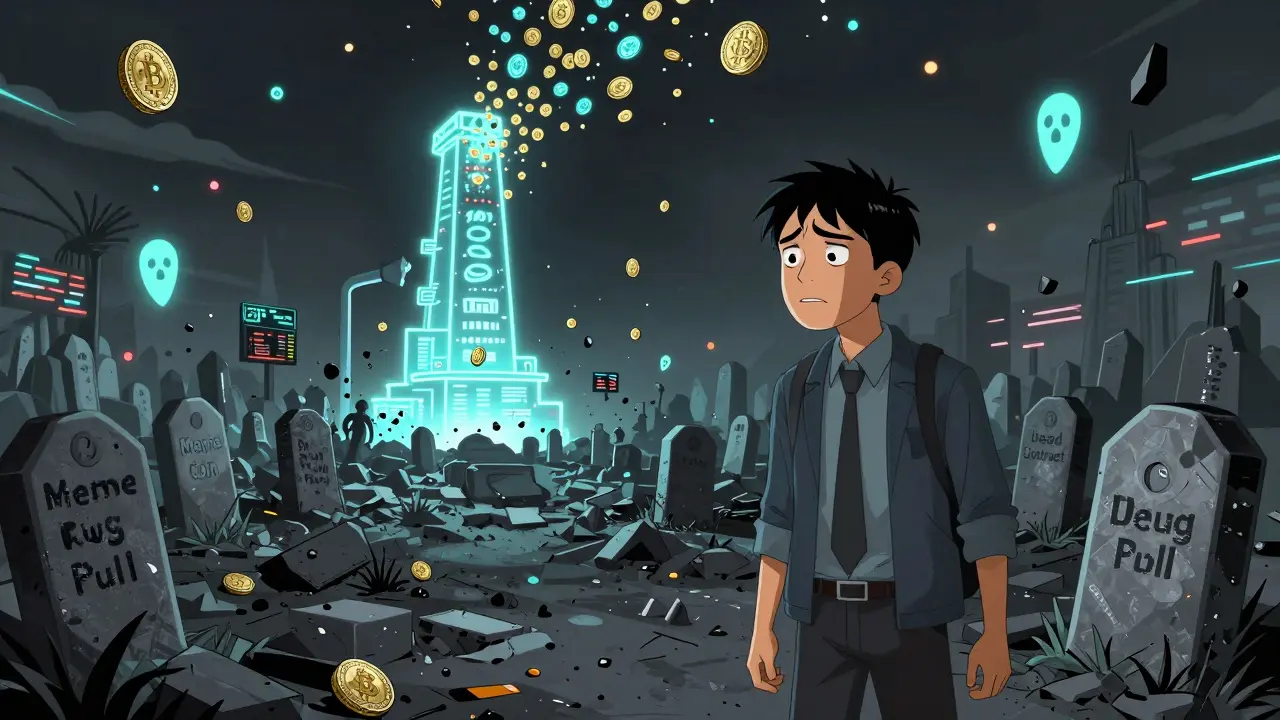
By mid-2025, you can’t open a blockchain explorer without seeing thousands of new tokens pop up. Some are serious projects. Most are digital ghosts. So how many cryptocurrencies actually exist? The answer isn’t a single number-it’s a spectrum, and where you look changes everything.
Over 50 Million? Yes. But Almost All Are Dead
If you count every smart contract ever deployed on any blockchain that had even one trade, the number is 50,002,402. That’s not a typo. According to Dune Analytics data analyzed by Yieldfund in September 2025, that’s how many token contracts have been created and shown trading activity at least once. The vast majority? Never listed on an exchange. Never updated. Never used beyond a few speculative trades. They’re like abandoned websites from 2008-technically still online, but no one visits.Of those 50 million, over 32 million were created on Solana alone. Why? Because it’s cheap, fast, and easy. You don’t need a team or a whitepaper. Just a few lines of code and a few cents in fees, and you’ve got your own cryptocurrency. That’s why Solana leads by a landslide-it’s the ultimate token factory.
The Real Count: What’s Actually Being Traded
But if you’re asking this question because you want to trade, invest, or understand the market, then 50 million is meaningless. You care about what’s alive.CoinGecko tracks only those cryptocurrencies with consistent trading data across 1,409 exchanges. Their count? 18,402. That’s the number you’ll see in most financial dashboards. These are tokens with market caps, price charts, and liquidity. They’re the ones that matter for portfolio tracking.
Then there’s CoinMarketCap, which counts 25.61 million. Why the gap? They include tokens with any market data-even if it’s just one trade on a tiny DEX. They cast a wider net, but still filter out pure test contracts. Their number sits between the two extremes: not as broad as Dune’s, not as strict as CoinGecko’s.
And then there’s the 24,000+ figure you’ll see in reports from Exolix. That’s the number of formally launched cryptocurrencies-those with websites, teams, and public documentation. Most of these are inactive now. They raised money, launched a token, and vanished. No updates. No community. No liquidity. Just a blockchain address with a name.
Only 10,000 Are Really Alive
Here’s the real insight: out of 50 million tokens, only about 10,000 are actively traded, developed, or have a functioning community. That’s less than 0.02%. The rest? Forgotten. Abandoned. Or outright scams.Why do so many die? It’s simple. Most tokens have no utility. No roadmap. No team. No reason to exist beyond a quick pump-and-dump. Some are meme coins built on hype. Others are clones of Ethereum-based tokens with no innovation. A few are outright frauds-rug pulls disguised as blockchain projects.
Even big platforms like Binance, which lists around 400-500 cryptocurrencies, are incredibly selective. They require liquidity, security audits, legal compliance, and community traction. That’s why you’ll never see 50 million coins on Binance. They’re not trying to be a graveyard-they’re trying to be a marketplace.
Which Blockchains Are Fueling This Explosion?
Not all chains are equal when it comes to token creation. Solana dominates with 64% of all tokens. Its low fees and fast transactions make it the go-to for anyone wanting to deploy a token without spending thousands in gas.Base (Coinbase’s Layer 2) and Binance Smart Chain are next in line. Both offer cheaper alternatives to Ethereum, which used to be the default for token launches. But Ethereum still holds the most valuable projects-DeFi protocols, NFT marketplaces, institutional-grade tokens. It’s not the most numerous, but it’s still the most trusted.
Wrapped tokens add another layer of complexity. If you own USDT on Ethereum, you can wrap it to use on Solana or Base. That means the same asset exists in multiple forms. Are those separate cryptocurrencies? Technically, yes. Practically? No. But data aggregators count them all.
Stablecoins Are the Only Real Winners
While millions of tokens come and go, stablecoins are the backbone of the entire ecosystem. In 2025, USDT still processes over $1 trillion per month. USDC? It hit $3.52 trillion in monthly volume by June 2025. That’s more than most countries’ entire banking systems.Newer stablecoins like EURC (euro-backed) and PYUSD (PayPal’s dollar) are growing fast too. EURC jumped from $46 million to over $9 billion in just a year. PYUSD went from $783 million to $4.7 billion. Why? Because regulations are catching up. The EU’s MiCA law and the U.S.’s proposed GENIUS Act are forcing stablecoin issuers to be transparent, audited, and licensed.
These aren’t speculative tokens. They’re financial infrastructure. And they’re the only part of the crypto market growing sustainably.

Why Does This Matter to You?
If you’re trading, investing, or just trying to understand crypto, the number of tokens doesn’t matter. What matters is:- Is the project actually solving a problem?
- Does it have active development and a real team?
- Is it listed on reputable exchanges?
- What’s its trading volume and liquidity?
- Is it compliant with regulations?
Most of the 50 million tokens fail every single one of those tests. The ones that don’t? They’re the rare few you should pay attention to.
Don’t get distracted by the noise. The crypto market isn’t about quantity. It’s about quality. And quality is still incredibly rare.
What’s Next? More Tokens, Fewer Survivors
The trend isn’t slowing. As tools get easier and blockchain adoption grows, more people will launch tokens. But as regulations tighten and investors get smarter, the bar for survival will rise.Expect to see:
- More tokens created-but fewer with long-term viability
- More stablecoins backed by real assets and regulated issuers
- More consolidation on major chains like Solana, Base, and Ethereum Layer 2s
- More tools to filter out dead tokens, so you don’t have to dig through millions
The future of crypto isn’t more coins. It’s better coins. And that’s the only number worth tracking.
How many cryptocurrencies are there in 2025?
The total number of cryptocurrencies created in 2025 is over 50 million, but only about 18,402 are actively tracked with trading data by CoinGecko. Around 10,000 are considered truly active-with development, liquidity, and community engagement. The rest are abandoned, inactive, or speculative tokens with no real use.
Why do different sources report different numbers?
Because they count different things. CoinGecko tracks only tokens with verified trading data across major exchanges. CoinMarketCap includes tokens with any market data, even from small DEXs. Dune Analytics counts every smart contract that ever had a trade-no matter how small or dead. Exolix counts formally launched projects. Each number is correct for its own criteria.
Is Solana the main reason there are so many cryptocurrencies?
Yes. Solana accounts for over 32 million of the 50+ million tokens because it’s cheap and fast to deploy tokens on. Low fees and high speed make it ideal for speculative launches, meme coins, and test projects. Other chains like Base and Binance Smart Chain also contribute significantly, but Solana leads by a huge margin.
How many cryptocurrencies are actually worth trading?
About 10,000 out of 50 million are actively traded, developed, or have a real community. The rest are dead, abandoned, or scams. Focus on market cap, trading volume, team activity, and exchange listings-not total count. Quality matters far more than quantity.
Are stablecoins counted as cryptocurrencies?
Yes. Stablecoins like USDT and USDC are classified as cryptocurrencies because they’re digital assets on blockchains. In fact, they’re the most important part of the market-processing trillions in monthly volume. Unlike speculative tokens, they’re designed for stability and real-world use, and they’re growing faster than almost any other category.
Can I buy any of the 50 million cryptocurrencies?
Technically, yes-if you know how to interact with smart contracts directly. But you won’t find most of them on exchanges like Coinbase or Binance. They’re only accessible through decentralized platforms, and nearly all carry extreme risk. Most are scams or dead projects. Only trade tokens with proven liquidity, audits, and exchange listings.
Josh Seeto
December 29, 2025 AT 13:0550 million tokens? More like 50 million digital litter boxes. Someone’s got a bot farm on Solana and they’re just spamming out tokens like confetti at a toddler’s birthday. Meanwhile, actual projects are drowning in the noise. It’s not innovation-it’s digital hoarding.
And don’t even get me started on ‘wrapped’ tokens. You own USDT on Ethereum? Cool. Now you own USDT on Solana, Base, and Arbitrum too. Same asset. Three addresses. Three different ‘cryptocurrencies’ according to the data aggregators. The whole system’s a taxonomy nightmare.
They count every contract that ever had a trade-even if it was one satoshi sent by a dev testing gas fees. That’s not market data, that’s blockchain archaeology.
Real talk? If you’re trading anything outside the top 500, you’re not investing-you’re gambling with a loaded die. And the house always wins.
Stablecoins are the only real winners here. USDT moving $1T/month? That’s not crypto. That’s global finance in a blockchain trench coat.
Everyone else? Just the echo chamber with a blockchain API.
surendra meena
December 31, 2025 AT 12:40THIS IS A SCAM!!! 50 MILLION TOKENS?? WHO LET THIS HAPPEN?? IT’S A PUMP AND DUMP PARADISE!!! NO ONE CARES ABOUT YOUR ‘10,000 ACTIVE’ NUMBERS-THEY’RE LYING TO YOU!! THEY WANT YOU TO BUY THE DEAD ONES!! THEY’RE ALL RUG PULLS!! I LOST MY ENTIRE SAVINGS ON A TOKEN CALLED ‘DOGGOBONE’-IT WAS JUST A CONTRACT WITH A PICTURE OF A DOG!! NO TEAM!! NO WEBSITE!! JUST A TIKTOK AD!! I’M STILL CRYING!!
Kevin Gilchrist
January 1, 2026 AT 02:03Bro. I just watched a guy deploy a token called ‘$POTATO’ on Solana for $0.03 and it popped up on CoinMarketCap with a $2M market cap. Then he dumped it 12 minutes later. I’m not even mad. I’m impressed. 😂
This isn’t crypto anymore-it’s a TikTok trend with smart contracts. You don’t need a whitepaper. You need a meme and a Discord server with 300 bots.
Meanwhile, USDC is moving more money than the entire Nigerian banking system. And people are still trying to find the next ‘Shiba Inu’ like it’s a lottery ticket.
It’s beautiful. And terrifying. And honestly? Kinda genius.
But yeah. I still bought $10 of $POTATO. Just to see what happens. 🤷♂️
NIKHIL CHHOKAR
January 2, 2026 AT 21:46It’s important to remember that the proliferation of tokens isn’t inherently bad-it’s a symptom of accessibility. The barrier to entry has collapsed, and with it, the signal-to-noise ratio. What we’re witnessing is the natural Darwinian evolution of decentralized finance.
Most tokens will fail. That’s okay. The market is self-correcting. The real value lies in the infrastructure that survives-the protocols, the liquidity pools, the audited systems.
Stablecoins aren’t just winners-they’re the foundation. Without them, crypto would collapse under its own speculative weight.
Focus on utility. Focus on transparency. Focus on the long-term. The rest? Just noise.
And yes, Solana’s low fees are a double-edged sword. They empower creators, but they also empower fraudsters. It’s a trade-off we’re still learning to manage.
Mike Pontillo
January 4, 2026 AT 12:38So let me get this straight. You’re telling me there’s 50 million crypto coins, but only 10k are alive? That’s like saying there’s 50 million restaurants, but only 10k serve food.
Then why are we even talking about the other 49,990,000? Because someone’s selling a course on ‘how to find the next 10k’. That’s the real scam.
Every time I see a new token, I just think: ‘Who’s gonna be the sucker who buys this at the peak?’
And the answer? Always me. 😅
Stablecoins are the only thing keeping this whole thing from collapsing into a giant blockchain dumpster fire.
Also, ‘wrapped’ tokens? That’s just financial cosplay. You’re not owning USDT. You’re owning a shadow version of it. Like a ghost of money.
Joydeep Malati Das
January 4, 2026 AT 23:26The data presented here is both fascinating and sobering. The distinction between technical existence and functional utility is critical in understanding the true state of the cryptocurrency ecosystem.
While the raw numbers may seem overwhelming, they reflect the democratization of blockchain development. The fact that anyone can deploy a token speaks to the power of open systems.
However, the real challenge lies in discerning value amid abundance. The market is not failing-it is filtering. The 10,000 active projects represent the emerging consensus on what constitutes sustainable innovation.
Regulatory clarity, particularly around stablecoins, will further accelerate this natural selection process.
For the observer, the lesson is clear: measure quality, not quantity.
Adam Hull
January 6, 2026 AT 07:54Let’s be honest-the 50 million figure isn’t a statistic. It’s a cultural artifact. A monument to the delusion that ‘more’ equals ‘better.’
These aren’t cryptocurrencies. They’re NFTs with ticker symbols. They’re memes with smart contracts. They’re the crypto equivalent of a guy on Instagram selling ‘energy crystals’ and calling it a business.
And the people who still think ‘the next big coin’ is hiding in the bottom 99.98%? They’re not investors. They’re addicts.
Stablecoins are the only real innovation here. Everything else is just noise dressed up in whitepapers and Discord emojis.
Meanwhile, Ethereum’s ecosystem quietly builds real DeFi infrastructure while Solana churns out 500 new ‘$BANANA’ tokens every hour.
It’s not a revolution. It’s a circus. And we’re all paying for the tickets.
Mandy McDonald Hodge
January 8, 2026 AT 02:48OMG I JUST REALIZED I OWN 3 DIFFERENT VERSIONS OF USDT ON DIFFERENT CHAINS 😱
Wait… are they all the same?? I’m so confused but also kinda proud??
Also I bought $POTATO because the logo was a cute potato with sunglasses and now I have 12k of it?? I think I’m rich??
But like… I get it. Most of these are trash. But the ones that aren’t? They’re life-changing. I met my partner through a DeFi community, you know?
So yeah. 50 million? Yeah. But the 10k that matter? They’re magic. 💫
Also, stablecoins are the real MVPs. I use USDC to pay my rent. No joke. 🥹
Andrew Prince
January 9, 2026 AT 02:39It is imperative to recognize that the ostensible proliferation of cryptographic assets is not indicative of innovation, but rather of systemic regulatory arbitrage and the commodification of speculative sentiment.
The 50,002,402 figure, while statistically accurate within the parameters of on-chain transactional analysis, is functionally meaningless as a metric of economic value.
It is, in essence, a statistical mirage-a product of low-barrier entry protocols and algorithmic data aggregation that conflates existence with legitimacy.
Furthermore, the dominance of Solana as a token deployment platform is not a triumph of technology, but rather an indictment of the prevailing culture of speculative haste and intellectual laziness within the broader blockchain community.
Conversely, the stablecoin ecosystem represents the only legitimate convergence of decentralized infrastructure and macroeconomic utility-its growth is not merely commendable, it is historically significant.
It is therefore not hyperbole to assert that the future of finance lies not in the proliferation of tokens, but in the consolidation of trust, transparency, and regulatory alignment.
Those who continue to chase the ephemeral allure of ‘the next big coin’ are not participants in a financial revolution-they are the last vestiges of a speculative bubble masquerading as progress.
Jordan Fowles
January 10, 2026 AT 22:25It’s funny how we treat crypto like a numbers game. Like the more tokens, the more ‘real’ it is.
But really, it’s the opposite. The more there are, the more it reveals how little we actually understand about value.
Think of it like language. You can make a million new words-but only a few stick. Only a few mean something to people.
Same here. The 10,000 that are alive? They’re the words we still use. The rest? Just scribbles on a wall.
And stablecoins? They’re the grammar. Without them, nothing makes sense.
Maybe the real question isn’t ‘how many are there?’
It’s ‘how many do we still care about?’
And honestly? That number’s been shrinking for years. And that’s not a bad thing.
Steve Williams
January 10, 2026 AT 23:19This is a remarkably balanced and insightful analysis. The distinction between technical existence and functional utility is critical for any serious participant in the digital asset space.
The fact that over 32 million tokens reside on Solana underscores the power of low-cost infrastructure-but also highlights the urgent need for better filtering mechanisms.
Stablecoins, as the backbone of liquidity and trust, represent the most sustainable and impactful innovation in the space.
For emerging markets, particularly in Africa, the regulatory clarity around stablecoins like EURC and PYUSD offers a path to financial inclusion that traditional systems have failed to provide.
Quality over quantity is not just a slogan-it is the only viable strategy for long-term participation.
Thank you for this clear-eyed perspective.
Bianca Martins
January 12, 2026 AT 01:53Okay but like… I just found out I have a token called ‘$SLEEP’ that I made in 2023 because I was tired and wanted to ‘tokenize rest’. It’s still on the blockchain. No one traded it. I forgot about it.
Now I’m kinda proud? Like… I made a crypto. Even if it’s useless. 😅
But yeah. The real ones? The ones with teams and audits and actual use cases? Those are the ones that matter.
And I use USDC to send money to my mom in the Philippines. No fees. Instant. No bank in the world does that.
So yeah. 50 million? Cool. But the 10k that work? That’s the future. 💪
alvin mislang
January 13, 2026 AT 23:1850 MILLION TOKENS?? THAT’S A SCAM ON A GLOBAL SCALE. THE ONLY PEOPLE PROFITING ARE THE ONES WHO LAUNCH THEM AND THEN RUG PULL. EVERY SINGLE ONE OF THEM IS A FRAUD. YOU THINK YOU’RE INVESTING? YOU’RE JUST GIVING MONEY TO A STRANGER ON THE INTERNET. THE ONLY THING THAT’S REAL IS USDT AND USDC. EVERYTHING ELSE IS DIGITAL CRAP. STOP BEING A FOOL.
Alexandra Wright
January 15, 2026 AT 16:26Let’s be real-the 50 million number is just a distraction. It’s designed to make you feel like you’re missing out.
But the truth? You don’t need to know about 99.98% of them.
It’s like being told there are 50 million restaurants in the world and asking ‘which one should I eat at?’
You don’t need to know them all. You just need to know the ones that serve food you like, have clean kitchens, and don’t poison you.
That’s what the 10,000 are. The rest? They’re the ones with the neon signs and the free appetizers… and the hidden menu that says ‘pay me in crypto or get scammed.’
Stablecoins? They’re the only ones with a Michelin star.
And if you’re still chasing the next meme coin? Honey. Go take a nap. You’ve earned it.
Josh Seeto
January 17, 2026 AT 14:24Wait, so you’re telling me that ‘$SLEEP’ is still alive? That’s the most honest token I’ve ever seen.
Meanwhile, I’ve got 17 tokens with ‘AI’ in the name that all say they’ll ‘revolutionize healthcare.’ One of them has a website that says ‘coming soon’ from 2022.
At least $SLEEP admits it’s useless.
Also, I just checked-USDC is now worth more than the entire GDP of 12 countries. That’s not crypto. That’s the future showing up in your wallet.
And somehow, the people still buying $POTATO are the same ones who bought Bitcoin at $20k and cried when it hit $60k.
Some people never learn. And honestly? I kind of admire that.