How to Use Multiple Crypto Exchanges Safely: Avoiding Restrictions and Risks

Imagine holding a significant amount of Bitcoin but finding yourself unable to move it because one exchange froze your account due to a minor compliance flag. For many crypto holders, this isn't just a hypothetical nightmare; it's a reality that has pushed users toward using multiple platforms simultaneously. While some do this for simple arbitrage or better liquidity, others use multiple crypto exchanges specifically to bypass geographic limits, trading caps, or strict regulatory checks. But here is the catch: in 2026, the line between smart financial planning and legal trouble is thinner than ever.
The landscape has shifted dramatically since the mid-2020s. Regulators like the U.S. Treasury’s Office of Foreign Assets Control (OFAC) are no longer just watching the big players; they are tracking the flow of funds across smaller, less compliant platforms. If you are spreading your assets across several venues to avoid restrictions, you need to understand exactly where the safety net ends and the legal risk begins. This guide breaks down how multi-exchange strategies work, the hidden dangers of 'nested' platforms, and how to keep your funds safe without ending up on a sanctions list.
Why Traders Spread Assets Across Platforms
There are two main reasons people use more than one exchange. The first is legitimate: access to specific pairs, lower fees, or higher liquidity. The second is strategic: avoiding local restrictions. In many jurisdictions, domestic exchanges impose daily withdrawal limits or require extensive documentation for large transfers. By splitting holdings, users can keep their transactions under the radar of single-platform monitoring systems.
However, this strategy relies on the assumption that each platform operates independently. In reality, most major centralized exchanges share data through industry consortiums and compliance providers. If you move $50,000 from Exchange A to Exchange B, both record the transaction. If the pattern looks suspicious-such as rapid movements followed by cash-outs-both may flag your account. This is why understanding the difference between standard diversification and active restriction evasion is critical for your long-term security.
The Rise of Nested Exchanges and Their Hidden Risks
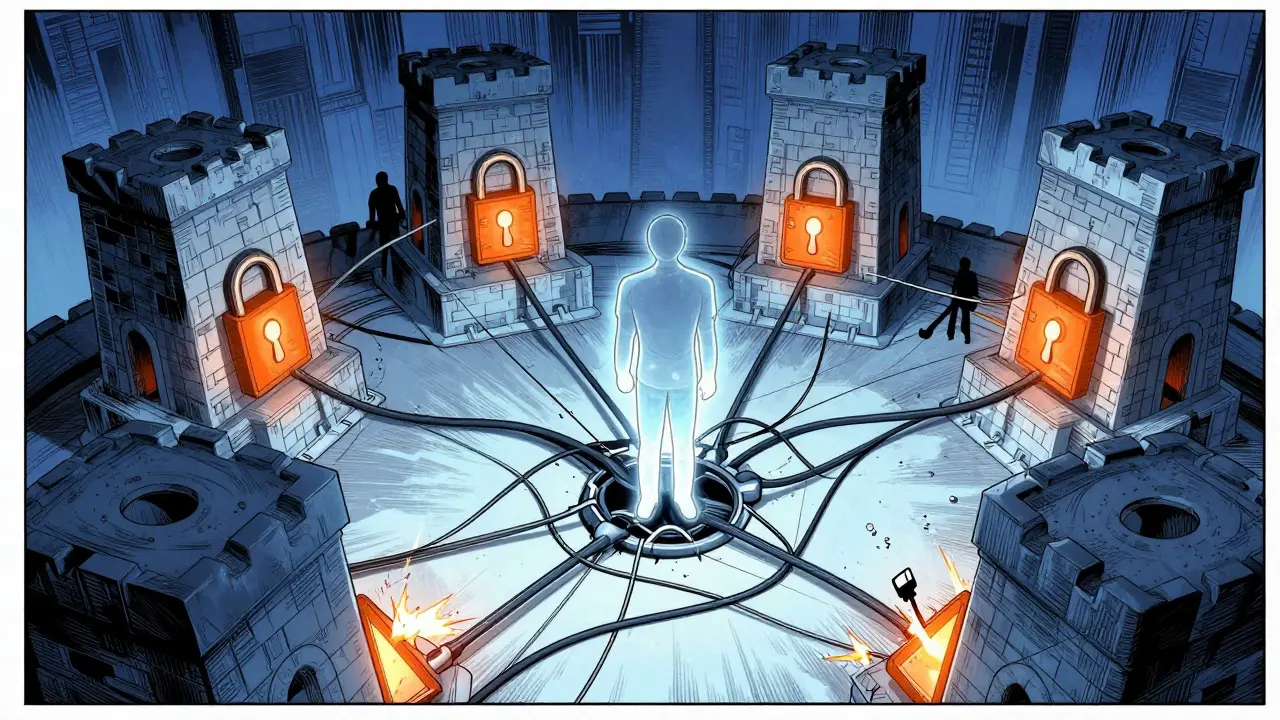
One of the most common ways to bypass restrictions involves what experts call "nested exchanges." These are platforms that don’t hold your coins directly but act as intermediaries, executing trades on your behalf through accounts on other major exchanges. They often appeal to users who want to avoid Know Your Customer (KYC) processes or operate in regions with heavy regulation.
While convenient, nested exchanges carry significant risks. Because they rely on third-party infrastructure, they have less control over security and compliance. If the upstream exchange freezes an account, your funds on the nested platform can become inaccessible. Furthermore, these platforms often lack robust Anti-Money Laundering (AML) controls, making them prime targets for cybercriminals. You are essentially trusting a middleman with fewer guarantees than the direct source. Before depositing, always verify if the nested exchange holds custody or merely mirrors balances from another provider.
Sanctions Evasion: Where Legal Meets Illegal
This is the most dangerous territory. Using multiple exchanges to avoid *market* restrictions is generally fine. Using them to avoid *sanctions* is a federal crime in the U.S. and increasingly so elsewhere. Since 2025, enforcement actions have targeted not just sanctioned individuals, but the platforms facilitating their trades.
A key example is the designation of Grinex by OFAC in March 2025. Grinex was created by employees of Garantex, a sanctioned exchange, specifically to continue operations after law enforcement seized Garantex’s servers. By moving customer deposits to this new entity, they attempted to obscure the trail of illicit funds. Users who traded on Grinex faced the risk of frozen assets and potential legal scrutiny. This case highlights a crucial point: successor entities created to circumvent sanctions are actively monitored. If you are using a lesser-known exchange to bypass a freeze on a major one, check its history. Was it launched immediately after a crackdown? Does it have transparent leadership? If the answers are yes and no, proceed with extreme caution.
| Exchange Type | KYC Requirement | Sanctions Risk | Liquidity Access | Best For |
|---|---|---|---|---|
| Major Centralized Exchanges | High / Strict | Low (Compliant) | High | Long-term holding, stable fiat on/off ramps |
| Nested Exchanges | Variable / Lenient | Medium / High | Medium | Bypassing local fiat limits, niche pairs |
| Decentralized Exchanges (DEX) | None (Wallet-based) | Low (Hard to track) | Variable | Privacy-focused swaps, DeFi yield farming |
Decentralized Exchanges: The Privacy Playbook
For those seeking maximum freedom from centralized oversight, Decentralized Exchanges (DEX) offer a different path. Unlike traditional platforms, DEXs operate via smart contracts on blockchains like Ethereum or Solana. There is no central authority to freeze your account or demand documents. You connect your wallet, swap tokens, and leave.
However, "decentralized" doesn't mean "anonymous." Blockchain explorers allow anyone to trace transactions. If you swap USDT for BTC on a DEX and then withdraw to a cold wallet, the link between your wallet address and the trade is public. To truly benefit from DEXs for restriction avoidance, you need to manage your on-chain footprint carefully. Using privacy-focused chains or mixing services can help, but these methods come with their own technical complexities and costs. Moreover, while governments struggle to shut down a DEX, they can still target the exit points where crypto converts back to fiat currency.

Red Flags to Watch Out For
Before committing funds to a secondary or tertiary exchange, run through this checklist. These indicators suggest a platform might be non-compliant or high-risk:
- Instant Onboarding: Legitimate KYC processes usually take hours or days. If you can start trading within seconds of signing up with no ID verification, ask why.
- Opaque Ownership: Can you find the names of the founders or the registered company jurisdiction? Anonymous teams are a major red flag in regulated markets.
- Aggressive Marketing of 'No Limits': While some exchanges offer tiered limits, promising completely unrestricted trading without compliance checks is often a lure for illicit activity.
- Newly Created Successors: If an exchange was launched immediately after a competitor was sanctioned or seized, investigate its connection to the previous entity.
Building a Safe Multi-Exchange Strategy
If you decide to use multiple platforms, structure your approach to minimize legal and security risks. First, separate your assets by purpose. Keep your core holdings on highly regulated, Tier-1 exchanges with strong insurance policies. Use secondary exchanges only for active trading or specific pair access, keeping balances low. Second, maintain clear records. Even if you are avoiding certain restrictions, having a paper trail of why you moved funds (e.g., "better fee structure," "access to specific asset") helps defend against accidental compliance flags.
Finally, stay updated on regulatory changes. The crypto space moves fast, and what is acceptable today might be scrutinized tomorrow. Follow official announcements from bodies like the SEC and OFAC, and monitor news regarding the specific exchanges you use. Diversification is a powerful tool, but only when applied with awareness of the rules governing each venue.
Is it illegal to use multiple crypto exchanges?
No, it is perfectly legal to use multiple exchanges for trading, arbitrage, or convenience. It only becomes illegal if you use them to evade specific laws, such as paying taxes, reporting foreign accounts, or complying with international sanctions.
What is a nested exchange?
A nested exchange is a platform that does not hold user funds directly but executes trades through accounts on other major exchanges. They often have lighter KYC requirements but carry higher counterparty risk.
Can OFAC track my transactions on decentralized exchanges?
Yes, to an extent. While DEXs lack central oversight, all transactions are recorded on public blockchains. Regulators can analyze on-chain data to identify patterns, especially when funds eventually move to centralized exchanges for cash-out.
Which exchanges are best for avoiding local trading limits?
It depends on your location. Generally, international exchanges with tiered KYC systems allow higher limits as you verify more identity details. Always compare the specific withdrawal caps and fee structures of at least three reputable platforms before choosing.
How do I protect my funds if a secondary exchange gets hacked?
Keep only working capital on secondary exchanges. Move profits to a hardware wallet or a primary, insured exchange regularly. Avoid leaving large idle balances on platforms with weaker security histories or unknown ownership structures.
Rebecca Springer
August 28, 2026 AT 17:38It is quite fascinating how the article draws a clear line between strategic diversification and actual legal evasion. I appreciate the nuance here because many people conflate the two, assuming that any multi-exchange strategy is inherently shady or risky. In my experience, keeping your core assets on Tier-1 platforms while using secondary venues for specific liquidity needs is a perfectly sound practice, provided you maintain transparent records. The mention of OFAC tracking smaller platforms is particularly relevant right now, as compliance infrastructure has tightened significantly across the board. It really highlights the importance of understanding not just where your money is, but who is watching it. I think this post serves as a good reminder to stay informed about regulatory shifts rather than just reacting to them. It’s always better to be proactive with your financial hygiene in this space.
Teresa Watson
August 30, 2026 AT 00:11oh come on everyone acts like its a huge deal but we all do it
why would anyone keep all their eggs in one basket when these companies freeze accounts for no reason at all
its just common sense not some illegal scheme
Nadia Christian
August 31, 2026 AT 14:44Absolutely correct! It is time we stopped letting foreign regulations dictate our domestic trading habits. We need to support American innovation by using exchanges that respect our privacy and freedom. Why should we have to beg permission from bureaucrats just to move our own digital property? It is high time we demanded true sovereignty over our assets!
jeffry jones
September 2, 2026 AT 11:52Good point. Just ensure your off-ramps are solid. Liquidity depth matters more than brand name sometimes.
Aaliyah Simpson
September 3, 2026 AT 02:45yeah sure... until the IRS decides they want a piece of the pie too. i bet they are already building a database of every wallet address linked to a KYC account. its only a matter of time before they start auditing 'casual' traders. the government loves crypto now because it gives them a new way to tax us without raising rates. don't trust any exchange that doesn't have a military-grade firewall, and even then, who knows what backdoor they have open for the feds.
Paul Needham
September 3, 2026 AT 10:06Oh, how delightfully naive. You assume the state wants your taxes; in reality, they want your soul. The 'compliance flag' isn't a bug, it's a feature designed to keep you docile. Enjoy your little diversification strategy while the real players play chess in the shadows.
Martha Packard
September 5, 2026 AT 01:03You're missing the forest for the trees again. The issue isn't the tax man, it's the centralization of power itself. By relying on multiple CEXs, you are merely shifting your dependency from one master to several masters. True freedom lies in self-custody, not in hopping from one cage to another. Your 'strategy' is just a sophisticated form of leash-walking.
Jarnail Singh
September 6, 2026 AT 21:05Well, well, look at all you Americans worrying about your precious 'sanctions' and 'compliance flags'! 😂 It is truly hilarious to see the global hegemon so nervous about moving some digital tokens around. In India, we understand the value of resilience and adaptability far better than you lot. You spend so much time debating legalities that you miss the market entirely. While you are busy reading this overly cautious article, we are already executing trades on three different platforms without breaking a sweat. 😎 Your fear is holding you back, my friends. Embrace the chaos!
Jane yuan
September 8, 2026 AT 10:30The concept of 'nested exchanges' is a dangerous illusion of safety. They are merely proxies for risk, offering convenience at the cost of control. One must question whether the perceived benefit outweighs the hidden liability.
Kevin Payette
September 8, 2026 AT 22:23You say 'illusion', but I say it's the only game in town for those of us who refuse to be leashed. You’re too afraid to take the leap, so you hide behind 'risk'. But risk is just opportunity wearing a mask. Stop being so timid and start playing. The weak get frozen, the strong get rich. Simple as that.
J Shepherd
September 9, 2026 AT 19:09Actually, the nested model is often used for arbitrage efficiency. If you're running high-frequency strategies, the latency reduction alone can justify the counterparty risk. Just make sure your API keys are scoped correctly and you're monitoring the upstream health checks. Don't let emotion drive your infra decisions.
Steve Sulley
September 9, 2026 AT 22:36honestly i think this whole thing is a big scam to keep us scared. why else would they push so hard for KYC everywhere? its all about controlling the flow of money. i use a mix of dexes and small cexs and never had a problem. probably just luck i guess. but the narrative is definitely cooked up by the banks to protect their turf. dont believe everything you read online.
Linda Jevne
September 11, 2026 AT 15:16There is a profound poetry in the way blockchain technology both liberates and binds us. We chase the horizon of decentralization, yet find ourselves tethered to the familiar anchors of centralized interfaces. Perhaps the true art of crypto lies not in choosing the safest harbor, but in learning to navigate the stormy seas between them. It is a dance of trust and verification, a constant negotiation between freedom and security. I wonder if we are building a new world or just a more complex version of the old one.
Carey Thornton
September 12, 2026 AT 08:15Ugh, finally someone said it with some flair! Most of these posts are dry as dust. But let me tell you, the real danger isn't the exchange freezing your account, it's the sheer mediocrity of the options available. We deserve better than these clunky, over-regulated abominations. The future is decentralized, but until then, we must suffer through this bureaucratic nightmare with style. Or at least try to.
David Powell
September 12, 2026 AT 10:05Sure, let's pretend that 'style' helps when your funds are frozen. Nice try, poet. Reality doesn't care about your metaphors. It cares about your compliance file. Keep dreaming.
Ellie Brooks
September 14, 2026 AT 06:52Okay so I read this whole thing and honestly it made me feel a bit safer knowing there are actually rules to follow! I was worried I was doing something wrong by having coins on three different places but looks like as long as I keep my records straight and avoid the shady 'successor' exchanges I should be totally fine. It is super helpful to know that DEXs are tracked too though, I didn't realize that part. Thanks for breaking it down so clearly, it makes me feel like I can manage my portfolio without losing sleep at night! Let's go crypto!