How Turkey, UAE, Philippines, and Croatia Got Off FATF's Grey List - And What It Means for Crypto

When the Financial Action Task Force (FATF) puts a country on its grey list, it’s like a global red flag for banks, exchanges, and investors. Suddenly, doing business becomes harder. Banking relationships dry up. Crypto exchanges pull out. Compliance costs skyrocket. But in the last two years, four countries - the United Arab Emirates, the Philippines, Croatia, and Turkey - did something rare: they got off the list. And for crypto, that change wasn’t just paperwork. It was a lifeline.
What the FATF Grey List Actually Means
The FATF isn’t a police force. It’s a global standard-setter. Founded in 1989, it creates rules to stop money laundering and terrorist financing. When a country fails to meet those rules, it gets put on the Jurisdictions Under Increased Monitoring - better known as the grey list. It’s not a blacklist. It’s a warning: Fix this, or face consequences. Countries on the grey list face real-world penalties. Banks in the U.S., Europe, and Asia become nervous. They start demanding more documents. They delay transfers. Some refuse to work with local firms altogether. For crypto companies, this means difficulty opening bank accounts, processing fiat deposits, or expanding into new markets. The FATF’s 2019 guidance on virtual assets made this even worse - suddenly, every crypto exchange had to be licensed, monitored, and report suspicious activity. If the country’s system was weak, the exchange was at risk.The UAE: From Tax Haven to Global Crypto Hub
In early 2024, the UAE was removed from the FATF grey list. It wasn’t easy. For years, the UAE had been seen as a haven for shell companies and opaque ownership structures. But starting in 2022, the government moved fast. They passed the Beneficial Ownership Law, forcing every company to register who actually owns it. No more anonymous LLCs. Then came stricter rules for financial institutions - banks and crypto firms alike had to use real-time transaction monitoring tools. The Dubai Financial Services Authority (DFSA) and the Abu Dhabi Global Market (ADGM) became models for crypto regulation in the Middle East. The result? Major exchanges like Binance, Bybit, and Kraken expanded their operations in Dubai. The UAE now has over 150 licensed virtual asset service providers. In 2024, crypto transaction volumes in the UAE hit $1.2 trillion - up 68% from the year before. The removal from the FATF list didn’t cause that growth. But it removed the last barrier. Banks finally started accepting crypto firms again. Payment processors returned. Venture capital flowed in.The Philippines: Regulating Crypto Without Killing It
The Philippines was on the grey list for four years. The problem? Weak oversight of money transfer services, slow prosecutions, and poor tracking of digital asset flows. The country’s crypto market was booming - over 10 million Filipinos used crypto in 2023 - but regulators were playing catch-up. In 2023, the Bangko Sentral ng Pilipinas (BSP) launched its Virtual Asset Service Provider (VASP) Licensing Framework. Every crypto exchange, wallet provider, and P2P platform had to register, verify users with ID, and report suspicious activity. By late 2024, over 80 firms were licensed. The government also created a dedicated crypto enforcement unit within the Anti-Money Laundering Council. FATF inspectors visited in early 2024. They found real enforcement: 23 money laundering cases tied to crypto were prosecuted in 2023, up from just 3 in 2021. In February 2025, the Philippines was removed. The impact? Local exchanges like Coins.ph and PDAX saw their banking partners return. International investors started seeing the Philippines as a safe crypto market. Remittance flows through crypto increased by 41% in 2025, helping millions of overseas workers send money home faster and cheaper.
Croatia: Small Country, Big Regulatory Leap
Croatia isn’t known for crypto. But in June 2025, it became the first EU country from the grey list to be removed. Why? Because it fixed its laws - fast. Before 2023, Croatia’s AML rules were outdated. Crypto firms operated in a legal gray zone. The Financial Intelligence Unit (HIU) had no power to audit exchanges. In 2023, the government passed the Law on the Prevention of Money Laundering and Terrorist Financing, which explicitly included virtual assets. All crypto businesses had to register with the Croatian Financial Services Supervisory Agency (HANFA). They had to implement KYC, monitor transactions, and report anything suspicious. HANFA started doing surprise audits. In 2024, they shut down two unlicensed crypto platforms and fined three others. The FATF team came in mid-2024 and found 92% compliance with their recommendations. By June 2025, Croatia was off the list. For crypto, this meant EU banks could now confidently work with Croatian exchanges. Local startups like CryptoHive and BitCroatia raised over $20 million in venture funding after removal. The EU also removed Croatia from its high-risk list in July 2025 - a double win.Turkey: The Missing Piece of the Puzzle
Turkey is still on the FATF grey list as of January 2026. But it’s not for lack of trying. The country has the highest crypto adoption rate in Europe - over 20% of adults own digital assets. The problem? Regulatory inconsistency. In 2023, Turkey banned crypto payments. Then in 2024, it started requiring exchanges to register with the Capital Markets Board (SPK). But enforcement has been patchy. Some exchanges comply. Others operate in the shadows. FATF assessors noted weak asset recovery and poor cooperation between agencies. Turkey’s path off the list will require three things: clear rules for DeFi and NFTs, real enforcement against unlicensed platforms, and better data sharing with international regulators. If they do it, they could become the crypto gateway between Europe and Asia. But right now, banks still avoid Turkish crypto firms. International investors hesitate. The removal isn’t guaranteed - but the will is there.Why This Matters for Crypto Businesses
When a country gets off the FATF grey list, it doesn’t just look better on paper. It changes how money moves. - Banks reopen doors. After the UAE’s removal, Citibank and HSBC started accepting crypto firms again. Before, they refused. - Payment processors return. Stripe, Adyen, and MoonPay had paused services in the Philippines. They returned within 60 days of removal. - Investors feel safer. After Croatia’s removal, venture funds from Germany and France invested $150 million in Balkan crypto startups - none of which would have happened in 2024. - Costs drop. Compliance costs for crypto firms in the Philippines fell by 37% in 2025. In the UAE, transaction processing times dropped from 7 days to under 24 hours. This isn’t just about regulation. It’s about trust. When the world sees a country fixing its systems, it trusts its crypto market. And trust is what lets crypto scale.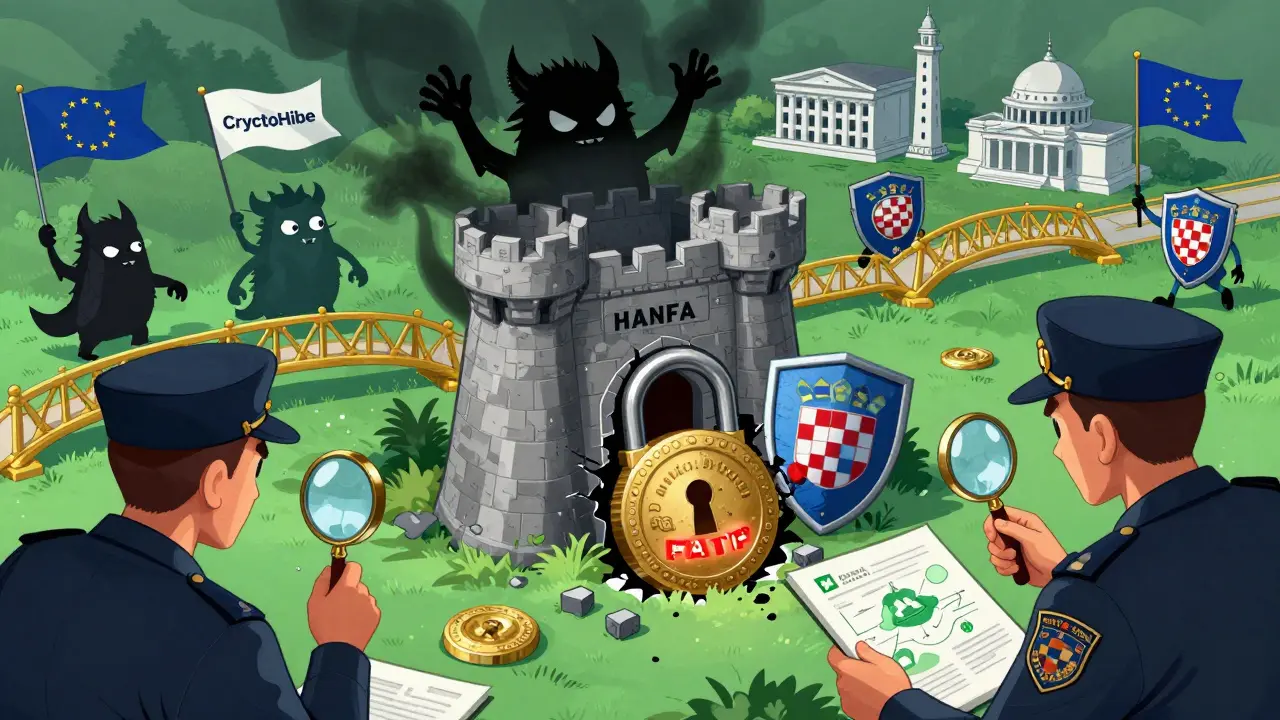
What’s Next? The FATF’s New Rules
In June 2025, FATF updated its guidance to say: “Financial inclusion isn’t optional - it’s part of fighting crime.” That’s a big shift. Countries can’t just crack down on criminals. They have to bring people into the system. For crypto, that means regulators can’t just ban anonymous wallets. They need to create safe, regulated paths for everyday users. The UAE did this with its digital dirham wallet. The Philippines did it with licensed P2P apps that let farmers send crypto to relatives. Croatia did it by letting small exchanges serve rural communities. The message is clear: crypto isn’t the problem. The lack of regulation is. And the countries that fix it - fast - win.Who’s Next?
As of January 2026, only three countries are on the FATF blacklist: North Korea, Iran, and Myanmar. They’re isolated. The grey list has 24 countries - including Algeria, Angola, Bolivia, and Bulgaria. Many of them are watching what the UAE, Philippines, and Croatia did. Vietnam is close to completing its action plan. Nigeria is revamping its crypto licensing system. Indonesia is preparing new rules for DeFi. If they follow the same path - clear rules, real enforcement, and public transparency - they could be next.What You Can Do
If you run a crypto business, don’t wait for regulators to catch up. Look at what the UAE, Philippines, and Croatia did:- Register with your country’s crypto authority - even if it’s not required yet.
- Implement real-time transaction monitoring. Use tools like Chainalysis or Elliptic.
- Train your team on AML procedures. Don’t treat it as a checkbox.
- Build relationships with local banks. Show them you’re compliant.
What does it mean if a country is removed from the FATF grey list?
It means the country has fixed its anti-money laundering and counter-terrorist financing systems to meet global standards. Banks and crypto exchanges can resume normal business with entities in that country without fear of regulatory penalties. It reduces compliance costs and improves access to international financial services.
Did crypto regulation help these countries get off the FATF list?
Yes - but indirectly. The FATF requires countries to regulate virtual asset service providers (VASPs) as part of its 40 Recommendations. The UAE, Philippines, and Croatia all created licensing systems for crypto exchanges, enforced KYC rules, and started monitoring transactions. These weren’t the only changes, but they were critical. Without them, FATF assessors wouldn’t have approved their progress.
Why is Turkey still on the FATF grey list?
Turkey has high crypto adoption but inconsistent enforcement. While it requires exchanges to register, many operate without oversight. The government has banned crypto payments but hasn’t fully integrated crypto into its AML system. FATF assessors say Turkey lacks strong asset recovery mechanisms and cross-agency coordination. Until these gaps are closed, removal is unlikely.
How long does it take to get off the FATF grey list?
It usually takes 2 to 4 years. Countries must complete a detailed action plan, pass new laws, train regulators, and prove enforcement through real cases. The UAE took 2 years. The Philippines took 4. Croatia took 3. Speed depends on political will and resources.
What happens to crypto exchanges when a country is removed from the FATF list?
They gain access to banking services again. Payment processors like Stripe and MoonPay return. International investors start funding local projects. Compliance costs drop. For example, after the Philippines was removed, its top three crypto exchanges saw their bank account approval rates jump from 30% to 85% within three months.
Linda Prehn
January 22, 2026 AT 06:16Brenda Platt
January 22, 2026 AT 18:27Barbara Rousseau-Osborn
January 24, 2026 AT 06:46Adam Fularz
January 24, 2026 AT 13:39Clark Dilworth
January 26, 2026 AT 11:49Athena Mantle
January 26, 2026 AT 14:29george haris
January 27, 2026 AT 03:43Catherine Hays
January 27, 2026 AT 22:09Sara Delgado Rivero
January 29, 2026 AT 16:06Steve Fennell
January 31, 2026 AT 15:28Roshmi Chatterjee
February 1, 2026 AT 12:39Mark Estareja
February 1, 2026 AT 23:27carol johnson
February 2, 2026 AT 00:23Nadia Silva
February 3, 2026 AT 21:37Adam Lewkovitz
February 4, 2026 AT 07:46