Interoperability in Modular Blockchains: How Chain Abstraction Solves Fragmentation

You probably remember the pain of moving funds from Ethereum to a new Layer 2 network. You had to bridge your assets, wait for confirmations, pay fees on two different chains, and pray that the bridge didn’t get hacked while you waited. That friction is exactly what modular blockchains are trying to eliminate. Unlike monolithic chains that try to do everything at once, modular architectures split execution, consensus, settlement, and data availability into separate layers. But here’s the catch: splitting things up creates fragmentation. If every specialized layer speaks a different language, who translates? That’s where interoperability comes in.
As of late 2026, the industry has seen a massive shift. The modularity and chain abstraction ecosystem grew by 300% in adoption over the past year. Why? Because users are tired of managing twenty different wallets just to access decentralized finance (DeFi). We have over 100 active blockchain networks now. Ethereum processes about 1.2 million transactions daily, while Solana handles over 40 million. These numbers aren’t just stats; they represent a fragmented landscape where liquidity is scattered like crumbs across a table. Interoperability isn’t just a nice-to-have feature anymore-it’s the plumbing that keeps the whole system from leaking.
The Architecture of Separation
To understand why interoperability is hard, you first need to grasp how modular blockchains work. Think of a traditional monolithic blockchain like a single-story house where the kitchen, bedroom, and garage are all in one room. It works, but if you want to expand the garage, you have to tear down the whole house. A modular blockchain separates these functions. One layer handles execution (running apps), another handles consensus (agreeing on truth), and a third ensures data availability.
This separation allows for specialization. A rollup can be optimized for high-speed gaming transactions, while another might focus on privacy-heavy financial settlements. However, this specialization creates silos. Without robust communication protocols, a game asset on Rollup A cannot easily interact with a financial derivative on Rollup B. This is where the concept of chain abstraction becomes critical. It acts as a universal translator, hiding the complexity of which chain you’re actually using from the end user.
Two Types of Interoperability Problems
Not all cross-chain needs are created equal. Current solutions mostly handle "1-to-1" interoperability. This means moving an asset directly from Chain A to Chain B. It’s straightforward: you lock tokens on A, mint wrapped tokens on B, and go about your day. Tools like liquidity routers and basic messaging protocols excel here.
But the real challenge is "n-to-1" interoperability. Imagine a decentralized exchange (DEX) that wants to offer the best price for swapping ETH for USDC. To do this, it needs to check liquidity pools on ten different chains simultaneously. It doesn’t just move money from A to B; it needs to read state from N chains to make a decision for 1 transaction. Traditional bridges fail here because checking ten chains sequentially is too slow and expensive. By the time you’ve checked the last pool, the price has already moved. Solving n-to-1 interoperability requires sophisticated orchestration frameworks that can query multiple states in parallel or use shared state layers.
Polkadot and Shared Security Models
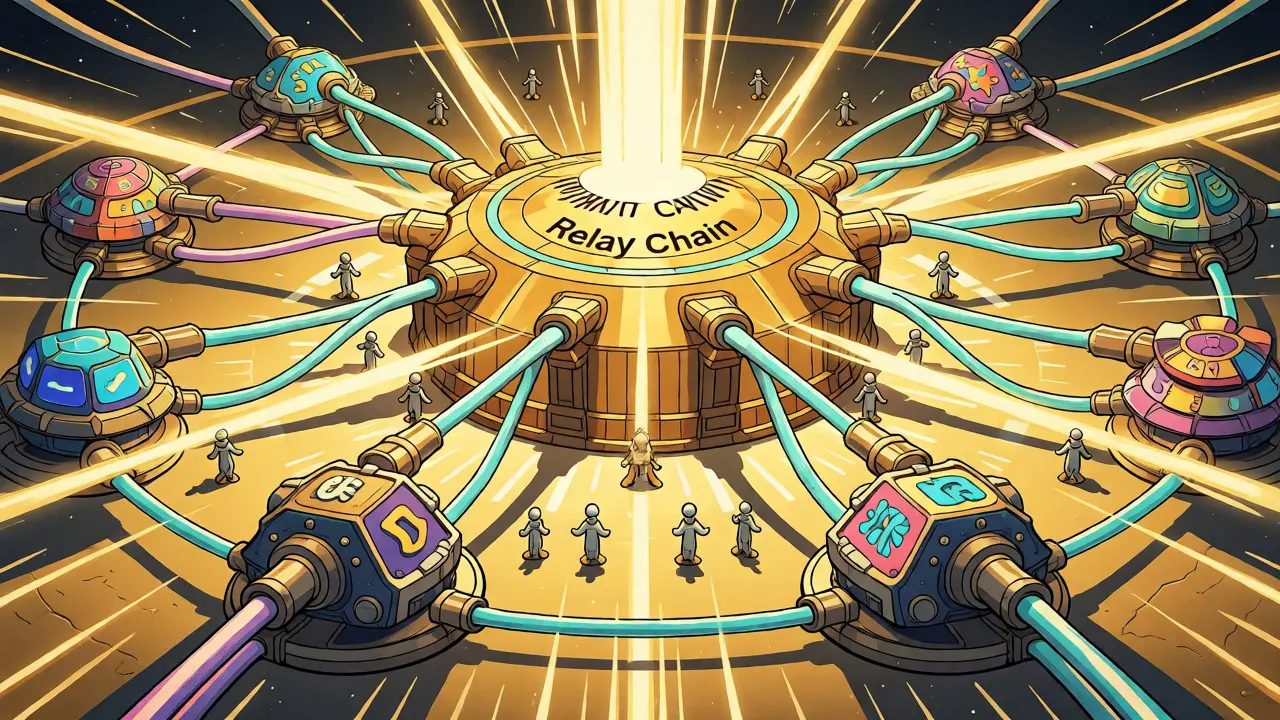
If you want to see modular interoperability done right, look no further than Polkadot. Gavin Wood, co-founder of Ethereum, built Polkadot years before "modularity" was a buzzword. Its core innovation is the Relay Chain, which provides consensus and shared security to all connected parachains.
In many other ecosystems, each new Layer 2 has to bootstrap its own validator set. If a small rollup gets hacked, the damage is contained but significant. In Polkadot, all parachains benefit from the main Relay Chain’s large, decentralized validator set. This means a new project doesn’t need to worry about attracting enough validators to secure its chain; it inherits security from the parent. This model enables fast finality-transactions are confirmed quickly and irreversibly without waiting for extra blocks or relying on external infrastructure.
The glue holding this together is the Cross-Consensus Messaging (XCM) format. XCM allows different parachains to communicate seamlessly. You don’t need a third-party bridge to move DOT from one parachain to another; the protocol itself understands the message. This native interoperability reduces the attack surface significantly compared to external bridges.
The Orchestration Layer: Making It Invisible
Even with great underlying tech, users shouldn’t care about relay chains or XCM formats. They just want to swap tokens. This is the job of orchestration projects. These platforms sit on top of the modular stacks and provide a unified interface. They break down into three key components:
- Account Abstraction: Projects like Avocado and Turnkey decouple the complex cryptographic keys from the user experience. You log in with an email or social account, and the backend handles the multi-chain private keys.
- Wallet Abstraction: Platforms like OneBalance, Particle Network, and Arcana Network allow you to manage assets across various blockchains through a single wallet interface. You don’t switch networks manually; the wallet does it for you.
- Orchestration Frameworks: Klaster, Light, Agoric, and Li.Fi coordinate cross-chain transactions. When you click "Swap," these frameworks figure out the best route across multiple chains, execute the trades, and settle the final balance, all while you watch a simple progress bar.
This layer solves the "user experience nightmare." Instead of juggling five different gas tokens and remembering which bridge to use, you interact with a single dashboard. The complexity is pushed down to the protocol level, where developers and bots can handle it more efficiently than humans can.
Security Risks and the Bridge Hack Reality
We can’t talk about interoperability without addressing the elephant in the room: security. Cross-chain operations have historically been the weakest link. The $600 million Ronin bridge hack in 2022 wasn’t just a loss of funds; it was a loss of trust. Bridges often rely on centralized validators or smart contracts that hold custody of assets on both sides. If those validators collude or the contract has a bug, the money disappears.
Modular approaches aim to mitigate this by reducing reliance on external custodians. In a shared security model like Polkadot’s, there is no external bridge holding your funds hostage. The security is native to the consensus mechanism. However, other ecosystems still rely heavily on optimistic or zero-knowledge proofs to verify cross-chain messages. While ZK-proofs are mathematically stronger, they are computationally heavy and expensive. Optimistic rollups are cheaper but require a challenge period, delaying fund access. Choosing the right interoperability solution often means balancing speed, cost, and security assumptions.

Comparing Interoperability Approaches
| Model Type | Primary Use Case | Security Assumption | Latency | Example Protocol |
|---|---|---|---|---|
| Shared Sequencer | High-frequency trading between specific L2 pairs | Trust in sequencer operator | Very Low | Espresso Systems |
| Messaging Protocols | General purpose asset transfer | External validators / Oracles | Medium | LayerZero |
| Native Shared Security | Deep integration within a multichain ecosystem | Parent Chain Consensus | Low | Polkadot XCM |
| ZK-Bridges | Secure, trust-minimized transfers | Mathematical Proof Validity | High | Succinct |
The Future: From Interoperability to Composability
Where do we go from here? The current goal is seamless movement. The next step is seamless composability. Right now, a smart contract on Chain A can send a message to Chain B. In the future, a smart contract should be able to call a function on Chain C as if it were local code. This requires standardized interfaces and faster verification times.
We are seeing early signs of this with "intent-based" architectures. Users express what they want (e.g., "Buy 1 ETH for the best price"), and solvers compete to fulfill that intent across any available chain. This shifts the burden from the user finding the path to the network finding the path. As latency drops and costs decrease, the distinction between "which chain am I on?" will vanish. You’ll just be on "the internet," powered by a mesh of modular blockchains working in concert.
For developers, this means building applications that are chain-agnostic by default. For investors, it means looking at projects that solve the n-to-1 problem, not just the 1-to-1 bridge problem. The winners won’t be the ones with the most bridges, but the ones with the deepest liquidity aggregation and the smoothest user abstraction.
What is the difference between monolithic and modular blockchains?
Monolithic blockchains, like Bitcoin or early Ethereum, handle execution, consensus, settlement, and data availability on a single layer. Modular blockchains separate these functions into distinct layers. This allows each layer to specialize-for example, one layer focuses solely on processing transactions quickly, while another focuses on securing the data. This separation improves scalability but requires robust interoperability protocols to keep the layers connected.
Why is 'n-to-1' interoperability harder than '1-to-1'?
1-to-1 interoperability involves moving data or value from Chain A to Chain B. N-to-1 interoperability requires accessing and reconciling data from multiple chains (N) to perform a single action on one chain (1). For example, a DEX needing global pricing must check liquidity on dozens of chains simultaneously. Doing this sequentially via traditional bridges is too slow and expensive, requiring advanced orchestration layers or shared state solutions.
How does shared security work in Polkadot?
In Polkadot, the central Relay Chain provides consensus and security for all connected parachains. Parachains do not need to run their own independent validator sets. Instead, they inherit the security guarantees of the Relay Chain's large validator set. This means a new parachain is secured by the same robust consensus mechanism as the main network, reducing the risk of attacks on smaller, newer chains.
What are the main risks of cross-chain bridges?
The primary risks include smart contract vulnerabilities, centralized validator failures, and oracle manipulation. High-profile hacks, such as the $600 million Ronin bridge exploit, demonstrate that if the bridge's custody mechanism is compromised, funds can be stolen regardless of the underlying chains' security. Modular approaches aim to reduce these risks by using native messaging protocols or zero-knowledge proofs rather than trusting external custodians.
What is chain abstraction?
Chain abstraction is a user experience layer that hides the complexity of interacting with multiple blockchains. Through account and wallet abstraction, users can manage assets across different chains using a single interface and login method. The underlying technology automatically routes transactions to the appropriate chain, handling bridging and gas payments in the background, so the user doesn't need to know which specific network they are using.