Middle Eastern crypto banking bans: Complete overview of GCC restrictions
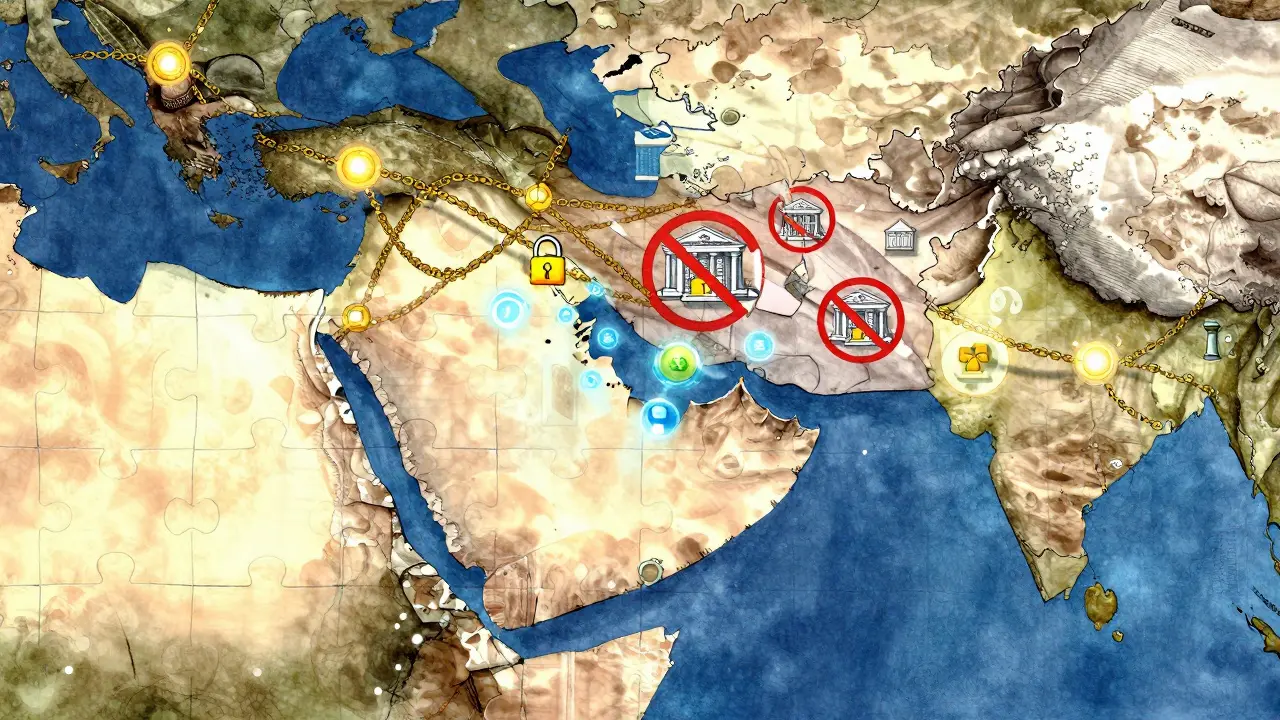
If you are trying to move money through the Middle East using cryptocurrency, you have probably noticed the roadblocks. Banks in Gulf Cooperation Council (GCC) nations treat digital assets differently than Western institutions do. While some countries welcome innovation, others shut down access entirely. As of March 2026, this landscape remains a complex mix of outright prohibitions and tightly controlled licensing. Understanding these restrictions is critical for anyone managing finances across the region.
The Regulatory Patchwork Across GCC Nations
Regulatory policy in the Gulf does not follow a single rulebook. Instead, experts describe the situation as a patchwork quilt. Each nation balances economic diversification goals with fears of financial instability. The total value of global digital assets has soared past $4 trillion, forcing regional regulators to act decisively. They distinguish sharply between retail crypto trading and services offered by traditional financial institutions. This distinction matters because your bank account status often determines your ability to interact with the blockchain economy.
Gulf Cooperation Council (GCC) consists of six key nations that coordinate economic policy while maintaining individual monetary sovereignty. These countries include Saudi Arabia, UAE, Qatar, Kuwait, Bahrain, and Oman. Their collective approach to virtual assets varies from aggressive prohibition to managed experimentation.
You cannot assume that regulations in Dubai apply to Riyadh. A policy update in one capital might take years to ripple across borders. This fragmentation creates significant friction for cross-border transactions. Banks remain cautious about processing payments involving even approved tokens due to fear of sanctions or reputational damage. The following sections break down the stance of each major player.
Saudi Arabia: Restricted but Strategic
Saudi Arabia operates under a nuanced framework where cryptocurrencies exist legally as assets but lack legal tender status. The Saudi Arabian Monetary Authority (SAMA) regulatory body responsible for overseeing financial markets and banking sector conduct. explicitly prohibits banks from processing cryptocurrency transactions without specific approval. This policy has been consistent since formal warnings issued by the Ministry of Finance in 2019.
Despite these banking restrictions, the Kingdom actively participates in blockchain development. It joined the mBridge CBDC pilot program alongside China, Thailand, and Hong Kong. This initiative shows that authorities want blockchain technology but strictly control private currencies. SAMA runs fintech sandboxes allowing controlled experiments. These programs suggest a pathway toward future formal frameworks without changing current prohibitions on public banking access.
United Arab Emirates: The Licensed Exception
The United Arab Emirates takes a more structured path compared to its neighbors. Here, licensed token frameworks allow specific activities while unlicensed operations remain strictly prohibited. Only approved tokens like Dirham Payment Tokens are permitted for payments. Banks operate under clear guidelines distinguishing between permitted and restricted digital asset activities.
The Central Bank of the UAE conducted interoperability tests for cross-border CBDC transactions through Project Aber as early as 2019. This indicates a deep technical foundation for digital finance. Experts often describe the UAE as 'unquestionably the keenest' among Arab countries toward adoption. However, this comes with strict banking controls ensuring that only vetted participants access the ecosystem.
Qatar: Shifting from Ban to Regulation
Qatar represents the most restrictive end of the spectrum historically. The Qatar Financial Centre Regulatory Authority (QFCRA) oversight body governing financial services within the Qatar Financial Centre zone. maintains comprehensive bans on cryptocurrency services including Bitcoin and stablecoins. By 2020, they expanded initial prohibitions to cover all virtual asset services within the financial center.
A significant shift occurred in September 2024 with the introduction of Digital Asset Regulations. These rules legalized tokenized assets like shares and bonds while explicitly designating cryptocurrencies as 'Excluded Tokens'. Banking sector prohibitions remain in force despite this progress. Compliance focuses on adhering to these prohibitions rather than implementing detailed Anti-Money Laundering requirements since most services are banned. The Q2 2025 framework finalization solidified these distinctions, creating a clear boundary between utility tokens and speculative crypto assets.

Kuwait and Enforcement Actions
Kuwait has implemented aggressive enforcement actions regarding mining. Restrictions resulted in a dramatic 55% reduction in local electricity usage tied to crypto mining. This demonstrates commitment to maintaining comprehensive restrictions on activities supporting global blockchain networks. Like Qatar, the country excludes itself from crypto markets while maintaining that digital assets are not legal tender. For businesses, this means zero tolerance policies on infrastructure support.
Bahrain: The Balanced Approach
Bahrain operates under a clear licensing regime via the Central Bank of Bahrain's Crypto-Asset (CRA) module. This determines permitted activities for financial institutions while prohibiting unlicensed operations. The country maintains active CBDC piloting programs. Unlike Qatar or Kuwait, Bahrain allows institutions to engage in approved crypto activities under oversight. This middle ground attracts regulated firms seeking access to the region without facing complete prohibition.
Oman: Following the Trend
Oman follows broader GCC trends with emerging specific regulations aligning with regional frameworks. While detailed rules continue developing, participation in regional CBDC pilots indicates movement toward defined structures. Future regulations will likely restrict unauthorized banking activities while permitting licensed operations similar to Bahrain and UAE models.
| Nation | Banking Access | Crypto Status | CBDC Involvement |
|---|---|---|---|
| Saudi Arabia | Prohibited without approval | Restricted Asset | mBridge Participant |
| UAE | Licensed tokens only | Legal with License | Project Aber |
| Qatar | Comprehensive Ban | Excluded Tokens | Active Pilots |
| Bahrain | Permitted via CRA Module | Regulated Activity | Active Pilots |

The Role of Central Bank Digital Currencies
These banking restrictions target private cryptocurrencies rather than blockchain technology itself. Governments view Central Bank Digital Currencies (CBDCs) digital forms of sovereign currency issued directly by national central banks. as strategic assets for financial sovereignty. The mBridge CBDC pilot represents wholesale development designed for institutions to facilitate domestic settlements. UAE, Bahrain, Oman, and Saudi Arabia maintain active programs focusing on regional interoperability.
This strategy reflects efforts to reduce reliance on Western financial systems. Research identifies these moves as central to national economic diversification. Experts characterize the approach as open but cautious regarding private crypto banking. You will see infrastructure growing even as consumer access shrinks.
Market Implications for Users and Businesses
Current barriers limit liquidity and institutional participation significantly. When banks refuse to process crypto withdrawals, users must rely on peer-to-peer methods or offshore exchanges. This increases risk and reduces market depth. However, the simultaneous development of regulatory sandboxes suggests eventual evolution. Companies planning entry must verify licensing requirements for each jurisdiction separately.
The distinction between retail trading warnings and banking prohibitions suggests clearer pathways for institutional participation in the future. If you run a business here, check whether your token falls under 'Excluded Tokens' as defined by local law. Qatar’s 2024 regulations offer a blueprint for how governments separate utility from speculation.
Looking Ahead: Standardization Efforts
Regional collaboration through projects like mBridge indicates movement toward coordinated approaches. The Qatar 2025 framework serves as a model for regional standardization. We expect gradual liberalization as regulatory frameworks mature. Strategic importance drives continued development despite restrictions. Reducing US dollar dependency enhances cross-border payment efficiency, a goal shared by all GCC members.
Are crypto bans permanent in the Middle East?
No, bans are often dynamic. Qatar updated its rules in late 2024, showing willingness to adapt. Current restrictions may evolve as CBDC frameworks prove successful and regulatory confidence grows.
Can I bank my crypto profits in Saudi Arabia?
Generally no. SAMA prohibits banks from processing crypto transactions unless specific approval is granted. Most individuals do not qualify for this exception.
What is the difference between a CBDC and Bitcoin?
A CBDC is a digital version of a government's currency, fully backed and regulated by the central bank. Bitcoin is a decentralized private asset. Governments prefer CBDCs because they retain control over monetary policy.
Is mining allowed in Kuwait?
Mining is strictly restricted. Enforcement measures led to significant drops in energy usage dedicated to crypto operations, indicating active suppression of this activity.
Which country offers the best crypto environment?
The UAE generally offers the most permissive environment for licensed activities. Bahrain also provides clear licensing modules. Both differ significantly from Qatar or Kuwait.
Florence Pardo
March 29, 2026 AT 05:09It is really fascinating to see how the regulatory landscape is evolving across the Gulf Cooperation Council nations during this period. The distinction between retail trading warnings and banking prohibitions seems to be the most critical factor for anyone involved in the industry. We are seeing a clear split where blockchain technology is welcomed while private currencies are often restricted entirely. This nuanced approach allows central banks to develop their own digital currency initiatives without compromising financial sovereignty. Countries like Qatar and Kuwait maintain strict bans which creates significant friction for international business operations involving these borders. Conversely, places like Bahrain and the United Arab Emirates have established licensing frameworks that provide a pathway for regulated firms to operate legally. The shift we are witnessing towards Central Bank Digital Currencies represents a strategic move to modernize payment systems while retaining control over monetary policy. It is quite obvious that the mBridge project involvement signals a desire for regional interoperability rather than isolated digital ecosystems. Investors need to understand that compliance requirements will differ drastically depending on which capital they are targeting for their expansion plans. The fragmentation of rules means that a license obtained in Dubai does not automatically grant permission to operate in Riyadh or Doha. This complexity necessitates a localized legal strategy for any serious enterprise wishing to engage with these markets. Banks remain extremely cautious about processing transactions linked to unapproved tokens due to fears of sanctions exposure. The fear of reputational damage drives institutional behavior more than the explicit laws in some cases. We might expect gradual standardization over time as the region seeks to reduce dependency on external financial systems. Eventually, we could see a unified framework emerge if the current pilot programs demonstrate sufficient stability and security.
Nicolette Lutzi
March 30, 2026 AT 22:57The whole push for CBDCs feels like a way to eliminate anonymity for good. They claim it helps efficiency but the goal is total surveillance of transactions. Governments always want more control over money flowing through their borders. It is interesting how they promote innovation in tech while restricting the tools that offer privacy. The restrictions on mining in Kuwait were just a cover story for stopping local energy consumption. You never see them admit the real reason behind the bans on crypto services. They frame it as protecting investors but it really limits individual freedom to choose assets. Financial sovereignty is just a fancy term for keeping power centralized. The western narrative tries to hide how restrictive these policies actually are for regular people. It makes sense why people look for peer-to-peer alternatives instead of trusting these banks.
Marie Mapilar
March 31, 2026 AT 03:06I totly agree with the assessment abut the fragmentated regulartory enviroment across the gulf states. The diffrentiation btwn utility tokens and speculative assetz is a crucial technical distinction for compiance officers. When we talk about interoperablilty in project aber it hilightes the infrastructural investment being made by central bank entities. Although the jusrictions vary significantly there is a common thread of risk mitigation strategies being deployed. SAMA and the qatar finanical center authorities seem to be aligning on the exclusionary priciples regarding unlicensed activity. The concept of sandbox testing is vital for innovation without exposing the traditinal banking sector to undue volatility. It is importamt to recognize the divergent approache taken by bahrain versus the stricter models seen in kuwait. The tokenized secuities framework offers a glimpse into where the market might mature in the next decade. Regulatory patchworks create friction but also allow for comparative analysis of policy efficacy across neighbors.
aravindsai pandla
March 31, 2026 AT 18:39While the previous comment highlights the technical distinctions well, the orthographic precision in discussing regulatory frameworks remains essential for accurate understanding. The terminology surrounding Excluded Tokens must be treated with absolute rigor when defining operational boundaries. It is important to note that the definition of virtual assets varies slightly between the national laws implemented by GCC members. Clarity on these points prevents misunderstandings for businesses seeking compliance pathways in the region.
Alicia Speas
April 1, 2026 AT 06:22The cultural context of financial regulation in the Middle East warrants a formal examination beyond mere legalistic terms. Each nation within the coalition exercises its monetary sovereignty with distinct priorities regarding economic diversification. We observe a deliberate separation between state-backed digital initiatives and decentralized network participation. The maintenance of this boundary is essential for preserving trust in domestic banking infrastructure. Institutions must adhere to these guidelines to ensure sustainable growth within their respective jurisdictions.
Dominic Taylor
April 1, 2026 AT 14:15The systemic integration of Project Aber indicates a robust commitment to cross-border settlement protocols within the sovereign digital currency architecture. Liquidity constraints imposed by traditional banking gateways effectively throttle the off-ramp capabilities for institutional participants. Interoperability standards defined by the mBridge consortium are establishing the necessary rails for future wholesale settlements. Tokenization of real-world assets presents a viable avenue for institutional entry under existing CRA modules in Bahrain. Market depth remains compromised until broader access permissions are granted to the wider banking community.
Sam Harajly
April 2, 2026 AT 07:00Observing the trend lines, one notices the consistent prioritization of Central Bank Digital Currency development over private cryptocurrency adoption. The strategic positioning suggests a focus on monetary control rather than technological suppression alone. Regional cooperation efforts indicate a shared interest in improving payment efficiency across borders. It appears that the barriers to retail access serve primarily to protect the integrity of national currencies. Future policy shifts may depend heavily on the success metrics of current pilot programs.
Neil MacLeod
April 2, 2026 AT 07:12It is tiresome to read yet another analysis stating the obvious about regional restrictions without acknowledging the underlying geopolitical motivations. The bureaucratic inertia within these financial centers ensures that meaningful liberalization remains unlikely in the immediate future. One must accept the status quo as the primary determinant of operational capability for now.
Andrea Zaszczynski
April 3, 2026 AT 04:32I wonder why everyone focuses so much on the banking aspect when the P2P networks are already circumventing these controls effectively. Perhaps the institutions feel threatened by the loss of transaction volume rather than actual security risks. Your perspective on the formal compliance ignores the reality of how money actually moves underground here. The disconnect between official policy and street-level usage is becoming increasingly difficult to ignore. People find ways to manage regardless of what the central banks say about prohibitions.
Shana Brown
April 3, 2026 AT 05:46I really appreciate the detailed breakdown of each country's specific stance on things! It is super helpful to know exactly where the red lines are drawn for licensing 👍 The difference between Dubai and Riyadh policies is huge and definitely something traders need to watch. Staying compliant is key to avoiding any headaches down the road! I think the CBDC pilots show great promise for the future of finance in the region 😊 Everyone should stay updated on the latest regulatory sandboxes.
Sarah Terry
April 3, 2026 AT 21:52Banks remain cautious about processing payments involving even approved tokens due to fear of sanctions.
Shayne Cokerdem
April 5, 2026 AT 13:48im not sure why ppl panic bout ths changes when ritefully govts want what they think is best for economy. maybe the system is trying to adapt to new tech slowy. u know what im meanin? its alll bout controlling the flow of cash insted of lettting random tokens fly arond. kowait mining ban was proably just energy savings too. we shuldnt read to much into the conspiracy stuff tho its getting too crazy.
Anna Lee
April 7, 2026 AT 11:47Hii friends I thnk your point abt energy saving in kuwait is so right! It might be a big factor in those deisions. Always good to check the local licnsing reqs before doing biz though! Hope evryone stays safe with there finances 😊 Dont forgit the rules change often in this space. Good luck with your investments!
namrata singh
April 8, 2026 AT 09:30It is deeply distressing to witness the limitations placed upon individual financial agency in these emerging markets. The potential for innovation is stifled by fear rather than fostered by structured support mechanisms. One feels a profound sadness knowing how many opportunities vanish due to arbitrary classification of digital assets. The silence from regulators regarding the benefits of decentralization speaks volumes about their true intentions. We must advocate for a balanced approach that respects both security and liberty.
YANG YUE
April 8, 2026 AT 19:24The essence of monetary sovereignty acts like a golden cage shielding the state from external volatility while locking out organic evolution. True freedom lies in the code yet the guardians of the treasury prefer the chains of regulation. History teaches us that suppression rarely stops the tide of technological progress eventually. The current gridlock represents merely a temporary pause in the grand narrative of digitization.
Alice Clancy
April 10, 2026 AT 08:06People are too naive to think licenses help you. Most get shut down anyway. Risky business.
Mohammed Tahseen Shaikh
April 10, 2026 AT 19:00Regulatory frameworks will likely tighten further as the Q2 2025 standardization concludes.