NHR Program and Cryptocurrency Tax Benefits in Portugal: What’s Still Possible in 2026
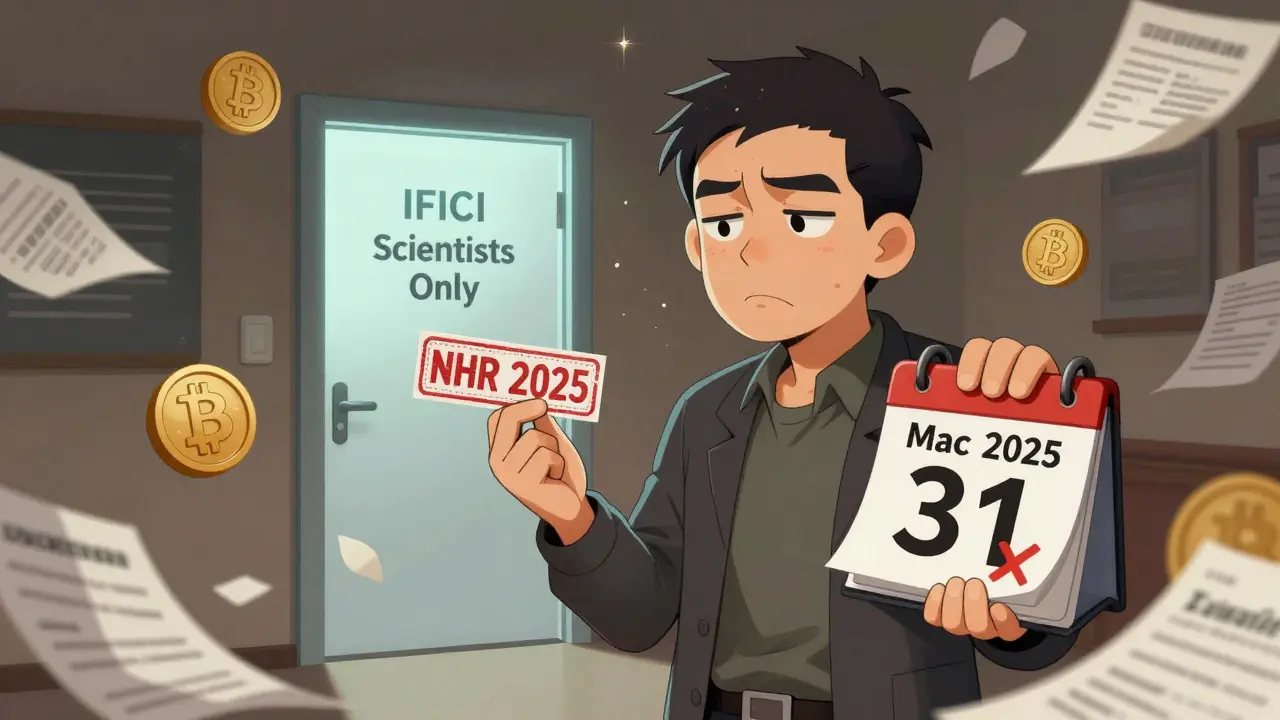
Portugal used to be the go-to place for crypto investors looking to avoid taxes. If you held Bitcoin for more than a year, you paid zero in capital gains tax. If you earned interest from staking or lending, you didn’t pay a cent. And if you moved there under the Non-Habitual Resident (NHR) program, your foreign income - including crypto profits - was completely tax-free. That was the reality before 2024.
What Happened to the NHR Program?
The original NHR program ended for new applicants on January 1, 2024. The Portuguese government didn’t scrap it overnight - they gave people a window to apply until March 31, 2025. If you didn’t submit your paperwork by then, you’re out. No exceptions. No loopholes. No last-minute saves. Now, the program has been replaced by the Tax Incentive for Scientific Research and Innovation (IFICI), also called NHR 2.0. It’s not the same. The old NHR was open to almost anyone: retirees, freelancers, remote workers, crypto traders. IFICI is narrow. It’s for scientists, engineers, researchers, and highly specialized professionals in tech and innovation. If you’re a full-time crypto trader making six figures but don’t have a PhD in blockchain or run a startup developing DeFi protocols, you won’t qualify.Cryptocurrency Taxes in Portugal Today
Even without NHR, Portugal still has one of the friendliest crypto tax systems in Europe - but only if you know the rules. Here’s how it works in 2026:- Long-term holdings (over 365 days): If you buy Bitcoin, hold it for more than a year, then sell it, you pay 0% tax. This still applies to everyone, regardless of residency status.
- Short-term holdings (under 365 days): Sell before the year is up? You pay 28% capital gains tax under Category G.
- Crypto-to-crypto trades: Exchanging Bitcoin for Ethereum? No tax triggered. This is huge. It lets you rebalance your portfolio without paying taxes.
- Staking, lending, airdrops: These are treated as income. You pay 28% when you receive them, not when you sell.
- Miners and professional traders: If the tax authorities decide your activity is a business (not personal investment), you pay income tax up to 48%. This is rare but possible if you’re trading daily with high volume.
Who Still Benefits from NHR?
If you got NHR status before March 31, 2025, you’re locked in for 10 years. That means if you applied in 2023, you’ll enjoy tax-free foreign income - including crypto gains - until 2033. That’s still a massive advantage. But here’s the catch: you have to prove you’re a tax resident. That means spending at least 183 days per year in Portugal. You can’t just rent an apartment for three months and call it home. You need a NIF (tax ID), a local bank account, utility bills in your name, and proof you live here. The Portuguese tax authority checks this.IFICI: The New Path - But Only for a Few
IFICI isn’t dead. It’s just not for everyone. To qualify, you must:- Work in scientific research, advanced technology, or innovation
- Have a job offer from a Portuguese company or research institution
- Be employed in a field approved by the government - think AI, quantum computing, biotech, or blockchain infrastructure development

What About Americans?
This is critical: Portugal doesn’t care what the IRS thinks. But the IRS cares a lot about what you do in Portugal. U.S. citizens and green card holders must report worldwide income - no exceptions. Even if Portugal taxes you at 0%, the IRS still wants its cut. Selling Bitcoin after holding it for 10 years in Portugal? You still owe U.S. capital gains tax. The U.S. doesn’t recognize Portugal’s 365-day rule. Your holding period resets the moment you become a U.S. taxpayer. Plus, FATCA forces Portuguese banks to report your account details to the IRS. You can’t hide. You’ll need to file Form 8938 and possibly FBAR if your foreign accounts exceed $10,000. Many Americans who moved to Portugal for crypto tax benefits are now facing double taxation - and penalties for not filing.Real Stories From People Who Tried
One Reddit user, "PortugalCryptoGuy," posted in June 2025: "I applied for NHR in February 2025. Got approved. Bought 5 BTC in March. Sold in April 2026 - tax-free. Saved over €22,000 in taxes. Worth every euro of the €2,000 application fee." Another, "TaxNomad2025," said: "I made €150k from crypto trading. Applied for IFICI. Got rejected. They said I’m not an ‘innovator.’ I’m just a trader. So now I pay 28% on every short-term trade. I’m moving to Georgia." Trustpilot reviews for NHR service providers show an average 4.2/5 rating - but almost all positive reviews are from people who applied before March 2025. New applicants are leaving negative reviews about confusion and rejection.What You Need to Do If You’re Thinking About Moving
If you’re considering relocating to Portugal for crypto tax benefits in 2026, here’s your checklist:- Check if you qualify for IFICI - Do you work in tech innovation? Can you prove it? If not, skip this route.
- Hold crypto for over a year - This is your only guaranteed tax-free path now.
- Use crypto tax software - Koinly or CryptoTaxAudit can track your 365-day window and flag taxable events.
- Never trade crypto-to-crypto thinking it’s tax-free - It is, but only if you’re not a professional trader. If you’re doing 20 trades a week, the tax office might call it a business.
- U.S. citizens: hire a cross-border tax pro - Don’t assume Portugal’s rules override the IRS. You need both.
- Don’t wait - The Portuguese Ministry of Finance is reviewing crypto tax rules in early 2026. There’s a real chance the 365-day rule could become 730 days.

How Portugal Compares to Other Countries
Portugal isn’t the only crypto-friendly country anymore:- Germany: Tax-free after one year, same as Portugal. No residency requirement.
- Switzerland: Some cantons (like Zug) have zero capital gains tax on crypto. No need to live there full-time.
- Georgia: Zero tax on crypto, no residency requirement, easy visa.
- Malta: Crypto gains taxed at 0% if held over 365 days - but you need to be a resident.
What’s Next for Portugal?
The EU’s MiCA regulations, fully active since July 2025, are changing everything. All EU countries must now regulate crypto exchanges, require KYC, and report transactions. Portugal will have to align its rules. Analysts at Deloitte Portugal predict the holding period for tax-free gains could extend to two years by 2027. The government is also under pressure from the EU to stop being a tax haven. The fact that 14,850 people got NHR in 2023 - and only 5,200 in 2024 - shows the tide has turned. Portugal wants high-value professionals, not just tax tourists.Final Reality Check
Portugal is still a great place to live. But the days of free crypto gains for anyone who moves there are over. If you didn’t lock in NHR before March 2025, you’re not getting it. The 28% short-term tax is now the norm. The 0% long-term rule still stands - but it’s not a loophole anymore. It’s a strategy. The smart move? Hold. Wait. Track. Document. And don’t assume Portugal will stay this way forever.Can I still get the NHR program in Portugal in 2026?
No. The original NHR program closed to new applicants on March 31, 2025. If you didn’t apply and get approved by that date, you cannot join. The replacement, IFICI, is only for scientists, researchers, and highly qualified professionals in tech and innovation - not for crypto traders or retirees.
Is cryptocurrency taxed in Portugal in 2026?
Yes - but only under certain conditions. If you sell crypto after holding it for less than 365 days, you pay 28% capital gains tax. If you hold it longer, you pay 0%. Staking, lending, and airdrops are taxed at 28% when received. Crypto-to-crypto trades are not taxable. This applies to everyone, regardless of residency status.
Do I need to live in Portugal full-time to get crypto tax benefits?
For the 0% long-term capital gains tax on crypto, no - you don’t need to live there. But if you want to qualify for IFICI (the new NHR), you must become a tax resident by spending at least 183 days per year in Portugal and proving you have ties to the country, like a local bank account, utility bills, and a NIF.
Can U.S. citizens avoid U.S. taxes by moving to Portugal?
No. The IRS requires U.S. citizens to report worldwide income, even if you live abroad. Portugal’s tax rules don’t override U.S. law. If you sell crypto in Portugal, you still owe U.S. capital gains tax. You must file Form 8938 and possibly FBAR. Many Americans who moved to Portugal for crypto tax benefits now face double taxation and penalties for not filing.
What’s the best strategy for crypto investors in Portugal today?
Hold your crypto for at least 366 days. Then, swap it for a stablecoin like USDC or USDT - this doesn’t trigger tax in Portugal. After that, cash out the stablecoin to euros. Since the stablecoin sale isn’t treated as a capital gain, you pay 0% tax. Use crypto tax software like Koinly to track your holding periods and avoid accidental taxable events.
Will Portugal change crypto tax rules again in 2026?
Yes, likely. The Portuguese Ministry of Finance is reviewing crypto taxation in early 2026. The EU’s MiCA regulations are pushing all member states to align rules. Industry analysts predict the tax-free holding period could extend from 365 to 730 days. Don’t assume the current rules will stay the same.
Is IFICI worth it for crypto investors?
Only if you’re a professional in tech innovation - like a blockchain developer, AI researcher, or founder of a regulated crypto startup. If you’re a trader or investor without a formal role in innovation, IFICI won’t help you. The flat 20% tax rate on Portuguese income is still available under IFICI, but you must meet strict professional criteria to qualify.
Raja Oleholeh
January 2, 2026 AT 17:30Prateek Chitransh
January 3, 2026 AT 19:08Alex Strachan
January 4, 2026 AT 06:12Rick Hengehold
January 5, 2026 AT 22:41Brandon Woodard
January 6, 2026 AT 07:52Antonio Snoddy
January 6, 2026 AT 17:03Ryan Husain
January 6, 2026 AT 19:36Rajappa Manohar
January 7, 2026 AT 09:11prashant choudhari
January 9, 2026 AT 06:38Willis Shane
January 9, 2026 AT 07:00Jake West
January 10, 2026 AT 11:13Shawn Roberts
January 11, 2026 AT 06:02