Nigeria's Crypto Banking Ban Reversal: From 2021 Prohibition to 2025 Regulation

When Nigeria’s Central Bank of Nigeria (CBN) banned banks from handling cryptocurrency transactions in February 2021, it didn’t stop people from buying Bitcoin. It just forced them underground. Overnight, millions of Nigerians switched to peer-to-peer (P2P) platforms, using mobile money and cash deposits to trade digital assets. The ban was meant to protect the financial system. Instead, it turned Nigeria into the world’s second-largest P2P crypto market-behind only Vietnam-with billions in monthly trades flowing outside the banking system.
The 2021 Ban: Why It Failed
The CBN’s February 5, 2021 circular didn’t make crypto illegal. It made it impossible to use banks. Financial institutions were ordered to cut off accounts linked to crypto exchanges and block transactions involving digital assets. Governor Godwin Emefiele claimed crypto posed a threat to financial stability. But the data told a different story: Nigerians weren’t using crypto to launder money-they were using it to save, send remittances, and protect savings from a collapsing naira. By 2022, Nigeria accounted for nearly 15% of global P2P crypto volume. Platforms like Paxful and Binance P2P became lifelines. People paid for Bitcoin with bank transfers, then withdrew cash from ATMs using gift cards or peer-to-peer deals. The ban didn’t kill crypto. It made it more decentralized, more risky, and harder to regulate.The Quiet Shift: Late 2022 to 2023
By late 2022, signs of change started appearing. Banks began quietly re-opening accounts for crypto firms-without public announcement. The CBN didn’t issue a statement, but compliance officers started asking for documentation. The reason? Foreign exchange pressure. Nigeria’s dollar reserves were shrinking. Remittances were falling. Crypto was bringing in hard currency without going through official channels. The turning point came in December 2023. The new CBN governor, appointed after Emefiele’s departure, lifted the 2021 ban. This time, there was no ambiguity. Banks could resume relationships with crypto firms-but only if those firms were licensed by the Securities and Exchange Commission (SEC). The CBN also issued its first-ever Virtual Asset Service Provider (VASP) Guidelines, setting rules for transaction limits, KYC checks, and reporting requirements.The 2025 Breakthrough: Legal Recognition
The real game-changer came in early 2025 with the passage of the Investments and Securities Act (ISA) 2025 which formally recognized digital assets as securities. For the first time, cryptocurrency exchanges, wallet providers, and trading platforms became regulated entities under the SEC’s authority. The law defined Virtual Asset Service Providers (VASPs) and required them to register, maintain capital reserves, and submit quarterly audits. This wasn’t just a policy tweak-it was a legal reset. Before ISA 2025, owning crypto was legal, but banking it wasn’t. Now, crypto firms must operate like banks, but under a securities regulator. The SEC now has the power to suspend or revoke licenses for non-compliance. This dual oversight-CBN for banking, SEC for securities-creates a system that’s more complex, but far more sustainable.
Who’s Getting Licensed? The Players Moving In
Major crypto platforms are rushing to apply. Yellow Card, a Lagos-based exchange, announced it had submitted its license application and partnered with Coinbase to expand its services across 20 African countries. Binance, despite being under investigation for alleged untraceable fund flows, is also believed to be preparing its application. But not everyone will get in. Industry insiders say the SEC plans to issue only a handful of licenses-perhaps five to seven-to avoid market fragmentation. One executive told Semafor Africa, “There aren’t going to be as many exchanges as I don’t think they’ll be giving so many licenses out.” This means the market may become dominated by a few well-capitalized players, leaving smaller operators behind.The Ongoing Tensions: Security Fears and Enforcement Risks
Even as the legal framework improved, enforcement stayed harsh. In March 2024, two Binance executives were detained by Nigerian authorities over allegations of facilitating illicit fund transfers. By May, the National Security Advisor reportedly considered labeling crypto trading a “national security threat.” The message was clear: regulation doesn’t mean freedom. The government still blames crypto for foreign exchange volatility. Traders who move large sums via P2P platforms are under scrutiny. The SEC and CBN have not yet clarified whether individuals must declare crypto purchases over a certain amount. This creates a gray zone: you can legally buy crypto through a licensed exchange, but if you use P2P, you’re still technically in violation of AML rules.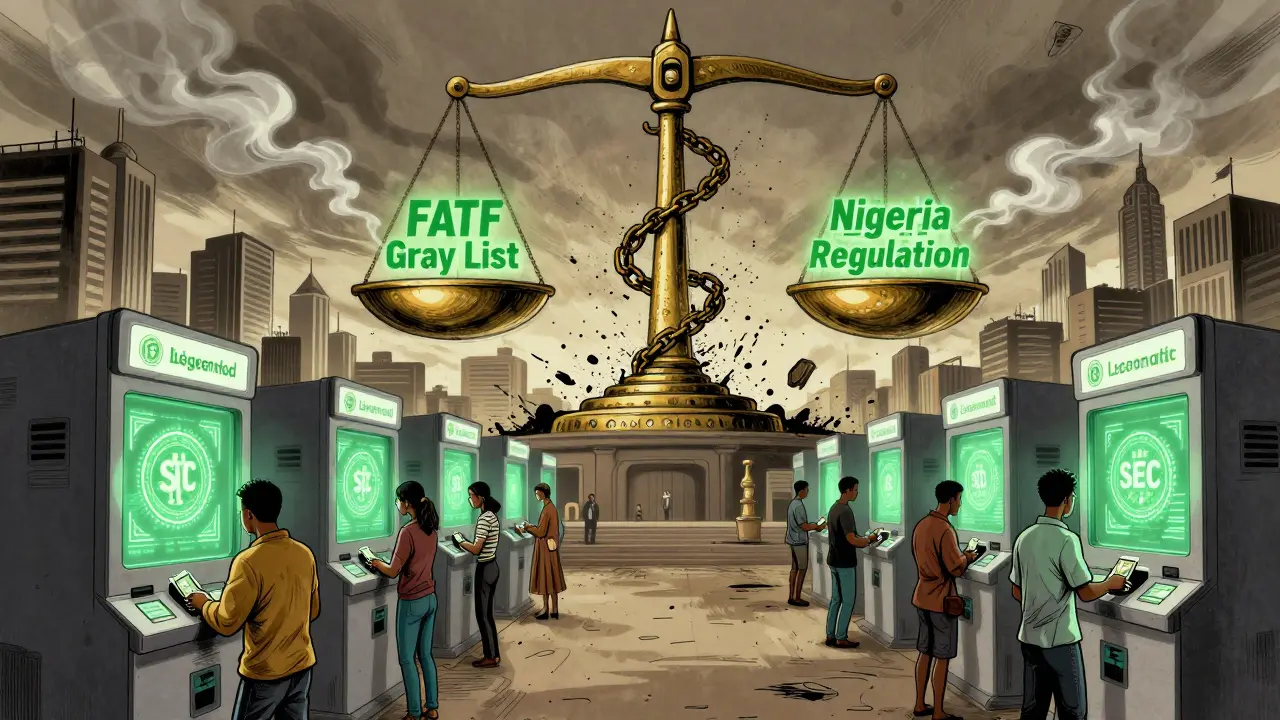
Why This Matters for Africa
Nigeria’s journey-from ban to regulation-is being watched across Africa. South Africa and Kenya have taken similar paths, but Nigeria’s scale makes it the test case. With over 180 million people and one of the highest crypto adoption rates on the continent, Nigeria’s success could set the standard for the whole region. The goal isn’t just to control crypto. It’s to get off the Financial Action Task Force’s (FATF) Gray List. Nigeria’s inclusion on that list since 2019 has hurt its access to international loans and investment. By implementing strict KYC and AML rules for VASPs, Nigeria hopes to be removed from the list by 2025. That’s the real driver behind the regulatory overhaul.What’s Still Unclear?
Despite the progress, big questions remain:- What are the exact transaction limits for crypto accounts? No public threshold has been set.
- Will individuals need to report crypto holdings on tax returns? The tax authority hasn’t clarified.
- Can you withdraw cash from a crypto-linked account? The CBN says no-but how is this enforced?
- Will P2P trading remain legal, or will it be restricted to licensed platforms only?
What’s Next?
The next 12 months will define Nigeria’s crypto future. If licensing moves quickly and transparency improves, crypto could become a legitimate part of the financial system. If the SEC delays approvals or enforces rules inconsistently, the market may fracture again-back into informal channels. For now, the reversal of the 2021 ban is a win for innovation. But it’s not the end of the story. It’s the beginning of a new phase: one where regulation is the tool, not the obstacle.Was cryptocurrency ever illegal in Nigeria?
No, owning or trading cryptocurrency was never illegal in Nigeria. The 2021 ban only prevented banks and financial institutions from facilitating crypto transactions. People could still buy and sell crypto through peer-to-peer platforms. The 2025 ISA law made it clear that digital assets are legal, but now they must be handled through licensed providers.
Can I still use Binance in Nigeria in 2025?
You can still access Binance’s platform, but if you want to use Nigerian banks to deposit or withdraw funds, you must go through a licensed VASP. Binance itself has not yet received a Nigerian license as of early 2025. Until it does, banking relationships remain restricted. Many users still rely on P2P trading, but that carries legal risk under current AML guidelines.
Which agencies regulate crypto in Nigeria now?
Two agencies share oversight: the Securities and Exchange Commission (SEC) handles licensing and compliance for crypto firms (as Virtual Asset Service Providers), while the Central Bank of Nigeria (CBN) controls banking relationships, transaction limits, and anti-money laundering rules for crypto-linked accounts.
Do I need a license to trade crypto as an individual in Nigeria?
No, individuals do not need a license to buy, sell, or hold cryptocurrency. Only businesses that offer crypto services-like exchanges, wallets, or trading platforms-must apply for a VASP license from the SEC. However, if you’re trading large amounts via P2P, you may be subject to AML scrutiny if your transactions trigger reporting thresholds.
Why did Nigeria reverse its crypto ban?
The ban failed. Nigerians kept using crypto anyway-billions in monthly trades flowed through informal channels. The government realized it couldn’t stop adoption, only control it. The reversal was driven by economic pressure: foreign exchange shortages, declining remittances, and the need to get off the FATF Gray List. Regulation offered a way to bring crypto into the light, reduce risks, and capture tax revenue.
Is crypto safe to use in Nigeria now?
It’s safer than before-if you use a licensed platform. The SEC’s oversight and KYC rules reduce fraud and scams. But the system is still new. Not all exchanges are licensed yet, and enforcement is uneven. Avoid unregulated platforms, never share your private keys, and only use services that display their SEC license number publicly.
Tracey Grammer-Porter
January 5, 2026 AT 18:27But honestly? The P2P scene was already a miracle. People were trading crypto like it was cash on the street, no banks needed. I've seen friends in Lagos do it with mobile airtime credits. Wild, right?
sathish kumar
January 7, 2026 AT 00:06Don Grissett
January 8, 2026 AT 23:59Classic government move. Always too late, always too bureaucratic. I mean come on
Mollie Williams
January 9, 2026 AT 12:18It's not just about money. It's about dignity. When your currency collapses, you don't wait for permission to survive.
Tiffani Frey
January 10, 2026 AT 02:42kris serafin
January 11, 2026 AT 17:12Nigeria turned a ban into a global crypto hub. Now they're bringing it in with rules? Respect. Hope they keep it simple for regular folks. No one wants to file a tax form just to buy Bitcoin. 🤞
Jordan Leon
January 12, 2026 AT 18:18Rahul Sharma
January 14, 2026 AT 04:17Paul Johnson
January 14, 2026 AT 15:44And why are we even letting these people have money when they dont even pay taxes??
Kelley Ramsey
January 16, 2026 AT 05:35Krista Hoefle
January 16, 2026 AT 16:44