No-KYC Crypto Exchange Shutdowns by Authorities: What’s Really Happening in 2026

It’s 2026, and if you’re still using a no-KYC crypto exchange, you’re playing with fire. Authorities aren’t just warning these platforms anymore-they’re shutting them down, freezing assets, and pressing criminal charges. This isn’t a rumor. It’s happening right now, and the list of fallen exchanges keeps growing.
Why Authorities Are Cracking Down
No-KYC exchanges sound appealing: no ID, no paperwork, no delays. But regulators see them as open doors for crime. Money laundering. Sanctions evasion. Ransomware payments. Terrorist funding. These platforms don’t track who’s sending or receiving money. That’s not privacy-it’s a blind spot that criminals exploit.
In 2025, the Financial Intelligence Unit of India (FIU-IND) sent notices to 25 offshore exchanges, including Huione, Paxful, and BitMex. These platforms weren’t just operating in India-they were actively targeting Indian users without registering. The result? Their apps were pulled from app stores. Their websites were blocked. Their access to Indian customers vanished overnight.
It’s not just India. The U.S. Department of Justice filed criminal charges against KuCoin and its founders in March 2024. Why? Because KuCoin allegedly processed over $5 billion in funds linked to crime while ignoring U.S. restrictions. The Commodity Futures Trading Commission added a civil complaint. The New York Attorney General hit them with a $22 million settlement. KuCoin didn’t just lose trust-it lost its legal footing.
The Domino Effect: What Happens When an Exchange Gets Shut Down
When a no-KYC exchange is taken down, it’s not just the platform that suffers. Users lose access to their funds. Support teams disappear. Withdrawal requests vanish into the void. And once a platform is flagged, banks cut ties.
That’s the real killer: banking de-risking. Major financial institutions won’t touch exchanges without solid KYC. Stablecoin issuers refuse to partner with them. Payment processors like Mastercard and Visa pull their cards. Even if a platform has $1.8 billion in daily volume-like Bitunix-it can’t survive if it can’t move money in and out.
And then there’s the reputational collapse. Advertisers and affiliate networks stopped working with non-compliant exchanges in 2025. No more Google Ads. No more influencer promotions. No more traffic. The marketing pipeline dries up, and without it, growth stalls.

The Global Shift: Compliance Is Now the Norm
The crypto world has changed. In 2023, 85% of centralized exchanges had KYC. By 2025, that number jumped to 92%. Why? Because the cost of non-compliance became too high.
Binance paid billions in fines. Coinbase settled a $100 million case with the New York Department of Financial Services and agreed to an independent compliance monitor. Even giants aren’t safe. If you’re not following the rules, regulators will find you.
And the rules are getting clearer. The Seychelles government passed strict licensing laws in September 2025. KuCoin and BTSE were forced to leave. They relocated to Turks and Caicos and Costa Rica-places with weak oversight. But that’s not a long-term fix. Global cooperation between financial intelligence units is tightening. Information flows faster. Jurisdictional loopholes are closing.
What Users Are Doing Now
Surprisingly, more users are asking for KYC-not avoiding it.
A 2025 CipherTrace report found that strong KYC reduced crypto fraud by 38%. 67% of institutional investors now say KYC is a dealbreaker. In the U.S., 58% of crypto users prefer exchanges that verify identities. Why? Because they feel safer.
And the process isn’t painful anymore. In 2023, KYC took 7 minutes on average. In 2026, it’s under 3.5 minutes. AI-powered document checks. Facial recognition. Instant verification. Compliance doesn’t mean friction-it means speed and security.
Where No-KYC Exchanges Still Hide (And Why It’s Risky)
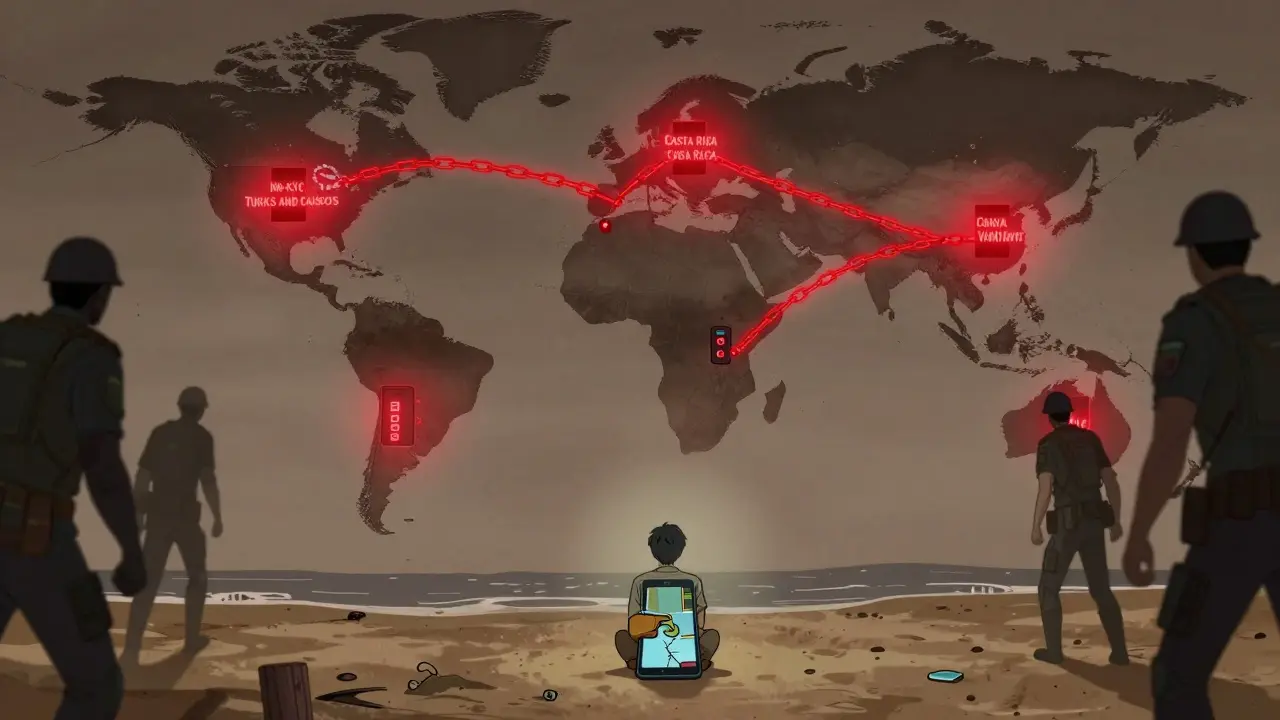
You’ll still find no-KYC platforms operating in places like Turks and Caicos, Costa Rica, and Vanuatu. These jurisdictions offer quick registration and minimal oversight. But they also offer zero legal protection.
If you’re holding funds on one of these platforms and it gets raided tomorrow, you have no recourse. No customer service. No legal team. No insurance. Your coins are gone. And if you’re a U.S., EU, or Indian resident, you’re already violating local laws by using them.
Regulators don’t care if you’re in New York or Nairobi. If you’re trading on a platform that ignores KYC, you’re part of the problem. And authorities are starting to track individual users too.
The Future: No-KYC Is Not an Option
By 2026, operating a major crypto exchange without KYC is practically impossible. The infrastructure doesn’t exist anymore. Banks won’t work with you. Payment networks won’t touch you. Advertisers won’t fund you. Users won’t trust you.
Regulators aren’t trying to kill crypto. They’re trying to remove the criminals. And the clean players? They’re winning. Platforms that built strong KYC systems early are now the most trusted. They’re the ones getting partnerships with banks. The ones launching ETFs. The ones listed on major exchanges.
The message is clear: if you’re avoiding identity verification, you’re not avoiding regulation-you’re inviting it. And when it comes, it won’t be polite. It won’t give you a second chance. It will shut you down, freeze your funds, and move on to the next target.
krista muzer
February 14, 2026 AT 22:51Okay but like… have you ever tried to do KYC on a platform that’s literally just a website with a form and a selfie cam? It’s not 3.5 minutes. It’s 47 minutes of uploading the same document three times because the AI said my left eyebrow was ‘suspiciously asymmetrical.’ And then they lock your account for ‘inconsistent lighting.’ I just want to trade Bitcoin, not audition for a spy thriller.
Ekaterina Sergeevna
February 16, 2026 AT 04:29Oh sweet merciful regulatory capitalism. We’ve officially turned decentralization into a compliance audit with a side of facial recognition. The real crime here isn’t the no-KYC exchanges-it’s that we’ve normalized surrendering our digital identity to corporations who sell our biometrics to third-party data brokers under the banner of ‘security.’ You call this progress? I call it a monoculture of surveillance dressed in blockchain glitter.
Brittany Meadows
February 17, 2026 AT 12:39They say 'criminals exploit no-KYC'-but what if the real criminals are the ones who invented KYC in the first place? 😏 Think about it. The moment you require ID to trade crypto, you create a centralized ledger of who owns what. That’s not privacy. That’s a government-issued blockchain of control. And now we’re all cheerleading it? We got played. The banks didn’t want crypto to be decentralized-they wanted it to be *banked*. 🤖💸
Ace Crystal
February 17, 2026 AT 19:24Look, I get the fear. But let’s not throw the baby out with the bathwater. The fact that you can move value without permission is revolutionary. KYC isn’t the solution-it’s the compromise. We don’t need to surrender our autonomy to regulators. We need better tech: zero-knowledge proofs, decentralized identity, on-chain reputation systems. The tools exist. The will? Not so much. Let’s build the future, not beg for permission.
Sanchita Nahar
February 19, 2026 AT 01:01Who cares? I used a no-KYC site last week. Got my BTC in 2 minutes. No forms. No selfie. No drama. Now I’m chilling with my coins while everyone else is filling out paperwork. You think the government cares about me? Nah. They’re busy chasing the big fish. I’m just a small fry. And small fries don’t get caught.
Lindsey Elliott
February 20, 2026 AT 22:1867% of institutional investors say KYC is a dealbreaker?? Bro. That’s not about security. That’s about liability. They don’t want to get sued if someone uses their platform to move ransomware cash. They want a paper trail so they can say 'we didn’t know!' when the Feds knock. Real users? We just want to trade. 😑
Claire Sannen
February 21, 2026 AT 20:02There’s a difference between regulation and oppression. KYC isn’t about surveillance-it’s about accountability. If you’re using crypto to avoid taxes or fund illegal activity, yes, you should be caught. But if you’re just buying Bitcoin to protect your savings from inflation? You deserve to do it safely, without being lumped in with criminals. Compliance doesn’t mean surrender. It means inclusion.
Will Lum
February 22, 2026 AT 21:54My uncle in Florida bought $50k in BTC on a no-KYC site last year. Got raided. Lost everything. Said he 'trusted the vibe.' Now he’s on a YouTube rabbit hole about how the Fed is using AI to track crypto wallets. He’s not angry. He’s just confused. The system didn’t fail him. The narrative did. We need better education, not more laws.
Keturah Hudson
February 23, 2026 AT 10:41In Nigeria, people use no-KYC platforms because banks freeze accounts for 'suspicious activity' if you even mention crypto. In India, they shut down exchanges because they don’t want people avoiding capital controls. In the US, we lecture about KYC like it’s a moral imperative. But the truth? It’s about control. Different countries, same playbook. The real issue isn’t crypto-it’s sovereignty.
Andrea Atzori
February 25, 2026 AT 08:20Let’s not romanticize the 'wild west' of crypto. When a platform like KuCoin allegedly processed $5 billion in criminal funds, that’s not innovation-that’s negligence. The fact that users are now *asking* for KYC because they feel safer? That’s evolution. We’re not losing freedom. We’re gaining trust. And trust is the foundation of any sustainable financial system.
Grace Mugambi
February 26, 2026 AT 02:39There’s a quiet truth here: most people don’t want to be anarchists. They want to feel safe. They want to know that if they lose their keys, there’s a path to recovery. That’s not weakness. It’s humanity. The real challenge isn’t forcing compliance-it’s building systems that are both secure and dignified. Not surveillance. Not perfection. Just dignity. That’s what we’re really fighting for.
Kaz Selbie
February 27, 2026 AT 21:31Let’s be real. The only reason KYC is 'under 3.5 minutes' now is because they’re using AI to auto-approve users who look like white middle-class professionals. My friend, a Black woman from Detroit, got flagged 12 times for 'suspicious facial features.' Meanwhile, some guy in Latvia with a fake passport got verified in 90 seconds. This isn’t security. It’s bias with a blockchain logo.
Robbi Hess
March 1, 2026 AT 17:56They’re shutting down no-KYC platforms? Good. But let’s not pretend this is about crime. It’s about revenue. Governments want to tax crypto. They want to track it. They want to control it. And if you’re not playing by their rules, you’re not just a criminal-you’re a tax evader. The real enemy isn’t the exchange. It’s the state’s hunger for financial dominion.
Christopher Wardle
March 3, 2026 AT 02:17Regulation isn’t the opposite of freedom. It’s the architecture that makes freedom possible. Without rules, markets collapse into chaos. Without KYC, crypto becomes a haven for the worst actors. And then the public turns against it entirely. We’re not losing autonomy-we’re building a system that can survive long enough to matter.
Tammy Chew
March 3, 2026 AT 19:40Remember when we called this 'financial liberation'? Now it’s just another corporate onboarding flow with a blockchain sticker. We traded freedom for convenience and called it progress. The irony? The people who preached decentralization are now the ones begging for government-approved wallets. We didn’t outgrow the system. We just got tired of fighting it.
Desiree Foo
March 4, 2026 AT 02:39It’s not about KYC. It’s about responsibility. If you’re going to participate in a global financial system, you owe it to everyone else to be transparent. This isn’t about trust in institutions-it’s about trust in each other. A world where anyone can send $10 million to a terrorist cell without a trace? That’s not freedom. That’s anarchy. And anarchy doesn’t scale. It collapses.
blake blackner
March 5, 2026 AT 08:53my 7 year old can do KYC now. literally. just take a selfie and say 'hi' and boom. verified. they even have a cartoon dog that says 'good job!' after. i used to spend hours on this stuff. now? i get my btc in 90 seconds. why are we still arguing? 🤷♂️✌️
Santosh kumar
March 5, 2026 AT 13:39For those who say KYC is the end of crypto freedom-remember this: Bitcoin was created to empower the unbanked. But true empowerment isn’t hiding. It’s inclusion. When people in rural India can finally access a verified, secure crypto wallet with just a phone, that’s the real revolution. Let’s not confuse convenience with freedom. Let’s build bridges, not barricades.
SAKTHIVEL A
March 6, 2026 AT 07:46It is an incontrovertible fact that the absence of Know Your Customer protocols constitutes a systemic vulnerability in the cryptographic financial architecture. The Financial Intelligence Unit of India, in its 2025 report, explicitly cited the absence of transactional traceability as a material risk to national economic sovereignty. To advocate for non-compliance is not to champion liberty-it is to wilfully endanger the integrity of the entire ecosystem. The time for rhetorical posturing has expired. Regulatory alignment is not optional. It is existential.