Nonce Range and Mining Difficulty: How Bitcoin Secures the Network
Imagine trying to guess a specific number between 1 and 4.3 billion, but you have to do it before your neighbor does, while millions of other people are guessing at the same time. That is essentially what Bitcoin mining is all about. At the heart of this digital gold rush lies a simple yet powerful cryptographic tool called the nonce. It sounds technical, but understanding how the nonce range interacts with mining difficulty explains why your laptop can’t mine Bitcoin anymore and why data centers in Texas burn through megawatts of electricity just to find one valid block.
What Exactly Is a Nonce?
A nonce stands for "number only used once." In the context of Bitcoin protocol, it is a 32-bit integer field inside the block header. Think of it as a random variable that miners tweak repeatedly. They take the block’s data-transactions, timestamp, previous block hash-and add this number. Then they run the whole package through the SHA-256 hashing algorithm. The goal? To produce a hash that starts with a certain number of zeros. If the hash doesn’t start with enough zeros, the miner changes the nonce by one (or more) and tries again. This process repeats billions of times per second.
The math here is strict. A 32-bit number has a maximum value of $2^{32} - 1$, which equals 4,294,967,295. This creates a fixed search space. Once a miner exhausts all possible values from 0 to 4.29 billion without finding a valid hash, they hit a wall. They can’t just keep incrementing the primary nonce because there are no numbers left. This limitation forces miners to change other parts of the block header, like the transaction order or the timestamp, to reset the nonce counter. It’s a clever constraint that keeps the system secure and predictable.
The Role of Mining Difficulty
If the nonce is the key, mining difficulty is the lock mechanism that determines how hard it is to turn that key. Difficulty isn’t a static number; it’s a dynamic target. The Bitcoin network adjusts this target every 2,016 blocks, which takes roughly two weeks. The formula is straightforward: if blocks are being found faster than the 10-minute average, difficulty increases. If they’re slower, it decreases.
This adjustment ensures that regardless of how many miners join or leave the network, new blocks appear on average every ten minutes. As of late 2023, the difficulty factor was over 63 trillion. This means the resulting hash must be numerically smaller than a specific 256-bit threshold. The higher the difficulty, the more leading zeros required in the hash, and the fewer valid nonces exist within that 4.29 billion range. When difficulty spikes, the probability of any single nonce guess succeeding drops dramatically, forcing miners to cycle through the entire nonce range much faster.
When the Primary Nonce Runs Out: The Extra Nonce
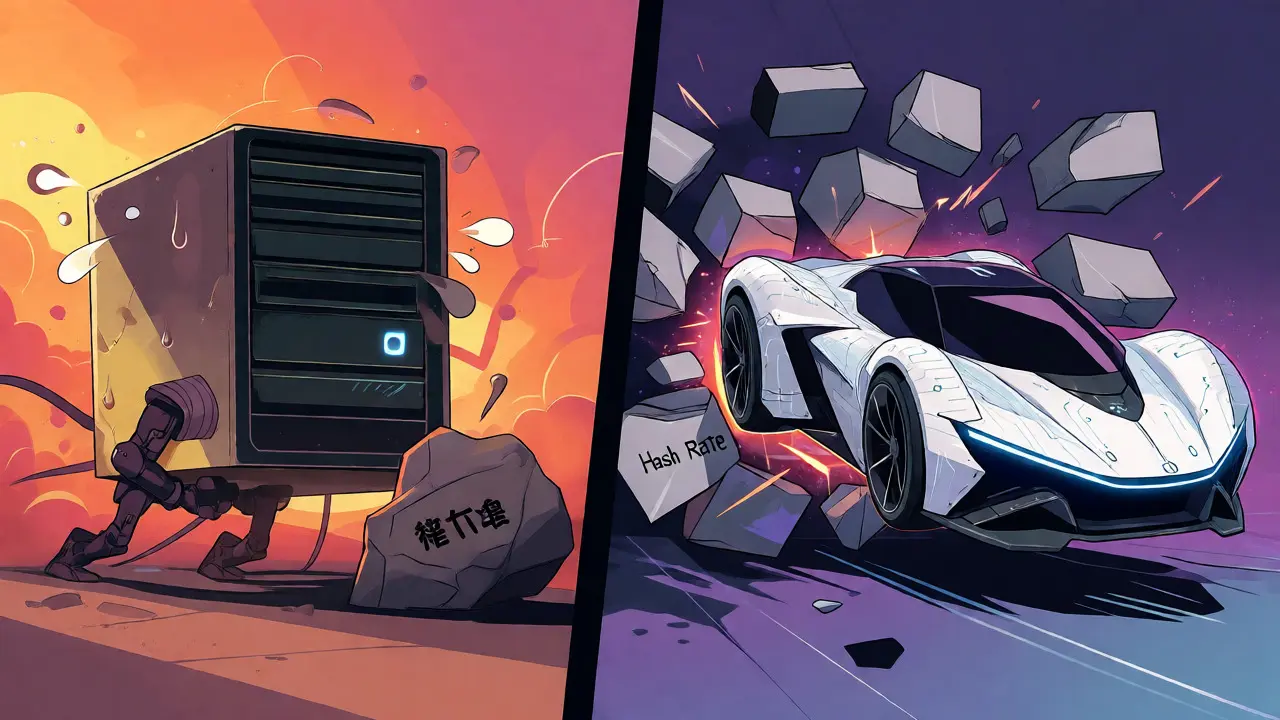
Here is where things get interesting for modern mining. With current hash rates exceeding 600 exahashes per second, a single ASIC miner can burn through the entire 32-bit primary nonce space in milliseconds. What happens then? Miners use an extra nonce. This is a variable-length field embedded in the coinbase transaction-the first transaction in every block that pays the miner. By changing the extra nonce, miners effectively create a new block template. This resets the primary nonce counter back to zero, allowing them to continue searching.
Think of the primary nonce as the first dial on a combination lock. You try all positions from 0 to 999. Once you’ve tried them all, you don’t give up; you rotate the second dial (the extra nonce) and try the first dial again. This layered approach allows Bitcoin to scale its security model without changing the fundamental 32-bit structure of the block header. However, it adds complexity. Mining pools now spend significant computational resources managing these extra nonces and rebuilding Merkle trees to ensure each attempt is unique.
| Feature | Bitcoin | Litecoin | Kaspa |
|---|---|---|---|
| Nonce Size | 32-bit | 32-bit | 64-bit |
| Max Values | ~4.3 Billion | ~4.3 Billion | ~18 Quintillion |
| Block Time Target | 10 Minutes | 2.5 Minutes | 1 Second |
| Extra Nonce Usage | Frequent | Moderate | Rare |
Why Hardware Matters More Than Ever
You might wonder why you can’t just buy a better graphics card and mine Bitcoin at home. The answer lies in the sheer volume of guesses required. A standard CPU might perform a few million hashes per second. A modern ASIC miner like the Antminer S19 XP performs 140 trillion hashes per second. At current difficulty levels, a solo miner with a high-end PC would statistically wait thousands of years to find a block. The nonce range is so large relative to the speed of consumer hardware that the odds are practically zero.
This disparity has driven the mining industry toward specialization. General-purpose GPUs were replaced by FPGAs, which were then replaced by Application-Specific Integrated Circuits (ASICs). These chips are designed to do one thing: iterate through nonce values and compute SHA-256 hashes as fast as possible. They don’t run Windows or play games. They are industrial machines dedicated solely to solving the nonce puzzle. This efficiency comes at a cost, both financially and environmentally, as the network’s total energy consumption scales with the hash rate.

Security Implications of the Fixed Nonce Space
Some critics argue that the 32-bit limit is a bottleneck. Dr. Pieter Wuille, a core contributor to Bitcoin Core, disagrees. He argues that the constraint is a feature, not a bug. Because miners must frequently change other header fields when the nonce runs out, they constantly rebuild the Merkle tree. This process introduces additional entropy and makes pre-computation attacks harder. If the nonce space were infinite, specialized hardware could potentially optimize the hashing pipeline more aggressively, possibly centralizing mining even further.
However, the pressure is real. As hash rates grow, the frequency of extra nonce rotations increases. This leads to more overhead in managing block templates. Proposals like BIP-320 aim to address these inefficiencies, but the Bitcoin community moves slowly. The priority remains stability. The current system has secured trillions of dollars in value for over a decade, proving that simplicity often beats theoretical perfection.
Practical Takeaways for Miners and Investors
If you are looking to enter the mining game or understand market dynamics, keep these points in mind:
- Difficulty Adjustments: Monitor the two-week adjustment period. A sudden drop in global hash rate (like when China banned mining in 2021) lowers difficulty, making mining temporarily more profitable for those who stayed online.
- Hardware Efficiency: Older ASICs may become unprofitable not because they break, but because their hash rate per watt can’t compete with newer models as difficulty rises.
- Pool vs. Solo: Due to the vast nonce range and high difficulty, joining a mining pool is essential for consistent income. Solo mining is akin to buying lottery tickets every ten seconds.
Understanding the interplay between the finite nonce range and the adjustable difficulty target gives you a clearer picture of Bitcoin’s economic engine. It’s not magic; it’s math enforced by electricity. Every block added to the chain represents a massive collective effort to solve a puzzle that gets harder every day, ensuring that the network remains secure against attackers who would need to control a majority of that computing power to rewrite history.
What happens if a miner uses up all 4.29 billion nonce values?
When a miner exhausts the 32-bit primary nonce range, they cannot simply continue incrementing the number. Instead, they modify other elements of the block header, such as the timestamp or the extra nonce in the coinbase transaction. Changing these fields creates a new block template, which effectively resets the primary nonce counter to zero, allowing the miner to begin a new cycle of guesses.
How does mining difficulty affect the nonce search?
Mining difficulty sets the target value that the SHA-256 hash must fall below. Higher difficulty means the target is smaller, requiring more leading zeros in the hash. This drastically reduces the percentage of valid nonces within the 4.29 billion range. Consequently, miners must test more nonce values to find a valid solution, increasing the computational work required per block.
Can quantum computers solve the Bitcoin nonce problem easily?
Not currently. While quantum computers excel at certain mathematical problems, breaking SHA-256 requires significantly more qubits than we have today. Research suggests fault-tolerant quantum computers would need billions of qubits to efficiently solve the nonce puzzle. Current processors have around 1,000 qubits, so Bitcoin's proof-of-work remains secure against quantum threats for the foreseeable future.
Why is the extra nonce necessary?
The extra nonce is necessary because the primary 32-bit nonce space is too small for modern mining speeds. High-performance ASICs can cycle through all 4.29 billion possibilities in milliseconds. Without the extra nonce, miners would have to stop and wait for a new block template from the network. The extra nonce allows them to continuously generate new candidate blocks locally without waiting for external updates.
Does a higher hash rate always mean higher difficulty?
Generally, yes, but with a delay. The network measures the time taken to mine the last 2,016 blocks. If the total hash rate increases, blocks are mined faster than the 10-minute target. After the next 2,016 blocks, the difficulty adjusts upward to compensate. There is a lag between a spike in hash rate and the corresponding increase in difficulty.