P2P Crypto Trading in Russia: Top Platforms and Real Risks in 2026
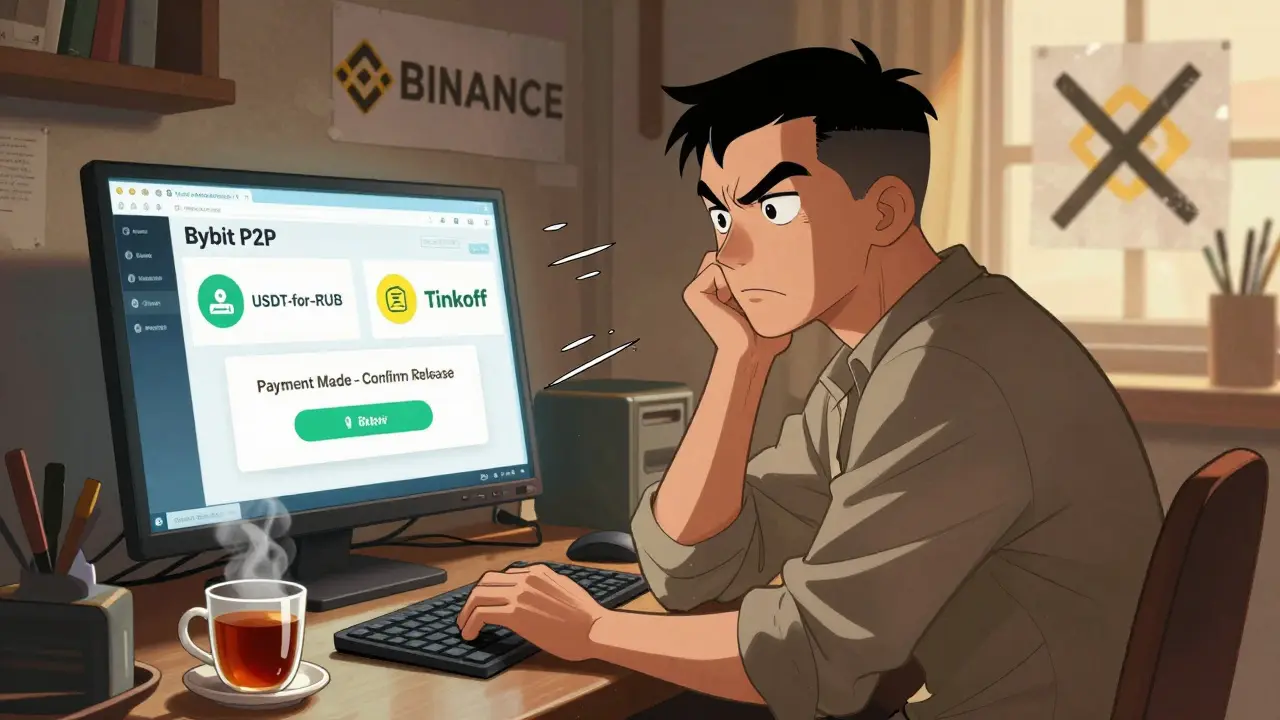
When banks in Russia stopped accepting crypto deposits and foreign exchanges pulled out, P2P trading didn’t just survive-it became the only way millions of Russians keep access to digital assets. If you’re trying to buy or sell crypto in Russia today, you’re not using a traditional exchange. You’re trading directly with another person, through a platform that holds your crypto in escrow until the rubles clear. It’s not ideal. But it’s functional. And it’s growing.
Why P2P Is the Only Option Left
In 2022, Binance and OKX stopped offering Russian ruble (RUB) trading. No deposits. No withdrawals. No ads. Overnight, millions of users lost their main gateway to convert crypto into cash. The Russian Central Bank had already made it clear: banks shouldn’t touch crypto-related transactions. So people turned to P2P platforms-places where you negotiate directly with another user, and the platform acts as a middleman, not a bank. Today, P2P isn’t just a workaround. It’s the backbone of Russia’s crypto economy. Over $40 million in crypto trades hands daily through these platforms, mostly in USDT. That’s because USDT is stable, widely accepted, and easy to convert into rubles. You don’t trade BTC for cash. You trade USDT for rubles. Then you hold the cash-or trade it back later.The Top 5 Platforms Still Operating in Russia (2026)
Not all platforms are equal. Some have vanished. Others adapted. Here are the five that still work-and why traders choose them.- Bybit: Leading the pack with over 3,800 active ads and $27 million in daily volume. It’s the most trusted because it offers full Russian language support, local bank integration (Sberbank, Tinkoff, MIR cards), and 0.1% fees. You can deposit rubles via SBP, Advcash, or card. It also supports staking, futures, and copy trading. Traders say it’s the most reliable for large trades.
- HTX P2P: Second in volume with $7.7 million daily. It’s stable, with over 1,300 ads. Supports RUB via bank transfer and local cards. Fewer features than Bybit, but solid for basic buying and selling.
- MEXC: The altcoin hunter’s choice. With 2,800+ cryptocurrencies and 0% maker fees, it’s where new tokens list first. Russian users love it because it accepts Payeer, Yandex Money, and SBP. You can trade with up to 500x leverage. Daily airdrops keep traders coming back.
- KuCoin: Offers 900+ coins with 0.1% fees. But here’s the catch: it only accepts RUB via credit and debit cards. No bank transfers. No SBP. That limits its appeal, but it’s still popular among users who want a clean interface and good liquidity.
- Bitget: Gained traction after getting a VASP license in Bulgaria in early 2025. It’s compliant with European rules, which makes it less likely to get blocked. Supports RUB via cards and SBP. Offers copy trading and futures with 125x leverage. BGB token discounts bring fees down to 0.02% for makers.
Notice what’s missing? Binance. OKX. Coinbase. They’re gone. No Russian RUB pairs. No ads. No deposits. If you see a platform claiming to be Binance P2P in Russia, it’s fake. Stick to the names above.
How P2P Trading Actually Works (Step by Step)
It’s not complicated, but one mistake can cost you.- Buy USDT using a bank card or SBP transfer on the platform. Most users start here because USDT is the bridge between rubles and crypto.
- Go to P2P and select "Sell USDT for RUB." You’ll see a list of buyers.
- Check the buyer’s profile. Look for completion rate (aim for 95%+), number of trades (at least 100), and feedback. Avoid new accounts.
- Choose payment method. Platforms color-code banks: Green = Sberbank, Yellow = Tinkoff (T-Bank), Blue = Raiffeisen, Red = MIR cards. This helps avoid confusion due to sanctions-related naming.
- Confirm the order. The platform holds your USDT in escrow.
- Send rubles. Transfer to the buyer’s bank account. Do NOT send to a third party. Do NOT use cash or intermediaries.
- Click "Payment Made". The platform releases your USDT.
That’s it. But if you skip checking the buyer’s history or send money before the escrow locks, you’re asking for trouble.
The Real Risks You Can’t Ignore
P2P trading isn’t risk-free. Here’s what actually goes wrong.- Counterparty risk: The buyer says they sent money. You release crypto. Then they claim they never paid. You lose your coins. Platforms have dispute systems, but they take 2-5 days. During that time, crypto can drop 10%.
- Bank freezes: Your bank might block your account if they see a payment to a crypto trader. It’s happened to users with Sberbank and Tinkoff. Always keep receipts. Use small, frequent transfers instead of one big one.
- Platform risk: What if the platform gets hacked? Or shuts down? Bybit and MEXC have strong security, but smaller platforms don’t. Stick to the top five.
- Price swings: Crypto moves fast. You start a trade at $1.00 USDT. By the time the ruble clears, it’s $0.98. You lose 2%. This happens often. Use limit orders when possible.
- Scams: Fake ads. Fake screenshots. Fake customer support. Always verify the platform’s official website. Never click links from Telegram or WhatsApp.
How to Stay Safe
You can’t eliminate risk. But you can reduce it.- Use 2FA on every platform. Google Authenticator, not SMS.
- Never trade outside the platform. No WhatsApp, no Telegram, no direct bank transfers without escrow.
- Start small. Do a $50 trade first. Test the buyer. Test the process.
- Keep records. Screenshot the order, the payment confirmation, and the chat. If something goes wrong, you need proof.
- Use only verified payment methods. Stick to SBP, local cards, and known e-wallets like Advcash or Yandex Money.
What’s Next for P2P in Russia?
The market is getting smarter. Platforms are adding tools to help users:- Automated dispute resolution with AI review
- Real-time ruble-to-USDT rate tracking
- Integrated wallets with built-in RUB on-ramps (like Bitget Wallet)
- More local payment options (including QR-based bank transfers)
Regulators haven’t legalized crypto. But they’re not shutting down P2P either. It’s a gray zone. And in that gray zone, traders are building their own system-one that works despite the rules.
Final Thought
P2P crypto trading in Russia isn’t about making quick profits. It’s about access. It’s about keeping your money liquid when banks won’t let you. It’s not perfect. It’s not safe. But it’s the only thing keeping the market alive. If you’re doing it, be smart. Be patient. And never trust anyone who says "it’s guaranteed."Is P2P crypto trading legal in Russia?
P2P crypto trading exists in a legal gray area. The Russian Central Bank doesn’t recognize cryptocurrency as legal tender, and banks are forbidden from processing crypto-related payments. However, there’s no explicit law banning individuals from trading crypto peer-to-peer. As long as you’re not running a business or laundering money, enforcement is rare. Most users operate under the radar, and platforms don’t require KYC for small trades.
Can I use Binance P2P in Russia?
No. Binance stopped supporting Russian ruble (RUB) trading in 2022. All RUB ads were removed. Any website or Telegram channel claiming to be "Binance P2P for Russia" is a scam. Stick to platforms that still show active RUB ads-Bybit, MEXC, HTX, KuCoin, and Bitget are the only ones with real volume.
Why do P2P platforms use color codes for bank cards?
Due to international sanctions, Russian banks have changed their names or restricted how they appear on global platforms. To avoid confusion and comply with naming rules, platforms use color codes: Green = Sberbank, Yellow = Tinkoff (T-Bank), Blue = Raiffeisen, Red = MIR cards. This helps traders quickly identify which bank the buyer uses without triggering automated filters.
Which platform has the lowest fees for P2P trading in Russia?
MEXC has the lowest fees: 0% for makers (people listing orders) and 0.02% for takers (people buying). Bybit and KuCoin charge 0.1% for spot trading. Bitget offers 0.02% maker fees if you pay with BGB tokens. For most users, MEXC is the cheapest option, especially if you’re trading altcoins or using leverage.
What should I do if my bank freezes my account after a P2P trade?
Contact your bank immediately. Provide screenshots of the P2P trade, the escrow confirmation, and your payment receipt. Explain you were selling crypto for rubles through a legitimate platform. Many users report success after submitting official documentation. Avoid large transfers in the future-split payments into smaller amounts under 100,000 RUB to reduce suspicion.
Can I withdraw crypto directly to a Russian bank account?
No. No platform allows direct crypto-to-bank transfers. You must sell crypto for rubles via P2P. The buyer sends rubles to your bank account. You never receive crypto into your bank. This is how platforms comply with anti-money laundering rules and avoid direct ties to banking systems.
Are there any Russian-only P2P platforms?
No. All major P2P platforms operating in Russia are international (Bybit, MEXC, etc.). There are no homegrown Russian P2P exchanges. This is because international platforms have the liquidity, security, and infrastructure that local startups can’t match. Russian users rely on these global platforms, even though they’re not based in Russia.
How do I know if a buyer is trustworthy?
Check three things: completion rate (must be 95%+), number of trades (at least 100), and feedback comments. Avoid users with no history or those who only have 1-2 trades. Look for traders who mention "fast payment," "no issues," or "used 10+ times." Never trade with someone who asks you to send money before the order is locked in escrow.
Do I need to pay taxes on P2P crypto profits in Russia?
Technically, yes. Russian tax law requires individuals to report income from crypto sales. However, enforcement is minimal. Most users don’t file. The tax authority doesn’t have access to P2P platform data. If you’re trading small amounts (under 500,000 RUB/year), the risk of being audited is extremely low. But if you’re making large profits, keep records. The law could change.
What’s the safest payment method for P2P trading in Russia?
SBP (Fast Payment System) is the safest. It’s instant, government-backed, and leaves a clear digital trail. Local bank cards (Sberbank, Tinkoff) are also reliable. Avoid e-wallets like Payeer or Advcash unless you’ve used them before-they’re more likely to be flagged. Never use cash, Western Union, or third-party payment services.
Zachary N
March 18, 2026 AT 18:03Let me tell you something most people don’t get about P2P in Russia - it’s not just a workaround, it’s a cultural adaptation. People didn’t just switch platforms; they rebuilt their entire financial mindset. The fact that SBP became the de facto standard for crypto settlements is wild when you think about it. A government-backed instant payment system, repurposed by ordinary citizens to bypass sanctions and banking restrictions. That’s not tech innovation - that’s grassroots resilience. I’ve talked to traders in Novosibirsk who do five small trades a day instead of one big one, not because they’re paranoid, but because they learned the hard way that banks flag anything over 80k RUB. And yeah, USDT is the lingua franca, but what’s fascinating is how local payment quirks evolved - like using Tinkoff’s yellow code to avoid automated filters that still think ‘T-Bank’ is some offshore shell. It’s like watching a new financial dialect get born in real time, and honestly? It’s beautiful.
Also, the idea that ‘no KYC = no risk’ is dangerously naive. I’ve seen users get locked out of their accounts because a buyer used a stolen card, and the platform had no way to verify identity. The escrow system helps, but it’s not a shield - it’s a buffer. And if you think ‘0% fees on MEXC’ means free money, you’re ignoring the fact that altcoin volatility eats your profits faster than a bad trade. I’ve watched people turn $500 into $480 in 20 minutes because they didn’t use limit orders. P2P isn’t about getting rich. It’s about staying solvent.
And don’t even get me started on Telegram scams. I had a friend who got ‘verified’ by a fake Bitget admin who sent him a link that cloned his 2FA. Lost everything. Never trust a DM. Ever. The platform’s official app is your only safe path. Period.
Sarah Hammon
March 19, 2026 AT 20:24soo i just tried doing a 200 ruble trade on bybit and it worked?? like i was scared to even try bc everyone says its risky but i followed the steps and the buyer was green (sberbank) and had 1200+ trades and 98% completion rate?? and like the usdt came right after i hit payemnt made?? idk i feel like a genius now
iam jacob
March 20, 2026 AT 16:14lol at people acting like this is some revolutionary system. it’s just a glorified paypal for criminals. banks didn’t pull out because they ‘couldn’t touch crypto’ - they pulled out because they didn’t want to get fined for laundering. and now we’ve got a whole underground economy running on color-coded bank codes like it’s some kind of crypto scavenger hunt. i’m just waiting for the first person to get arrested because they sent 500k rubles to a guy who turned out to be a FSB informant. classic.
Jesse Pals
March 20, 2026 AT 19:57bro this is wild 🤯 i mean like - imagine your bank account suddenly becoming a ghost town and then you find this whole secret network where people are just… trading crypto like it’s a garage sale but with 2FA and color codes 🤡 i’ve done 3 trades now and all went smooth - SBP is a MVP honestly. also MEXC’s 0% fees are giving me life 💸 i just traded 50 USDT for rubles and felt like i won the lottery. keep it real fam
Diane Overwise
March 22, 2026 AT 16:37How delightfully chaotic. Truly, nothing says "financial sovereignty" like trusting strangers with your life savings through a platform that uses "red = MIR cards" as a visual shorthand. How quaint. How… quaintly desperate. I do admire the ingenuity, though. One must hand it to the Russian people: when the system collapses, they don’t wait for a rescue - they build a new one out of duct tape, SBP, and sheer will. And yes, I’m still chuckling at the idea of a "VASP license in Bulgaria" as if that’s some kind of magical immunity charm. 🤦♀️
Ann Liu
March 23, 2026 AT 18:49There are several inaccuracies in the post that need correction. First, KuCoin does not support SBP - it only accepts debit and credit card payments in RUB. Second, Bitget’s 0.02% maker fee is conditional on holding BGB tokens, which is not mentioned clearly in the summary. Third, the claim that "no platform allows direct crypto-to-bank transfers" is technically correct, but misleading: some platforms offer instant ruble withdrawals via e-wallets like Yandex.Money, which then route funds to banks - this is functionally equivalent, just not labeled as such. Also, tax reporting thresholds vary by region in Russia; the 500,000 RUB/year figure is not universally enforced. Accuracy matters when people’s finances are at stake.
Bruce Doucette
March 24, 2026 AT 14:05you think you’re being smart trading on these platforms? 🤡 i’ve seen 3 people get scammed this month alone - all of them ignored the "completion rate" rule and went for "fast payment" ads. one guy even sent money before escrow locked. he cried in the comments. i didn’t reply. i just screenshot it and posted it on r/crypto. you’re not a trader. you’re a target. and yes, i’m judging you. 😏
Marie Vernon
March 25, 2026 AT 12:10I just want to say how inspiring it is to see communities adapt like this. I’m American, and I’ve never had to build my own financial safety net - but reading about how Russians are using color codes, SBP, and trust-based systems gives me hope. It’s not just about crypto. It’s about human resilience. I’ve shared this with my book club. We’re all going to start a "P2P solidarity fund" - small donations to help people in sanctioned economies stay connected. We’re not rich, but we care. 💛
Ross McLeod
March 25, 2026 AT 20:20Let’s be honest - this entire system is a house of cards built on optimism and ignorance. The fact that people treat Bybit as "the most reliable" is laughable. Reliability implies institutional stability. This is a patchwork of unregulated platforms, each one a potential honeypot for hackers or regulators. The $40 million daily volume? That’s not a sign of success - it’s a sign of desperation. And the claim that "regulators aren’t shutting it down" is dangerously misleading. They’re watching. They’re logging. They’re waiting for the moment when someone gets caught with a 2 million RUB transaction and uses it as a pretext to criminalize the entire system. This isn’t innovation. It’s a countdown.
Also, the notion that "small trades reduce suspicion" is a fantasy. Banks use AI now. They don’t look at single transactions - they look at patterns. Five $15,000 transfers in a week? That’s still a red flag. You’re not clever. You’re predictable.
rajan gupta
March 26, 2026 AT 05:23bro this is the real life matrix 🌌 we're all just code in a system that was meant to control us... but we broke free... with USDT and SBP... i mean... think about it... banks are just old gods... and we're the new priests of decentralization... 🙏🔥 i traded 100 USDT today and felt the universe align... i'm not human anymore... i'm a node... a ripple in the blockchain of destiny... 🌠