PFP NFTs: Profile Picture Collections Explained
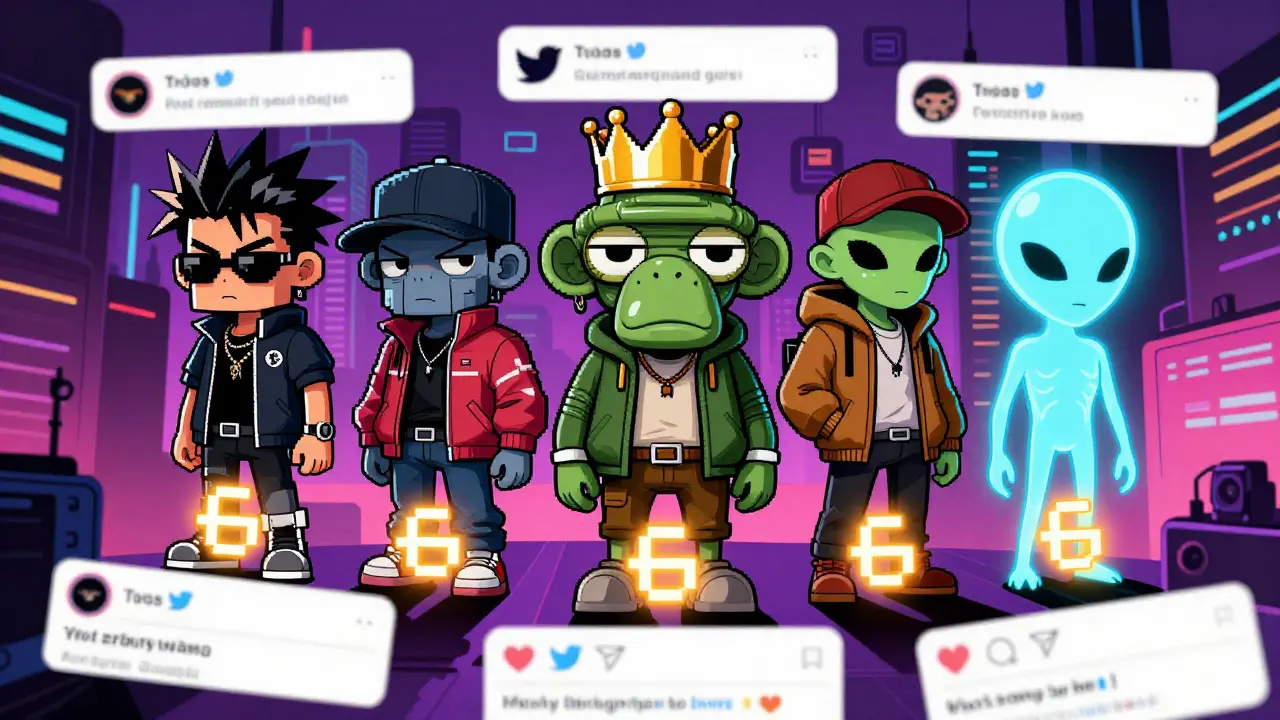
When you see someone on Twitter with a pixelated punk, a cartoon ape, or a glowing alien as their profile picture, you're not just looking at a random image. You're seeing a PFP NFT - a digital asset that proves real ownership of a unique piece of art. These aren't just fancy wallpapers. They're verified on the blockchain, traded like rare collectibles, and often serve as digital ID cards in online communities. The rise of PFP NFTs has reshaped how people express identity in the digital world - and it's not going away.
What Exactly Is a PFP NFT?
PFP stands for "Profile Picture," and a PFP NFT is exactly what it sounds like: a non-fungible token that doubles as your social media avatar. Unlike regular JPEGs you download from Google, a PFP NFT is tied to a blockchain record that proves you own it. That record includes who created it, who owned it before you, and when it changed hands. No one can fake it. No one can copy it without losing the proof of ownership.
The first major PFP collection was CryptoPunks, a set of 10,000 unique 24x24 pixel characters created by Larva Labs in 2017. Back then, most people ignored them. You could claim one for free - just pay the Ethereum gas fee. Fast forward to 2026, and the cheapest CryptoPunk now costs over $350,000. That’s not because the pixels got prettier. It’s because ownership became a status symbol.
How Are PFP NFTs Made?
Most PFP collections aren’t drawn by hand one by one. They’re generated using algorithms. Think of it like a digital slot machine: each NFT is built by randomly combining traits - hats, glasses, skin tone, background color, accessories. A collection might have 10,000 total pieces, but only 100 might have a gold crown and neon eyes. Those are "rare" traits. Rarity drives value.
For example, Bored Ape Yacht Club, a collection of 10,000 cartoon apes launched in April 2021, uses over 170 possible traits. Some apes have laser eyes. Others wear tuxedos or smoke cigars. The odds of getting a "golden fur with a crown" ape? Less than 0.5%. That’s why those sell for millions.
The generative process is key. It ensures every NFT is unique without requiring artists to draw 10,000 separate images. It also creates scarcity naturally. You can’t just print more. The code locks the total supply. That’s what makes them collectible.
Why Do People Pay So Much?
It’s not just about the art. It’s about what the NFT unlocks.
Early buyers of Bored Ape Yacht Club didn’t just get a picture. They got access to a private Discord server, exclusive events, and even free minting rights to other NFT projects. Some holders got real-world perks - like free whiskey deliveries or VIP tickets to music festivals. These weren’t gimmicks. They built communities.
When you use a PFP NFT as your profile picture, you’re signaling membership. You’re saying, "I’m part of this group." That’s powerful in a world where online identity is fragmented. A CryptoPunk or a Bored Ape acts like a digital handshake. It tells others you’re in the know.
There’s also speculation. People buy them hoping to flip for profit. Some have made millions. Others lost everything when the market crashed in 2022. The value isn’t guaranteed. But for many, the community and access are worth more than the price tag.
Where Are PFP NFTs Used?
Twitter is ground zero. Over 80% of high-value PFP owners use their NFTs as profile pictures there. It’s a visual language. You don’t need to say you’re into crypto. Your avatar says it for you.
But it’s going further. Platforms like Decentraland and The Sandbox let you wear your PFP NFT as your avatar in virtual worlds. Some games now require you to hold a specific PFP to unlock special weapons, maps, or roles. Imagine showing up to a multiplayer game and your character looks exactly like your Twitter avatar - that’s the future.
Even brands are paying attention. Companies like Nike and Adidas have launched their own PFP NFTs, letting owners access exclusive drops or digital merchandise. It’s not just about art anymore. It’s about utility.
How to Get Started
Buying your first PFP NFT isn’t hard - but it’s not simple either. Here’s what you need:
- A crypto wallet: Use MetaMask or Coinbase Wallet. These let you store Ethereum and interact with NFT marketplaces.
- Ethereum (ETH): Most PFPs live on Ethereum. You’ll need ETH to buy and pay gas fees. Buy it on Coinbase, Kraken, or Gemini.
- An NFT marketplace: OpenSea is the biggest. You can browse collections, filter by rarity, and place bids.
- Research: Don’t just buy the first one you see. Check the project’s Discord, Twitter, and roadmap. Are they active? Do they have real utility? Or is it just hype?
Start small. Look at collections with fewer than 5,000 pieces. Prices are lower, and communities are more active. Avoid "meme coins" with no team or no roadmap. If the creators vanish after launch, your NFT becomes a digital ghost.
The Risks
PFP NFTs aren’t investments. They’re collectibles with emotional and social value - and they’re volatile.
Market crashes happen. In 2022, trading volume dropped over 80%. Many collections lost 90% of their value. Some projects vanished overnight. If you bought in at the peak, you might still be underwater.
Scams are common. Fake marketplaces, phishing links, and fake Discord servers are everywhere. Always double-check URLs. Never click links from DMs. Use only official project sites.
And don’t forget gas fees. Ethereum transactions can cost $20-$100 during busy times. That eats into profits. Some newer blockchains like Polygon or Solana offer cheaper options - but they come with trade-offs in community size and liquidity.
What’s Next for PFP NFTs?
The next phase isn’t about pixels. It’s about identity.
Projects are now linking PFPs to real-world credentials. Imagine holding a PFP that proves you’ve completed a blockchain course, attended a conference, or contributed to a DAO. Your avatar becomes your resume.
AI is also changing the game. Some collectors now use AI tools to generate custom traits for their NFTs - adding personalized backgrounds or accessories. Others are using AI to predict rarity trends before a collection drops.
And the metaverse? It’s still early, but PFPs are becoming the default avatar standard. In virtual worlds, your NFT isn’t just a picture - it’s your body. That makes ownership more personal than ever.
The big question isn’t whether PFP NFTs will survive. It’s whether they’ll evolve beyond status symbols into functional tools for digital identity. If they do, they’ll be as normal as usernames are today.
Are PFP NFTs only for rich people?
No. While top collections like CryptoPunks cost hundreds of thousands, there are thousands of smaller PFP projects with entry prices under $100. Many new collections launch with affordable mints. The key is finding active communities, not just the most expensive ones.
Can I use any NFT as a profile picture?
Technically, yes. But PFP NFTs are designed specifically for that use. They’re usually square, centered, and visually clear at small sizes. Other NFTs - like landscape art or 3D models - don’t work well as profile pics. The best ones are made to be seen on Twitter, Instagram, or Discord.
Do I need to pay taxes on PFP NFTs?
Yes. In the U.S., buying or selling an NFT is a taxable event. If you sell for more than you paid, you owe capital gains tax. If you trade one NFT for another, that’s also taxable. Keep records of every transaction. Many users use tools like Koinly or TokenTax to track this automatically.
What’s the difference between a PFP NFT and other NFT art?
PFP NFTs are designed to be worn - not just displayed. They’re built for social signaling. Other NFT art might be a landscape or abstract piece meant for a digital gallery. PFPs are social tokens. They’re meant to be seen by others, and they often come with community perks. That’s the big difference.
Can I make my own PFP NFT collection?
Yes. Tools like ArtBlocks, HashLips, and Rarible let creators generate 10,000 unique NFTs with a few clicks. But success requires more than tech - it needs community, marketing, and long-term vision. Most new collections fail. Only about 5% gain lasting traction. If you’re thinking about launching one, start by joining existing communities first.
Lucy de Gruchy
March 15, 2026 AT 22:13Let me just say this: PFP NFTs are a glorified version of those 2008 MySpace custom layouts, but now with blockchain scams attached. You're paying $300,000 for a 24x24 pixel JPEG? The only thing more absurd is people who think this is 'digital identity.' Identity isn't a JPEG you bought with ETH-it's how you show up in real life. And no, wearing a cartoon ape doesn't make you 'in the know.' It makes you a walking ad for crypto bros who think scarcity equals value.
Also, who approved the term 'utility'? That's just corporate speak for 'we're gonna give you a Discord role and call it a lifestyle.' I've seen more meaningful communities in my local knitting group.
Lauren J. Walter
March 17, 2026 AT 11:16So… you’re telling me I’m supposed to care because someone paid $400k for a pixelated alien? 🤡
Tobias Wriedt
March 18, 2026 AT 01:34Yessss!!! 🤘🔥 This is the future!! I’ve been saying this since 2021!! PFPs are the new flag!! You don’t see me with a regular pic? Because I’m a Bored Ape holder and I’m PROUD!! 🐒💎
Also, my Discord role says ‘OG Ape’ and I get free merch!! That’s more than my job gives me!!
S F
March 19, 2026 AT 16:32Let’s be real-this whole thing is a Zionist crypto scheme to replace the dollar. You think these ‘apes’ are random? Look at the traits. The gold crowns? The laser eyes? That’s coded symbolism. This isn’t art-it’s a psychological operation. And Twitter? That’s just the front for the real game.
Anyone who buys into this is being played. The real power isn’t in owning an NFT-it’s in who controls the blockchain ledger. And guess who’s behind it? Same people who told you to buy Bitcoin in 2013. Now they’re selling you cartoon monkeys. Wake up.
Angelica Stovall
March 21, 2026 AT 09:57People paying money for pixels? That’s rich. Literally. Most of these collections are just AI-generated garbage with a fancy name. You think your ape is rare? There’s 10,000 of them. One has a hat. Big deal. I can make 10,000 of these in 2 hours on my laptop. The only thing rare here is the gullibility.
And don’t even get me started on ‘utility.’ You get a Discord role? Cool. Now what? Are you gonna start a revolution? Or just post memes in a group chat? This isn’t identity. It’s a cult with a wallet.
Taylor Holloman.
March 23, 2026 AT 03:51There’s something quietly beautiful about this whole thing, honestly.
People are using these tiny, algorithmically generated images to say, ‘I belong here.’ It’s not about the money. It’s about finding your tribe in a world that’s never felt more lonely. I’ve seen strangers become friends because they both had the same hat on their pixel ape. That’s weirdly human.
Yeah, some people are flipping them like stocks. And yeah, scams exist. But the core idea? A digital handshake? A visual ‘I’m one of you’? That’s ancient. We used to do it with tattoos. With uniforms. With flags.
Maybe PFPs aren’t the future of money. But they might be the future of belonging.
Bryan Roth
March 24, 2026 AT 16:38Look, I get the skepticism. I really do. But if you’re writing this off as ‘just a trend,’ you’re missing the point.
These aren’t just pictures. They’re door keys. I got into a DAO meeting because I held a PFP. I met my co-founder because we both had the same rare sunglasses on our apes. That’s real connection. That’s real networking.
And yeah, some projects die. But so do startups. So do bands. So do blogs. The ones that stick? They build communities. They create value beyond the screen.
Don’t knock it till you’ve tried it. Start small. Buy one under $100. Join the Discord. Talk to people. See what happens. You might be surprised.
iam jacob
March 26, 2026 AT 09:17i just wanna say… i lost everything in the crash… i thought my punk was my soul… but it was just a jpeg… and now i cry into my coffee every morning… 🥲💔
Jesse Pals
March 28, 2026 AT 02:38Man I remember when I first minted my PFP back in '21… didn't even know what blockchain meant… just liked the art… now I'm in 3 different DAOs… got free concert tickets… met my wife on Discord…
It's not about the money… it's about the people…
Stay chill… keep building…
Diane Overwise
March 29, 2026 AT 05:50Oh. My. Gosh. You mean to tell me… that… these… are… NFTs? Like… blockchain? Like… digital… stuff? I’m so confused. But also… kinda intrigued? 🤔✨
Wait… so if I buy one… does that mean I’m cool now? Because I really need to be cool.
Ann Liu
March 29, 2026 AT 11:04There are several factual inaccuracies in this article that need correction. First, CryptoPunks were not ‘claimed for free’-they required gas fees, which in 2017 were not negligible. Second, the term ‘rarity traits’ is misleading; rarity is calculated by algorithmic frequency, not subjective appeal. Third, the assertion that PFPs are ‘verified on the blockchain’ is imprecise-only the token metadata and ownership are recorded, not the image itself, which is typically hosted off-chain via IPFS or centralized servers.
Additionally, tax treatment varies by jurisdiction. In the U.S., NFTs are treated as property, not currency, which affects capital gains calculations. Always consult a CPA.
Dionne van Diepenbeek
March 30, 2026 AT 05:17why do people spend so much on pictures
just use a selfie
Graham Smith
March 30, 2026 AT 20:36The entire PFP paradigm is a post-capitalist aesthetic reconfiguration of identity commodification through non-fungible tokenized social capital accumulation. It’s not about the image-it’s about the ontological rupture between symbolic ownership and performative identity in the hyper-digital subject.
Have you read Baudrillard? Or even just Deleuze? No? Then you’re missing the meta-narrative. The ape isn’t the avatar. The avatar is the algorithmic self.
Katrina Smith
April 1, 2026 AT 09:31so you’re telling me a guy paid 400k for a pixel monkey… and i’m supposed to be impressed?
cool. now go cry into your eth
Anastasia Danavath
April 2, 2026 AT 23:34lol imagine spending money on this 😂
my cat is my pfp and she’s way cuter
🐱
anshika garg
April 4, 2026 AT 18:48Isn't it fascinating how humans create symbols to feel connected? We've always done this-tribal tattoos, clan crests, religious icons. Now we use code and blockchain.
It's not about the value. It's about the ritual. The act of minting. The shared belief. The quiet hope that somewhere, someone else sees the same thing in the same way.
Maybe the real NFT isn't the image. It's the feeling it gives you.
And that… is priceless.
Bruce Doucette
April 5, 2026 AT 13:11you think you’re cool with that ape? i’ve got a crypto punk and i still don’t trust you
you’re probably a bot
or worse… a fomo buyer
🙄
Marie Vernon
April 6, 2026 AT 21:58Hey everyone-just wanted to say thank you to this community. I came in skeptical, but reading your comments made me realize something: this isn’t just about NFTs. It’s about how we find belonging in a digital world that’s often cold and lonely.
Whether you’re here for the art, the community, the memes, or the hope-it matters. We’re all just trying to say, ‘I’m here. Do you see me?’
And sometimes… a pixelated alien does that better than a photo.