Privacy Protocol Regulations in Blockchain: 2025 US State Laws and Global Compliance

By 2025, privacy protocol regulations are no longer just a technical concern for blockchain projects-they’re a legal requirement. If your blockchain application handles user data, even indirectly, you’re now caught in a web of state, federal, and international rules that don’t just ask for consent-they demand proof, accountability, and real-time compliance. This isn’t about GDPR from 2018 anymore. This is about eight new U.S. state laws, India’s Digital Personal Data Protection Act, and blockchain-specific challenges that make traditional data handling models obsolete.
Why Blockchain Can’t Ignore Privacy Laws Anymore
Blockchain is built on transparency. Transactions are public. Addresses are traceable. Smart contracts execute without human intervention. But when those transactions involve names, email addresses, IP logs, wallet identifiers linked to real people, or even metadata from NFT purchases, you’re collecting personal data. And under 2025’s privacy laws, that makes you a data controller-no matter if you’re a DeFi platform, a Web3 wallet provider, or a DAO with a website. The biggest myth? That blockchain’s immutability makes you exempt from data deletion rights. It doesn’t. Delaware’s DPDPA, New Jersey’s NJCPA, and Maryland’s MODPA all require businesses to honor consumer requests to delete personal data. If a user asks you to erase their identity-linked wallet history, you can’t just say, “It’s on the blockchain.” You have to remove identifiers from off-chain databases, delete associated metadata, and stop processing their data. The chain stays, but your link to the person must go.The 2025 U.S. State Privacy Law Maze
Eight new state laws took effect in 2025. Each has different rules. Here’s what actually matters for blockchain companies:- Delaware (DPDPA): Applies to companies processing data of just 35,000 users annually-or 10,000 if you make over 20% of revenue from selling data. Nonprofits aren’t exempt. Even if you’re a small NFT marketplace, you’re in scope. You must list every third party that receives user data. If your wallet connects to a analytics tool like Chainalysis or a marketing platform like Segment, you need to disclose it.
- Iowa (ICPA): Only lets users opt out of data sales-not targeted ads or profiling. That’s a problem for blockchain ad networks that track wallet behavior to serve crypto ads. Iowa also gives you 90 days to respond to deletion requests, the longest in the U.S. But it doesn’t let users correct their data. If a user says their wallet address is mislinked to their name, you don’t have to fix it.
- New Jersey (NJCPA): Gives you 30 days to fix violations before fines kick in-until July 15, 2026. After that, no grace period. If your smart contract logs IP addresses and a user files a deletion request, you have to act fast.
- Minnesota (CDPA) and Maryland (MODPA): Both allow 30- to 60-day cure periods, but Maryland’s lasts until April 2027. That’s your buffer if you’re rolling out compliance slowly.
How Blockchain Companies Are Failing Compliance
Most Web3 teams think they’re safe because they’re decentralized. They’re wrong. Here’s what’s going wrong:- Wallets storing PII: Many wallets ask for email, phone number, or government ID for KYC. That’s personal data. If you store it in a centralized database, you’re subject to all state laws.
- Analytics on-chain: Tools that track wallet activity to build user profiles for advertising? That’s profiling. Delaware and New Jersey treat that the same as Facebook tracking.
- Smart contracts logging user data: If your contract writes a user’s wallet address to a public log along with their transaction amount, timestamp, and IP, you’re creating a personal data record. You can’t delete it from the chain, but you can stop collecting it and anonymize future logs.
- Third-party integrations: Using MetaMask, CoinGecko, or Chainlink? You need to know what data they collect and whether you’ve disclosed it to users. Delaware requires you to list every vendor. Most blockchain startups don’t even have a vendor list.

Global Rules That Hit Blockchain Hard
The U.S. isn’t alone. India’s Digital Personal Data Protection Act (DPDPA) kicks in July 2025. If your blockchain app has users in India-even one-you must:- Get clear, informed consent before collecting any digital personal data
- Limit data retention to only what’s necessary
- Report breaches within 72 hours
- Appoint a data protection officer if you process large volumes
What You Need to Do Right Now
Here’s a practical checklist for blockchain teams in 2025:- Map your data flows. Where does user data enter your system? Where is it stored? Who gets it? Use a simple spreadsheet: Data Type | Source | Storage Location | Third Parties | Purpose.
- Identify your jurisdiction. Are you serving users in Delaware, Iowa, or India? Each law has different thresholds. If you have more than 35,000 users globally, assume you’re covered by at least one law.
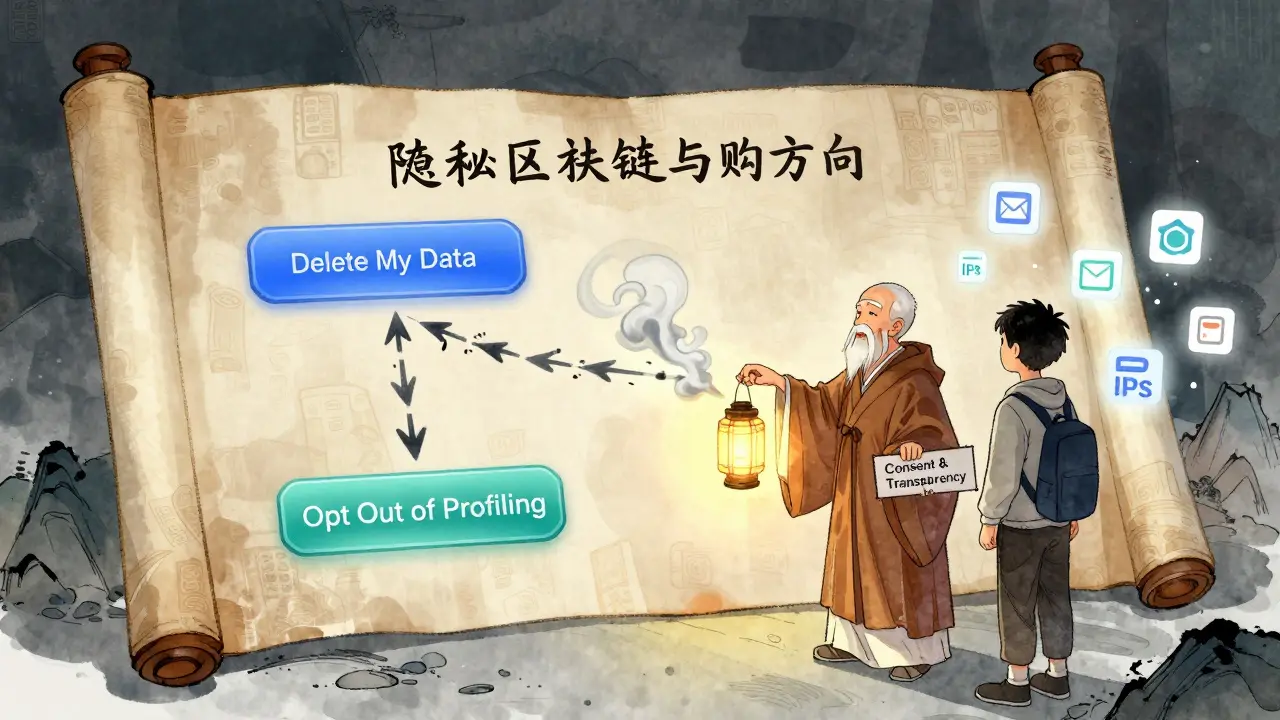
- Build a privacy portal. Users need to access, delete, or correct their data. Build a simple form on your website that connects to your backend. Don’t rely on Discord or Telegram for requests.
- Stop logging unnecessary data. If you don’t need an IP address to process a transaction, don’t collect it. If you don’t need a phone number for wallet recovery, remove the field.
- Update your privacy policy. List every third party you share data with. Explain how users can opt out of profiling. Use plain language-not legalese.
- Train your team. Developers, customer support, and community managers need to know what “personal data” means. A wallet address linked to a real name? That’s personal data. A public transaction hash? Not necessarily.
The Real Cost of Noncompliance
Delaware can fine you $10,000 per violation. Iowa: $7,500. India: up to 25 crore rupees (about $3 million). These aren’t theoretical numbers. In 2024, the FTC fined a DeFi platform $2.1 million for collecting KYC data without proper consent. In 2025, state attorneys general are actively monitoring blockchain apps. They’re not waiting for complaints-they’re scanning app stores and GitHub repos for data collection practices. And the damage isn’t just financial. A single privacy violation can destroy trust. If your users find out you’re secretly tracking their wallet behavior and selling it to advertisers, they’ll leave. And in crypto, trust is your only asset.What’s Next?
More states will pass laws in 2026. Federal privacy legislation is still stalled, but that’s not a reason to wait. The trend is clear: privacy is becoming non-negotiable. Blockchain’s promise of user control must now include control over your own data-not just your crypto. The companies that survive won’t be the ones with the most advanced smart contracts. They’ll be the ones that treat privacy like a core feature-not an afterthought.Do blockchain transactions themselves count as personal data under privacy laws?
No, a raw blockchain transaction-like a transfer from one public wallet to another-is not personal data by itself. But if that transaction is linked to your real identity (through KYC, IP logging, email, or metadata), then it becomes personal data. Privacy laws regulate the link between the blockchain address and the person, not the transaction history alone.
Can I delete a user’s data if it’s on a public blockchain?
You cannot delete data from a public blockchain. But you don’t have to. Privacy laws require you to stop processing the data and remove any off-chain links to the user. That means deleting their email from your database, anonymizing their wallet address in your logs, and removing their profile from your website. The blockchain stays public; your connection to the person doesn’t.
Do I need to comply with privacy laws if I’m a DAO?
Yes-if your DAO operates a website, collects user emails, runs a wallet, or processes data from users in states like Delaware or New Jersey, you’re legally a data controller. The decentralized structure doesn’t shield you. If your DAO has a treasury that pays for servers, or a team managing user support, you’re an organization under the law.
What’s the easiest way to start complying with privacy laws?
Start by removing unnecessary data. Stop collecting phone numbers and IPs unless you absolutely need them. Then build a simple privacy portal where users can request data deletion or access. Use open-source tools like Osano or OneTrust’s free tier. Document everything. Most small blockchain projects can get compliant in under two weeks with minimal cost.
Do privacy laws apply to crypto exchanges?
Absolutely. Crypto exchanges collect names, addresses, IDs, and transaction histories-all personal data under every 2025 privacy law. Even if you’re regulated by FinCEN or the SEC, you still need to comply with state privacy laws for consumer rights like deletion and opt-out. Regulatory overlap doesn’t mean exemption.
Is zero-knowledge proof enough to satisfy privacy regulations?
Zero-knowledge proofs help reduce data exposure, but they don’t automatically make you compliant. If you still collect user emails, IPs, or wallet identifiers off-chain, you’re still subject to privacy laws. ZKPs are a technical tool, not a legal shield. You still need consent mechanisms, data mapping, and deletion processes.
What happens if I ignore these laws?
You risk fines, lawsuits, and loss of user trust. State attorneys general are already auditing crypto platforms. In 2024, a Web3 gaming company was fined $1.2 million for collecting minors’ data without consent. In 2025, enforcement is ramping up. Ignoring privacy isn’t a strategy-it’s a liability.
roxanne nott
December 18, 2025 AT 19:30Lloyd Yang
December 20, 2025 AT 04:39Janet Combs
December 21, 2025 AT 03:35Shubham Singh
December 21, 2025 AT 20:32Vyas Koduvayur
December 23, 2025 AT 03:34Sarah Glaser
December 23, 2025 AT 09:39Sheila Ayu
December 25, 2025 AT 08:30Dan Dellechiaie
December 27, 2025 AT 01:41Radha Reddy
December 27, 2025 AT 10:32Sybille Wernheim
December 27, 2025 AT 23:51vaibhav pushilkar
December 29, 2025 AT 07:43Jake Mepham
December 30, 2025 AT 21:04Luke Steven
December 31, 2025 AT 06:00Ellen Sales
December 31, 2025 AT 21:20Charles Freitas
January 2, 2026 AT 03:24Craig Fraser
January 2, 2026 AT 20:47Ashley Lewis
January 4, 2026 AT 02:35Jacob Lawrenson
January 4, 2026 AT 18:07Zavier McGuire
January 6, 2026 AT 11:30SHEFFIN ANTONY
January 7, 2026 AT 03:58