Private Key Generation and Randomness: Why Entropy Is Your Blockchain's Lifeline

You have a Bitcoin wallet. You have the password to log in. But do you really control your assets? The answer depends entirely on one invisible factor: randomness. If the private key protecting your funds was generated with poor randomness, an attacker doesn't need to hack your computer-they just need to guess the math. In 2012, researchers found that nearly 1% of all RSA keys on the internet were duplicated because devices failed to generate enough entropy during boot-up. That same vulnerability exists in blockchain wallets today.
Private key generation is not just about creating a long string of numbers. It is about capturing true chaos from the physical world and converting it into digital secrecy. When we talk about private key generation, we are discussing the foundational act of identity in cryptography. Without high-quality randomness, encryption collapses. Let’s break down how this process works, why it fails, and how you can ensure your keys are truly unbreakable.
The Anatomy of a Private Key
A private key is essentially a large random number. In asymmetric cryptography, such as the Elliptic Curve Cryptography (ECC) used by Bitcoin and Ethereum, this number acts as the seed for a pair of keys. The private key stays secret; the public key is shared openly. The magic lies in the mathematical relationship between them: deriving the public key from the private key is easy, but reversing the process is computationally impossible-unless the private key itself is weak or predictable.
The strength of this system relies on entropy. Entropy is a measure of uncertainty or disorder. In cryptography, we want maximum entropy. If a generator produces a number based on a pattern-like the current time or a simple counter-it has low entropy. An attacker can predict the next number. High-entropy sources include hardware noise, atmospheric radio static, or precise timing intervals between keystrokes. For a standard Bitcoin address using the secp256k1 curve, you need at least 128 bits of true entropy to be considered secure against brute-force attacks.
| Cryptographic Standard | Key Size | Minimum Required Entropy | Security Level |
|---|---|---|---|
| RSA | 2048-bit | 112 bits | Moderate (Legacy) |
| ECC (secp256k1) | 256-bit | 128 bits | High (Bitcoin/Ethereum) |
| Post-Quantum (Kyber) | Varies | 128+ bits | Future-Proof |
Where Does Randomness Come From?
Computers are deterministic machines. They follow instructions precisely. By nature, they are bad at being random. To fix this, operating systems use Cryptographically Secure Pseudo-Random Number Generators (CSPRNGs). These algorithms take a small amount of true randomness (the seed) and expand it into a long stream of pseudo-random data. The quality of the output depends entirely on the quality of the seed.
In Linux systems, two primary interfaces handle this task: /dev/random and /dev/urandom. Historically, developers were told to use /dev/random because it would block if the system ran out of entropy. This caused applications to hang indefinitely if no user activity occurred. Modern best practices favor /dev/urandom or the newer getrandom() system call, which never blocks and uses a cryptographically strong mixing function to maintain security even when entropy estimates are low.
Hardware Security Modules (HSMs) take this a step further. Devices like the Thales nShield contain True Random Number Generators (TRNGs) that capture electronic noise from physical components. While expensive-ranging from $15,000 to $50,000 per unit-they provide the highest assurance of entropy. For most users, however, software-based solutions are sufficient if configured correctly.
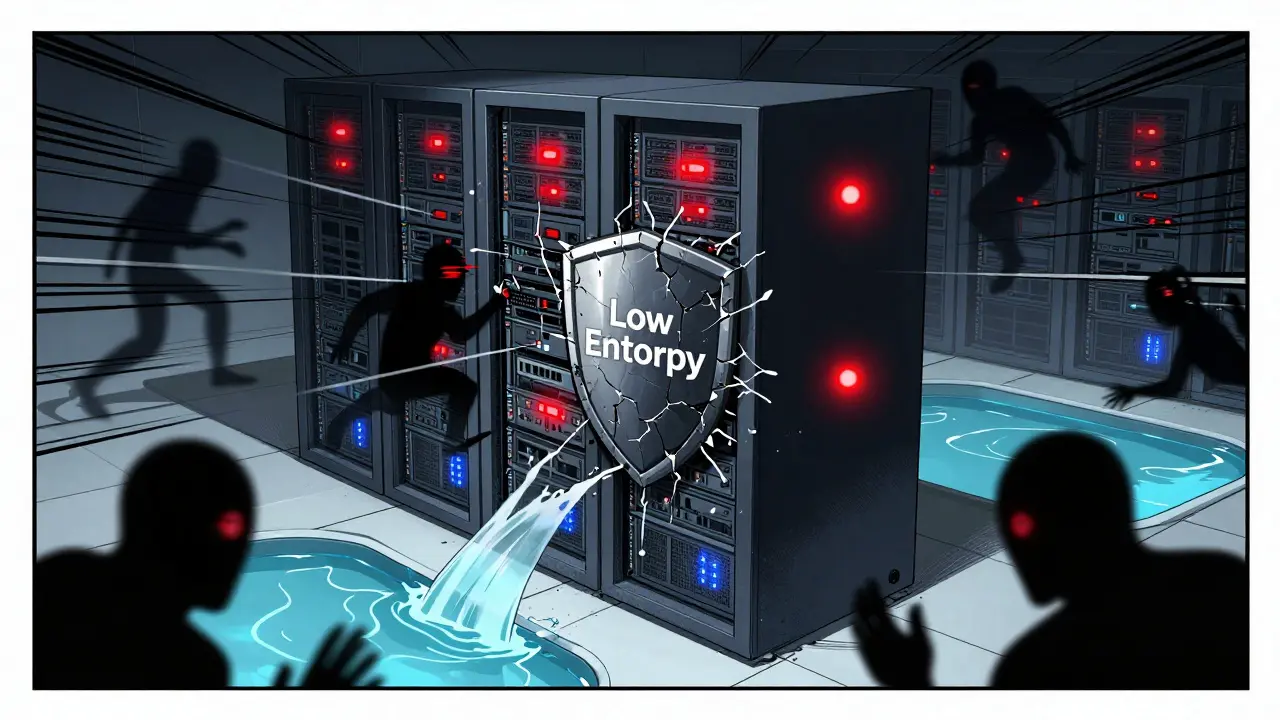
The Boot-Time Vulnerability
The biggest risk in private key generation occurs during the early stages of a device's startup. When a server, router, or smartphone boots up, the operating system hasn't collected much environmental noise yet. There are no keystrokes, no mouse movements, and minimal disk interrupts. The entropy pool is shallow.
If a device generates a private key during this window, it may reuse the same seed as other identical devices. This happened catastrophically in 2012 when a study revealed that 5.5% of embedded devices (mostly routers) shared identical RSA keys. Attackers could simply download a database of these duplicate keys and decrypt traffic globally. Today, this risk persists in virtualized environments and headless servers.
Cloud functions, such as AWS Lambda, face similar challenges. During "cold starts," the container spins up with a fresh, empty entropy state. If a cryptographic library attempts to generate a key immediately without waiting for entropy accumulation, the resulting key may be weak. Developers must explicitly wait for the OS to gather sufficient entropy before initiating key generation routines.
Best Practices for Secure Key Generation
Ensuring your private keys are secure requires a combination of proper tooling and awareness of your environment. Here are actionable steps to mitigate risks:
- Use Modern System Calls: Avoid direct reads from
/dev/randomunless necessary. Usegetrandom()on Linux orBCryptGenRandom()on Windows. These APIs are designed to fail securely rather than return weak data. - Augment Entropy on Headless Servers: Install daemons like
havegedorjitterentropy. These tools harvest timing variations from CPU execution to keep the entropy pool full, even without user interaction. - Verify Library Implementations: Not all cryptographic libraries are equal. OpenSSL’s
RAND_bytes()is widely used but requires careful seeding. Libraries like Libsodium provide simpler, safer defaults that reduce the chance of developer error. - Avoid Virtual Machine Cloning: When cloning VMs, the entropy pool is often copied along with the disk image. This leads to duplicate keys across instances. Always reseed the entropy pool after cloning by running commands like
rngd -r /dev/hwrandom. - Monitor Entropy Levels: On Linux, check
/proc/sys/kernel/random/entropy_avail. A healthy system should show values above 2048 bits. If it drops below 128, key generation should pause until more entropy is available.

Emerging Solutions: Verifiable Randomness
Traditional key generation relies on trust. You assume the OS did its job. But what if you could prove it? Researchers are developing protocols like Key Generation with Verifiable Randomness (KEGVER). This approach allows a party to generate a key and provide a zero-knowledge proof that the key was created according to strict randomness standards, without revealing the key itself.
While still emerging, verifiable randomness addresses a critical gap in Certificate Authorities and decentralized identity systems. It shifts the model from "trust me" to "prove it." As quantum computing threats loom, ensuring the integrity of key generation will become even more vital. NIST’s post-quantum cryptography standards, such as CRYSTALS-Kyber, maintain similar entropy requirements but demand stricter verification processes.
Conclusion
Private key generation is the silent guardian of digital security. Whether you are managing a corporate blockchain infrastructure or a personal crypto wallet, the security of your assets hinges on the quality of randomness used to create your keys. By understanding entropy, avoiding boot-time vulnerabilities, and using modern cryptographic tools, you can ensure that your keys remain truly private. Don’t let a lack of randomness compromise your security.
What happens if a private key is generated with low entropy?
If a private key is generated with low entropy, it becomes predictable. Attackers can use brute-force methods or pre-computed databases to guess the key, compromising the security of the associated account or transaction. This led to massive breaches in 2012 where thousands of devices shared identical keys.
Is /dev/urandom safe for generating private keys?
Yes, /dev/urandom is generally safe and recommended for most applications. Unlike /dev/random, it does not block when entropy is low, using a cryptographically strong algorithm to mix available entropy. Modern kernels ensure that even early-boot usage remains secure.
How many bits of entropy are needed for a Bitcoin key?
A Bitcoin private key uses the secp256k1 elliptic curve, which requires a minimum of 128 bits of entropy to be considered secure against current and near-future computational attacks.
Why are Hardware Security Modules (HSMs) so expensive?
HSMs contain specialized hardware for True Random Number Generation (TRNG) and tamper-resistant storage. They provide the highest level of assurance for entropy and key protection, justifying their high cost for enterprise and financial institutions.
Can I generate secure keys on a headless server?
Yes, but you must augment entropy sources. Install services like haveged or jitterentropy to harvest CPU timing variations. Ensure the system has been running long enough to accumulate sufficient entropy before generating keys.