Providing Liquidity to AMM Pools: A Practical Guide for DeFi Users

So, you've heard the buzz about earning passive income in DeFi and want a piece of the action. You see friends talking about "providing liquidity" and making double-digit yields, but the idea of locking up your crypto feels risky. Is it worth it? The short answer is yes, but only if you understand what you're actually doing. Providing liquidity isn't just depositing coins into a smart contract; it's becoming a market maker for decentralized exchanges.
This guide cuts through the jargon. We'll look at how Automated Market Makers (AMMs) work, why they matter, and how you can provide liquidity without getting burned by hidden risks like impermanent loss. Whether you're new to Uniswap or looking to optimize your strategy on Layer 2 networks, this breakdown gives you the concrete steps and data you need to make informed decisions.
The Core Mechanism: How AMM Pools Actually Work
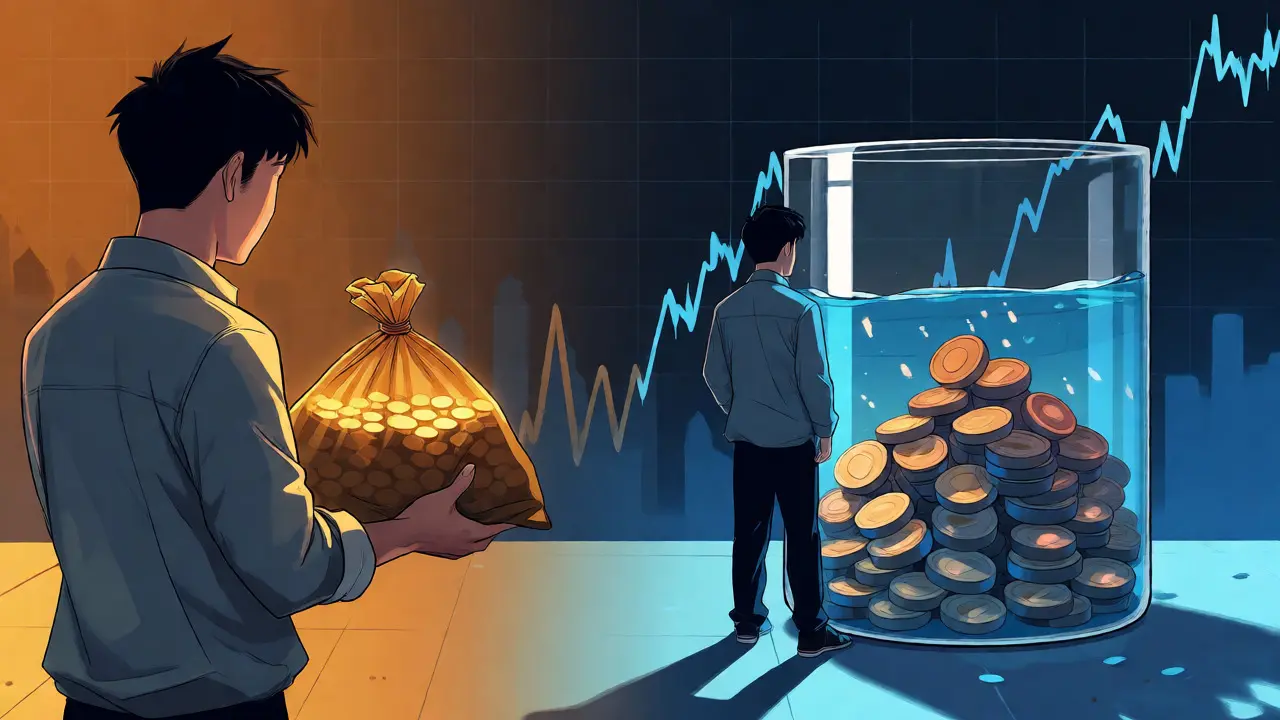
Traditional stock exchanges use order books, where buyers and sellers match manually. Decentralized exchanges (DEXs) don't have that luxury because they run on code, not humans. Instead, they use Automated Market Makers. Think of an AMM pool as a digital bucket containing two different tokens, say ETH and USDC. When you want to trade one for the other, you don't wait for a counterparty; you swap against this bucket.
The price isn't set by a human trader but by a mathematical formula. The most common model, pioneered by Uniswap, is the constant product formula: $x \times y = k$. Here, $x$ is the amount of Token A, $y$ is the amount of Token B, and $k$ is a constant. If you buy more ETH from the pool, the amount of ETH ($x$) decreases, so the price must go up to keep $k$ the same. This mechanism ensures there is always liquidity available for trading, provided someone has funded the pool.
You become part of this system by depositing equal values of both tokens into the pool. In return, you receive LP tokens, which represent your share of the total pool assets. These LP tokens are crucial-they act as proof of ownership and allow you to withdraw your original funds plus any earned fees later.
Why Provide Liquidity? The Yield Potential
Why would anyone lock up their capital instead of just holding it? The primary incentive is trading fees. Every time a user swaps tokens within the pool, they pay a small fee, typically between 0.05% and 1%. This fee is distributed pro-rata among all liquidity providers based on their contribution size.
Beyond basic fees, many protocols offer additional incentives known as liquidity mining or yield farming. For example, platforms like Curve Finance or SushiSwap might reward LPs with governance tokens (like CRV or SUSHI). These rewards can significantly boost annual percentage yields (APY), sometimes pushing returns above 20% during bull markets. However, high APYs often come with higher volatility in the reward token's price, so it’s vital to distinguish between stablecoin yields and speculative token emissions.
| Platform | Best For | Key Feature | Risk Profile |
|---|---|---|---|
| Uniswap V3 | Volatility traders & pros | Concentrated liquidity ranges | High (requires active management) |
| Curve Finance | Stablecoins & pegged assets | Low slippage, minimal IL | Low |
| Balancer | Diversified portfolios | Multi-token pools (up to 8 assets) | Medium |
| PancakeSwap | BNB Chain users | Low gas fees, high volume | Medium |
The Big Risk: Understanding Impermanent Loss
If providing liquidity were purely profitable, everyone would do it. But there’s a catch called impermanent loss (IL). This happens when the price ratio of the two tokens in the pool changes after you deposit them. Because the AMM algorithm rebalances the pool to maintain the $x \times y = k$ invariant, you end up selling the appreciating asset and buying the depreciating one automatically.
Let’s make this concrete. Suppose you deposit ETH and USDC when ETH is $2,000. If ETH rises to $4,000, the pool will contain less ETH and more USDC than you started with. If you had simply held your initial ETH and USDC, you’d be richer than if you withdrew from the pool now. That difference is impermanent loss. It’s called "impermanent" because if prices return to the original ratio, the loss disappears. But if prices diverge further, it becomes real.
Recent academic research from 2025 highlights a sobering statistic: on average, realized impermanent loss leads to a 3.8% loss per position compared to a simple buy-and-hold strategy. This means trading fees must exceed 3.8% annually just to break even against holding. On highly volatile pairs, IL can wipe out profits quickly. Conversely, on stablecoin pairs like USDC/USDT, IL is negligible, making these pools safer for conservative investors.
Advanced Strategies: Concentrated Liquidity and Range Management
Early AMMs forced you to spread your capital across the entire price curve from zero to infinity. This was inefficient. Enter Uniswap V3 and its concept of concentrated liquidity. Now, you can choose specific price ranges where your capital is active. For example, if you believe ETH will trade between $2,500 and $3,000, you can place your liquidity solely in that band.
This innovation dramatically improves capital efficiency. By concentrating your funds where trades actually happen, you earn a larger share of the fees relative to your deposited amount. However, this comes with a trade-off: if the price moves outside your chosen range, your liquidity stops earning fees, and you’re left holding 100% of the underperforming asset. Managing these ranges requires monitoring. Successful LPs treat their positions like limit orders-adjusting them as market conditions shift.
Dynamic fee structures are another advanced feature appearing on newer platforms. Instead of fixed fees, some AMMs adjust rates based on volatility. During high-volatility periods, fees increase to compensate LPs for higher risk. This aligns incentives better, ensuring you’re paid fairly when the market gets choppy.
Choosing the Right Network and Pool
Where you provide liquidity matters as much as what pair you choose. Ethereum mainnet offers deep liquidity and security but suffers from high gas fees. A single transaction to add liquidity might cost $20-$50, eating into profits for smaller positions. Layer 2 solutions like Arbitrum, Optimism, and Base offer similar security with fees often under $1. This makes them ideal for retail investors who want to participate without massive overhead costs.
Research presented at the CAAW 2025 conference revealed interesting dynamics across networks. Ethereum pools tend to be overcapitalized, meaning too much liquidity chases too few trades, diluting returns. In contrast, emerging networks like Base show positive elasticity-more liquidity attracts more trading volume, creating a virtuous cycle for LPs. This suggests that moving to newer L2s could offer better risk-adjusted returns in 2026.
- Ethereum Mainnet: Best for large capital ($10k+) due to high TVL and institutional trust.
- Arbitrum/Optimism: Good balance of low fees and established ecosystem.
- Base/Solana: High growth potential, lower competition, but potentially higher technical risk.

Step-by-Step: How to Provide Liquidity
Ready to try it? Here’s a practical workflow using a standard DEX interface:
- Select a Pair: Choose a pair with correlated assets (e.g., ETH/wstETH) to minimize IL, or high-volume pairs (ETH/USDC) for fee generation.
- Check Metrics: Look at the 24-hour volume and current APR. Avoid pools with near-zero volume unless you’re speculating on future incentives.
- Set Your Range (if applicable): On Uniswap V3, define upper and lower price bounds. Tighter ranges yield more fees but require more attention.
- Approve Tokens: Sign transactions to allow the smart contract to spend your tokens. This is a one-time cost per token.
- Add Liquidity: Confirm the final transaction. Ensure you have enough ETH/SOL for gas fees.
- Monitor: Use tools like DeBank or Zapper to track your position value versus holding.
Common Pitfalls and Pro Tips
Newcomers often fall into three traps. First, ignoring gas costs. On Ethereum, adding and removing liquidity can cost more than the fees earned in a month for small deposits. Second, chasing high APYs on obscure tokens. A 500% APY on a token that drops 90% in value is a net loss. Third, failing to exit. Many LPs forget to claim rewards or remove liquidity when trends reverse, leaving capital stuck in unprofitable positions.
A pro tip: consider "correlated pairs." Pools involving wrapped versions of the same asset (like WBTC/BTC) or staked derivatives (wstETH/ETH) have very low correlation divergence. This minimizes impermanent loss while still generating trading fees. Another strategy is matching duration. Research shows longer position durations generally correlate with better outcomes, allowing fees to accumulate and offset potential IL spikes.
Frequently Asked Questions
Is providing liquidity safe?
It carries smart contract risk (bugs/hacks) and market risk (impermanent loss). Established protocols like Uniswap and Curve have undergone extensive audits, reducing smart contract risk, but never invest more than you can afford to lose.
What is the minimum amount needed to start?
Technically, you can start with $10. However, due to gas fees, it’s economically viable only if you have at least $500-$1,000 on Layer 2 networks or $5,000+ on Ethereum mainnet to ensure fees don’t eat your profits.
Do I need to monitor my position daily?
For wide-range or stablecoin pools, weekly checks suffice. For tight-range concentrated liquidity positions, daily monitoring is recommended to rebalance if the price exits your range.
How are taxes handled for LP rewards?
In many jurisdictions, LP rewards are taxed as income upon receipt, and impermanent loss may not be deductible until you sell. Consult a tax professional familiar with crypto in your region.
Can I lose all my money?
Yes, if a token in the pair goes to zero (rug pull) or if severe impermanent loss coincides with a crash. Diversifying across multiple pools helps mitigate this.