Qatar Institutional Crypto Ban: Rules for the Financial Sector

Imagine running a top-tier investment firm in Doha and wanting to offer your clients a way to hedge with Bitcoin. In most global hubs, that's a standard request. In Qatar, however, doing so could cost you your license. While some neighbors in the Gulf are rolling out the red carpet for Web3, Qatar has built a massive regulatory wall between its financial institutions and the world of decentralized coins.
The Hard Line on Virtual Assets
For any bank or investment firm operating in the region, the rules are blunt. Qatar Central Bank is the primary monetary authority responsible for maintaining financial stability and overseeing the banking sector in Qatar . Back in February 2018, the QCB issued Circular No. (6), which essentially told every financial institution in the country to stay away from Bitcoin and other cryptocurrencies. This wasn't a suggestion; it was a direct prohibition on facilitating transactions or offering any services related to digital currencies.
A few years later, the Qatar Financial Centre Regulatory Authority (or QFCRA) is the independent regulator overseeing the financial services provided within the Qatar Financial Centre (QFC) stepped in to tighten the screws. In December 2019, they issued a strict alert that banned virtual asset services. They defined virtual assets as digital substitutes for currency used for trading or payments. If it looks like money, acts like money, but isn't issued by a government, the QFCRA generally doesn't want it in the regulated financial system.
What Exactly is Banned?
It is not just about Bitcoin. The Qatar institutional crypto ban covers a wide net of digital assets. If you are a regulated entity, you cannot touch the following:
- Exchanging virtual assets for fiat: You can't swap a digital coin for Qatari Riyals or US Dollars.
- Custody and Safekeeping: Providing a digital wallet or holding private keys for a client is off-limits.
- Transfer Services: You cannot act as a bridge to move virtual assets from one party to another.
- Issuance: Offering financial services related to the creation or sale of new virtual assets is prohibited.
This restriction extends to stablecoins and even some types of Central Bank Digital Currencies (CBDCs) that don't fit their specific criteria. In the eyes of the regulators, these are "Excluded Tokens." The goal here is clear: protect the sovereign control of monetary policy and keep the financial system away from the extreme volatility that usually comes with crypto markets.
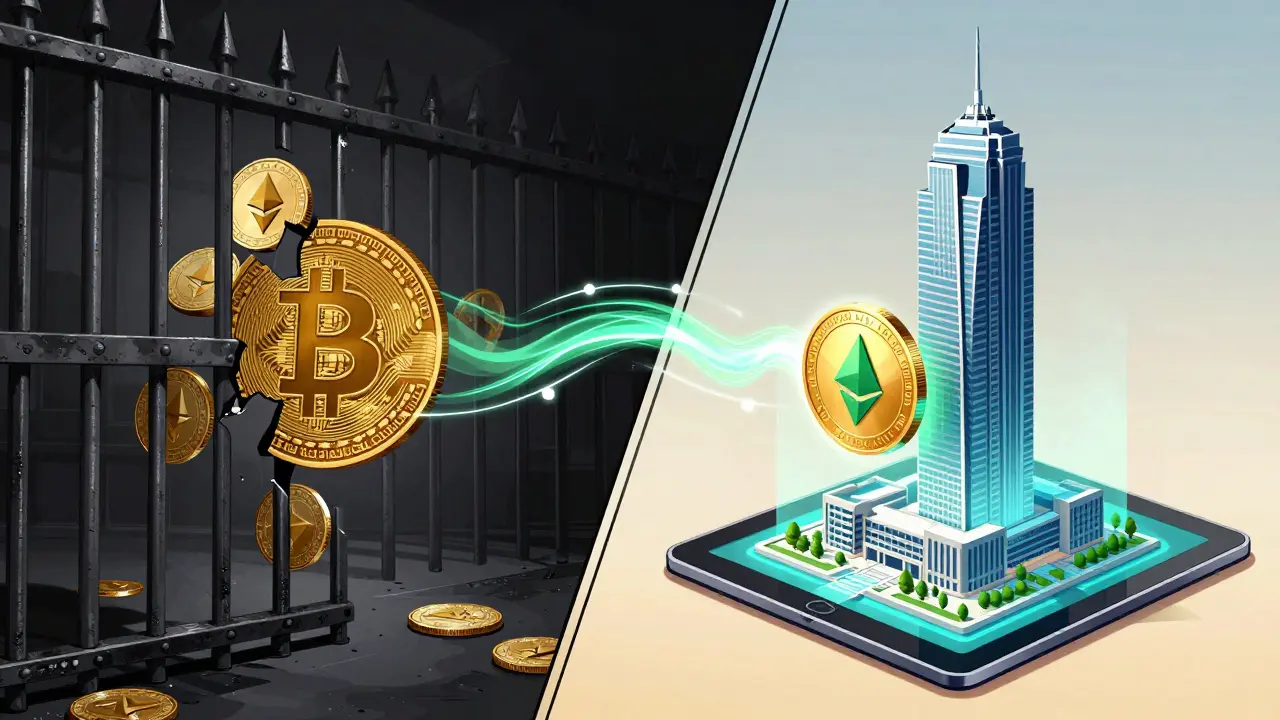
The Twist: Tokenization is Actually Allowed
Here is where it gets interesting. Just because Qatar hates "crypto-currency" doesn't mean they hate blockchain technology. On September 1, 2024, the QFC introduced the Digital Assets Regulations. This created a legal pathway for something called tokenization.
Tokenization is the process of taking a real-world asset-like a piece of real estate in Lusail or a corporate bond-and representing it as a digital token on a ledger. Unlike Bitcoin, which has no underlying physical value, tokenized assets are backed by something tangible. The QFC now allows the validation and registration of tokens for:
- Shares and equity in companies
- Bonds and Sukuk (Islamic bonds)
- Commodities like gold or oil
- Real estate holdings
By separating "virtual assets" (which are banned) from "tokenized traditional assets" (which are welcomed), Qatar is trying to have its cake and eat it too. They want the efficiency of blockchain for settlement and ownership, but they refuse to let volatile, decentralized coins enter their institutional plumbing.
| Asset Type | Status | Example | Regulated Use Case |
|---|---|---|---|
| Virtual Assets | Prohibited | Bitcoin, Ethereum, Tether | None (Excluded Tokens) |
| Tokenized Assets | Permitted | Digital Real Estate Deeds | Institutional Investment |
| Fiat Currency | Legal Tender | Qatari Riyal (QAR) | Standard Banking |
How Qatar Compares to the Rest of the GCC
If you look at the Gulf Cooperation Council (GCC) region, Qatar and Kuwait are the "conservative twins." Both have implemented comprehensive prohibitions to minimize risk. On the other hand, the United Arab Emirates is a federation of seven emirates that has become a global hub for cryptocurrency through entities like VARA in Dubai . The UAE has created entirely new regulatory bodies specifically to attract crypto businesses, making it a polar opposite to Qatar's approach.
Bahrain has also taken a progressive route, developing frameworks that allow virtual asset service providers to operate under a license. Meanwhile, Saudi Arabia is focusing heavily on wholesale CBDCs for interbank settlements, carving out a niche that emphasizes government control over retail speculation.

The Compliance Headache for Global Firms
For a global bank with offices in Dubai, Manama, and Doha, this creates a massive operational split. They can't just have one "Middle East Strategy." Instead, they have to build a functional firewall. In their Dubai office, they might be helping a client manage a portfolio of Ethereum and Solana. But for that same client's account in Doha, those services must be completely invisible and inaccessible.
Failure to maintain this separation is a high-stakes gamble. The QCB and QFCRA don't just issue warnings; they have the power to revoke licenses. This means compliance officers in Qatar spend a huge amount of time auditing internal systems to ensure no "leakage" of crypto services occurs within the jurisdiction.
Looking Ahead: Will the Ban Ever Lift?
Is there a chance we'll see a "Crypto-Doha" in the next few years? Probably not in the way we see it in Dubai. Qatar's National Vision 2030 and its Third Financial Sector Strategic Plan emphasize stability and diversification, but not at the cost of sovereign monetary control.
The most likely evolution is the expansion of the approved digital assets list. We will probably see more complex tokenized products-perhaps synthetic assets or more advanced Sukuk structures-entering the market. However, the core ban on cryptocurrencies as a medium of exchange or a speculative institutional product is likely to stay. Qatar views the decentralized nature of crypto as a direct challenge to the state's ability to manage its economy.
Can individuals in Qatar still buy cryptocurrency?
The institutional ban specifically targets financial institutions (banks, investment firms). While the law is focused on the regulated sector, the general environment remains very restrictive. There is no legal framework protecting individual retail traders, and because local banks are banned from facilitating transactions, moving money from a Qatari bank account to a global crypto exchange can be extremely difficult and may trigger compliance flags.
What is the difference between a virtual asset and a tokenized asset in Qatar?
A virtual asset (like Bitcoin) is a digital substitute for currency with no underlying physical asset and is prohibited for institutional use. A tokenized asset is a digital representation of a real-world asset (like a building or a bond). Because the token represents something with intrinsic value, it is permitted under the QFC Digital Assets Regulations of 2024.
Which authorities enforce the crypto ban in Qatar?
The two main authorities are the Qatar Central Bank (QCB), which oversees all commercial banks and the wider banking sector, and the Qatar Financial Centre Regulatory Authority (QFCRA), which regulates the specific financial firms operating within the QFC zone.
Are stablecoins allowed in the QFC?
No. Stablecoins are explicitly classified as "Excluded Tokens" because they act as substitutes for currency. Even though they are pegged to a fiat currency like the USD, they are still treated as virtual assets and are therefore banned from institutional use.
What happens if a Qatari bank violates these rules?
Violations can lead to severe regulatory sanctions, including heavy fines and the potential revocation of the institution's operating license by the Qatar Central Bank or the QFCRA.
Prachi Bhadarge
April 20, 2026 AT 06:24Oh sure, let's just trust the central banks to "protect" us from volatility by banning everything that actually works.
Classic move to keep the power concentrated while pretending they're doing us a favor.
Shantal Sanjur
April 21, 2026 AT 10:11Wake up people! This isn't about "stability" or some boring financial regulation. This is clearly a coordinated effort to force everyone into a programmable CBDC where they can literally switch off your money if you say something they don't like. First they ban the decentralized stuff, then they give you "tokenized assets" which is just a fancy way of saying "government-controlled digital coupons." It's all part of the same globalist playbook to eliminate financial privacy entirely. They want a total panopticon of your spending habits and this "regulatory wall" is just the first brick in the prison. Don't be fooled by the distinction between virtual and tokenized assets because it's a fake dichotomy designed to lead you right into the trap. The fact that they allow real estate tokens just means they want to track the wealth of the elites more efficiently while the rest of us are blocked from using actual Bitcoin. It is honestly terrifying how people just accept this as "standard policy." The red flags are everywhere and we are just watching it happen in real time. Absolute madness.
Joshua Salwen
April 23, 2026 AT 02:37OMG the sheer AUDACITY of this regulatory framework!!
Like, imagine thinking you can just selectively pick which parts of a decentralized revolution you like? It's absolutely laughable and honestly just tragic for anyone trying to innovate in Doha!
Abhinav Chaubey
April 24, 2026 AT 22:19Typical Western perspective to think this is "backward." Qatar is simply exercising sovereign monetary control. In India, we understand the need for a strong regulatory hand to prevent systemic collapse, and frankly, the way the US handles crypto is a complete circus. Qatar's approach is actually quite disciplined compared to the chaos of unregulated markets.
Kevin Lư
April 25, 2026 AT 09:14Honestly, it's probably for the best since most people just gamble their life savings away on shitcoins anyway. I'm just glad they're keeping the risky stuff out of the mainstream banks.
Yuhan Mo
April 26, 2026 AT 00:41The bifurcation of the asset class into virtual and tokenized categories effectively mitigates systemic risk while optimizing the settlement layer for institutional custody. It is a pragmatic approach to liquidity management.
Mike Kempenich
April 27, 2026 AT 06:30I think it's actually a great starting point. Once they see the efficiency of tokenized real estate, they'll naturally be more open to other digital assets. Progress takes time!
Chintu Parikh
April 29, 2026 AT 00:45It is truly heartening to see such a detailed exploration of the regulatory landscape in the Gulf region. I believe we can all find common ground in acknowledging the importance of financial stability while gradually embracing the inevitable shift toward digitization.
Sandeep Bhoir
April 30, 2026 AT 01:17Right, because nothing says "innovation" like a government deciding which specific tokens are allowed to exist on a ledger. Groundbreaking stuff.
Gillian Kent
April 30, 2026 AT 08:33Its lauly interesting how differnt countries handle this stuff. i think its cool that they try to keep the real estate side digital even if the rest is banned
Mark Pfeifer
May 1, 2026 AT 06:33The operational split for global firms sounds like a nightmare. I wonder how they actually manage the data silos to prevent leakage across borders.
Saurav Bhattarai
May 2, 2026 AT 21:17Imagine being so desperate for "innovation" that you look at Dubai and think it's a model. Please. This institutional ban is the only logical way to run a state. The rest of the world is just playing with digital marbles while Qatar secures its actual assets.
Sean Mitchell
May 4, 2026 AT 05:36The writing in this post is so dry it's almost offensive. Who cares about the QFCRA's circulars? Just tell us if we can buy Bitcoin or not.
Keri Pommerenk
May 4, 2026 AT 13:37totaly makes sense to protect the system like this i think its a smart move for the long term
Thomas Jewett
May 5, 2026 AT 02:18I find it absolutely abhorrent that these global banks try to circumvent local laws by setting up offices in Dubai just to play with these digital scams, and honestly we should be looking at our own borders more closely because if Qatar is this strict maybe we should be too because its all just a bubble and a way for people to avoid paying their fair share of taxes while the real economy suffers from this obsession with fake money and digital gold and everything that isnt a real hard asset like land or gold which they at least are tokenizing correctly