Raydium CLMM Crypto Exchange Review: How It Works, Pros, Cons, and 2026 Outlook

Raydium isn't just another crypto exchange. If you're trading on Solana, you're probably already using it - even if you didn't realize it. Unlike centralized platforms like Binance or Coinbase, Raydium runs entirely on the Solana blockchain. It doesn't hold your money. You control your wallet. And its secret weapon? A liquidity model called CLMM - Concentrated Liquidity Market Maker. This isn't a token. It's not a separate app. It's the engine behind why Raydium moves more volume than most DEXes on Solana.
What Raydium Actually Is (And What CLMM Isn't)
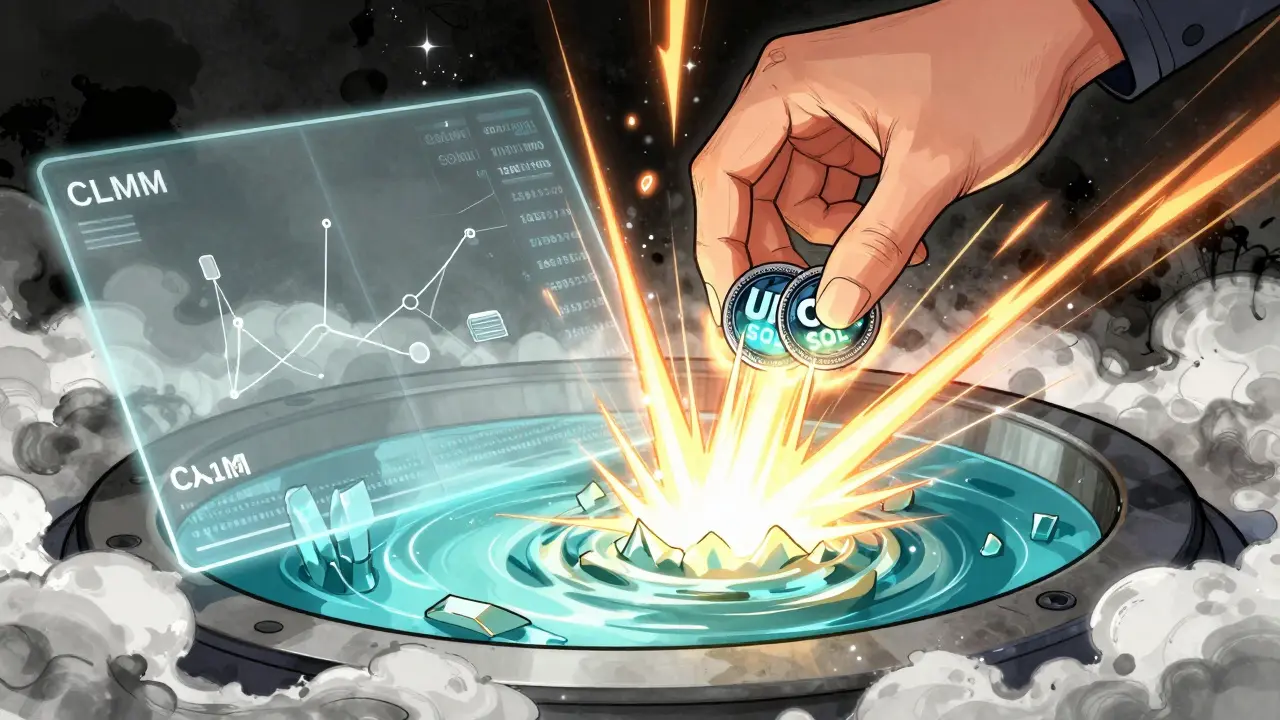
Let’s clear up a common mistake right away: CLMM is not the name of the exchange. It’s not even a coin. CLMM stands for Concentrated Liquidity Market Maker. It’s a smarter way to provide liquidity. Think of it like this: on most decentralized exchanges (like Uniswap), when you put up $10,000 to help trade SOL for USDC, your money is spread evenly across every possible price from $0 to $10,000. Most of that cash sits idle. CLMM changes that. It lets you choose a price range - say, $120 to $150 for SOL - and puts all your money right where trades are actually happening. That means more fees earned, less wasted capital.
Raydium launched in February 2021 as part of the Serum ecosystem. It’s not trying to be everything. It’s built for speed. Solana handles 400-800ms transactions. Fees? Around $0.00025. That’s why traders flock here. And unlike other DEXes that just use automated market makers (AMMs), Raydium connects directly to Serum’s central limit order book. That means you get better prices, tighter spreads, and deeper liquidity - especially for new tokens.
How Raydium Works: The Two Liquidity Models
Raydium offers two ways to trade and provide liquidity:
- Traditional AMM Pools: These work like Uniswap. Liquidity is spread out. Simple. Passive. But inefficient.
- CLMM Pools: Introduced in 2023, this is where Raydium shines. You pick a price range. You concentrate your funds there. The result? Up to 4,000x more capital efficiency than standard AMMs, according to Raydium’s own whitepaper.
For example: if you’re providing liquidity for USDC/SOL, using CLMM lets you earn 3.7x more fees than if you used a regular pool - especially when prices are stable. For volatile tokens? You still get 2.4x more efficiency than Uniswap V3. That’s why over 78% of new token launches on Raydium in 2025 used CLMM pools.
Trading fees are 0.25% for AMM pools. Of that, 0.22% goes to liquidity providers. The other 0.03% is burned or distributed to RAY token stakers. CLMM pools have flexible fees - from 0.01% for stablecoins up to 2% for risky meme coins. This lets liquidity providers match risk with reward.
RAY Token: Governance, Staking, and Value
The native token is RAY - not CLMM. There is no CLMM token. RAY has a max supply of 555 million, with 283 million in circulation as of early 2026. It’s not a revenue-sharing token like some others. Instead, it gives you voting power on protocol upgrades and lets you earn a cut of trading fees by staking.
Staking RAY earns you a portion of the 0.03% fee from every AMM trade. You can also lock RAY in governance pools to vote on things like fee structures, new pool types, or even how to allocate treasury funds. In 2025, staking rewards averaged 8-12% APY depending on network demand. That’s not insane compared to some DeFi projects, but it’s steady - and backed by real volume.
Performance and Market Position
Raydium is the #2 DEX on Solana. As of January 2026, it handles 24.7% of all Solana DEX volume. Orca leads with 31.2%. Jupiter is close behind at 18.9%. But Raydium’s edge? It’s the only one that fully integrates with Serum’s order book. That gives it a 0.8-1.2% price advantage over pure AMMs, according to a 2025 University of Zurich study.
Total trading volume since launch? Over $200 billion. Daily volume? Around $476 million. That’s not just big - it’s dominant. And it’s not just retail. In September 2025, Raydium launched an institutional portal. Seventeen hedge funds and market makers are now actively using it to provide liquidity. That’s rare for a Solana-native DEX.
Security: Audits, Incidents, and Risks
Raydium’s code has been audited five times - by CertiK, Neodyme, and others. 98.7% of critical functions are covered. But let’s be real: audits don’t mean invincible.
On December 5, 2022, attackers exploited a flaw in the CLMM contract and stole $5.5 million. The team reacted fast. They froze the affected pool, reimbursed users from treasury funds, and patched the code. It was a major wake-up call. Since then, every new feature goes through a 30-day bug bounty period before launch.
Still, experts warn: Raydium moves fast. New features drop weekly. Sometimes, speed outpaces safety. Mark Chen, a former Chainalysis analyst, put it bluntly: “Raydium’s rapid deployment cycle is its strength and its Achilles’ heel.”
User Experience: Powerful, But Not Beginner-Friendly
Raydium’s interface is functional. It’s not pretty. It’s not polished. If you’re used to Coinbase or MetaMask’s simple swap, you’ll feel overwhelmed.
Setting up a CLMM pool? You need to choose:
- Which token pair
- Price range (too narrow? You lose fees. Too wide? You waste capital)
- Fee tier
- Duration
A 2025 study by the Blockchain Education Network found new users take 8-12 hours to get comfortable with CLMM. For basic swaps? Just 4-6 hours. That’s a steep climb.
Mobile experience? Bad. 34% more errors than desktop. Customer support? Average response time on Discord: 72 hours. That’s not acceptable for a platform handling hundreds of millions daily.
Most users rely on Phantom Wallet - 98.7% of Raydium users do. If you’re not using Phantom, Backpack, or Slope, you’re not ready for Raydium.
Pros and Cons at a Glance
| Pros | Cons |
|---|---|
| Unmatched liquidity for new token launches | Complex CLMM interface - hard for beginners |
| 0.00025 transaction fees on Solana | No cross-chain support - Solana-only |
| 4,000x capital efficiency with CLMM pools | Mobile app is buggy and unreliable |
| Integrated with Serum’s order book - better prices | Slow support (avg. 72 hours) |
| Strong institutional adoption since 2025 | Risk of rapid feature rollout outpacing security |

Who Should Use Raydium?
Raydium isn’t for everyone. If you’re a casual trader buying SOL or ETH once a month, stick with Coinbase or MetaMask.
But if you’re:
- Trading new Solana meme coins or tokens
- Providing liquidity and want maximum yield
- Using Solana wallets daily
- Comfortable with advanced DeFi tools
Then Raydium is one of the best tools on the market. Its CLMM model is the most advanced on any single-chain DEX. And its integration with Serum’s order book gives it a real edge in price execution.
What’s Next? Raydium’s 2026 Roadmap
Raydium isn’t resting. In January 2026, they launched v3.2, which improved oracle integration and cut impermanent loss for stablecoin pairs. Then, on February 1, they integrated with Marginfi - letting liquidity providers borrow against their positions. That’s a game-changer. Now you can earn yield while also leveraging your capital.
Upcoming updates:
- Q2 2026: Multi-chain CLMM - starting with Ethereum L2s (Arbitrum, Optimism)
- Q3 2026: Institutional analytics dashboards - real-time P&L, slippage tracking
- Q4 2026: Dedicated stablecoin AMM for USDC/USDT/SOL - optimized for low slippage
If they pull this off, Raydium could become the first DEX to bring concentrated liquidity across chains. That would put it in direct competition with Jupiter and PancakeSwap - not just on Solana, but globally.
Final Verdict: High Risk, High Reward
Raydium is not a passive investment. It’s a power tool. It demands attention. You need to manage your CLMM ranges. You need to monitor price movements. You need to understand fees, impermanent loss, and slippage.
But if you do, you’ll find one of the most efficient, high-yield, and high-volume trading platforms on Solana. It’s not the prettiest. It’s not the easiest. But in 2026, it’s one of the most effective. For serious DeFi users? It’s almost essential.
Is CLMM a token on Raydium?
No, CLMM is not a token. It stands for Concentrated Liquidity Market Maker - a liquidity model used by Raydium to improve capital efficiency. The native token of Raydium is RAY.
How does Raydium make money?
Raydium earns revenue through trading fees. It charges 0.25% on AMM pools and variable fees (0.01%-2%) on CLMM pools. Of that, 0.22% goes to liquidity providers, and 0.03% is distributed to RAY stakers. The protocol doesn’t take a cut - it’s all passed through to users.
Can I use Raydium without Solana?
Not currently. Raydium is built exclusively on Solana. You need a Solana-compatible wallet like Phantom or Backpack. Cross-chain support is planned for Q2 2026, but for now, it’s Solana-only.
Is Raydium safe to use?
Raydium has undergone five security audits and has strong code coverage. However, it experienced a $5.5 million exploit in December 2022 due to a CLMM contract flaw. While fixes were made and users reimbursed, the platform’s fast development pace increases risk. Use only trusted wallets, avoid large deposits in new pools, and never leave funds idle in CLMM ranges without monitoring.
What wallet should I use with Raydium?
Phantom Wallet is used by 98.7% of Raydium users. Backpack and Slope are also fully supported. Avoid using wallets not explicitly listed on Raydium’s official site - third-party wallets may not support CLMM pools correctly.
How do I earn with Raydium?
You can earn by providing liquidity in AMM or CLMM pools, earning a share of trading fees. You can also stake RAY tokens to earn a portion of the 0.03% protocol fee. Some users combine both - providing liquidity and staking RAY to maximize yield. Always check impermanent loss before locking funds.
Katie Haywood
February 8, 2026 AT 16:49Mrs. Miller
February 9, 2026 AT 22:42Sharon Lois
February 10, 2026 AT 04:39mahikshith reddy
February 12, 2026 AT 00:15Matt Smith
February 12, 2026 AT 16:44Josh Flohre
February 13, 2026 AT 00:00Joshua Herder
February 13, 2026 AT 16:48Reda Adaou
February 13, 2026 AT 23:53David Bain
February 15, 2026 AT 18:03Brendan Conway
February 17, 2026 AT 01:53Brittany Coleman
February 17, 2026 AT 02:35Deeksha Sharma
February 17, 2026 AT 16:36Alisha Arora
February 18, 2026 AT 04:01Freddie Palmer
February 19, 2026 AT 01:59Taybah Jacobs
February 20, 2026 AT 09:06Brittany Novak
February 22, 2026 AT 09:06Udit Pandey
February 22, 2026 AT 10:08