Russian Central Bank Crypto Oversight: Strict Rules, Limited Exceptions in 2026
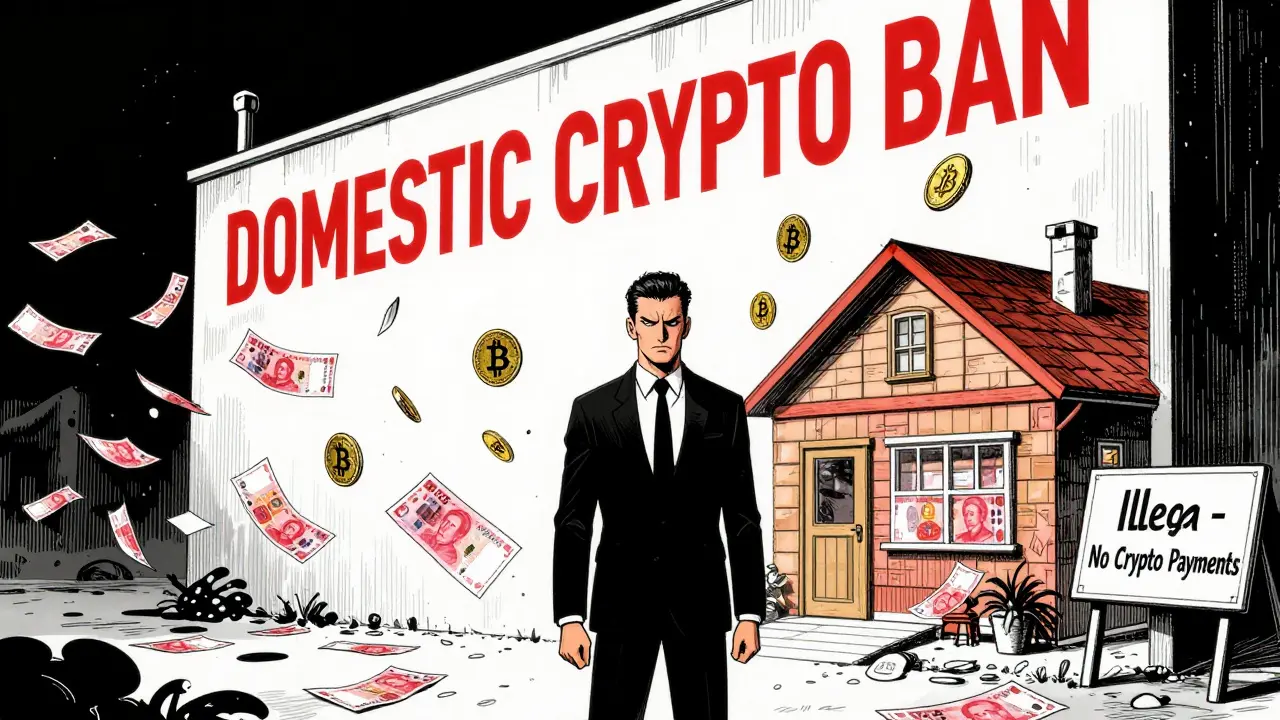
When it comes to cryptocurrency, Russia doesn't play by the same rules as most countries. While places like the U.S. or Singapore try to balance innovation with oversight, the Russian Central Bank has built one of the most restrictive frameworks in the world. It’s not about banning crypto outright-it’s about controlling every single step of it. And by 2026, that control is getting tighter.
Domestic Crypto Payments Are Still Illegal
You won’t find any Russian store accepting Bitcoin for coffee, and you won’t be able to pay your utility bill with Ethereum. The Russian Central Bank has made it clear: cryptocurrency has no place as a payment method within Russia. This isn’t a temporary policy-it’s a core principle. The bank fears that widespread use of digital assets could undermine the ruble, destabilize monetary policy, and make it harder to track capital flows. Even during economic hardship caused by international sanctions, the CBR held firm on this point. The logic? If people start using crypto to buy goods or send money domestically, it becomes nearly impossible to enforce tax laws, prevent money laundering, or monitor financial stability.But There’s a Loophole for International Trade
Here’s where things get interesting. In summer 2024, Russia quietly changed course for one specific use case: international trade. Companies can now legally use digital currencies to settle cross-border payments. This wasn’t a move toward crypto adoption-it was a survival tactic. Western sanctions made traditional banking channels difficult or impossible for many Russian firms. Crypto offered a way out. Now, a Russian manufacturer can sell machinery to a buyer in Turkey and receive payment in USDT or another stablecoin. The transaction still has to be reported, but it’s allowed. Experts call this a "critical loophole," and it’s the only major exception to Russia’s otherwise rigid crypto rules.Strict Rules for Banks: The "CryptoBasel" Rule
Banks in Russia are caught in the middle. They can’t let customers use crypto for payments. They can’t lend money to crypto firms easily. And starting in 2026, they’ll face the toughest rule yet: crypto investments can’t exceed 1% of a bank’s capital. This isn’t just a suggestion-it’s a legal limit. If a bank has 100 billion rubles in capital, it can only expose 1 billion rubles to crypto-related activities. The rule comes from an informational letter issued in May 2025 (IN 03-23/87), which required banks to fully back every ruble of crypto investment with their own funds. Think of it like this: if a client invests 100,000 rubles in a crypto product through a bank, the bank must set aside 100,000 rubles of its own money as a safety cushion. That’s why experts call it "CryptoBasel"-it’s modeled after international banking safety standards, but even more conservative.
The Experimental Legal Regime: Who Can Play?
The Russian Central Bank didn’t just shut the door. It built a gated compound. The Experimental Legal Regime (ELR) is Russia’s attempt to experiment with crypto without letting it spread. Only "especially qualified" investors can join. That means you need a high net worth, proven financial experience, and a long paper trail. The CBR vets you. You must pass strict KYC checks. You can’t just open an account online. And even if you’re in, you can’t trade with regular Russians. The ELR is isolated. Transactions inside it are monitored. Transactions outside it? Illegal. The goal? Keep crypto contained. Let experts play with it, but make sure it never touches the average citizen.Surveillance Is Everywhere
Russia isn’t just writing rules-it’s building tools to enforce them. The Central Bank and the Ministry of Digital Development teamed up to create a digital platform that tracks crypto users. It doesn’t just monitor exchanges. It traces peer-to-peer transactions, wallet addresses, and even mining activity. If you’re involved in crypto in Russia, you’re likely on their radar. Financial institutions must report any transaction over 600,000 rubles to tax authorities. That’s about $7,000 USD. Any activity above that threshold triggers automatic reporting. And the government isn’t stopping there. Rosfinmonitoring-the agency responsible for fighting financial crime-has openly stated it will regulate all virtual asset service providers (VASPs), including crypto exchanges, brokers, and even wallet providers. If you’re offering crypto services in Russia, you have two choices: join the state system or get blocked.
Stablecoins Are Getting Their Own Rules
Stablecoins like USDT or USDC are the most widely used digital assets in Russia’s international trade. That’s why the Ministry of Finance and the Central Bank are working together to create specific regulations for them. By the end of 2025, new rules are expected to finalize how these assets are issued, backed, and traded. The goal? Make sure they’re not used to bypass sanctions or launder money. The regulations will likely require stablecoin issuers to prove they hold real reserves-dollars, euros, or gold-and that those reserves are audited regularly. This isn’t about encouraging stablecoins-it’s about making sure they don’t become a hidden threat to Russia’s financial system.Why This Matters Beyond Russia
Russia’s approach is extreme, but it’s also telling. It shows how a government can use crypto regulation as both a shield and a weapon. The domestic ban protects the ruble. The international exception keeps trade alive. The surveillance system ensures no one slips through. The capital limits stop banks from taking big risks. And the ELR keeps crypto in a cage. This isn’t a model other countries are copying-yet. But it’s a blueprint for how authoritarian states might respond to decentralized finance: total control, zero trust, and absolute surveillance. If you’re thinking about crypto regulation globally, Russia’s path is worth watching-not because it’s smart, but because it’s ruthless.What’s Next in 2026?
By the start of 2026, the Russian Central Bank will have fully implemented its new capital rules for banks. The ELR will be fully operational. Stablecoin regulations will be in force. And the surveillance platform will be actively tracking transactions. Experts like Andrey Tugarin from GMT Legal say these changes aren’t revolutionary-they’re just formalizing what’s already happening. Banks have been avoiding crypto for years. The new rules just make that avoidance official. But even if nothing fundamentally changes, the message is clear: crypto has no future in Russia’s financial system-unless the state says so.Can Russian citizens use cryptocurrency for personal transactions?
No. The Russian Central Bank prohibits all domestic cryptocurrency payments for goods, services, or peer-to-peer transfers. Using crypto to pay for anything inside Russia-whether online, in-store, or between individuals-is illegal. The only exception is through the Experimental Legal Regime, which is restricted to a tiny group of qualified investors and does not allow everyday transactions.
Are cryptocurrency exchanges legal in Russia?
No cryptocurrency exchange can operate freely in Russia. All virtual asset service providers (VASPs), including exchanges and brokers, must integrate into the state-controlled system or face being blocked. The Central Bank and Rosfinmonitoring require full KYC, AML compliance, and transaction reporting. Any platform that refuses to comply is shut down or blocked by authorities.
Can Russian banks invest in Bitcoin or Ethereum?
Russian banks can invest in cryptocurrency, but only up to 1% of their total capital, and only under strict conditions. Starting in 2026, this limit becomes legally binding. Every ruble invested in crypto must be fully backed by the bank’s own funds. This rule, based on Basel-style capital requirements, effectively prevents banks from taking meaningful crypto exposure. Most banks avoid crypto entirely because of the high compliance burden and risk.
Why does Russia allow crypto in international trade but ban it domestically?
Russia allows crypto in international trade as a workaround for Western sanctions that cut off many banks from global payment systems. Crypto offers a way for Russian exporters and importers to continue doing business abroad. But domestically, the Central Bank fears loss of monetary control, tax evasion, and financial instability. The policy is designed to protect the ruble and the banking system while keeping trade alive-two conflicting goals resolved by strict separation.
What happens if someone violates Russia’s crypto rules?
Violating crypto regulations can lead to heavy fines, criminal charges, or both. Individuals and businesses using crypto for domestic payments, failing to report transactions over 600,000 rubles, or operating unlicensed exchanges face penalties under Russia’s financial and tax laws. The state has the tools to trace transactions and identify users through its surveillance platform, making evasion increasingly difficult.
Sarah Terry
March 23, 2026 AT 11:16Russia's approach is terrifyingly efficient. No domestic crypto use, strict bank limits, surveillance everywhere - it's like they built a financial aquarium and locked the lid. But honestly? It makes sense. If your currency is already under siege by sanctions, you don't let people gamble with decentralized assets on the home front. The international trade loophole? Brilliant pragmatism. They didn't embrace crypto - they weaponized it.
Shayne Cokerdem
March 23, 2026 AT 20:28lol so russia is just scared of people bein free? like wtf. they ban crypto but let it through for trade? so its ok to use it to screw over the west but not to buy a pizza? hypocrites. the whole system is rigged. they dont want freedom, they want control. and they call it "stability"? lolol
aravindsai pandla
March 23, 2026 AT 23:27It's important to recognize that Russia's model, while extreme, is not without strategic logic. Unlike Western nations that prioritize innovation first and regulation later, Russia is prioritizing systemic integrity. The 1% capital rule for banks is conservative, yes - but it prevents systemic risk. And the ELR? It’s a controlled environment for research, not adoption. This isn’t anti-innovation; it’s anti-chaos.
namrata singh
March 24, 2026 AT 04:30I wonder how many ordinary Russians even know about the ELR. Or if they just accept the ban because it’s easier than fighting the system. I’ve read stories of people using P2P apps anyway - quietly, nervously. The surveillance platform probably catches most, but not all. There’s always a gray zone, even under tight control.
Zion Banks
March 25, 2026 AT 11:50THIS IS A PSYOP. The "cryptoBasel" rule? A distraction. The real goal is to force everyone into the digital ruble. They don’t hate crypto - they want to replace it with a state-controlled version. The surveillance platform? That’s the real weapon. Every wallet address, every transaction - it’s all feeding into a centralized ledger. By 2026, your money won’t be yours. It’ll be theirs. And if you try to move it? You’ll vanish into the system. This isn’t regulation. It’s digital serfdom.
Annette Gilbert
March 26, 2026 AT 23:12Oh wow, Russia’s finally doing something sensible. Let me grab my monocle and weep with joy. "Crypto for trade, but not for coffee" - how poetic. It’s like they’re running a financial version of a prison: you can have one meal a day, but only if it’s government-approved gruel.
John Alde
March 28, 2026 AT 11:41Let’s unpack this a bit deeper. The fact that Russia allows crypto in international trade while banning it domestically isn’t contradictory - it’s a masterclass in asymmetric policy. Sanctions broke their access to SWIFT and correspondent banking, so they needed a workaround. Crypto became the duct tape. But domestically, they’re terrified of capital flight, tax evasion, and loss of monetary sovereignty. The ELR isn’t a loophole - it’s a pressure valve. And the 1% capital rule? That’s the real genius. It’s not about stopping banks from investing - it’s about making the cost of doing so so high that they don’t even bother. Compliance becomes its own deterrent. This isn’t anti-crypto. It’s anti-risk.
manoj kumar
March 30, 2026 AT 12:01So they’re banning crypto for normal people but letting billionaires play with it? Classic. They don’t want freedom - they want to be the only ones with access. The "Experimental Legal Regime" sounds like a fancy name for "rich kids’ club." Meanwhile, regular folks get fined for buying a coffee with Bitcoin. This isn’t control - it’s class warfare dressed up as policy.
Alicia Speas
March 30, 2026 AT 23:17There’s something admirable about how Russia has drawn clear lines. Other countries waffle between innovation and regulation. Russia says: here’s what we protect (the ruble, the system), and here’s what we tolerate (international trade). It’s not democratic, but it’s coherent. And honestly? If you’re a nation under sanctions, maybe that’s the only way to survive. I don’t agree with it - but I understand it.
Kevion Daley
March 31, 2026 AT 19:31It’s fascinating how Russia has turned crypto into a state-controlled luxury good. Like owning a vintage Ferrari - only if you’re on the approved list, and your car is tracked by GPS. The ELR? That’s not an experiment. That’s a gated community for the financial elite. And the 1% rule? That’s not a limit - it’s a tax on ambition. 🤷♂️
Tammy Stevens
April 1, 2026 AT 00:08Let’s be real - the whole system is built on fear. Fear of the ruble collapsing, fear of capital flight, fear of losing control. But here’s the kicker: the surveillance platform is probably the most advanced crypto-tracking tool in the world right now. They’ve turned blockchain transparency into a weapon. Every on-chain transaction? Logged. Every P2P? Traced. Even mining rigs are being monitored. They’re not banning crypto - they’re colonizing it. And honestly? That’s scarier than any ban.
Justin Credible
April 1, 2026 AT 08:07so like, they let crypto for trade but ban it at home? sounds like a scam. but also kinda genius? idk. i just hope my crypto stays safe lol. also why is everything so complicated? can’t we just chill?