SatoExchange Review: Is It Safe? Fees, Risks & Verdict
Imagine you finally decide to trade Bitcoin. You sign up for an exchange, deposit your funds, and hit buy. Simple enough, right? Now imagine trying to withdraw that same money later, only to find a fee that eats up half your profit-or worse, no way to put real cash (fiat) in the first place. This is the reality many users face with niche platforms like SatoExchange.
If you’ve stumbled upon SatoExchange while looking for a new place to trade altcoins, you might be wondering if it’s worth the risk. The short answer? Proceed with extreme caution. While some early reviews praised its simplicity, recent data paints a much grimmer picture involving low user ratings, high withdrawal fees, and significant red flags regarding its native token.
The Core Problem: No Fiat On-Ramps
Let’s start with the biggest hurdle. If you are brand new to crypto and want to buy your first Bitcoin or Ethereum using dollars or euros, SatoExchange is likely not for you. Unlike giants like Coinbase or Kraken, this platform operates strictly as a cryptocurrency-to-cryptocurrency exchange.
This means you cannot deposit USD, EUR, or GBP directly. You must already own crypto on another wallet or exchange, transfer it to SatoExchange, and then trade. For seasoned traders who hold assets across multiple wallets, this isn’t a dealbreaker. But for beginners? It adds a layer of complexity and extra transaction fees before you even start trading.
Why does this matter? Because it limits the user base to people who are already deep into the crypto ecosystem. It also raises questions about liquidity. Without fresh capital flowing in from fiat deposits, where does the trading volume come from?
Fees That Bite Harder Than Expected
You might think that because it’s a smaller exchange, the fees would be lower to attract users. Unfortunately, that’s not the case here. Let’s break down the costs so you know exactly what you’re paying.
| Fee Type | SatoExchange Rate | Industry Average | Verdict |
|---|---|---|---|
| Trading Fee (Maker/Taker) | 0.20% | 0.10% - 0.15% | Above Average |
| BTC Withdrawal Fee | 0.001 BTC | ~0.00053 BTC | Expensive (~40% higher) |
| Fiat Deposit | Not Available | Varies (Credit Card/Bank) | Limited Access |
That flat 0.20% trading fee sounds reasonable at first glance. However, most major competitors have dropped their rates to 0.10% or even lower for high-volume traders. More concerning is the Bitcoin withdrawal fee. At 0.001 BTC, you are paying significantly more than the global average. If Bitcoin is priced at $60,000, that withdrawal costs you $60. On other platforms, that same action might cost you around $28. Over time, these small differences add up, especially if you move funds frequently.
The SATX Token Mystery
Every modern exchange has a native token, and SatoExchange is no exception. Its token is called SATX (SatoExchange Token). Typically, these tokens offer discounts on fees or governance rights. But here, things get strange.
According to market data trackers like CoinMarketCap, the total supply of SATX is capped at 300 million tokens, with 238.03 million created. However, the circulating supply is listed as zero. What does that mean? It suggests that either the token hasn’t been distributed to the public yet, or there is a significant error in reporting. If you can’t buy or sell the token easily, how do you benefit from holding it?
This lack of clarity is a major red flag. In the crypto world, transparency is everything. When an exchange’s core utility token has a mysterious circulation status, investors should ask: Who holds these tokens? Are they locked up by the founders? Is there a plan to release them, or is this a dormant project?
User Trust: The Numbers Don't Lie
Let’s talk about reputation. Some older blog posts from 2023 claimed SatoExchange was "reliable and efficient." But blogs can be paid promotions. User reviews on independent platforms tell a different story.
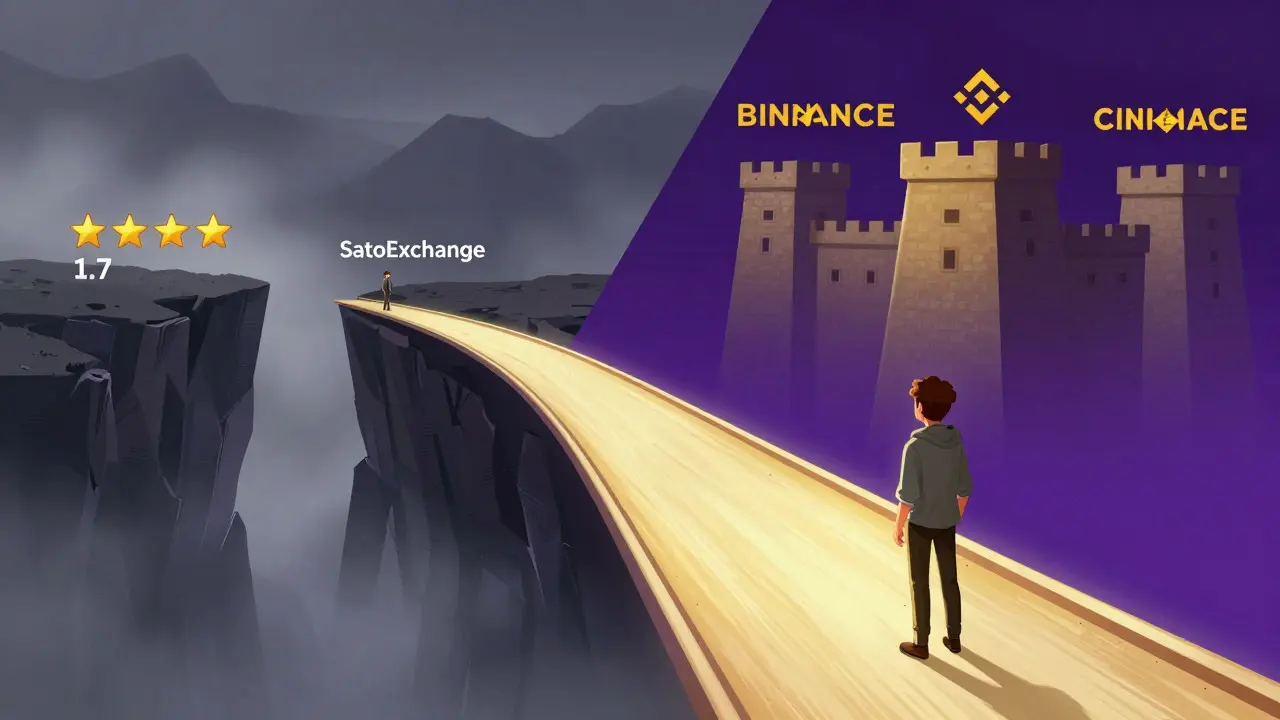
Data from Traders Union highlights a Trustpilot rating of just 1.7 out of 5 stars based on 22 reviews. That is abysmal. A rating below 2 usually indicates systemic issues-whether it’s poor customer support, stuck withdrawals, or confusing interfaces. Compare this to top-tier exchanges that boast thousands of reviews with ratings above 4.0.
While 22 reviews isn’t a massive sample size, the sentiment is overwhelmingly negative. Common complaints in similar niche exchanges often involve:
- Difficulty contacting support teams.
- Delays in processing withdrawals.
- Lack of clear information about security measures.
When you combine a 1.7-star rating with high fees and a confusing tokenomics structure, the trust factor plummets.
Security and Regulation: The Silent Killer
Here is the most critical part of any crypto exchange review: Where is it regulated? As of mid-2026, the regulatory landscape for crypto is tightening globally. The EU has MiCA regulations, and the US is pushing for clearer federal guidelines.
SatoExchange appears to operate in a gray area. There is no publicly available documentation stating that it holds licenses in major jurisdictions like the United States, the European Union, or Singapore. This doesn’t automatically make it a scam, but it does mean you have less legal recourse if something goes wrong.
If your funds disappear on a regulated exchange, you can file a complaint with financial authorities. If they vanish on an unregulated offshore platform, you might be chasing ghosts. Given the lack of transparent ownership details and regulatory filings, SatoExchange falls into the "high risk" category for asset safety.
Who Should Use SatoExchange? (And Who Shouldn't)
So, is SatoExchange completely useless? Not necessarily, but its audience is extremely narrow.
You might consider it if:
- You already hold specific altcoins listed on SatoExchange that aren’t available elsewhere.
- You are comfortable with high withdrawal fees and don’t mind moving crypto between wallets manually.
- You are an experienced trader who understands the risks of unregulated platforms.
You should avoid it if:
- You are a beginner looking to buy crypto with a credit card or bank transfer.
- You care about low fees and maximizing your returns.
- You prioritize security and regulatory compliance.
- You want to earn rewards through a native token (given the SATX circulation issues).
Better Alternatives Exist
In 2026, the crypto market is dominated by platforms that offer better security, lower fees, and full fiat integration. Instead of risking your funds on a platform with a 1.7 Trustpilot score, consider established alternatives:
- Binance: Offers the widest selection of coins and competitive fees, though it faces ongoing regulatory scrutiny in various regions.
- Kraken: Known for excellent security records and strong customer support, ideal for serious traders.
- Coinbase: The go-to for beginners due to its ease of use and regulatory compliance in the US and Europe.
- KuCoin: Often called the "people's exchange," it lists many obscure altcoins that larger exchanges ignore, similar to SatoExchange’s niche, but with a much larger user base and better track record.
These platforms may not be perfect, but they have survived multiple market cycles and have millions of users vouching for their reliability. SatoExchange lacks that proven history.
Final Verdict: Skip the Risk
After digging into the fees, the user reviews, and the tokenomics, the conclusion is clear. SatoExchange offers little advantage over established competitors. It charges higher-than-average fees, lacks fiat on-ramps, suffers from poor user satisfaction scores, and operates without clear regulatory oversight.
The only reason to use it would be if you absolutely needed to trade a specific pair unique to their platform. For everyone else, the risks outweigh the benefits. In the crypto world, preserving your capital is rule number one. Don’t hand it over to a platform that hasn’t earned your trust.
Is SatoExchange a scam?
While there is no definitive proof labeling SatoExchange a outright scam, the evidence points to high risk. With a Trustpilot rating of 1.7/5, unclear regulatory status, and suspicious token distribution metrics for its SATX coin, it exhibits many characteristics of unreliable platforms. Users should exercise extreme caution and never deposit more than they can afford to lose.
Can I buy Bitcoin with USD on SatoExchange?
No. SatoExchange does not support fiat currency deposits. You must already own cryptocurrency (like Bitcoin or Ethereum) on another exchange or wallet, transfer it to SatoExchange, and then trade it for other assets. This makes it unsuitable for beginners who need to convert cash to crypto.
What are the trading fees on SatoExchange?
SatoExchange charges a flat fee of 0.20% for both makers and takers. While this seems standard, it is higher than the 0.10%-0.15% rates offered by many major competitors. Additionally, withdrawal fees, particularly for Bitcoin (0.001 BTC), are significantly above the industry average.
What is the SATX token used for?
SATX is the native utility token of SatoExchange. Typically, such tokens are used to pay for trading fees at a discount or for governance voting. However, current data shows a circulating supply of zero, which creates uncertainty about its actual utility and availability for traders.
Is SatoExchange regulated?
There is no public information confirming that SatoExchange holds licenses in major jurisdictions like the US, EU, or Singapore. This lack of regulatory transparency is a significant risk factor, as it means users may have limited legal protection if disputes arise or funds are lost.
Marcia Albert
July 29, 2026 AT 16:44Oh honey, look at that fee structure. It’s not just a bite, it’s a full-on mauling by the crypto wolves. I tried a similar shady platform last year and my funds vanished faster than ice cream in July. Stick to the big boys unless you really enjoy donating to offshore accounts.
Ed Mitchell
July 31, 2026 AT 03:30The establishment wants you to believe these small exchanges are risky because they threaten the monopoly of the banking cartels. But have you considered that SatoExchange is actually a front for something much deeper? The zero circulating supply of SATX isn't an error; it's a signal. They are hoarding the tokens for a future elite class while we peasants pay the 0.20% tax. Wake up sheeple! The regulators are blind to what is happening in the shadows.
Emma Smith
August 2, 2026 AT 01:35one must ponder the existential dread of holding assets on a platform with no fiat bridge. it is a limbo state where your wealth exists only in the digital ether yet cannot touch the material world. the lack of punctuation in their terms of service mirrors the void in their customer support. we are all just trading ghosts here
Michael Mostyn
August 3, 2026 AT 07:46It is quite fascinating how the absence of regulatory oversight correlates so strongly with user dissatisfaction. One might argue that transparency is not merely a bureaucratic hurdle but a fundamental requirement for trust in any financial instrument. The data presented regarding the Trustpilot rating is damning indeed. It suggests a systemic failure rather than isolated incidents.
Erica Johnson
August 4, 2026 AT 04:53lol really? people still fall for this stuff. the satx token having zero circulation is basically screaming 'rug pull' in neon letters. if you cant buy it or sell it its just paper weight. dont be that guy who loses his life savings because he read a blog post instead of checking coinmarketcap. :)
Ken G
August 4, 2026 AT 11:16its obvious the moral decay of society has led us here. we trust faceless entities with our money because we are too lazy to think for ourselves. the fees are high because they know we are sheep. simple as that. stay away from the corrupt systems and keep your cash under the mattress if you have to. better safe than sorry i guess
Lorraine Surringer
August 6, 2026 AT 05:32I feel like this review is missing the emotional toll it takes to watch your hard earned money get eaten by fees. Its so frustrating when you try to do the right thing by diversifying and then get burned by a sketchy site. My heart goes out to anyone who lost money here. Please take care of yourselves and maybe try meditation instead of trading for a bit?
Alex Di Mango
August 8, 2026 AT 04:52Look, everyone has different risk tolerances. If someone knows exactly which altcoin pair they need and accepts the fees, that's their choice. But for the average person starting out, yeah, Coinbase or Kraken makes way more sense. No need to hate on the niche players though, they serve a purpose even if it's a small one.
Amor Jordan
August 8, 2026 AT 20:25This is heartbreaking to read. Imagine putting your trust into a system that doesn't value you back. The 1.7 star rating is not just a number, it represents real people feeling unheard and undervalued. We need more empathy in finance, not just cold hard numbers. Let's support platforms that treat humans with dignity.
Nick Darring
August 8, 2026 AT 22:01You guys are all sleeping on this opportunity because you're too scared to think outside the box. Sure, the fees are higher, but have you considered that the liquidity might be thinner meaning less slippage on obscure pairs? And the lack of regulation means faster innovation without red tape slowing them down. Maybe the zero circulation is a strategic move to prevent early dumping. Who knows? You're all just copying each other's fears instead of doing your own due diligence on the actual tech stack.
Eden Tadesse
August 10, 2026 AT 13:28i agree with most of this but typos aside the point stands. why would anyone use this when binance exists? the withdrawal fee alone is crazy. 0.001 btc is like paying for a nice dinner every time you move money. just stick to the main ones ppl.
Eric Zehr
August 12, 2026 AT 00:57Great breakdown here. It is always important to verify the source before trusting your funds. The comparison table was particularly helpful in visualizing the cost difference. Keep up the good work in educating the community about these hidden risks.
Namrata Mapgaonkar
August 12, 2026 AT 20:10in india we also see many such small exchages popping up and vanishing. the trust factor is very low everywhere. i prefer to keep my crypto in hardware wallet and only trade on big names. hope this helps someone avoid loss :)