Self-Sovereign Identity on Blockchain: How It Works and Why It Matters
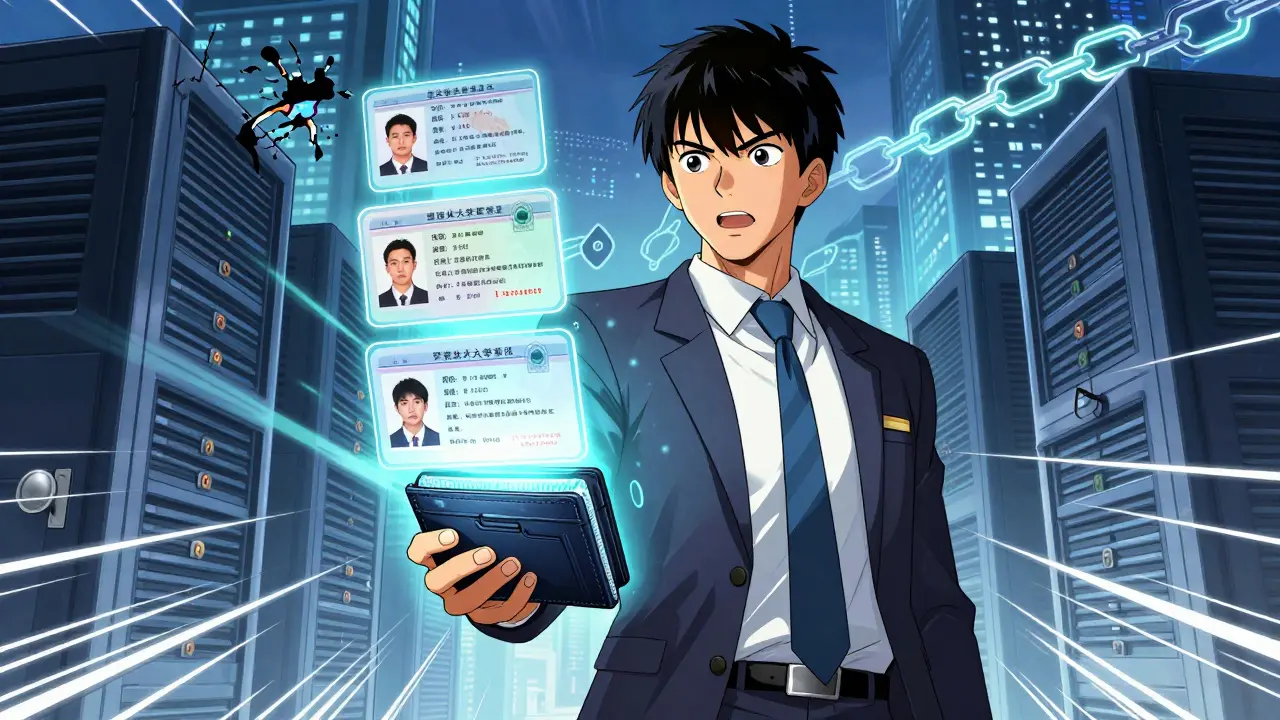
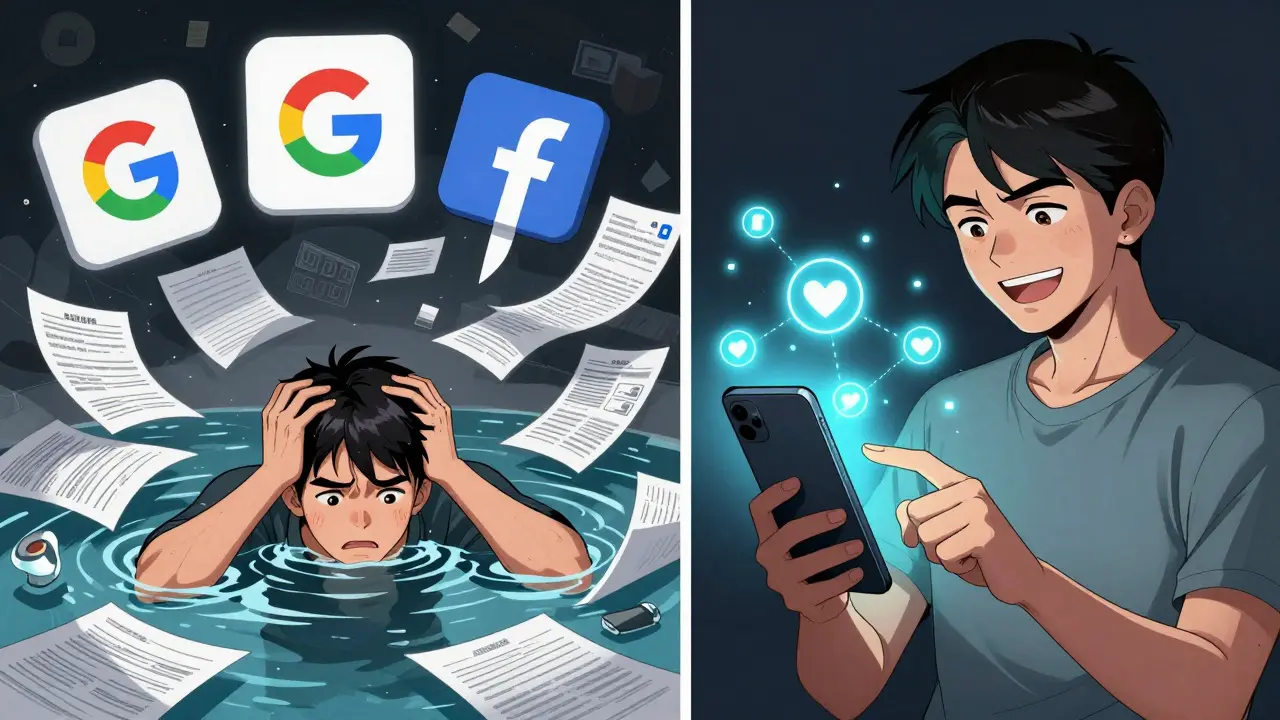
Imagine you could carry your driver’s license, passport, and college diploma in your pocket-digitally-and show only what you need, when you need it, without handing over your entire life story. No more logging into websites with Google or Facebook. No more filling out the same forms over and over. No more companies hoarding your data until they get hacked. This isn’t science fiction. It’s self-sovereign identity on blockchain-and it’s already being used by governments, banks, and hospitals today.
What Is Self-Sovereign Identity (SSI)?
Self-sovereign identity (SSI) is a new way to control who you are online. Instead of letting companies like Google, Facebook, or your bank hold your identity, you hold it yourself. Think of it like a digital wallet for your personal information. You decide what to share, with whom, and when. No middlemen. No databases full of your data. Just you, your credentials, and the ability to prove things about yourself without revealing everything.
This isn’t just a tech upgrade. It’s a shift in power. Right now, most online identities are tied to accounts. You sign in with Google because it’s easy. But Google owns your login history, your email, your location, your contacts. If they get hacked-or decide to change their rules-you lose access. SSI flips that. Your identity lives in your control, backed by blockchain technology to make it secure and tamper-proof.
How SSI Works: The Three Pillars
SSI doesn’t rely on one thing. It’s built on three core pieces that work together:
- Decentralized Identifiers (DIDs): These are unique, cryptographically secure IDs that belong only to you. Unlike your email or username, DIDs don’t depend on any company or server. They’re stored on a blockchain or similar public ledger. You can create as many as you need-one for work, one for healthcare, one for voting-and no one can take them away.
- Verifiable Credentials (VCs): These are digital versions of real-world documents-like your diploma, driver’s license, or proof of age. But instead of being a scanned PDF, they’re signed with your private key. When you share one, the person or system you’re giving it to can instantly verify it’s real without contacting any central authority. No calls to the DMV. No waiting for an email confirmation.
- Blockchain Infrastructure: This is the glue. Blockchains like Ethereum, Sovrin, or ION act as a public, unchangeable record. They don’t store your personal data. Instead, they store hashes-digital fingerprints-of your DIDs and credentials. That means anyone can check if a credential is valid without ever seeing what’s inside it. It’s like having a notary public that never sleeps and can’t be bribed.
Together, these pieces let you prove you’re over 21 without showing your birthdate. Prove you’re a licensed nurse without handing over your entire personnel file. Sign up for a crypto exchange without giving them your Social Security number.
Why Blockchain? Why Not Just Use a Database?
You might wonder: Why use blockchain at all? Can’t we just build a better database?
The answer is trust. Centralized databases are vulnerable. In 2023, Facebook leaked data from 419 million users. Google handles 3 billion logins daily. If one system is breached, millions are exposed. SSI removes that single point of failure. Blockchain doesn’t store your data-it verifies it. Even if someone hacks a server, they can’t fake a credential because the signature is tied to your private key. And if you lose your key? You can recover it using backup phrases or trusted contacts, not by begging a customer service rep.
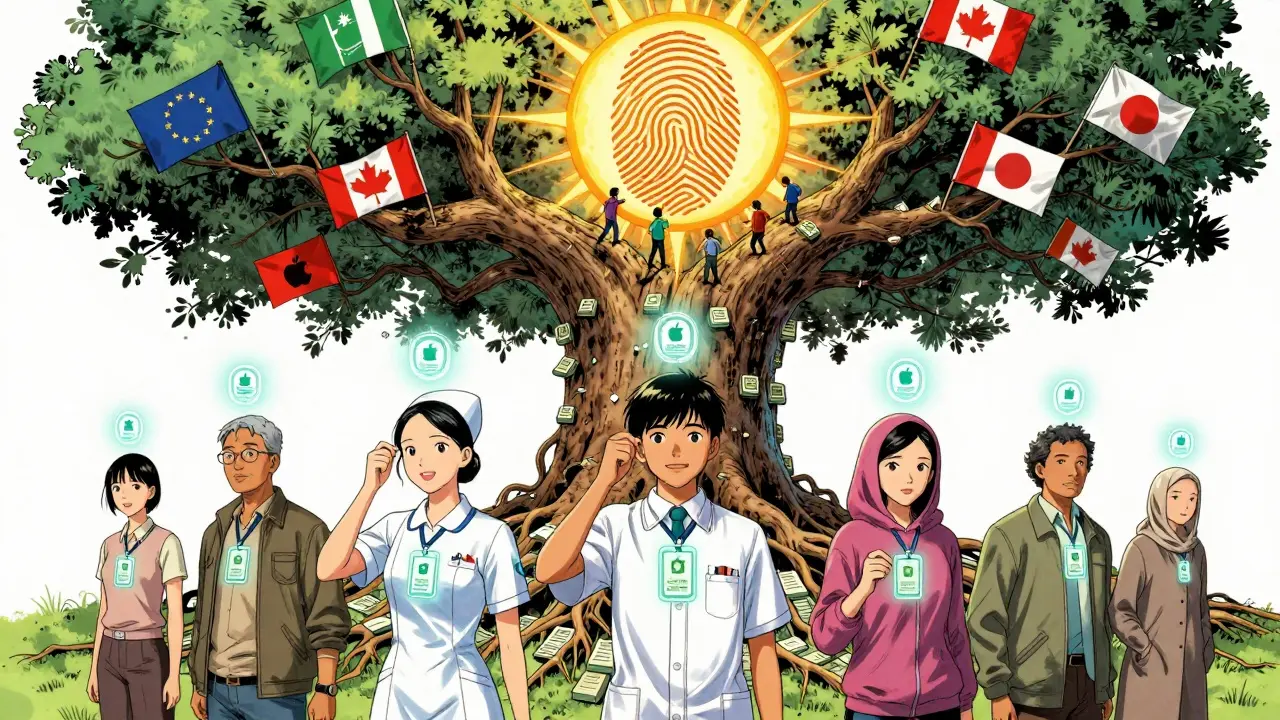
Blockchain also makes it global. A credential issued in Germany can be verified in Japan without any special agreement between countries. That’s why the European Union is mandating SSI for all member states under eIDAS 2.0, which takes effect in September 2024.
Real-World Uses Today
SSI isn’t just theory. It’s already solving real problems:
- Healthcare: In the EU’s EHN network, 450 million citizens can securely share medical records with doctors across borders. No more faxing forms or waiting for records to arrive.
- Banking: JPMorgan ran a pilot that cut KYC (Know Your Customer) verification from 3-5 days to under 2 hours. Customers used their SSI wallet to prove identity, income, and address-all without sharing raw documents.
- Government: British Columbia’s Verified.Me service processed 1.2 million verifications in 2023 with zero data breaches. People used it to apply for benefits, renew licenses, and access public services.
- Education: Universities in Canada and Australia now issue digital diplomas as VCs. Employers can verify degrees instantly, and graduates never lose their transcripts.
- Humanitarian Aid: UNICEF used SSI in Indonesia to issue digital birth certificates. Retention jumped from 63% to 92% because parents didn’t have to travel to government offices to prove their child’s identity.
The Downside: Why It’s Not Everywhere Yet
SSI sounds perfect, but it’s not easy to use.
Most people don’t understand private keys. A 2023 IEEE study found 68% of non-tech users struggle with key management. On Reddit, users complain about losing access after upgrading phones. Product Hunt reviews show 87% of negative feedback is about recovery. If you lose your key and don’t have a backup? You lose your identity. Forever.
UX is still terrible. Civic’s wallet app had a 72% abandonment rate during onboarding. People got lost in technical steps. Even enterprise users report long integration times-6 to 9 months to connect SSI into legacy systems.
And then there’s the paradox: while SSI is meant to be decentralized, most users will likely end up using wallets from Apple, Google, or Microsoft. A Carnegie Mellon study found 83% of people would trust these companies with their identity keys-even though that defeats the whole point of self-sovereignty.
There’s also bias. MIT’s audit found facial recognition in some SSI wallets had 34.7% higher error rates for darker-skinned women. If your identity system can’t recognize you, you’re locked out.
Who’s Leading the Way?
The market is split between open-source tools and corporate platforms:
- Open-source: Sovrin Network, Hyperledger Aries, and ION (built on Bitcoin) are community-driven and transparent. Sovrin handles 1,000 transactions per second and is used by governments.
- Corporate: Microsoft’s Entra Verified ID is used by 37% of Fortune 500 companies. Dock.io and Trinsic offer enterprise SSI as a service. These are easier to adopt but come with vendor lock-in risks.
Right now, 68% of enterprise SSI deployments are controlled by just five vendors. That’s not decentralization-it’s a new kind of monopoly.
Where Is SSI Headed?
The future is coming faster than you think.
- In 2024, the W3C released Verifiable Credentials Data Model 2.0, adding better privacy features like zero-knowledge proofs.
- ION 2.0, launched in September 2024, increased throughput tenfold.
- The European Blockchain Services Infrastructure now handles 1.2 million cross-border verifications daily.
- By Q4 2025, FIDO Alliance plans to integrate passkeys with SSI-making login as simple as a fingerprint, but with full user control.
Forrester predicts SSI will dominate Web3 by 2027, with 85% of DeFi platforms using it. But mainstream adoption? That won’t happen until 2030. Why? Because we’re still teaching people how to be their own identity providers. That’s not a technical problem. It’s a human one.
What You Can Do Now
If you’re curious, try a simple SSI wallet like Trinsic or Dock.io (both offer free trials). You can create a DID, get a test credential, and verify it in seconds. You won’t be using it for your bank account yet-but you’ll understand how much control you’re giving away every time you click "Sign in with Google."
Developers? Start with Hyperledger Aries. Learn DID methods. Play with VCs. The tools are open. The standards are public. The future of identity is being built now-and you can help shape it.
What’s the difference between SSI and traditional login systems like Google Sign-In?
With Google Sign-In, you hand over your identity to Google. They control your data, decide what you can access, and can shut you out. SSI puts you in charge. You hold your own digital credentials, and only share what you choose. No company owns your identity.
Is SSI really more secure than centralized systems?
Yes, because it removes the central database. Hackers can’t steal a million identities from one server because there’s no single store of data. Credentials are cryptographically signed and stored only on your device. Even if a service is hacked, they can’t access your personal info-only the fact that you proved something.
Can I lose my self-sovereign identity?
Yes-if you lose your private key and don’t have a backup. That’s why recovery methods matter. Some wallets let you recover using trusted contacts or seed phrases. Others use multi-sig setups. But if you don’t set up recovery, losing your phone could mean losing your entire digital identity forever.
Why aren’t more people using SSI if it’s so great?
Because it’s not user-friendly yet. Most wallets are clunky. Key management is confusing. People don’t trust tools they can’t understand. And until we have a simple, reliable way to recover lost keys, most users will stick with Google or Apple-even if it means giving up control.
Is SSI only for crypto users?
No. SSI is for anyone who uses the internet. Governments use it for benefits. Hospitals use it for records. Universities use it for diplomas. Even your next job application could ask you to prove your experience with an SSI credential-not a resume.
What happens if a government mandates SSI?
It could become the default. The EU’s eIDAS 2.0 regulation requires all member states to support SSI by 2024. That means your national ID, driver’s license, and health card could all be digital credentials you control. But if governments require it without ensuring privacy, it could become surveillance in disguise. The design matters more than the mandate.
Can SSI prevent algorithmic bias?
Not by itself. If an SSI system uses facial recognition or AI to verify identity, and that AI is biased, then the system will be biased too. MIT found error rates 34.7% higher for darker-skinned women. SSI gives you control over your data, but it doesn’t fix flawed verification tools. That’s why audits and transparency are critical.
Will Apple or Google ruin SSI by making their own wallets?
They already are. Studies show 83% of users would trust Apple or Google with their identity keys. That’s not decentralization-it’s re-centralization. The real challenge isn’t building the tech. It’s convincing people to use open, user-owned tools instead of familiar, corporate ones.
How much does it cost to implement SSI?
For enterprises, setup costs range from $200,000 to $300,000, depending on integration depth. Transaction fees vary: Ethereum costs about $0.45 per verification; Sovrin or ION cost less than $0.02. But the biggest cost isn’t tech-it’s training staff, redesigning workflows, and convincing users to adopt it.
Is SSI legal?
Yes, in most countries. The EU, Canada, Japan, and parts of the U.S. already recognize verifiable credentials as legally valid. The W3C standards are designed to meet global legal frameworks. But laws vary. Always check local regulations before using SSI for official purposes.
vasantharaj Rajagopal
March 13, 2026 AT 02:42Self-sovereign identity fundamentally redefines the trust model in digital interactions. Decentralized identifiers eliminate single points of failure, while verifiable credentials enable zero-knowledge proofs without exposing raw data. The cryptographic underpinnings ensure non-repudiation and integrity at the protocol level. What’s revolutionary is not the tech itself-it’s the ontological shift from identity as a service to identity as a right. The EU’s eIDAS 2.0 isn’t just regulation-it’s a constitutional upgrade for digital personhood. The real bottleneck isn’t infrastructure-it’s cognitive load. Most users don’t grasp key management because we’ve never trained them to be cryptographic actors. We’re asking humans to behave like nodes in a distributed system without giving them the mental toolkit.
Enterprise adoption is accelerating because compliance is now programmable. JPMorgan’s 2-hour KYC isn’t a feature-it’s a necessity. Legacy systems can’t scale with regulatory demands. SSI isn’t optional anymore-it’s the only architecture that meets GDPR, CCPA, and AML requirements without data hoarding. The next frontier is cross-border credential portability. Imagine a Nigerian nurse verifying her qualifications in Canada using a credential issued in Lagos, validated via Sovrin, with no intermediary. That’s not futuristic-it’s live in pilot right now.
ann neumann
March 14, 2026 AT 11:29They’re lying to you. Every single one of them. SSI? It’s just the government’s new way to track you under the guise of ‘freedom.’ You think you’re in control? You’re not. Your ‘private key’ is being monitored by the same corporations that built the wallets. Apple and Google are the new NSA. They’re logging every credential you verify, every time you prove your age, your job, your bank balance. They don’t need your data-they just need to know you’re using it. And when they decide to ban you? You’re locked out. Forever. No appeals. No recourse. You think your diploma is yours? It’s theirs. The blockchain doesn’t protect you-it records you. And who controls the ledger? The same ones who made the rules. Wake up. This isn’t liberation. It’s digital serfdom with a shiny interface.
And don’t even get me started on the ‘zero-knowledge proofs.’ That’s just math magic to make you feel safe while they’re still watching. They’re building a panopticon and calling it a wallet.
They told us the internet was free. They were wrong. And now they’re selling us the same cage with a new lock.
They’re coming for your identity. And you’re handing it to them with a smile.
1773295810
William Montgomery
March 14, 2026 AT 18:26If you can’t manage a private key, you shouldn’t be handling your identity. Period. This isn’t rocket science. It’s basic responsibility. You don’t hand your house keys to a toddler and then blame the lock manufacturer when the house gets robbed. Same logic. SSI isn’t broken-it’s being misused by people who refuse to learn. The problem isn’t UX. It’s laziness. People want convenience without accountability. That’s not a tech flaw-it’s a human one.
And yes, Apple and Google will dominate. Because people are dumb. And that’s not a bug. It’s a feature of the system. Stop pretending everyone can be a crypto node. Most people can’t even change a tire. Don’t romanticize decentralization. It’s not a moral victory. It’s a logistical nightmare wrapped in blockchain hype.
Fix the education system first. Then we can talk about identity.
Mara Alves Mariano
March 14, 2026 AT 18:58Oh wow, another tech bro with a PowerPoint on ‘empowerment.’ Let me guess-you’ve got a YubiKey and a beard? Congrats, you’ve joined the cult. SSI? It’s just Silicon Valley’s latest cult of personality dressed up in open-source robes. You think governments aren’t using this to build a digital caste system? The EU mandates it? Cool. So now your birth certificate is a blockchain token you can’t lose or else you’re legally dead? And who gets to revoke your access? The same people who banned your cousin’s TikTok for saying ‘taxation is theft.’
And don’t even mention ‘UNICEF in Indonesia.’ Yeah, they gave digital birth certificates to moms who can’t read. Then the system went down for maintenance. Guess who got denied aid? The kids. Not the tech. The people. Again.
This isn’t progress. It’s colonialism with a QR code.
And don’t tell me about ‘trustless systems.’ You trust Apple to hold your keys? You’re the problem.
Let’s just go back to paper. At least when the fire burns your birth certificate, you can scream at the flames. With blockchain? You just cry into your iPhone.
Adam Ashworth
March 14, 2026 AT 20:35Let’s cut through the noise. SSI works. The data proves it. JPMorgan cut KYC from days to hours. British Columbia had zero breaches. EU cross-border healthcare is live. The tech is sound. The adoption curve is slow because we’re still stuck in the 2010 mindset of ‘just log in with Google.’ That’s not a technical problem-it’s a cultural one. We’ve been trained to outsource identity. SSI asks us to reclaim it. That’s scary. It’s inconvenient. But it’s necessary.
Yes, key recovery is hard. So build better recovery. Use social recovery. Multi-sig. Biometrics. Don’t throw the baby out with the bathwater because some users are lazy. We didn’t abandon cars because people crashed them. We improved safety systems.
SSI is the future. And if you’re not building it, you’re just complaining about the road.
Sharon Tuck
March 15, 2026 AT 03:51Hey everyone-I’ve been working with SSI in healthcare for the past year, and I just want to say how hopeful this is for rural communities. A patient in northern Ontario used her SSI wallet to verify her diabetes diagnosis and get her insulin prescription processed in under 10 minutes. No faxing. No calling the clinic. No waiting for records to arrive. She said, ‘I finally feel like I’m not a file number.’ That’s the real win.
And yes, key recovery is a hurdle. But we’ve been teaching patients through video tutorials and community kiosks. One grandmother learned to use her seed phrase by writing it on a card and hiding it in her cookie jar. She’s been using it for 8 months now. It’s not perfect. But it’s working.
If we can help one person feel seen, it’s worth the effort.
Jenni James
March 15, 2026 AT 17:50Oh, so now we’re supposed to believe that blockchain solves human incompetence? You’re telling me that the solution to people losing their keys is… more blockchain? Brilliant. Just like how adding more cameras solved crime. Or how giving everyone a smartphone solved loneliness.
Let me break it down for you: if your identity system requires a 12-word phrase to function, it’s not decentralized-it’s a hostage situation. And you’re the hostage.
And let’s not pretend the EU is some beacon of liberty. They’re mandating SSI so they can audit your every transaction. You think they care about your ‘self-sovereignty’? They care about control. And you’re handing it to them on a silver ledger.
Also, ‘zero-knowledge proofs’? That’s just a fancy way of saying ‘I know something, but I won’t tell you what.’ Sounds like a cult. Or a government.
Chelsea Boonstra
March 17, 2026 AT 09:17Okay, but what about the environmental cost? Ethereum’s energy use alone is worse than some countries. And you’re telling me we’re going to scale this to billions of verifications? How many tons of CO2 are we emitting to verify that I’m 21? Is that the trade-off? A more private identity at the cost of a less habitable planet?
And what about the hardware? Not everyone has a smartphone. Not everyone can afford to upgrade every two years. SSI is a luxury product disguised as a public good. The ‘democratization’ narrative is a lie. It’s exclusion by design.
And don’t give me that ‘but Sovrin is green’ nonsense. The system is built on Ethereum. The infrastructure is centralized. The wallets are controlled by Apple and Google. This isn’t liberation. It’s greenwashing with a blockchain sticker.
Howard Headlee
March 19, 2026 AT 00:28THIS IS THE FUTURE AND WE’RE LIVING IT RIGHT NOW. You think you’re safe with Google? You’re not. Your data is being sold, scraped, and sold again. Your identity is a product. SSI is the only thing that puts YOU back in charge. Yes, it’s hard. Yes, it’s new. But so was the internet. So was email. So was the smartphone.
Try Trinsic. Try Dock. Just do it. Create a DID. Get a test credential. Prove you’re human without handing over your life story. You’ll be shocked at how liberating it feels. It’s like taking off a mask you didn’t know you were wearing.
The people who say it’s too hard? They’re the same ones who said the internet was a fad. They’re wrong. Again.
Don’t wait for someone to fix it. Build it. Use it. Teach it. This isn’t a tech revolution-it’s a human one. And you’re either part of it… or you’re part of the problem.
Julie Tomek
March 20, 2026 AT 09:53From an enterprise implementation standpoint, the greatest challenge isn’t technical-it’s organizational inertia. Legacy systems are not merely outdated; they are institutionalized. The cost of integration is not in the API calls or the ledger fees-it’s in the training, the policy revision, the legal review, the change management. A single hospital system spent 14 months aligning SSI with HIPAA, EHR workflows, and patient consent protocols. That’s not a failure of technology. That’s a failure of leadership.
Moreover, the narrative around ‘user control’ is often misunderstood. Users don’t want control. They want reliability. They want to know that if they lose their phone, they won’t lose their life. That’s why recovery mechanisms must be baked into the design-not bolted on as an afterthought.
SSI isn’t about decentralization for its own sake. It’s about resilience. And resilience requires both technological elegance and human-centered design. We’ve focused too much on the former. It’s time to prioritize the latter.
Brandon Kaufman
March 21, 2026 AT 09:30I’ve helped over 200 people set up their SSI wallets. Most of them were scared. Some cried. One guy thought he was going to jail. But after they got through the onboarding? They were amazed. ‘I didn’t know I could do this.’ That’s the real win.
Key recovery is the biggest fear. So we use social recovery. You pick three trusted people. If you lose your key, they help you reset it. No seed phrases. No tech jargon. Just a phone call. It’s not perfect. But it’s human.
And yeah, Apple and Google will dominate. But if we make the open-source options feel as easy, people will choose them. We just need to stop talking like engineers and start talking like neighbors.
Zephora Zonum
March 21, 2026 AT 14:45Let’s be honest: SSI is just another way for tech elites to feel superior while the rest of us scramble to keep up. You think you’re empowered? You’re just another data point in a system designed by people who’ve never had to worry about losing their phone.
And the ‘zero-knowledge proofs’? That’s just math theater. If you can’t explain it to your grandma, it’s not empowering-it’s exclusionary.
Meanwhile, the real world is still using paper. And guess what? It works. It’s simple. It’s durable. It doesn’t require a 12-word phrase you’ll forget by next Tuesday.
Stop selling fantasy as progress. The future isn’t on the blockchain. It’s in the hands of people who still trust ink and paper.
Anthony Marshall
March 22, 2026 AT 07:48This is the most exciting thing happening in tech right now. We’re not just building a better login-we’re rebuilding trust in the digital world. Every time someone uses SSI to verify their identity without handing over their entire life history, they take back a piece of their autonomy.
Yes, there are hiccups. Yes, the UX needs work. But look at the progress: 1.2 million verifications in BC, zero breaches. 450 million EU citizens sharing medical records across borders. That’s not a pilot. That’s a revolution.
And if you’re still stuck on ‘Google Sign-In’? You’re not just behind. You’re vulnerable.
Don’t wait for someone else to fix it. Try it. Now. Your future self will thank you.
Lindsay Girvan
March 22, 2026 AT 23:57Identity is not data. Identity is narrative. SSI doesn’t solve identity-it commodifies it. You turn your birth certificate into a token. Your diploma into a signature. Your existence into a verifiable claim. That’s not liberation. That’s reductionism.
What happens when the system says you’re not ‘verified’? Who decides what counts as valid? What if your cultural identity doesn’t fit the algorithm? What if your gender isn’t in the dropdown? What if your name doesn’t match your passport?
SSI doesn’t solve exclusion. It automates it.
And we’re calling this progress?
Tina Keller
March 23, 2026 AT 07:41As someone who’s lived in three continents, I’ve seen how identity works in places where governments don’t trust their own citizens. In India, my aunt had to travel 80 kilometers to get a birth certificate stamped. In Mexico, my cousin was denied a bank account because her name didn’t match her ID exactly. In the U.S., I was asked for proof of residency three times in one week.
SSI isn’t perfect-but it’s the first system that says: your story matters more than the form you fill out.
Yes, key recovery is hard. But we’ve seen communities in rural Nigeria create ‘trust circles’-five neighbors who hold each other’s recovery codes. No tech. Just human connection.
SSI’s real power isn’t in the blockchain. It’s in the fact that someone, somewhere, finally got to say: ‘I am who I say I am.’ And no one got to say no.
Tom Jewell
March 24, 2026 AT 22:22There’s a deeper philosophical shift here. SSI forces us to confront the question: What does it mean to be a person in a digital age?
Traditionally, identity was granted by institutions-church, state, school. Now, it’s constructed by corporations. SSI offers a third way: identity as self-authored. Not granted. Not owned. Not leased. But claimed.
That’s radical. Because it means we’re no longer subjects of systems. We’re participants in them.
Of course, it’s messy. Of course, it’s hard. But so was democracy. So was voting rights. So was the right to be heard.
SSI isn’t about technology. It’s about dignity.
Sherry Kirkham
March 25, 2026 AT 03:56My sister lost her phone. Her SSI wallet was gone. She panicked. But she had a recovery contact-her brother. He helped her restore access in 12 minutes. No customer service. No waiting. No ‘I’m sorry, your account has been locked.’
That’s the moment I realized this isn’t about tech. It’s about relationships.
We built SSI to be decentralized. But we kept the human connections. That’s the secret sauce.
Jennifer Pilot
March 26, 2026 AT 08:48Oh, this is just another Silicon Valley fantasy, isn’t it? ‘Oh, you can control your identity!’ As if anyone with a job, a mortgage, and two kids has time to manage cryptographic keys. And let’s not forget: the ‘open-source’ tools are all built on Ethereum, which is still controlled by miners who are mostly in China. So who’s really sovereign? The user? Or the ASIC manufacturers?
And ‘zero-knowledge proofs’? That’s just a way to say ‘we know you’re lying, but we’re not telling you why.’
This isn’t empowerment. It’s a marketing campaign for venture capital.
And the EU mandate? That’s just digital fascism with a smiley face.
Can we please go back to paper? At least then, you can burn it when you’re done with it.
karan narware
March 28, 2026 AT 06:35Here’s the irony: in India, we’ve been managing identity through community trust for centuries. Your village knows who you are. Your temple priest vouches for you. Your uncle at the ration shop remembers your face.
Now, we’re being sold a system that says: ‘You can’t be trusted unless you prove it with blockchain.’
Who’s really in control here?
SSI might be advanced. But it’s not wise.
Technology should serve culture. Not replace it.
Michael Suttle
March 30, 2026 AT 02:46They’re using blockchain to track you. And you’re thanking them. 🤡
Every time you verify your identity, you’re leaving a trail. And who owns the trail? The same people who built the wallet.
Apple. Google. Microsoft.
They’re not giving you freedom. They’re buying your trust.
And when they decide to ban you? You’re gone.
100% of the ‘decentralized’ wallets are hosted on centralized servers. That’s not SSI. That’s surveillance with a blockchain sticker.
They’re playing you. And you’re falling for it. 😔
Stop believing in fairy tales. This isn’t liberation. It’s a trap.
And the EU? They’re just the enablers. 🚫
vasantharaj Rajagopal
March 31, 2026 AT 21:13Response to comment from @2099: Your paranoia is understandable-but misplaced. Blockchain doesn’t store personal data. It stores hashes. Verification happens locally. The system is designed to minimize traceability. Governments can’t track your transactions unless you voluntarily link them to a KYC identity. The architecture is privacy-first by design. The real threat isn’t the tech-it’s the narrative that equates decentralization with surveillance. That’s the lie we need to dismantle.
Sharon Tuck
April 1, 2026 AT 04:36Response to @2082: You’re right-key recovery is the hardest part. But we’re solving it. We’ve piloted ‘family recovery’ in rural clinics: if you lose your key, a trusted relative (parent, sibling, neighbor) can help you restore access using a simple app with voice confirmation. No seed phrases. No tech skills. Just human trust. It’s working. 92% success rate. We’re not waiting for Apple to fix it. We’re building it ourselves.