Setting Up a Crypto Mining Operation in 2026: Hardware, Costs, and Profitability
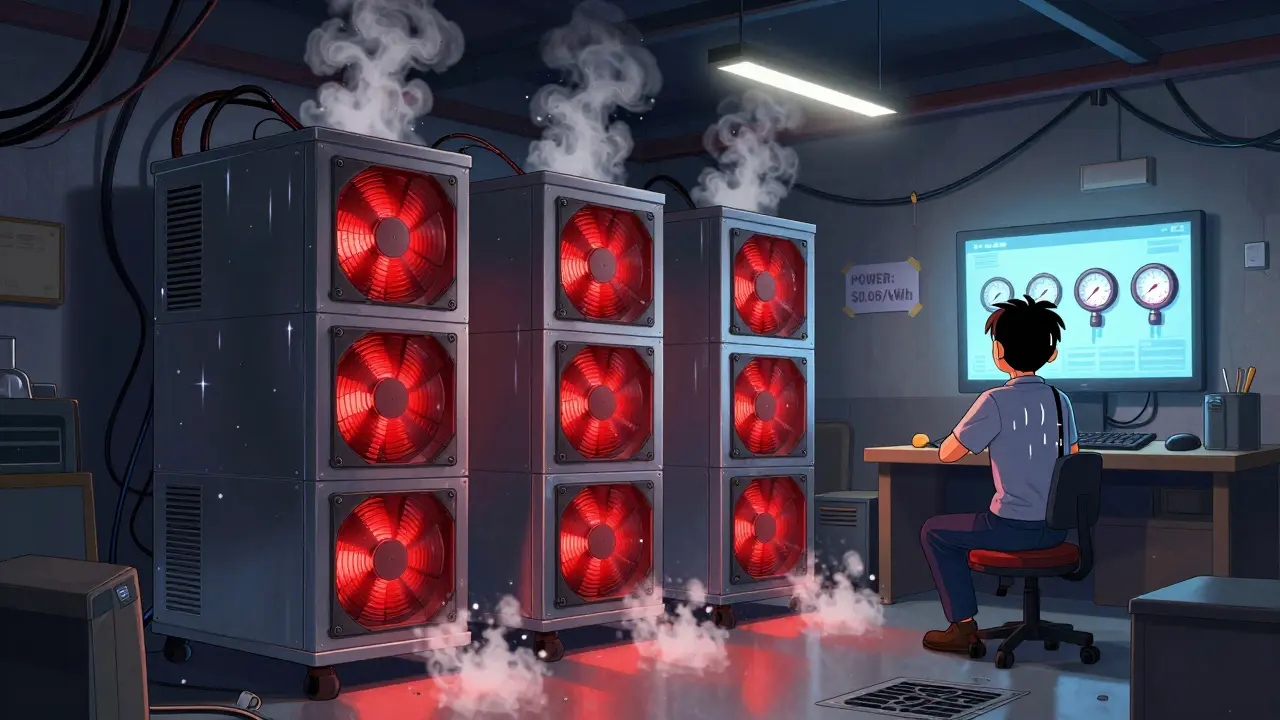
Setting up a crypto mining operation isn’t like buying a laptop and starting to earn. By 2026, it’s a full-blown industrial project with real costs, real heat, and real risks. If you’re thinking about mining Bitcoin or another cryptocurrency from your garage, you need to know what you’re getting into - not just the gear, but the electricity bills, the cooling nightmares, and the brutal math behind every hash. This isn’t a side hustle. It’s a business that demands upfront cash, technical know-how, and constant attention.
Hardware: ASICs Are the Only Real Option for Bitcoin
Forget using your gaming rig or old laptop. In 2026, Bitcoin mining is dominated by ASIC miners - machines built for one thing: solving blockchain puzzles as fast and efficiently as possible. These aren’t general-purpose computers. They’re specialized hardware that crushes the SHA-256 algorithm used by Bitcoin. The two most popular models right now are the Antminer S21 Pro and the Whatsminer M66S. Both cost between $2,000 and $17,000, depending on their hash rate and efficiency.
Efficiency matters more than raw power. Look at the Joules per Terahash (J/TH) rating. Lower numbers mean less electricity used per unit of computing power. A miner at 20 J/TH is far better than one at 35 J/TH - even if the cheaper one has higher hash rate. That’s where your profit dies.
GPU mining still exists, but only for altcoins like Ethereum Classic or Ravencoin. For Bitcoin? ASICs are the only game in town. And you can’t just buy any ASIC - it has to be programmed for the right algorithm. A miner built for Litecoin won’t work on Bitcoin. Always double-check the specs before you pay.
Hidden Costs: It’s Not Just the Miner
The miner is just the tip of the iceberg. Here’s what else you need:
- Power Supply Unit (PSU): Don’t buy one that just matches your miner’s wattage. Get one with at least 20% extra headroom. A 3,000-watt miner needs a 3,600-watt PSU. Cheap PSUs fail under load - and when they do, your miner dies too. Budget $50-$300.
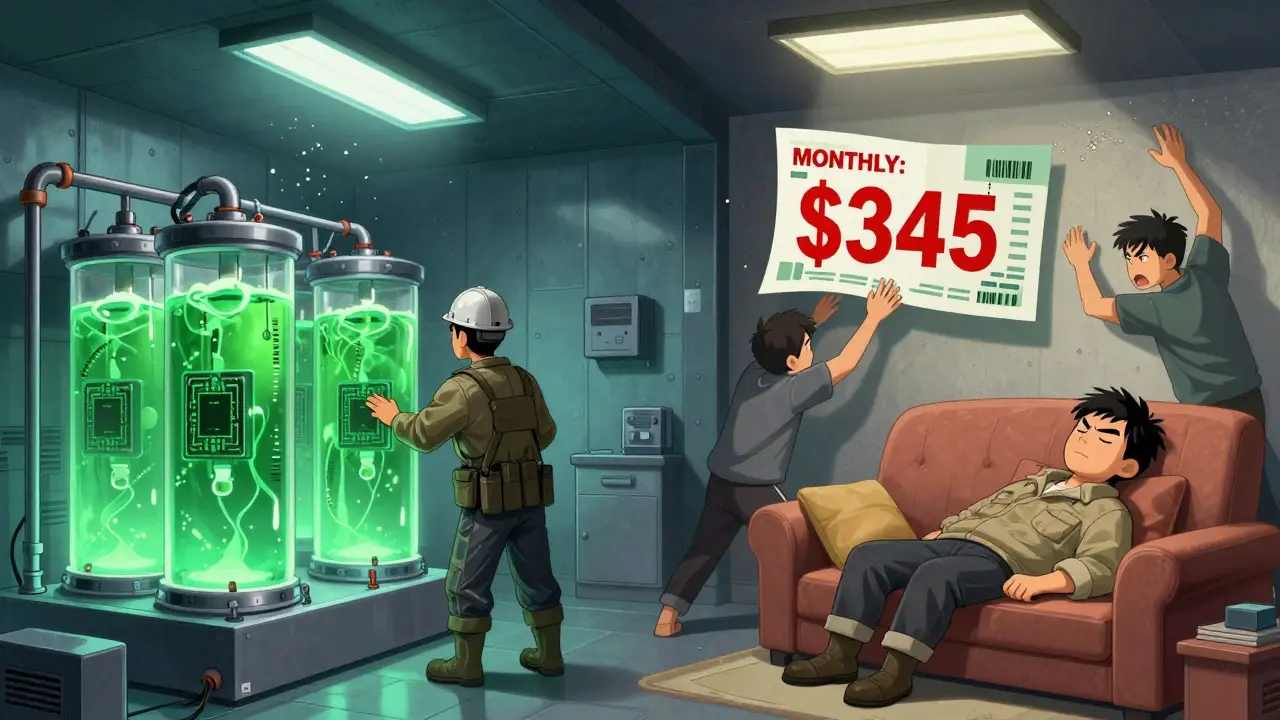
- Cooling: ASICs run hot. A single miner can hit 80°C. Without cooling, it throttles, wears out faster, or melts. Basic fans cost $50-$500. If you’re running more than five units, consider immersion cooling - submerging miners in non-conductive fluid. It’s expensive ($5,000-$10,000), but it cuts noise and power use by 30%.
- Soundproofing: These machines sound like jet engines. If you’re mining at home, soundproofing your room or building an external shed costs $100-$1,000. Ignoring this means angry neighbors - or a landlord who kicks you out.
- Network gear: You need a solid router and Cat6 Ethernet cables. Wi-Fi won’t cut it. Lag means missed blocks. Budget $50-$300.
- Surge protectors and backup power: Power spikes kill miners. A good UPS or generator adds $30-$500. If your area has frequent outages, this isn’t optional.
Altogether, even a small setup of one or two ASICs can easily cost $3,000-$5,000 before you even turn it on. There’s no way around it: mining requires serious capital.
Software: Free, But Not Simple
You don’t pay for mining software. Tools like CGMiner, NiceHash Miner, and HiveOS are free. But choosing the right one matters.
Windows 10 is easy for beginners. Plug in, click, start mining. But it’s inefficient. For serious miners, Linux-based systems like HiveOS or RaveOS are the standard. They’re lightweight, let you monitor dozens of miners from a browser, and update automatically. You’ll need to learn how to SSH into your rig, but the payoff is worth it.
Set up a cryptocurrency wallet before you start. You need a secure place to receive your rewards. Hardware wallets like Ledger or Trezor are safest. Never leave coins on an exchange or a software wallet you don’t control.
Join a Mining Pool - Don’t Go Solo
Solo mining is like buying one lottery ticket every day. You might win - someday. But the odds are astronomically low. In 2026, Bitcoin’s network difficulty is higher than ever. A single ASIC might take years to find a block on its own.
Instead, join a mining pool. These are groups of miners who combine their computing power. When the pool finds a block, rewards are split based on how much work each miner contributed. Pools like F2Pool, Slush Pool, and Antpool are reliable and pay daily.
Configuring a pool is simple: enter the pool’s server address, your worker name (like miner01), and your wallet address. Most software guides you through it. Don’t pick a pool based on hype - check their payout history, fees (usually 1-3%), and uptime.
Electricity: The Real Profit Killer
Here’s the cold truth: your electricity rate decides if you make money or lose it. A miner that costs $5,000 might seem expensive - until you see your power bill.
Let’s say you run an Antminer S21 Pro. It uses 3,200 watts. If electricity costs $0.15 per kWh, you’re spending $11.52 a day just to keep it running. That’s $345 a month. If your miner earns $250 in Bitcoin per month, you’re already in the red.
But if you live where electricity is $0.06/kWh - like parts of Texas, Georgia, or Scandinavia - you’re looking at $46 a month in power. Now you’re profitable. That’s why mining farms cluster in places with cheap, renewable energy. If your power cost is over $0.10/kWh, you’re already fighting an uphill battle.
Use a mining profitability calculator - there are dozens online. Plug in your hardware, electricity rate, and current Bitcoin price. If it says “loss” after 6 months, walk away.
Heat, Noise, and Long-Term Risks
Running mining hardware 24/7 is brutal on equipment. Heat shortens lifespan. Dust clogs fans. Power surges fry circuits. You need to monitor temperatures daily. Most mining OSes show real-time stats - keep your ASICs below 75°C.
Noise? It’s constant. You’ll get used to it - but your family won’t. If you’re mining in a house, soundproofing isn’t optional. An outdoor shed with proper ventilation is the smartest move.
And then there’s the market. Bitcoin’s price can swing 20% in a week. If it drops, your miner becomes a paperweight. Hardware depreciates fast. A $10,000 miner might be worth $4,000 in 18 months. You’re not investing in an asset - you’re running a high-risk utility business.
Is It Worth It? The Bottom Line
Setting up a crypto mining operation in 2026 is possible - but only if you have:
- Access to electricity under $0.08/kWh
- $5,000-$15,000 to invest upfront
- A space that can handle heat, noise, and high power draw
- The time to monitor, update, and troubleshoot
If you don’t meet those conditions, don’t do it. Mining isn’t passive income. It’s a job with equipment, bills, and constant pressure. Most people who start with one miner lose money. Those who win - they scale up. They build farms. They negotiate bulk power deals. They treat it like a factory, not a hobby.
There’s no magic trick. No app you can download to mine Bitcoin on your phone. No shortcut. If someone tells you otherwise, they’re selling you a dream - not a business plan.
Can I mine Bitcoin with my gaming PC or laptop?
No. Modern Bitcoin mining requires ASIC hardware. A gaming PC or laptop lacks the computational power to compete. Even if you could mine a block, the electricity cost would far exceed any reward. Mining on a laptop in 2026 is not just unprofitable - it’s a waste of time and risks damaging your device.
How long does it take to break even on a mining setup?
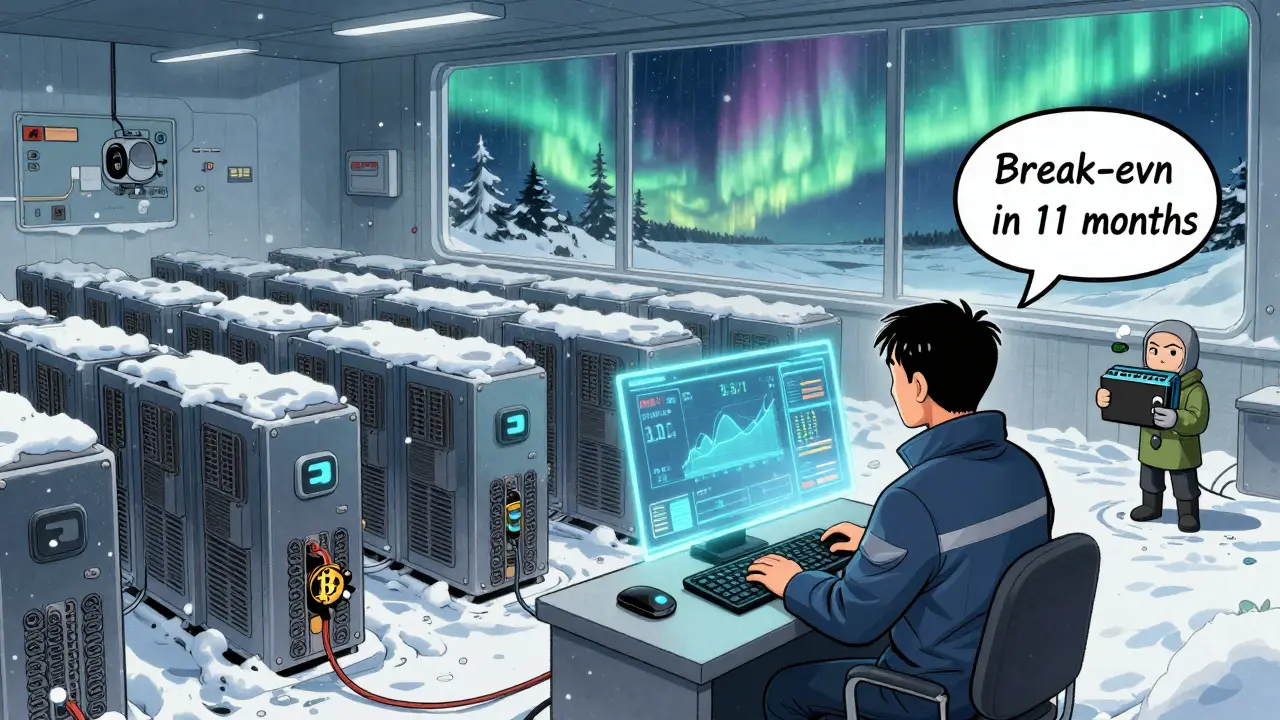
Break-even time varies wildly. With low electricity ($0.06/kWh) and a top-tier ASIC, you might recover your costs in 8-14 months. With average rates ($0.12/kWh), it could take 2-3 years - if Bitcoin’s price stays stable. If the price drops or difficulty spikes, you might never break even. Always assume the worst-case scenario when calculating ROI.
Are there alternatives to buying hardware?
Yes - cloud mining services let you rent hash power without owning hardware. But most are scams or have hidden fees that eat into profits. A few legitimate providers exist, like Hashflare or NiceHash, but even they rarely outperform owning your own ASIC. Unless you have zero technical access or live in a country that bans mining, buying hardware is still the most reliable path.
What’s the best cryptocurrency to mine in 2026?
Bitcoin remains the most profitable for ASIC miners with cheap power. For GPU miners, Ethereum Classic, Ravencoin, and Dogecoin are still viable. But profitability changes daily. Use a mining calculator to compare coins based on current difficulty, price, and your hardware. Never mine a coin just because it’s popular - mine the one that makes you money.
Can I mine crypto in a cold climate?
Yes - and it’s actually an advantage. Cold air helps with cooling, reducing the need for expensive fans or liquid systems. Places like Canada, Iceland, and parts of Russia have lower cooling costs. But you still need to manage humidity and condensation. A well-ventilated, insulated space is key - even in freezing temperatures.
Sean Logue
March 2, 2026 AT 14:08Just ran my first ASIC for 3 weeks. Power bill jumped $180. Made $140 in BTC. Guess what? I’m shutting it down. This isn’t mining - it’s donating money to the grid.
And don’t even get me started on noise. My dog started barking at the machine like it was a ghost.
Michelle Xu
March 3, 2026 AT 11:20While the article correctly emphasizes electricity cost as the primary variable, it underestimates the operational burden. Monitoring 10+ ASICs daily requires at least 15 minutes of active management - temperature logs, fan speeds, pool connectivity checks.
Many newcomers assume ‘set and forget’ - but thermal throttling, dust accumulation, and firmware updates are relentless. A miner at 78°C for 48 hours is a brick. You can’t automate away human vigilance.
Also - don’t overlook local regulations. Some U.S. counties now require mining permits. Others ban commercial power draw in residential zones. Check before you buy.
Ryan Burk
March 4, 2026 AT 01:05Amanda Markwick
March 4, 2026 AT 16:53I love how this post treats mining like a science experiment instead of a gamble with your savings.
But I want to say - if you’re reading this and thinking ‘I’ll just try one miner’ - please do it. Not because you’ll make money. But because you’ll learn. You’ll understand energy grids, hardware failure, blockchain economics.
That knowledge? It’s worth more than the BTC you might mine.
Just don’t quit your day job. And maybe start with a used S19 - not the S21. Let the early adopters bleed first.
John Fuller
March 5, 2026 AT 08:45Lucy Simmonds
March 5, 2026 AT 13:19Maggie House
March 6, 2026 AT 17:59Hey, I just started with one Antminer S19j - bought it used for $1,800. Electricity here is $0.09/kWh. First month I made $190. Power was $130. Not bad!
But I didn’t know about the noise until my cat started hiding under the bed. Now I put it in the garage with a fan blowing out the window. It’s still loud but at least the neighbors haven’t called the cops yet.
Also - HiveOS is way easier than I thought. Just follow the YouTube tutorial. Don’t overthink it. And get a UPS. My router died once from a surge. Total nightmare.
Dana Sikand
March 8, 2026 AT 11:31I’ve been running a small farm since 2023. Five S19 Pros. One M66S. I didn’t believe the ‘electricity is everything’ thing until I moved from Illinois to Georgia. Power dropped from $0.14 to $0.07. My profit tripled overnight.
And yes - immersion cooling changed everything. No more dust. No more fan noise. Just quiet, humming tanks of mineral oil. It cost $8,000 to set up. But I’m saving $400/month on cooling alone.
It’s not glamorous. But it’s real. And if you’re patient? It pays. Not fast. Not easy. But it pays.
Cameron Pearce Macfarlane
March 10, 2026 AT 10:07Daisy Boliaan
March 11, 2026 AT 09:05I tried mining. Bought two S21 Pros. Installed them in my basement. First week: neighbors complained. Second week: my AC died. Third week: my router caught fire.
Turns out, 6,400 watts in a 1990s house is a bad idea.
I sold everything for $3,000. Bought a Tesla. Now I charge it with solar. Still ‘mining’ - just not the blockchain.
Also - my ex still texts me asking why I didn’t ‘just use her basement’. Ugh.
Nicki Casey
March 11, 2026 AT 12:10It is deeply concerning that this article normalizes what is essentially a form of digital resource exploitation. The energy consumption of Bitcoin mining in 2026 is not merely inefficient - it is a moral failure. The carbon footprint of a single ASIC miner over its lifespan exceeds that of a mid-sized SUV.
Furthermore, the claim that ‘cheap electricity makes mining viable’ ignores the fact that many low-cost grids are subsidized by public utilities - meaning taxpayers are indirectly funding private profit. This is not entrepreneurship - it is regulatory arbitrage.
And let us not forget: the blockchain is not a public good. It is a speculative ledger controlled by oligopolistic mining pools that have consolidated over 70% of global hash power into three corporate entities.
If you wish to participate in decentralized finance, do so through legitimate DeFi protocols - not through energy-intensive, environmentally destructive, and socially unjust mining operations.
Curtis Dunnett-Jones
March 11, 2026 AT 15:30As a former energy infrastructure engineer, I must commend the precision of this analysis. However, the omission of grid stability metrics is a critical oversight.
Many regions offering sub-$0.08/kWh electricity do so because they have surplus renewable generation - often wind or hydro - that is otherwise curtailed. Mining operations stabilize these grids by absorbing excess supply, preventing blackouts and reducing renewable waste.
Moreover, the depreciation curve of ASICs is frequently mischaracterized. While hardware does lose value, the resale market for 12-18 month old miners remains robust, particularly in emerging markets with high electricity costs.
Thus, the enterprise is not merely a utility cost center - it is a dynamic asset class with embedded grid-support value. The profitability calculation must account for ancillary services, not just hash rate and kWh.
For the informed operator, mining remains one of the few high-yield, infrastructure-aligned investment opportunities in the digital age.