ShadowSwap Crypto Exchange Review: Is It Safe or a Scam?
You see a new name pop up on your crypto dashboard. The charts look wild. The promises sound huge. But when you try to trade, something feels off. That is exactly where ShadowSwap sits right now.
If you are looking for a reliable place to swap tokens, ShadowSwap might not be the answer you need. This platform operates as a decentralized exchange (DEX) on the Core blockchain network. It launched in 2023 with big ambitions to offer low fees and high anonymity. However, the reality of its current state tells a very different story. With near-zero trading volume, limited supported coins, and massive price volatility, this review will help you decide whether to keep your funds away from this niche protocol.
What Is ShadowSwap Finance?
To understand if ShadowSwap is worth your time, we first need to define what it actually is. Unlike centralized exchanges like Binance or Coinbase, which act as middlemen holding your money, ShadowSwap is a decentralized application (dApp). It uses an Automated Market Maker (AMM) model. This means there are no order books. Instead, you trade against liquidity pools provided by other users.
The platform runs entirely on the Core blockchain. This is a relatively new network compared to giants like Ethereum or Solana. The idea behind using Core is to leverage lower transaction fees and faster speeds. In theory, this sounds great for small traders who hate paying $50 in gas fees just to swap $100 worth of tokens. In practice, however, the ecosystem around Core is still tiny. This limits who you can trade with and how easily you can move your assets elsewhere.
ShadowSwap was established in 2023. In the fast-moving world of crypto, that makes it a young project. It positions itself as more than just a swap tool. It claims to offer staking farms, a launchpad for new tokens, and even an NFT marketplace for "Shadow Puppets." But does having many features make it safe? Not necessarily. Often, complex feature sets in early-stage projects are used to distract from weak fundamentals.
The Red Flags: Liquidity and Volume
When reviewing any crypto exchange, liquidity is king. Liquidity determines if you can actually sell your tokens without crashing the price. Here is the hard truth about ShadowSwap’s current status as of mid-2026:
- Trading Volume: The 24-hour trading volume is approximately $477 USD. Yes, less than five hundred dollars. For context, major DEXs like Uniswap process billions daily. Even smaller niche exchanges usually handle tens of thousands.
- Supported Coins: The platform currently supports only 3 coins and 6 trading pairs. You cannot find popular tokens like USDT, USDC, or major altcoins here unless they have specific bridges into the Core network.
- User Traffic: Recent monthly pageviews are reported as zero. This suggests minimal active user engagement. If no one is visiting the site, why would you trust it with your capital?
Low liquidity creates a dangerous situation called slippage. If you try to swap a significant amount of tokens, you might get far less back than expected because the pool is too shallow. Worse yet, if you want to exit quickly during a market dip, you might not find anyone willing to buy from you at all.
| Metric | ShadowSwap | Uniswap (Ethereum) | PancakeSwap (BSC) |
|---|---|---|---|
| 24h Volume | ~$477 | $1B+ | $500M+ |
| Supported Tokens | 3 | Thousands | Thousands |
| Network | Core Blockchain | Ethereum | Binance Smart Chain |
| Trust Score | Low (Niche/New) | High (Established) | High (Established) |
The SHDW Token: A Volatile Asset
Every DEX has a governance or utility token. For ShadowSwap, that is the SHDW token. Investors often buy these tokens hoping for price appreciation or to use them for fee discounts. Let’s look at the data for SHDW.
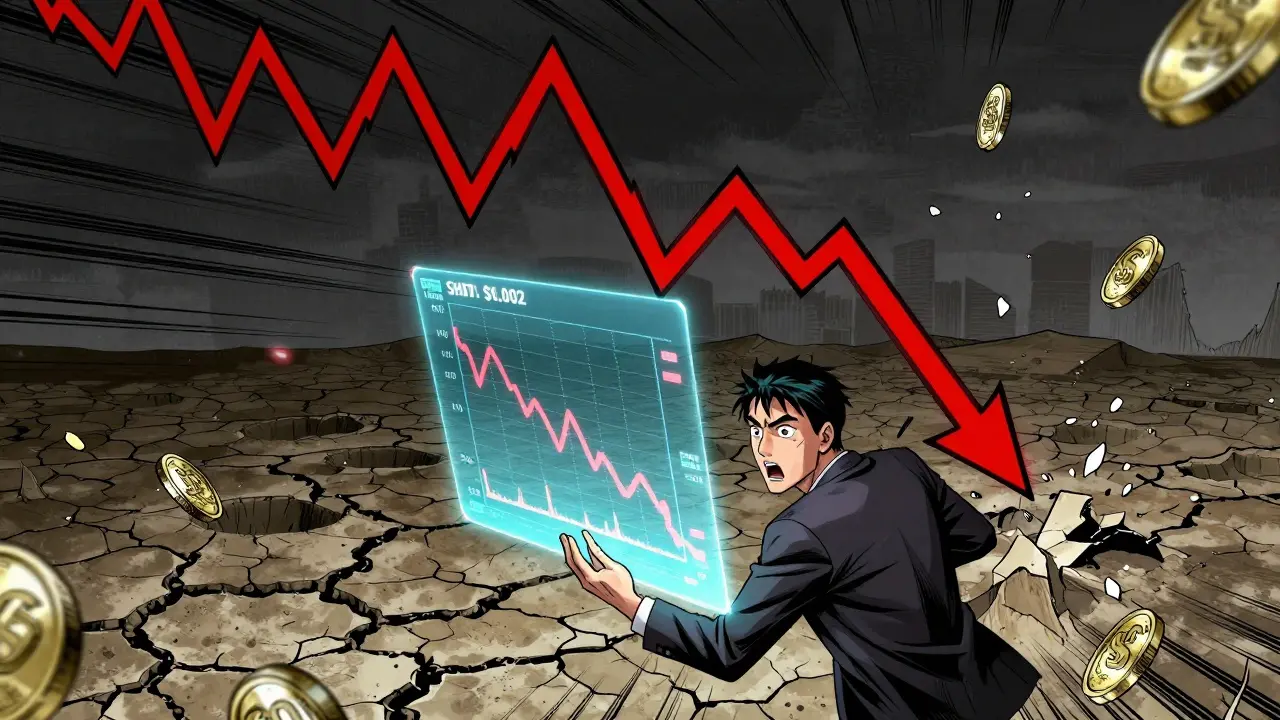
The token has seen extreme volatility. Its all-time high was $10.88. As of late 2025 and moving into 2026, the price hovered around $0.002. That is a drop of over 99% from its peak. While crypto markets are cyclical, such a drastic decline usually indicates one of two things: either the project failed to deliver on its roadmap, or the initial hype was artificially inflated and collapsed.
Recent short-term movements show wild swings, including an 80% increase in seven days followed by a 13% drop in 24 hours. This kind of instability is characteristic of low-cap tokens with little real-world usage. Predictions for October 2025 suggested a modest price of roughly $0.0017, indicating that analysts do not expect a significant recovery anytime soon. Holding SHDW is essentially a high-risk gamble, not an investment strategy.
Features Beyond Swapping: Farms, Launchpad, and NFTs
ShadowSwap tries to compensate for its lack of trading volume by offering additional services. These include:
- Liquidity Farms: Users can deposit their tokens into pools to earn bonus rewards. This is standard DeFi behavior. However, farming on a platform with low volume means your rewards might be negligible compared to the risk of impermanent loss.
- Shadow Launchpad: This feature allows new projects to launch tokens. While this sounds innovative, launchpads on obscure platforms are often hotbeds for "rug pulls"-scams where developers abandon the project after raising funds. Without rigorous vetting, participating here is risky.
- NFT Marketplace: Specifically for "Shadow Puppets." Unless you are already invested in this specific collection, this feature adds complexity without clear value. Bridging NFTs between networks like Ethereum, Optimism, and Aptos requires technical know-how and exposes users to bridge vulnerabilities.
These features create a "walled garden" effect. They encourage you to stay within the ShadowSwap ecosystem, making it harder to leave if you spot red flags later.
Security and Trust: Who Is Behind It?
In centralized finance, you check for licenses and customer support. In decentralized finance, you check for audits, team transparency, and community sentiment. ShadowSwap scores poorly on most fronts.
First, there is a lack of substantial user reviews or expert analyses. When a platform has zero pageviews and minimal social media presence, it raises questions about who is maintaining the code. Is the team anonymous? Have smart contracts been audited by reputable firms like CertiK or OpenZeppelin? The available information does not confirm any major security audits.
Second, the platform operates on the Core blockchain. While Core offers scalability, it is not as battle-tested as Ethereum. Newer chains sometimes have undiscovered bugs in their infrastructure. If the underlying chain fails, your assets could be locked or stolen.
Finally, consider the "fee-free" model mentioned in some reports. While attractive, free services often hide costs elsewhere. In DEXs, this usually means higher slippage or lower yields for liquidity providers. There is no such thing as a free lunch in crypto.

Who Should Avoid ShadowSwap?
This review is not meant to bash small projects. Innovation often starts small. However, ShadowSwap is not ready for the average trader. You should avoid this platform if:
- You are new to cryptocurrency and do not understand how AMMs work.
- You plan to store significant amounts of capital. The risk of loss is too high given the low liquidity.
- You need stablecoins (USDT/USDC) for daily transactions. ShadowSwap does not support them natively in a useful way.
- You prioritize security and proven track records over experimental features.
If you are a developer interested in testing the Core blockchain or a degenerate gambler looking for high-risk, high-reward micro-caps, you might explore it. But for everyone else, the risks outweigh the potential benefits.
Alternatives to Consider
If you want low fees and fast transactions, there are better options. Consider these established alternatives:
- PancakeSwap: Runs on Binance Smart Chain. Low fees, huge liquidity, and a trusted reputation.
- Uniswap: The gold standard for Ethereum-based swaps. Higher fees but unmatched security and asset variety.
- Raydium: Great for Solana users who want speed and low costs.
These platforms have millions of users, regular security audits, and deep liquidity pools. You can trade confidently knowing that if you want to exit, you can do so instantly.
Is ShadowSwap a scam?
While there is no definitive proof that ShadowSwap is a fraudulent scheme designed to steal funds directly, it exhibits many characteristics of high-risk projects. These include extremely low liquidity, anonymous development teams, lack of third-party security audits, and massive token price depreciation. Traders should exercise extreme caution and assume that funds deposited here are at high risk of being lost due to technical failures or rug pulls.
What is the Core blockchain?
The Core blockchain is a newer layer-1 network that ShadowSwap utilizes for its operations. It aims to provide faster transaction speeds and lower fees compared to Ethereum. However, because it is less established, it has fewer dApps, less liquidity, and a smaller community. This makes assets on Core harder to move to other chains and potentially more vulnerable to network-specific issues.
Can I withdraw my money from ShadowSwap?
Technically, yes, as long as the smart contracts are functioning and there is liquidity in the pools. However, due to the extremely low trading volume ($477/day), you may face high slippage, meaning you will receive significantly less value when swapping out. Additionally, if the bridge to your preferred network (like Ethereum) is congested or broken, your funds could be stuck indefinitely.
Why is the SHDW token price so low?
The SHDW token dropped from an all-time high of $10.88 to around $0.002. This collapse is likely due to a combination of factors: initial hype fading, lack of real utility driving demand, low trading volume preventing price stability, and broader market corrections. The token lacks strong buying pressure from institutional investors or large communities.
Are ShadowSwap farms profitable?
It is unlikely. Profitability in yield farming depends on trading volume fees and reward emissions. With such low volume, the fee income is minimal. Furthermore, the reward tokens (SHDW) have lost almost all their value. You risk losing your principal investment through impermanent loss while earning negligible rewards in a depreciating asset.