SushiSwap v3 on Polygon: A Real-World Crypto Exchange Review

Trading crypto on Ethereum used to mean paying $50 in gas fees just to swap tokens. Now, on Polygon, you can do the same trade for less than a penny. That’s the real difference SushiSwap v3 on Polygon brings to the table. This isn’t another copy-paste DEX. It’s a fully functional, low-cost, reward-driven exchange built for people who want to trade, earn, and stake without getting crushed by fees.
What Exactly Is SushiSwap v3 on Polygon?
SushiSwap v3 on Polygon is a decentralized exchange (DEX) that runs on the Polygon blockchain - a fast, cheap layer-2 network built to solve Ethereum’s high fees and slow speeds. Unlike centralized exchanges like Binance or Coinbase, SushiSwap doesn’t hold your crypto. You trade directly from your wallet using smart contracts. No sign-ups. No KYC. Just connect your MetaMask, swap tokens, and go.
It’s not new - SushiSwap started in 2020 as a fork of Uniswap. But while Uniswap stuck with Ethereum, SushiSwap went multi-chain. By 2025, it’s fully optimized on Polygon, making it one of the most practical DEXs for everyday users. The v3 upgrade brought concentrated liquidity, meaning you can set tighter price ranges for your funds and earn more fees per dollar locked in.
How It Works: No Order Books, Just Pools
Most crypto exchanges use order books - buyers and sellers list prices, and the system matches them. SushiSwap doesn’t do that. Instead, it uses liquidity pools. Think of it like a shared jar of tokens. If you want to swap ETH for USDC, you’re trading against a pool that has both tokens in it. The price changes based on supply and demand inside that pool, using a math formula called x*y=k.
When you add liquidity, you deposit equal value in two tokens - say, $100 worth of ETH and $100 worth of USDC - and you get LP tokens in return. Those tokens prove you own a share of the pool. Every time someone trades against that pool, you earn a cut. On SushiSwap v3, 0.25% of every trade goes to liquidity providers. That’s the same as Uniswap. But here’s the twist: 0.05% goes to xSUSHI stakers.
The xSUSHI Staking Edge
This is where SushiSwap beats Uniswap. If you hold SUSHI tokens and stake them in the SushiBar, you get xSUSHI. It’s not a new token - it’s a staked version of SUSHI that earns rewards. And those rewards come from that extra 0.05% of every trade on the platform. So you’re not just earning from liquidity. You’re earning from the platform’s overall trading volume.
For example, if you stake 1,000 SUSHI, you get 1,000 xSUSHI. Over time, you earn a share of the 0.05% fee pool. That’s passive income just for holding and staking. Uniswap doesn’t offer this. You only earn if you provide liquidity. SushiSwap gives you two ways to earn: liquidity provision AND token staking.
Why Polygon Makes All the Difference
Polygon isn’t just a sidechain - it’s a scalable, Ethereum-compatible network with near-zero gas fees. On Ethereum, rebalancing your liquidity position might cost $20. On Polygon? $0.02. That changes everything.
For active traders and yield farmers, this means you can:
- Adjust your price ranges daily without worrying about fees eating your profits
- Enter and exit liquidity pools as market conditions shift
- Participate in Onsen programs (more on that below) without burning through capital
It also means you can use SushiSwap on mobile without waiting 30 seconds for a transaction to confirm. It’s fast. It’s cheap. It’s usable.

The Onsen Program: High Rewards for New Tokens
If you want to earn big, the Onsen Program is your best bet. It’s SushiSwap’s way of rewarding liquidity providers who support new tokens. When a new project lists on SushiSwap v3 on Polygon, they can apply to be part of Onsen. If accepted, they offer extra SUSHI rewards on top of the trading fees.
For example, a new DeFi token might offer 500 SUSHI per day to people who provide liquidity to its ETH/NEWTOKEN pool. That’s extra income on top of the 0.25% fee share. Some users have earned over $1,000 in SUSHI rewards in a week by joining early-stage Onsen pools.
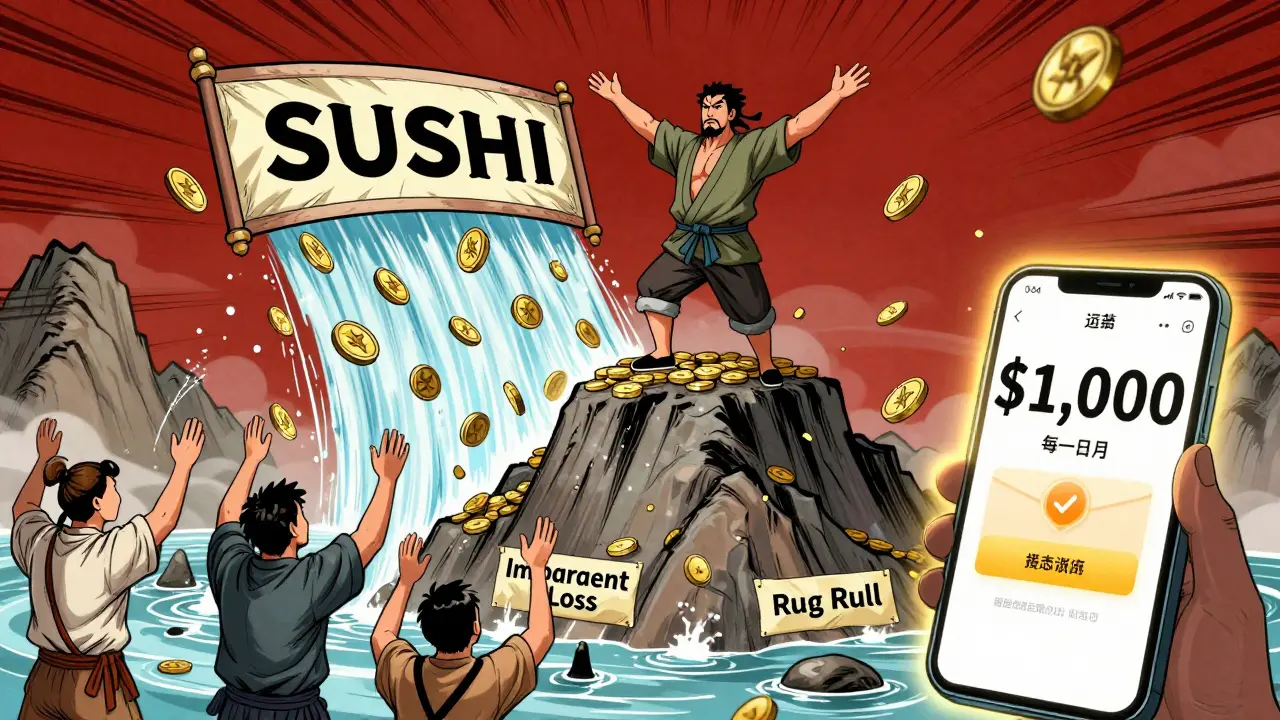
But here’s the catch: new tokens are risky. Many fail. You could lose money from impermanent loss if the token price swings hard. So only put in what you’re willing to lose. But for those who know how to pick winners, Onsen is the most lucrative part of SushiSwap.
Trading, Leverage, and More
SushiSwap v3 on Polygon isn’t just about swapping tokens. You can also:
- Trade with up to 5x leverage (margin trading)
- Buy crypto with a credit card via integrated fiat gateways
- Access OTC trading for large orders
- Use the launchpad to invest in new projects before they list
The mobile app works smoothly. The desktop interface is clean. You don’t need to be a coder to use it. If you’ve used Uniswap before, you’ll feel right at home. The only difference? You’re earning more.
How Much Can You Earn?
Let’s say you deposit $5,000 into a popular SUSHI/ETH liquidity pool on SushiSwap v3 on Polygon. Here’s what you could earn in a month:
- Trading fees (0.25%): $12-$30 (depending on volume)
- SUSHI rewards (if pool is in Onsen): $50-$200
- xSUSHI staking (if you stake your SUSHI): $5-$15
Total? $67-$245 in one month. That’s not bad for a $5,000 deposit. Compare that to staking ETH on Ethereum - you’d get maybe $10-$15. SushiSwap on Polygon gives you multiple streams of income.
Keep in mind: SUSHI token price matters. As of January 2026, it’s trading around $2.19. Analysts are split - some predict $3.99 by 2030, others say $1.68 in 2025. If the price drops, your rewards are worth less. But the fee structure stays the same. So even if SUSHI crashes, you’re still earning from trades.
What People Are Saying
On Reddit, users rave about the low fees. One trader said: “I used to trade on Uniswap and pay $40 every time I adjusted my position. Now on Polygon, I do it 10 times a day. My profits doubled.”
Others warn about complexity. “I didn’t understand impermanent loss until I lost $300 on a bad LP position,” wrote a user on Twitter. That’s real. Liquidity provision isn’t risk-free. If a token you’re paired with crashes 50%, you lose value - even if you earn fees.
Still, most agree: SushiSwap v3 on Polygon is the most rewarding DEX for active users. It’s not the biggest - trading volume is lower than Uniswap’s - but it’s the most user-friendly for earning.
Who Should Use It?
Use SushiSwap v3 on Polygon if:
- You want to trade crypto with near-zero fees
- You’re comfortable with DeFi and self-custody
- You want to earn from both liquidity and staking
- You’re interested in new tokens and Onsen rewards
Avoid it if:
- You want customer support when something goes wrong (there isn’t any)
- You’re new to crypto and don’t understand wallet security
- You expect guaranteed returns - DeFi is risky
It’s not for everyone. But if you’re serious about earning in DeFi, this is one of the best tools out there.
How to Get Started
Here’s the simple step-by-step:
- Get a Web3 wallet (MetaMask or Coinbase Wallet)
- Buy ETH on a centralized exchange like Kraken or Binance
- Bridge ETH to Polygon using the official Polygon bridge or a trusted service like QuickSwap
- Swap some ETH for MATIC (Polygon’s token) to pay for gas
- Go to app.sushi.com and connect your wallet
- Choose your pair, add liquidity, or just swap
- Stake your SUSHI in the SushiBar to earn xSUSHI
Start small. Try swapping $50 first. See how it feels. Then go bigger.
Final Thoughts
SushiSwap v3 on Polygon isn’t flashy. It doesn’t have a celebrity CEO or a viral meme coin. But it’s built for people who want to earn, not just speculate. It’s a quiet, efficient machine that rewards participation.
It’s cheaper than Uniswap. More rewarding than most DEXs. And it’s running on a network that actually works for daily use. If you’re tired of paying $30 to swap tokens, this is your upgrade.
The future of DeFi isn’t about big names. It’s about low fees, smart incentives, and real utility. SushiSwap v3 on Polygon is already there.
Is SushiSwap v3 on Polygon safe to use?
Yes, but with caveats. The smart contracts have been audited by reputable firms like CertiK and PeckShield. No major exploits have occurred on Polygon. However, you’re still dealing with DeFi - no one holds your funds. If you send crypto to the wrong address or lose your private key, it’s gone. Always double-check addresses and never share your seed phrase.
How do I get SUSHI tokens to stake?
You can buy SUSHI on centralized exchanges like Binance, KuCoin, or Kraken. Then send it to your wallet. Alternatively, you can trade ETH or USDC for SUSHI directly on SushiSwap v3 on Polygon. Once you have SUSHI, go to the SushiBar on the platform and stake it to receive xSUSHI.
What’s the difference between SUSHI and xSUSHI?
SUSHI is the native governance token. xSUSHI is what you get when you stake SUSHI. It’s not a new token - it’s a staked version. You can’t trade xSUSHI. But you earn a share of the platform’s 0.05% fee pool. When you unstake, you get your original SUSHI back, plus any rewards earned.
Can I lose money providing liquidity?
Yes. This is called impermanent loss. If the price of one token in your pair changes dramatically compared to the other, your position loses value - even if you earn fees. For example, if you add ETH and a new token that crashes 70%, your LP position might be worth less than when you started. Always research tokens before adding liquidity.
Is SushiSwap better than Uniswap on Polygon?
For earning, yes. Uniswap doesn’t have a staking reward system. SushiSwap gives you two income streams: trading fees + xSUSHI rewards. It also has the Onsen Program, which Uniswap lacks. Uniswap has higher overall volume, but SushiSwap gives you more ways to profit from the same activity.
Richard Kemp
January 30, 2026 AT 18:04used to pay 40 bucks just to look at a chart on uniswap. now i trade like it's free money.
also i didn't even know about xsushi until today. mind blown.
Parth Makwana
February 1, 2026 AT 15:13Rob Duber
February 2, 2026 AT 17:22BUT I MADE BACK 600 FROM THE FEES AND XSUSHI REWARDS SO I'M STILL UP.
DEFI IS A THRILL RIDE AND I'M STILL ON THE ROLLERCOASTER. 🎢💸
Gary Gately
February 4, 2026 AT 03:23also xsushi is kinda like getting free candy just for holding your tokens. no cap.
Joshua Clark
February 6, 2026 AT 00:24Gareth Fitzjohn
February 7, 2026 AT 22:54Katie Teresi
February 9, 2026 AT 07:23Polygon? Built by Americans. SushiSwap? Built by Americans. Your ‘decentralized’ stuff is just a copy.
Get your act together.
Moray Wallace
February 10, 2026 AT 22:43Maybe one day there’ll be a safety net.
William Hanson
February 11, 2026 AT 07:01Low fees don’t fix dumb people.
Steven Dilla
February 13, 2026 AT 00:22i staked my sushi, added liquidity to a couple pools, and i’m actually making something back.
not just ‘maybe’ - i’m seeing it in my wallet. 🙌
also the mobile app doesn’t crash. i don’t know how they did it but thank you.
Aaron Poole
February 14, 2026 AT 05:28I know people say ‘don’t chase yields’ but if you do your homework, it’s not gambling - it’s participating. And the fact that you can do it all on your phone without waiting 5 minutes per transaction? That’s the future right there.
Joseph Pietrasik
February 15, 2026 AT 02:27Pamela Mainama
February 15, 2026 AT 07:53You hold your keys. You earn from your participation. No middleman.
That’s the real win.
Nickole Fennell
February 16, 2026 AT 01:50WHY DOESN’T THE APP JUST WARN PEOPLE?
This isn’t ‘empowerment’ - it’s predatory. Someone should get sued.
Edward Drawde
February 17, 2026 AT 09:19so what. i got 300 xsushi out of it. i’m not mad. just confused.