The Constant Product Formula: How x*y=k Powers DeFi and Uniswap

Imagine you want to swap Bitcoin for Ethereum without talking to a human or using a centralized exchange. You just click a button, and the trade happens instantly. Behind that simple click is a piece of math so old it dates back to ancient Greece, yet so powerful it now moves billions of dollars every day. That math is the Constant Product Formula, defined as xy = k, where x and y are variables and k is a constant.
In the world of Decentralized Finance (DeFi), this formula isn't just theory. It is the engine inside Automated Market Makers (AMMs). If you’ve used Uniswap, you’ve interacted with this formula. Understanding how it works helps you see why prices move the way they do, why slippage happens, and how liquidity providers make money-or lose it.
What Is the Constant Product Formula?
At its core, the constant product formula describes an inverse relationship between two variables. The equation looks like this:
x * y = k
Here, x and y represent the amounts of two different assets in a pool. k is a constant number that never changes during a single trade. In a crypto context, if x is the amount of USDC in a pool and y is the amount of ETH, their product must always equal k.
This means if one variable goes up, the other must go down to keep the product stable. For example, if you add more USDC (x increases), the amount of ETH (y) available for sale decreases proportionally. This mathematical rule ensures there is always a price for every asset, even when no human trader is watching.
From Boyle’s Law to Blockchain
You might wonder why a physics law from the 17th century matters for crypto. Robert Boyle discovered that for a fixed amount of gas at a constant temperature, pressure and volume have a constant product (P * V = k). As you squeeze a gas (increase pressure), its volume shrinks.
The same logic applies to digital assets. When demand for an asset rises (you buy more), its "volume" in the pool drops, causing its price to rise. The constant product formula models this perfectly. It was adopted by early DeFi protocols because it is simple, trustless, and computationally cheap to run on a blockchain.
Unlike traditional order books, which require buyers and sellers to match exactly, the constant product formula creates a continuous market. This innovation allowed anyone to provide liquidity and earn fees, democratizing market making.
How Uniswap Uses the Formula
Uniswap popularized the use of the constant product formula in DeFi. Before Uniswap, most exchanges relied on central servers matching orders. Uniswap replaced that with smart contracts executing trades based on x * y = k.
Here is how it works in practice:
- Liquidity Pools: Users deposit pairs of tokens (e.g., ETH and USDC) into a pool. These deposits form the initial values of x and y.
- Price Discovery: The price of an asset is determined by the ratio of the reserves. If there is less ETH than USDC, ETH is more expensive.
- Trading: When you buy ETH, you send USDC to the pool. The contract calculates how much ETH you get out such that the new balance still satisfies x * y = k.
This system handles massive volume. As of late 2023, Uniswap had processed hundreds of billions of dollars in cumulative trading volume, all driven by this single mathematical constraint.
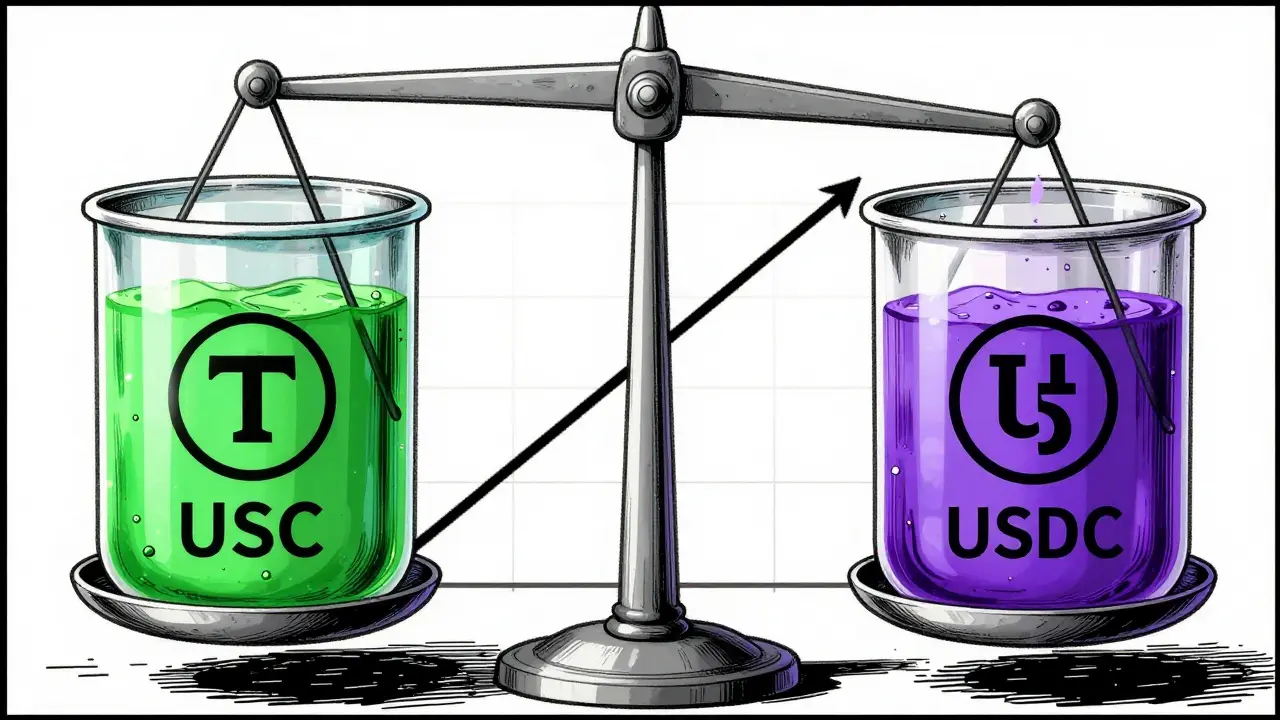
Slippage and Impermanent Loss Explained
The constant product formula has downsides. Two major concepts you need to understand are slippage and impermanent loss.
Slippage occurs because the curve is hyperbolic. As you trade larger amounts, the price moves against you more sharply. If you try to buy a large chunk of ETH, you deplete the ETH supply in the pool rapidly. To maintain k, the price of ETH spikes. You end up paying more per unit than the current market rate. Small trades have minimal slippage; large trades suffer significantly.
Impermanent Loss affects liquidity providers. It happens when the price of your deposited assets changes relative to each other. Because the pool rebalances automatically to maintain the constant product, you hold more of the depreciating asset and less of the appreciating one compared to just holding them in a wallet. If prices revert, you break even. If they diverge further, you may lose value compared to holding.
| Feature | Constant Product (x*y=k) | Direct Proportionality (y=kx) |
|---|---|---|
| Relationship | Inverse: As X increases, Y decreases | Direct: As X increases, Y increases |
| Graph Shape | Rectangular Hyperbola | Straight Line through Origin |
| Use Case | AMMs, Gas Laws, Levers | Speed/Distance, Hooke's Law |
| Zero Value | Undefined (cannot divide by zero) | Defined (0,0 is valid) |
Why Not Use Other Formulas?
Developers have experimented with other curves, like the StableSwap formula used by Curve Finance for stablecoins. However, the constant product formula remains the standard for volatile assets.
Its strength is simplicity. It requires no external price feeds (oracles) to function. The price emerges purely from supply and demand within the pool. While this can lead to inefficiencies compared to order books, it provides unparalleled accessibility and composability. Any developer can build on top of it without permission.
Critics point out that the formula assumes infinite liquidity elasticity, which isn't true in reality. During extreme volatility, the gap between the AMM price and the real market price widens, leading to arbitrage opportunities but also higher costs for traders.

Practical Tips for Traders and Providers
If you are using platforms powered by the constant product formula, keep these tips in mind:
- Check Slippage Tolerance: Set reasonable limits. High slippage means you’re getting a bad deal due to the curve’s steepness.
- Monitor Pool Depth: Deeper pools (larger k) offer better prices for large trades. Shallow pools cause significant price impact.
- Understand Impermanent Loss: Only provide liquidity if you believe the assets will stay correlated or if trading fees outweigh potential losses.
- Use Limit Orders Where Possible: Some newer interfaces allow setting target prices, mitigating some slippage risks.
The Future of Constant Product Models
As DeFi matures, we see hybrid models emerging. Concentrated liquidity, introduced by Uniswap V3, allows providers to allocate capital within specific price ranges. This modifies the effective constant product behavior, increasing capital efficiency but adding complexity.
Despite these evolutions, the core principle remains. The constant product formula taught us that trustless markets are possible. It turned abstract mathematics into a global financial infrastructure. Whether you are a student learning about inverse proportions or a trader swapping tokens, understanding x * y = k gives you a clearer view of how modern finance operates.
What is the constant product formula in DeFi?
It is the equation x * y = k, used by Automated Market Makers to determine asset prices based on reserve balances in liquidity pools.
Who invented the constant product formula?
The mathematical concept dates back to ancient Greek mathematics and was formalized in the 17th century by scientists like Robert Boyle. In DeFi, it was popularized by Uniswap developers.
Why does slippage happen with the constant product formula?
Slippage occurs because the price curve is hyperbolic. Large trades deplete reserves quickly, causing the price to change drastically to maintain the constant product k.
Is the constant product formula safe for liquidity providers?
It carries risk, primarily impermanent loss. Providers should monitor market conditions and ensure trading fees compensate for potential value divergence.
Can the constant product formula be used outside of crypto?
Yes, it is widely used in physics (Boyle's Law), economics, and engineering to model inverse relationships between variables.