The Real Computational Cost of Zero-Knowledge Proofs in Blockchain
You want privacy on the blockchain. You want speed. But you also want to keep your hardware from melting down. This is the central tension of modern cryptography: the computational cost of zero-knowledge proofs. These mathematical marvels allow you to prove you know a secret without revealing it, but that magic comes with a heavy price tag in processing power and time.
If you are building a decentralized application or just trying to understand why transactions on privacy-focused chains take longer than on public ledgers, you need to look under the hood. The cost isn't just a number; it's a trade-off between security, privacy, and efficiency. Let's break down exactly where these costs come from, how different proof systems handle them, and what this means for the future of scalable blockchain technology.
Understanding the Core Trade-Off
To grasp the computational cost, we first need to define what a Zero-Knowledge Proof (ZKP) is. It is a cryptographic protocol where one party (the prover) convinces another party (the verifier) that a statement is true without revealing any information beyond the validity of the statement itself. This concept was formalized in 1985 by Shafi Goldwasser, Silvio Micali, and Charles Rackoff.
The core problem is complexity. To create a ZKP, you must translate a real-world computation into a mathematical format called an arithmetic circuit. Imagine converting a complex software program into millions of simple addition and multiplication gates. The larger the program, the more gates you have. The more gates you have, the higher the computational cost.
- Circuit Size: The number of constraints in the mathematical representation directly correlates to processing time.
- Proof Generation: The act of creating the proof is computationally expensive.
- Verification: Checking the proof is usually cheap, but not free.
This asymmetry is key. In many systems, generating the proof takes seconds or minutes, while verifying it takes milliseconds. However, if you are the user sending a transaction, you bear the generation cost. If you are the network node, you bear the verification cost. Understanding who pays which part of the bill is crucial for system design.
ZK-SNARKs vs. ZK-STARKs: A Cost Comparison
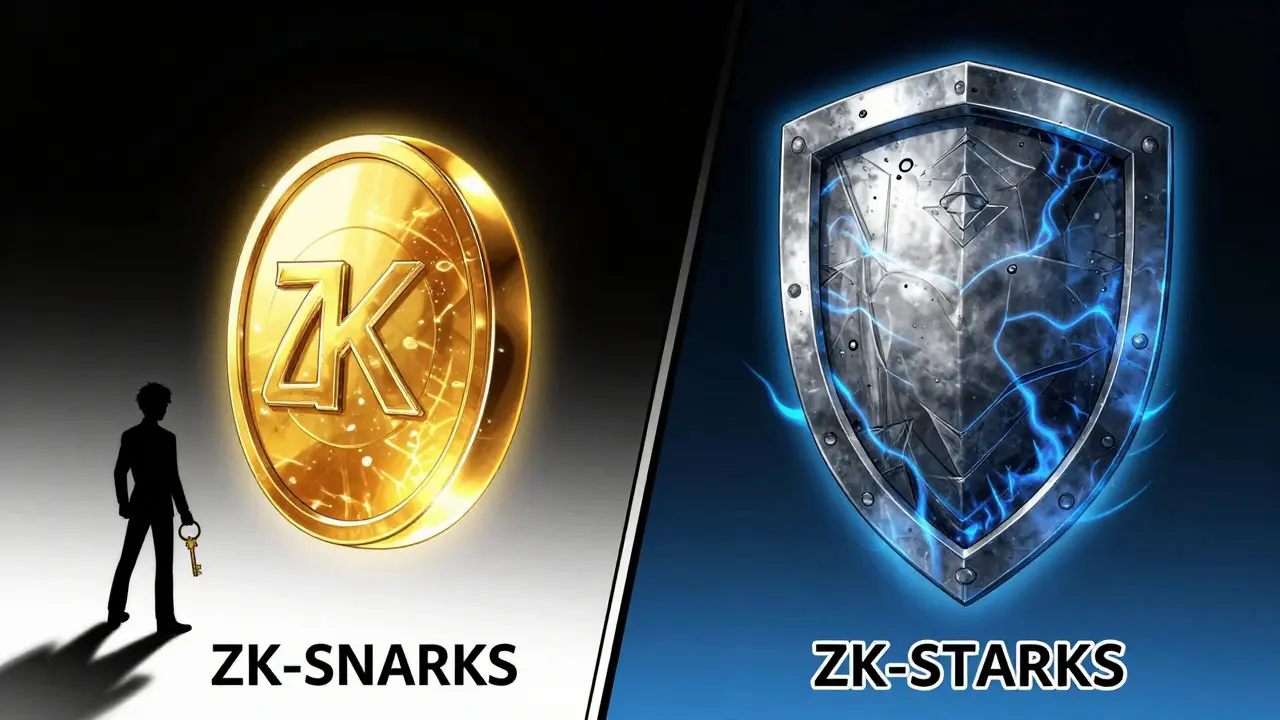
Not all zero-knowledge proofs are created equal. The two dominant families today are ZK-SNARKs and ZK-STARKs. Their architectural differences lead to vastly different computational profiles.
| Feature | ZK-SNARKs | ZK-STARKs |
|---|---|---|
| Setup Requirement | Requires a trusted setup ceremony | No trusted setup needed |
| Proof Size | Very small (constant size) | Larger (logarithmic growth) |
| Prover Computation | Faster for smaller circuits | Slower due to heavier hashing |
| Verifier Cost | Extremely low | Low, but higher than SNARKs |
| Quantum Resistance | Not quantum-resistant | Quantum-resistant |
ZK-SNARKs (Succinct Non-interactive Arguments of Knowledge) rely on elliptic curve pairings. This allows for incredibly small proof sizes and fast verification. However, they require a "trusted setup." If the initial parameters are compromised, the entire system's integrity fails. The computational cost here is heavily skewed toward the prover, but the verification is so cheap that it makes SNARKs ideal for blockchain integration where block space is expensive.
In contrast, ZK-STARKs (Scalable Transparent Arguments of Knowledge) use hash functions instead of elliptic curves. They do not need a trusted setup, making them more transparent and secure against future attacks, including those from quantum computers. The trade-off? Larger proof sizes and higher computational overhead during generation. STARKs scale better for massive computations but demand more bandwidth to transmit the proofs.
Where Does the Processing Power Go?
When we talk about computational cost, we aren't just talking about CPU cycles. We are looking at specific mathematical bottlenecks.
Polynomial Commitments
A major component of ZKP generation is polynomial commitments. The prover must commit to a polynomial that represents their computation. Systems like KZG commitments (used in SNARKs) require complex pairing operations. These operations are mathematically dense and cannot be easily parallelized on standard CPUs. This is why specialized hardware or highly optimized libraries like circom or Halo2 are essential for reducing generation time.
Recursive Proving
To scale further, developers use recursive proving. This involves proving that a previous proof was valid, chaining them together. While this reduces the final proof size sent to the main chain, it increases the computational load on the prover significantly. Each layer of recursion adds overhead. For example, a rollup solution might generate thousands of proofs off-chain before submitting one aggregated proof on-chain. The off-chain prover needs significant RAM and multi-core processing power to handle this aggregation efficiently.
Memory Access Patterns
Modern ZKP algorithms are memory-intensive. They require random access to large arrays of data. If the data doesn't fit in the CPU cache, performance plummets. This is why high-bandwidth memory (HBM) and fast SSDs matter for ZKP nodes. The computational cost isn't just calculation; it's data movement.
Real-World Benchmarks and Expectations
Let's get concrete. What does this cost look like in practice? While exact numbers vary based on hardware and implementation, we can establish realistic expectations for 2026 standards.
- Simple Transaction: Proving knowledge of a signature or basic balance check might take 100-500ms on a modern laptop CPU.
- Complex Smart Contract: Executing a full DeFi swap logic inside a ZKP circuit can take 10-30 seconds for generation.
- Large Rollups: Aggregating state updates for a Layer 2 blockchain can require dedicated servers with multiple GPUs or specialized ASICs to achieve sub-second finality.
For the verifier, the cost is negligible. Verifying a SNARK proof typically takes less than 10 milliseconds. This is why blockchains love SNARKs-they shift the heavy lifting to the user (or a centralized prover service) and keep the blockchain light.
However, this creates a centralization risk. If only powerful entities can afford the computational cost to generate proofs quickly, the network becomes dependent on them. This is why projects like StarkNet and Polygon zkEVM invest heavily in optimizing their proving stacks and offering decentralized proving markets.

Optimization Strategies for Developers
If you are building with ZKPs, you don't have to accept the default computational costs. There are several strategies to reduce overhead.
- Circuit Optimization: Write efficient circuits. Avoid unnecessary constraints. Use lookup tables for repetitive operations. A well-written circuit can be 10x faster than a naive one.
- Hardware Acceleration: Utilize GPUs or FPGAs. Many ZKP libraries now support CUDA acceleration, leveraging the parallel processing power of graphics cards to speed up polynomial evaluations.
- Parallel Proving: Break large computations into smaller chunks that can be proved simultaneously, then aggregate them. This trades some memory usage for significant speed gains.
- Choose the Right System: If you need small proofs and don't mind a trusted setup, use SNARKs. If you need transparency and quantum resistance, and can handle larger proofs, use STARKs.
Another emerging trend is the use of Plonky2 and similar systems that aim to provide the best of both worlds: fast proving times without the need for a trusted setup, though often at the cost of slightly larger proof sizes.
The Future of ZKP Efficiency
We are still in the early stages of ZKP adoption. As algorithms mature, computational costs will continue to drop. Research into new commitment schemes, such as Brakedown, promises even faster verification and proving times.
Furthermore, the rise of decentralized proving networks means that users won't always need to pay the computational cost themselves. Instead, they can submit their computation to a marketplace where specialized provers compete to generate the proof for a fee. This shifts the burden from individual devices to a global resource pool, making ZKPs accessible to everyone, regardless of their hardware.
Ultimately, the computational cost of zero-knowledge proofs is not a barrier-it's a design parameter. By understanding the trade-offs between SNARKs and STARKs, optimizing circuits, and leveraging hardware acceleration, developers can build private, scalable, and efficient blockchain applications. The cost is high, but the value of true privacy and scalability is worth every cycle.
What is the most computationally expensive part of a zero-knowledge proof?
The most expensive part is usually the proof generation phase, specifically the polynomial commitment and evaluation steps. This requires complex mathematical operations over large datasets, which are difficult to parallelize and demand significant CPU or GPU resources.
Are ZK-STARKs slower than ZK-SNARKs?
Yes, generally speaking. ZK-STARKs rely on hash functions which are computationally heavier than the elliptic curve pairings used in ZK-SNARKs. However, STARKs scale better for very large computations and do not require a trusted setup, offering a different set of advantages.
Can I generate a zero-knowledge proof on my smartphone?
For simple proofs, yes. Modern smartphones have powerful processors capable of handling basic ZKP generation in a few seconds. However, for complex smart contract executions or large rollup aggregations, a smartphone would be too slow and battery-draining, requiring cloud-based or specialized hardware solutions.
How does the computational cost affect blockchain fees?
The computational cost primarily affects the prover (user). However, since ZKPs allow for batch verification, they reduce the amount of data stored on-chain. This lowers gas fees for end-users because the blockchain only needs to verify a small proof rather than process thousands of individual transactions.
What is a trusted setup in ZK-SNARKs?
A trusted setup is a one-time ceremony where cryptographic parameters are generated. If any participant in this ceremony keeps a copy of the "toxic waste" (secret keys), they can forge false proofs. This is a security risk, which is why ZK-STARKs, which do not require a trusted setup, are considered more robust against this specific threat.