Thruster v2 (1.0%) Crypto Exchange Review: Is It Worth It for Blast Ecosystem Users?
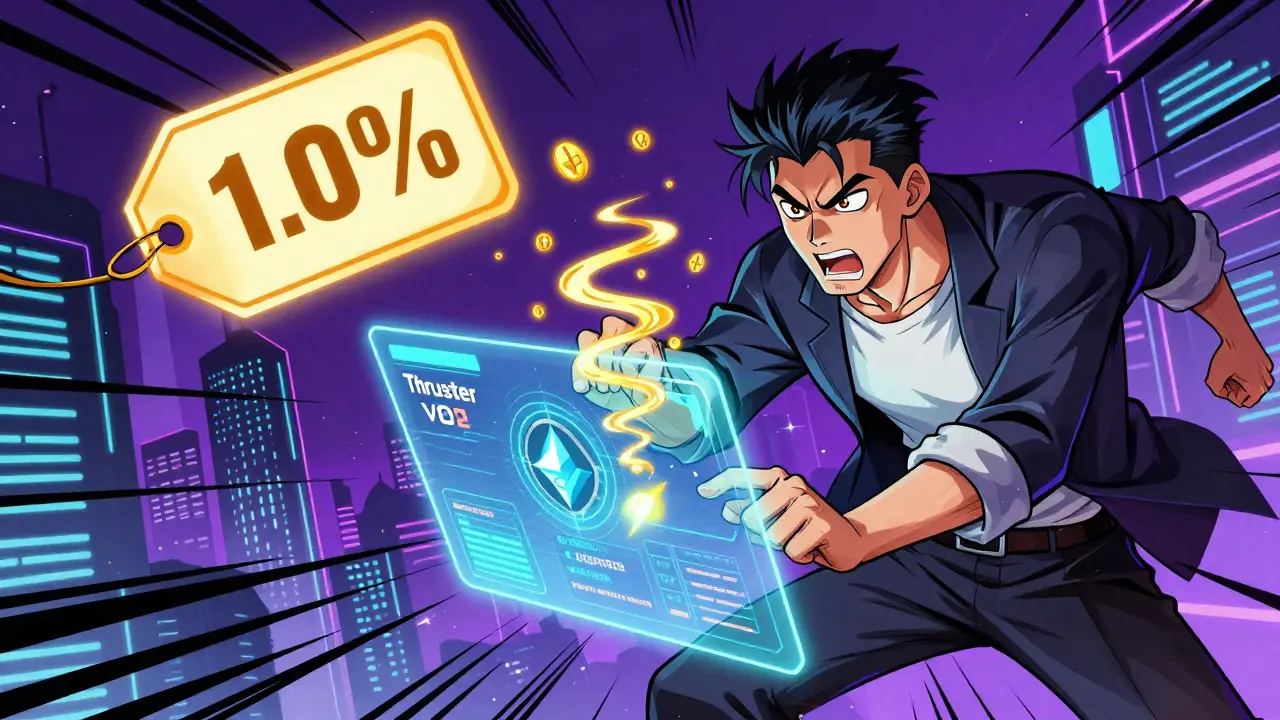
Most crypto exchanges charge 0.25% to 0.3% per trade. Thruster v2 charges 1.0%. That’s more than three times higher. So why would anyone use it?
The answer isn’t about lower fees. It’s about what you get when you pay more.
Thruster v2 isn’t trying to be the next Uniswap. It doesn’t list hundreds of tokens or support multiple chains. It’s built for one thing: making the Blast Layer 2 ecosystem work better for traders and liquidity providers who are already there. If you’re not on Blast, this exchange won’t help you. If you are? It might be the most efficient tool you’ve used.
What Is Thruster v2?
Thruster v2 is a decentralized exchange (DEX) built exclusively for the Blast blockchain. Launched in early 2024, it’s not a side project-it’s the native automated market maker (AMM) designed to handle everything from token swaps to yield generation in one place. Unlike other DEXes that just let you trade, Thruster ties your trading activity directly to earning rewards.
It runs on Blast, a Layer 2 chain that’s growing fast. As of September 2024, Blast had over $1.24 billion locked in its protocols. Thruster captures about 12.7% of all DEX trading volume on Blast, making it the third most-used exchange there-after ODOS and xExchange.
Its 1.0% fee tier isn’t a mistake. It’s a design choice. That fee gets split between liquidity providers and the protocol’s own yield engine. You’re not just paying to swap-you’re funding a system that automatically boosts your returns.
How Thruster v2 Works (No Fluff)
Most DEXes use a simple model: you swap tokens, liquidity providers earn a small cut. Thruster v2 adds a layer: your liquidity doesn’t just sit there. It earns yield while you trade.
Here’s how:
- You add ETH or USDB to a liquidity pool on Thruster.
- Instead of waiting for rewards to claim manually, the protocol automatically reinvests your fees into the pool.
- That compounding happens every time someone trades-no extra steps needed.
That’s called integrated yield. And according to CoinLocally’s data, it gives you 1.7x better returns than if you were manually staking elsewhere. For stablecoin pairs like USDB/ETH, users report average APYs of 8.2%-not bad for a DEX with only two trading pairs.
It uses concentrated liquidity, meaning you pick the price range where your funds work. If you think ETH will stay between $2,000 and $2,500, you put all your capital there. That increases your fee earnings per dollar invested. It’s advanced, but the interface walks you through it.
Swaps are fast. Average completion time: 2.4 seconds. Gas fees? Around $0.0037 per trade. That’s cheaper than most Ethereum mainnet DEXes, even though you’re on a Layer 2.
Why the 1.0% Fee? Is It Justified?
Yes-if you’re in the right place.
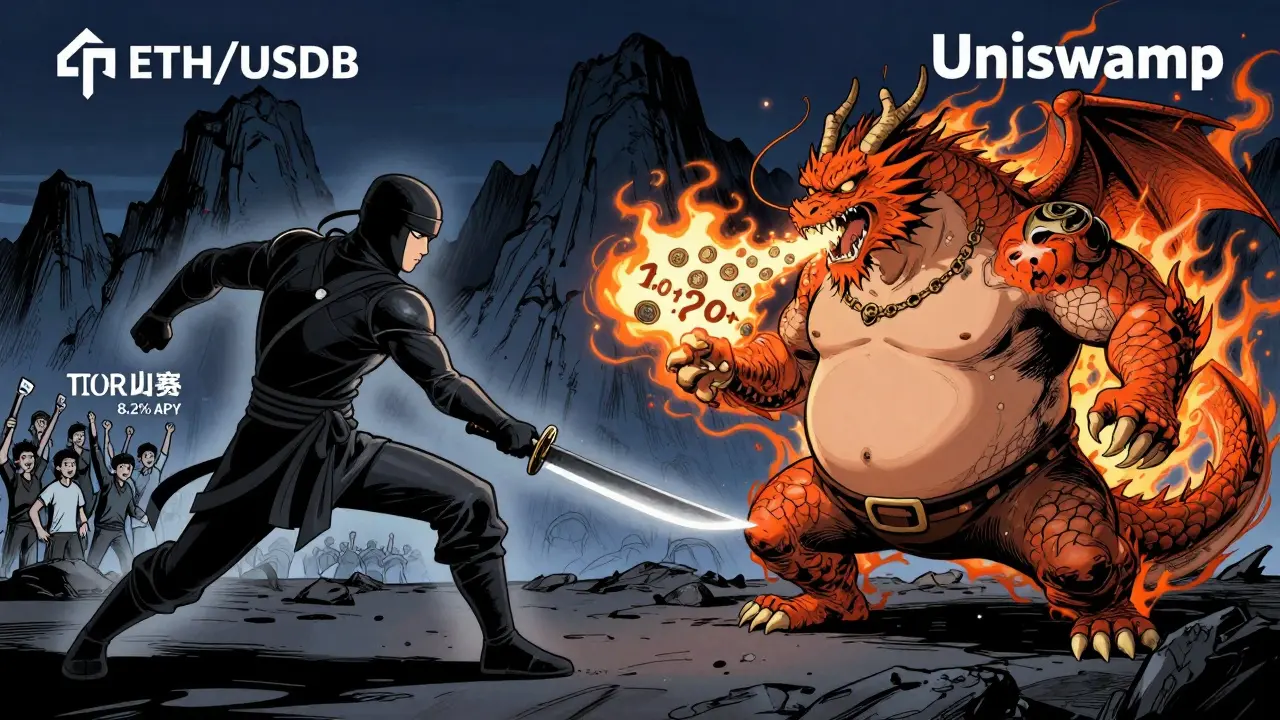
On Uniswap, you pay 0.3%. On Thruster, you pay 1.0%. But here’s the catch: on Thruster, 70% of that fee goes straight to liquidity providers. The rest funds the yield engine. On Uniswap, you get 0.3%-and then you have to go find a separate staking pool to earn more.
Thruster removes that friction. You don’t need to jump between apps. Your liquidity earns while you trade. That’s why experienced Blast users call it “degen-first.” It’s built for people who know what they’re doing and want maximum efficiency.
But if you’re new to DeFi? That 1.0% fee will feel brutal. A $500 swap costs $5 in fees. On other DEXes, it’d be $1.50. And if the market moves fast? Slippage can hit 4.7% on newer pairs, according to Reddit users. That’s because liquidity is thin.
So the fee isn’t a ripoff. It’s a trade-off: higher cost for automatic, high-yield rewards. If you’re holding Blast-native tokens and plan to trade regularly, it pays for itself.
What You Can Trade (And What You Can’t)
Thruster v2 supports only two tokens: ETH and USDB (Blast’s native stablecoin). That means just two trading pairs: ETH/USDB and USDB/ETH.
That’s it.
No Solana, no Polygon, no meme coins from other chains. If you want to trade BONK or SHIB, you’ll need another exchange. Thruster doesn’t care.
This is intentional. Thruster isn’t trying to compete with Uniswap. It’s trying to be the best place to trade within Blast. That’s why it’s so focused. There are no distractions. No clutter. Just the two tokens most people use on Blast.
But here’s the problem: if you want to trade a new token that just launched on Blast, you’re out of luck. Thruster doesn’t support new listings yet. That’s a big gap. Other Blast DEXes like xExchange allow community-driven token additions. Thruster doesn’t.
According to the roadmap, Thruster plans to expand to 15+ trading pairs by Q1 2025. Until then? You’re locked into ETH and USDB.
Who Is This For? Who Should Avoid It?
Thruster v2 is perfect for:
- Users already active on Blast Layer 2
- Liquidity providers who want automatic compounding
- Traders who make frequent swaps between ETH and USDB
- Experienced DeFi users who understand concentrated liquidity
It’s a bad fit if you:
- Trade altcoins outside ETH/USDB
- Want to use multiple blockchains
- Are new to DeFi and don’t know what APY or slippage means
- Need deep liquidity for large trades
Most users on Thruster are veterans. Cryptorank’s data shows 68% have been in crypto for over three years. Only 22% are intermediate. Enterprises? None. This isn’t a place for institutions. It’s for the people who are already deep in Blast’s ecosystem.
Performance, Security, and Reliability
Thruster’s smart contracts were audited by Blast-certified auditors. No public name was released, but the audit was completed before launch. That’s standard practice on Blast-many projects don’t disclose audit firms publicly.
Security-wise, it’s solid. No exploits reported since launch. The interface is simple: connect your MetaMask, approve a transaction, swap. No complex governance tokens or voting systems.
But reliability? Mixed.
On CoinAcademy’s review platform, 32% of negative reports mention failed transactions during peak hours. Wallet timeouts happen 27% of the time. These aren’t bugs-they’re symptoms of a small, growing network. When traffic spikes, Blast’s Layer 2 can get congested. Thruster doesn’t have backup routes. It’s all or nothing.
Community-built fixes exist on GitHub (Thruster-Support-Snippets), with 87 troubleshooting scripts. But that’s not something a beginner should have to rely on.
User Experience: Easy or Confusing?
For someone who’s used to MetaMask and Uniswap, onboarding takes 15-22 minutes. You’ll need to:
- Connect your wallet to Blast
- Get some ETH or USDB on Blast (via bridge or swap)
- Approve token access on Thruster
- Choose your liquidity range
- Start swapping
For beginners? 45+ minutes. The docs (docs.thruster.finance) have 12 guides, but they’re only in English. French and Spanish users report missing translations. There’s no video walkthrough. No live chat. You’re on your own.
That’s fine for experienced users. For newcomers? It’s intimidating.
What’s Next? Thruster v3 and the Roadmap
Thruster v2 is already being replaced. The team is working on v3, which is rumored to include:
- Cross-margin trading (Q2 2025)
- Institutional analytics dashboards (Q3 2025)
- 15+ new trading pairs (Q1 2025)
But here’s the real question: will Blast keep growing?
Thruster’s future is tied to Blast’s. If Blast becomes a top 3 Layer 2 by 2025, Thruster could see 40-60% more volume. If Blast stalls? Thruster becomes a relic.
ICORankings calls it a “high-risk, high-reward niche play.” That’s accurate. It’s not a safe bet. But if you believe in Blast? It’s one of the best tools you can use right now.
Final Verdict: Should You Use Thruster v2?
Yes-if you’re already on Blast and trade ETH and USDB regularly.
No-if you want broad token selection, low fees, or beginner-friendly tools.
Thruster v2 isn’t for everyone. It’s for a very specific group: the degen traders, the yield farmers, the people who live on Blast and want to squeeze every bit of return out of their capital. The 1.0% fee isn’t a flaw-it’s the price of automation, speed, and integrated rewards.
It’s not the biggest DEX. It’s not the cheapest. But if you’re in the right ecosystem, it might be the smartest choice you make this year.
Use it if you know what you’re doing. Skip it if you don’t.
What is the fee structure on Thruster v2?
Thruster v2 charges a flat 1.0% fee on all trades. 70% of that fee goes directly to liquidity providers, and 30% funds the protocol’s integrated yield engine. This is higher than most DEXes, which charge 0.25-0.3%, but the fee includes automatic compounding of rewards, eliminating the need for separate staking.
What tokens can I trade on Thruster v2?
As of late 2024, Thruster v2 only supports two tokens: ETH and USDB (Blast’s native stablecoin). That means only one trading pair: ETH/USDB. New token listings are not supported yet, but the roadmap includes expanding to 15+ pairs by Q1 2025.
Is Thruster v2 safe to use?
Yes, but with caveats. Thruster’s smart contracts were audited by Blast-certified auditors, and no exploits have been reported since launch. However, it’s a small, niche platform with limited liquidity. Large trades may suffer from high slippage (up to 4.7% on new pairs), and transaction failures can occur during peak network congestion.
Can I use Thruster v2 if I’m not on Blast?
No. Thruster v2 is built exclusively for the Blast Layer 2 blockchain. You cannot connect wallets from Ethereum, Polygon, or any other chain. You must first bridge your assets to Blast before using Thruster. It has zero cross-chain support.
How does Thruster v2 compare to Uniswap?
Uniswap offers 1,200+ trading pairs, lower fees (0.3%), and works on Ethereum and multiple Layer 2s. Thruster v2 offers only 1 pair, higher fees (1.0%), but includes automatic yield compounding and is optimized for Blast. Uniswap is for broad access. Thruster is for deep efficiency within one ecosystem.
What’s the average APY on Thruster v2?
For ETH/USDB liquidity pools, users report average APYs of 8.2%. This is due to the integrated yield engine that automatically reinvests trading fees. That’s significantly higher than manual staking on other platforms, especially after accounting for gas costs.
Does Thruster v2 support mobile wallets?
Yes, as long as the wallet is Ethereum-compatible and supports Blast. MetaMask Mobile works fine. Wallets like Trust Wallet and Rainbow also support Blast. Just ensure you’ve switched networks to Blast before connecting.
Is there a mobile app for Thruster v2?
No. Thruster v2 is a web-based platform only. You access it through your browser on desktop or mobile. There is no official app in the App Store or Google Play. Always verify you’re on docs.thruster.finance to avoid phishing sites.
Shawn Roberts
December 26, 2025 AT 14:04surendra meena
December 27, 2025 AT 11:19Kevin Gilchrist
December 28, 2025 AT 01:50Khaitlynn Ashworth
December 28, 2025 AT 07:23NIKHIL CHHOKAR
December 29, 2025 AT 02:44Abhisekh Chakraborty
December 30, 2025 AT 00:43dina amanda
December 31, 2025 AT 19:04Emily L
January 1, 2026 AT 16:06Gavin Hill
January 3, 2026 AT 09:37SUMIT RAI
January 3, 2026 AT 12:59Andrea Stewart
January 4, 2026 AT 09:08Josh Seeto
January 5, 2026 AT 03:40Mike Pontillo
January 5, 2026 AT 09:50Joydeep Malati Das
January 7, 2026 AT 08:27rachael deal
January 7, 2026 AT 21:22Elisabeth Rigo Andrews
January 9, 2026 AT 03:02Adam Hull
January 10, 2026 AT 20:29Mandy McDonald Hodge
January 12, 2026 AT 09:31Bruce Morrison
January 13, 2026 AT 16:54Andrew Prince
January 14, 2026 AT 22:48