Uniswap Crypto Exchange Review 2026: What You Need to Know
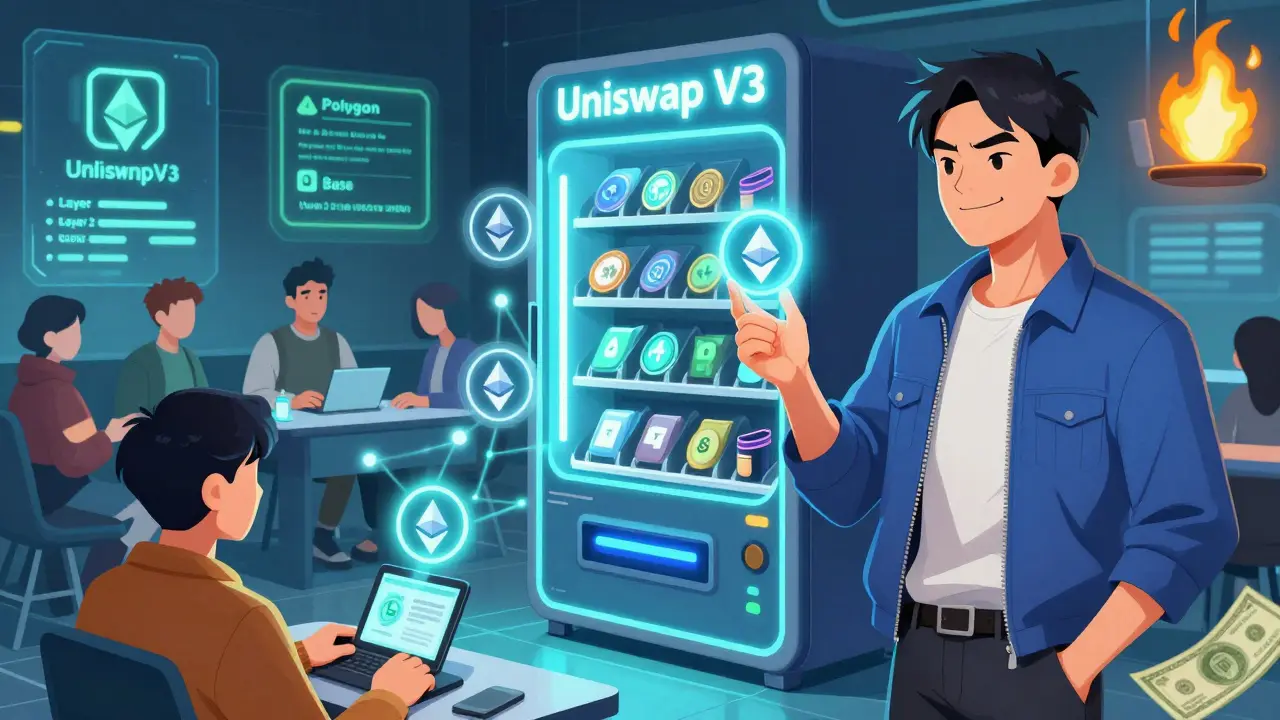
People often type "USWAP" when they mean Uniswap. It’s a common mistake, but it matters - Uniswap isn’t a traditional exchange you sign up for. It’s a decentralized protocol that lets you trade crypto directly from your wallet. No registration. No KYC. No middleman. Just smart contracts doing the work. If you’re wondering whether Uniswap is right for you in 2026, here’s the real deal - no fluff, just facts.
How Uniswap Actually Works
Uniswap runs on Ethereum and other blockchains. It doesn’t use order books like Binance or Coinbase. Instead, it uses something called an Automated Market Maker (AMM). Think of it like a vending machine for crypto. You put in one token, and it gives you another based on a formula. The catch? There’s no single price. The price changes based on how much of each token is in the pool.
Liquidity providers - everyday users like you - deposit pairs of tokens (like ETH and USDC) into these pools. In return, they earn a cut of every trade that happens in that pool. That’s how Uniswap stays liquid. Over 11 blockchains now support Uniswap, including Ethereum, Polygon, Arbitrum, and Base. That means you can swap tokens on cheaper, faster networks instead of paying high Ethereum fees every time.
Uniswap V3: The Game-Changer
Uniswap V3, launched in May 2021, changed everything. Before V3, liquidity providers had to spread their funds across the whole price range. That meant most of their money sat idle. V3 fixed that. Now, you can choose a price range - say, between $3,000 and $3,500 for ETH - and put all your capital there. This made capital usage up to 4,000x more efficient, according to Uniswap’s own docs.
It also introduced four fee tiers:
- 0.01% - for stablecoin pairs like USDC/DAI
- 0.05% - for semi-stable pairs like wBTC/renBTC
- 0.3% - the default for most tokens like ETH/USDT
- 1% - for risky, low-volume tokens
Most users stick with 0.3%. It’s fair, simple, and covers the majority of trades. But if you’re trading stablecoins, you can save money by choosing the 0.01% pool.
Gas Fees and Network Costs
This is where beginners get shocked. On Ethereum mainnet, a simple swap can cost anywhere from $1.50 to $15. During peak times - like when a new token launches - it spikes to $50 or more. That’s why most experienced users avoid Ethereum for small trades.
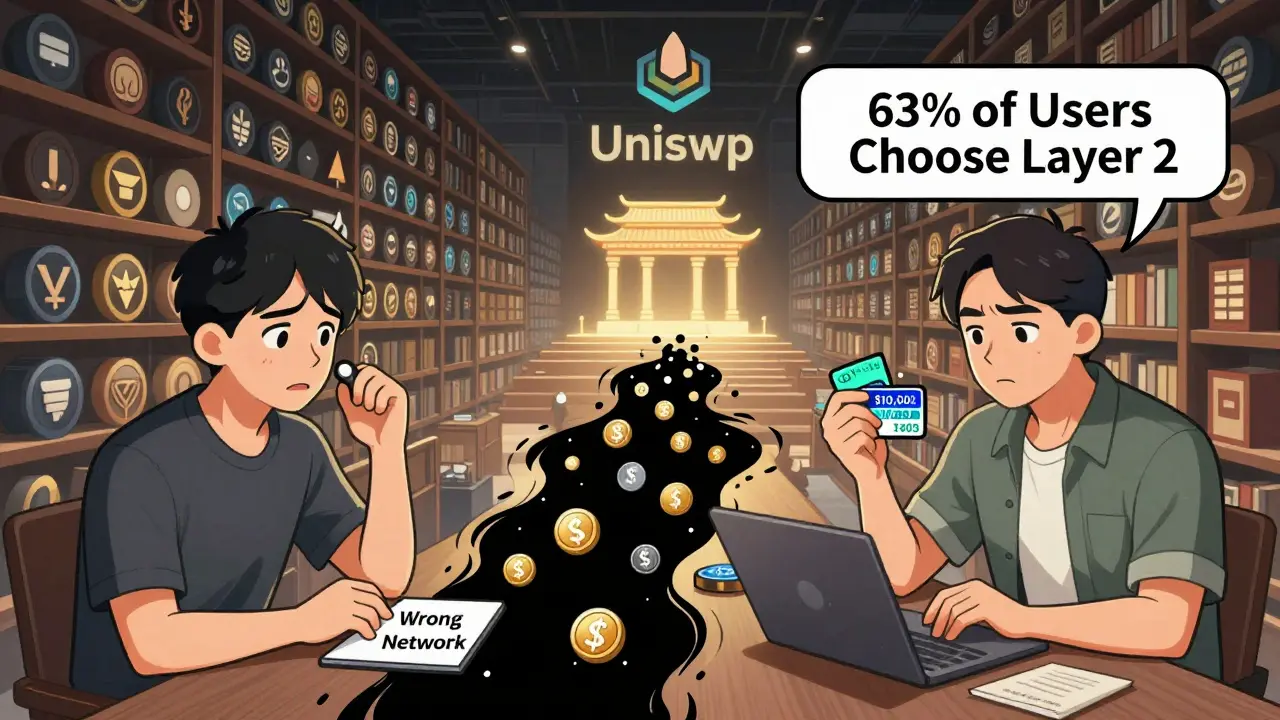
But Uniswap isn’t stuck on Ethereum. You can use it on Polygon, where gas fees average $0.02-$0.05. Or on Base, where it’s often under $0.01. A $10,000 ETH/USDC swap on Ethereum has slippage of just 0.05%. On Polygon? Same slippage, but you pay 300x less in fees. That’s why 63% of Uniswap users now trade on Layer 2 chains.
Wallets and Security
You need a wallet. No exceptions. Uniswap doesn’t hold your funds. You do. That’s the whole point. Supported wallets include MetaMask, Trust Wallet, Coinbase Wallet, Ledger Live, and Brave Browser Wallet. All connect via WalletConnect or direct browser integration.
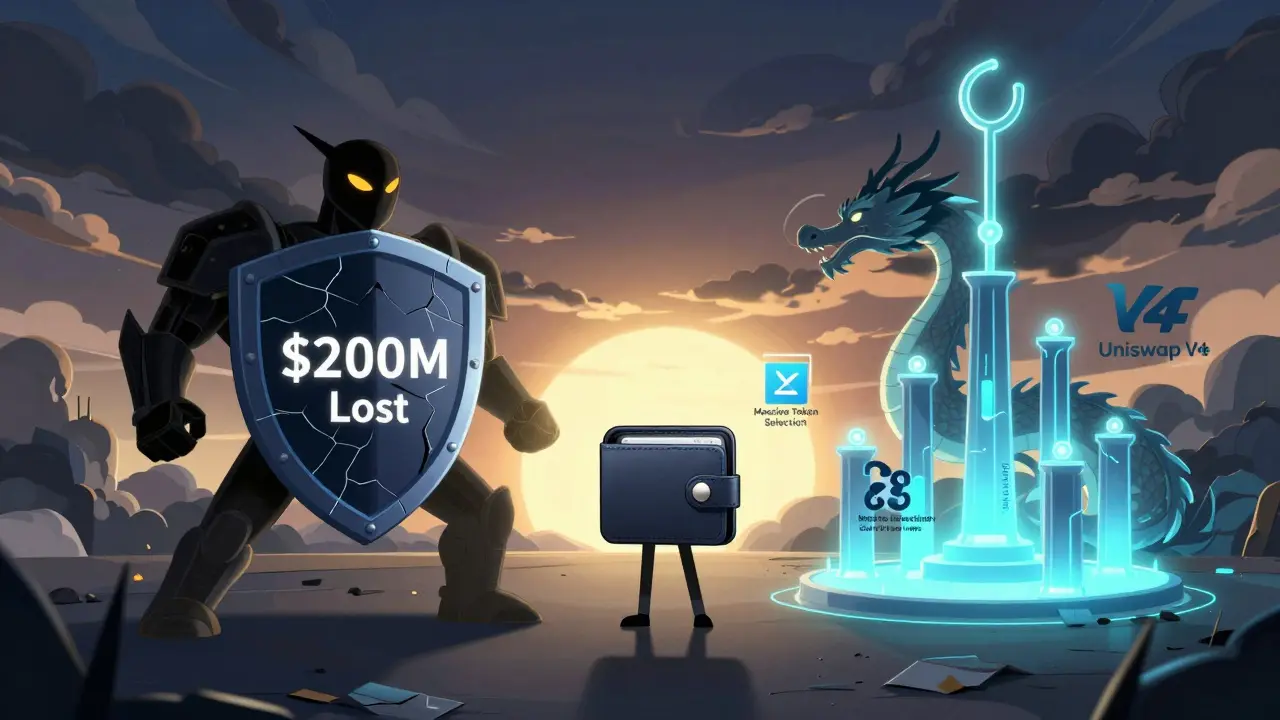
Security? Uniswap has been audited by OpenZeppelin, Trail of Bits, and others. No major exploits since V2. Compare that to centralized exchanges like Bybit, which lost $200 million in 2024. Uniswap’s non-custodial design means no single point of failure. But here’s the catch: if you send tokens to the wrong address, or set slippage too high, there’s no customer service to help you. You’re on your own.
What Uniswap Does Better Than Anyone Else
Token selection. If you want to trade a new DeFi token that just launched, Uniswap is likely the only place you can. Over 1.2 million unique tokens have been listed on Uniswap across all chains. That’s more than all other DEXs combined. You won’t find most of these on Coinbase or Kraken.
Liquidity depth. For major pairs like ETH/USDC, Uniswap has the deepest pools in crypto. A $10,000 trade moves the price by less than 0.05%. That’s why institutions now account for 17% of Uniswap’s volume - up from 8% in early 2025. They’re using it because it’s the most reliable DEX for large trades.
No KYC. If you’re in a country where centralized exchanges are blocked, or you just hate handing over your ID, Uniswap is the only way. It’s open to anyone with a wallet and some crypto.
Where Uniswap Falls Short
Beginners struggle. A September 2025 usability test showed 65% of first-time users completed a swap on the first try. That sounds good - until you realize 38% of failed swaps were due to incorrect slippage settings. Another 27% chose the wrong network. If you don’t know what gas fees or slippage mean, you’ll lose money.
No fiat on-ramps. You can’t deposit USD, EUR, or GBP. You need to buy crypto elsewhere first - like on Coinbase or Kraken - then send it to your wallet before using Uniswap. That’s a huge barrier for newcomers.
No customer support. If your transaction fails, you won’t get an email, chat, or phone call. You have to troubleshoot yourself. Reddit and Discord are your only help. The Uniswap Discord has 287,000 members, but average response time to questions is 47 minutes.
Competitors are catching up. DEXs like Aster and Curve now offer hidden orders, MEV protection, and cross-chain routing. Uniswap doesn’t. In October 2025, Uniswap’s market share dropped to 58.7% from 68.3% in January. It’s still #1 - but it’s not invincible anymore.
Who Is Uniswap For?
Uniswap isn’t for everyone. If you’re new to crypto and need to buy your first ETH with a credit card - skip it. Use Coinbase or Kraken instead.
But if you:
- Already own crypto and want to swap it
- Trade lesser-known tokens
- Use a wallet like MetaMask
- Understand gas fees and slippage
- Want to avoid KYC
Then Uniswap is the best tool you have. It’s the most open, most liquid, and most trusted DEX on the market. And with V4 coming in Q1 2026 - which will let developers build custom liquidity pools - it’s only getting more powerful.
Real User Experiences
On Reddit, user DeFi_Dave wrote: "Swapped 5 ETH for SHIB on Polygon today. Paid $0.03 gas and 0.3% fee. Total cost: $1.87. Cheaper than any CEX."
On Trustpilot, one user complained: "My swap failed. No one answered my ticket. I lost $800 worth of tokens." That’s the trade-off: freedom vs. safety net.
A survey of 1,200 users found 78% of those with over 6 months of DeFi experience rated Uniswap highly. Only 42% of beginners did. The top praised features? "No KYC" (85%) and "massive token selection" (89%). The top complaints? "High Ethereum gas fees" (76%) and "no fiat on-ramps" (68%).
Final Verdict
Uniswap isn’t perfect. But it’s the most important decentralized exchange in crypto history. It gave people control over their money when no one else would. It’s not a place to buy your first Bitcoin. It’s a place to move, trade, and explore the open financial system.
Use it on Polygon or Base. Set slippage at 1% for new tokens. Double-check your network. And never send crypto to a contract you don’t understand. Do that, and Uniswap will serve you better than any centralized exchange.
Is USWAP the same as Uniswap?
No. USWAP is a common misspelling. The correct name is Uniswap. There is no crypto exchange called USWAP. If you see a website or app using "USWAP," it’s likely a scam or phishing site. Always use uniswap.org or the official app from your wallet provider.
Do I need to create an account to use Uniswap?
No. Uniswap doesn’t require accounts, emails, or KYC. You just connect your wallet - like MetaMask or Trust Wallet - and start trading. Your funds stay in your wallet the whole time. That’s what makes it decentralized.
Can I buy crypto with USD on Uniswap?
No. Uniswap doesn’t support fiat deposits. You must buy crypto on a centralized exchange like Coinbase or Kraken first, then transfer it to your wallet. From there, you can swap it on Uniswap. This is a major limitation for beginners.
Why are Uniswap fees so high sometimes?
The 0.3% swap fee is fixed. But the real cost is gas - the fee paid to miners to process your transaction on Ethereum. On Ethereum mainnet, gas can spike during congestion. To avoid this, use Uniswap on Layer 2 networks like Polygon or Base, where gas fees are under $0.05.
Is Uniswap safe?
The protocol itself is secure - audited by top firms and never hacked. But your safety depends on you. Never share your private key. Always verify contract addresses. Avoid unknown tokens with low liquidity. And never ignore slippage warnings. The biggest risk isn’t Uniswap - it’s user error.
What’s the difference between Uniswap V3 and V4?
V3 introduced concentrated liquidity - letting providers earn more by focusing capital in price ranges. V4, launching in Q1 2026, adds hook contracts. These let developers build custom liquidity pools - like ones that auto-rebalance or lock funds for time periods. V4 won’t change how users swap, but it will unlock new DeFi tools built on top of Uniswap.
Can I earn money on Uniswap?
Yes - by providing liquidity. If you deposit ETH and USDC into a Uniswap pool, you earn a share of every trade in that pool. But it’s not risk-free. You could lose money if the price of either token moves sharply - this is called impermanent loss. Only provide liquidity if you understand the risks.
How does Uniswap compare to PancakeSwap or SushiSwap?
Uniswap leads in total volume and token selection. PancakeSwap is mostly on BNB Chain and focuses on meme coins. SushiSwap has fewer chains and less liquidity. Uniswap supports 11 networks. PancakeSwap supports 4. SushiSwap supports 7. For serious trading, Uniswap is still the default.
Richard Cooper
February 22, 2026 AT 21:50Dee Resin
February 23, 2026 AT 23:41Tanvi Atal
February 25, 2026 AT 00:08Sony Sebastian
February 26, 2026 AT 11:00Jan Czuchaj
February 28, 2026 AT 05:45George Suggs
March 1, 2026 AT 01:27Dianna Bethea
March 2, 2026 AT 19:10Felicia Eriksson
March 4, 2026 AT 01:42Michael Rozputniy
March 5, 2026 AT 13:50Danny Kim
March 7, 2026 AT 06:55Jeremy buttoncollector
March 8, 2026 AT 23:27Michelle Xu
March 10, 2026 AT 22:47Ryan Burk
March 12, 2026 AT 13:23Amanda Markwick
March 12, 2026 AT 17:51Arya Dev
March 14, 2026 AT 16:17Cathy Sunshine
March 15, 2026 AT 22:41Shannon Black
March 17, 2026 AT 03:53kati simpson
March 18, 2026 AT 09:26Amita Pandey
March 19, 2026 AT 02:14