What Are Wrapped Tokens? A Simple Guide to Cross-Chain Crypto
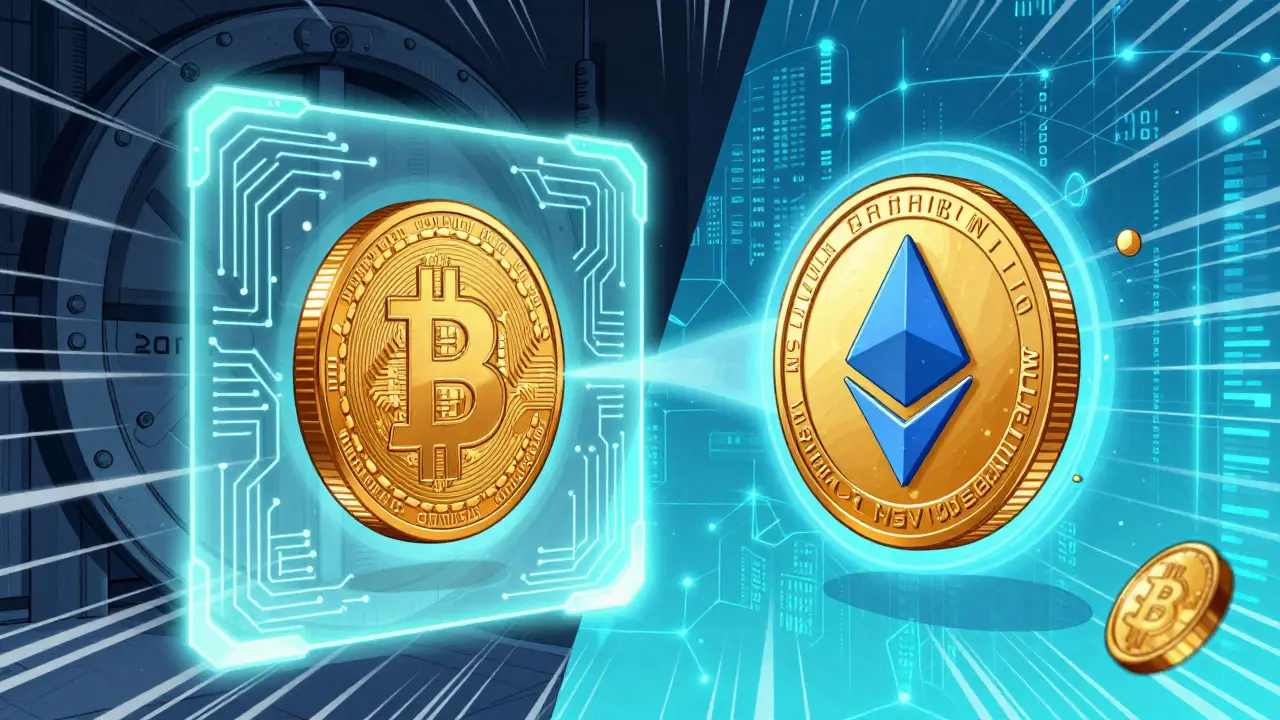
Imagine you have a gold bar locked in a vault in London. You want to use it as collateral for a loan in New York, but shipping the physical gold takes weeks and costs a fortune. Instead of moving the metal, you get a digital receipt that represents that exact gold bar. You can trade, lend, or spend that receipt instantly in New York, knowing the real gold is safe back in London.
This is exactly how wrapped tokens work in the crypto world. They are digital receipts that allow assets from one blockchain to live and work on another. If you’ve ever wondered why Bitcoin shows up on Ethereum-based apps like Uniswap or Aave, wrapped tokens are the reason.
Key Takeaways
- Wrapped tokens are bridge assets that let cryptocurrencies operate on blockchains they weren’t originally built for.
- The most famous example is WBTC (Wrapped Bitcoin), which lets Bitcoin users access Ethereum’s decentralized finance (DeFi) ecosystem.
- They work through a custodial model: your original coin is locked in a vault, and an equivalent token is minted on the new chain.
- While they solve major interoperability issues, they introduce counterparty risk because you must trust the custodians holding your original assets.
What Exactly Is a Wrapped Token?
To understand wrapped tokens, you first need to grasp a core problem in crypto: blockchains are isolated islands. Bitcoin runs on its own protocol. Ethereum runs on its own. Solana, Cardano, and Polkadot all speak different technical languages. By default, Bitcoin cannot talk to Ethereum. You can’t send BTC directly to an Ethereum wallet address.
A wrapped token solves this by creating a compatible version of an asset. When you wrap a token, you aren’t changing the underlying asset; you’re wrapping it in a smart contract that the target blockchain understands. For example, Bitcoin uses UTXO (Unspent Transaction Output) accounting, while Ethereum uses account balances. To make Bitcoin work on Ethereum, it needs to be converted into an ERC-20 token standard. That wrapped version is called WBTC (Wrapped Bitcoin).
Think of it like currency exchange at an airport. You don’t physically change the value of your money, but you swap dollars for euros so you can spend them in Paris. Wrapped tokens are the "euros" of the crypto world, allowing native assets to function in foreign ecosystems.
How Does the Wrapping Process Work?
The mechanism behind wrapped tokens relies on three main components: custodians, smart contracts, and a 1:1 backing ratio. Here is the step-by-step process when you decide to wrap your Bitcoin into WBTC:
- Deposit: You send your native Bitcoin to a designated multi-signature wallet controlled by a consortium of trusted companies (custodians). This wallet acts as a secure vault.
- Minting: Once the custodians confirm the Bitcoin has arrived and is locked, their smart contract mints an equal amount of WBTC on the Ethereum network. If you sent 1 BTC, you receive 1 WBTC.
- Usage: You now hold WBTC in your Ethereum-compatible wallet (like MetaMask). You can use it to provide liquidity on Uniswap, borrow against it on Aave, or trade it on any Ethereum DEX.
- Burning (Unwrapping): When you’re done, you send your WBTC back to the burning address. The smart contract destroys the WBTC, and the custodians release the original Bitcoin from the vault back to your address.
This process ensures that for every single unit of wrapped token in circulation, there is an identical unit of the original asset locked away. This 1:1 peg is critical. If the ratio breaks, the wrapped token loses its value.

Why Do We Need Wrapped Tokens?
You might ask, "Why not just keep my Bitcoin on the Bitcoin network?" The answer lies in utility. Bitcoin is great for storing value, but its scripting language is limited. It doesn’t natively support complex smart contracts needed for lending, borrowing, or automated market makers.
Ethereum, however, is a global computer packed with decentralized applications (dApps). By wrapping Bitcoin into WBTC, you unlock billions of dollars in DeFi opportunities. According to data from DeFi Llama, wrapped tokens represent over $12 billion in total value locked across various chains. WBTC alone accounts for a massive chunk of this, often ranking among the top 20 cryptocurrencies by market cap.
Without wrapped tokens, Bitcoin holders would miss out on yield farming, liquidity provision, and other financial primitives available only on EVM (Ethereum Virtual Machine) compatible chains. It turns a static store of value into a productive asset.
The Risks: Trust and Centralization
Here is the catch: wrapped tokens are not fully decentralized. In fact, they introduce a significant point of failure. When you use native Bitcoin, you control your keys. When you use WBTC, you are trusting a group of companies (the custodians) to hold your actual Bitcoin.
This creates counterparty risk. If the custodian goes bankrupt, gets hacked, or decides to run away with the funds, your wrapped token becomes worthless paper. You own a claim on an asset that no longer exists.
Let’s look at the specific risks:
- Custodial Risk: The central team managing the vault holds the private keys. This contradicts the "not your keys, not your coins" ethos of crypto.
- Smart Contract Risk: The code governing the minting and burning process could have bugs. While audits are common, exploits do happen.
- Regulatory Risk: Governments may classify wrapped tokens differently than native assets. For instance, if a custodian exerts too much control, regulators might deem the wrapped token a security, leading to legal crackdowns.
In November 2022, a bug in the RenBridge protocol temporarily stranded $96 million in wrapped tokens. It took 72 hours to resolve. Imagine if that had been a malicious hack instead of a bug. The losses could have been catastrophic.
WBTC vs. Other Wrapped Assets
While WBTC is the king of wrapped tokens, it isn’t the only one. Different projects offer varying levels of decentralization and security models.
| Token | Custody Model | Decentralization Level | Primary Use Case |
|---|---|---|---|
| WBTC | Consortium (BitGo, Kyber, Ren) | Low (Centralized Custody) | High Liquidity DeFi |
| renBTC | Distributed Nodes (RenVM) | Medium (Permissionless Validators) | Privacy & Interoperability |
| tBTC | Threshold Network (DAO Governance) | High (Decentralized Threshold Signatures) | Trust-Minimized DeFi |
WBTC dominates because it was first and has the deepest liquidity. Most major DeFi protocols integrate WBTC immediately because users expect it. However, critics argue its centralized nature is a systemic risk.
renBTC attempts to solve this by using a distributed network of nodes to sign transactions, reducing reliance on a single corporate entity. tBTC goes further by using threshold cryptography, where no single party holds the full key to the vault, making it theoretically more secure against insider threats.

Are There Better Alternatives?
Wrapped tokens are currently the industry standard, but they are seen by many experts as a "necessary evil." Vitalik Buterin, co-founder of Ethereum, has described them as a temporary solution until native cross-chain communication matures.
Here are the emerging alternatives:
- Atomic Swaps: These allow direct peer-to-peer exchange of different cryptocurrencies without a middleman. They are trustless but currently lack scalability and user-friendly interfaces.
- Cross-Chain Bridges: Protocols like Wormhole or LayerZero enable message passing between chains. While powerful, bridges have been prime targets for hackers, losing hundreds of millions in exploits since 2022.
- Native Interoperability: Projects like Polkadot and Cosmos were built from the ground up to communicate with each other. However, they struggle to attract liquidity from established networks like Bitcoin and Ethereum.
For now, wrapped tokens remain the most practical way to move value between the two largest blockchains. As technology evolves, we may see a shift toward trust-minimized bridges, but that transition will take years.
How to Get Started with Wrapped Tokens
If you want to try wrapping your own assets, here is what you need to know:
- Choose a Reputable Service: Stick to well-audited projects like WBTC or renBTC. Avoid obscure wrapped tokens with low liquidity.
- Prepare Gas Fees: Wrapping involves transactions on both the source and destination chains. Ensure you have enough ETH (for Ethereum) or BTC (for Bitcoin) to cover gas fees.
- Use a Compatible Wallet: You’ll need a non-custodial wallet like MetaMask or Ledger that supports the target blockchain’s token standard (e.g., ERC-20).
- Verify Reserves: Before depositing large amounts, check proof-of-reserve audits. Reputable providers publish regular attestations showing their vaults are fully backed.
Be aware of the costs. Wrapping fees typically range from 0.1% to 0.3%, plus network gas fees. During periods of high congestion, these costs can spike. Always calculate whether the potential yield or trading opportunity outweighs the wrapping cost.
The Future of Wrapped Tokens
The landscape is shifting. Regulatory bodies like the SEC are scrutinizing custodial models, potentially forcing providers to adopt stricter compliance measures. Meanwhile, developers are pushing for decentralized autonomous organization (DAO) governance for wrapped assets, as seen with the planned DAO migration for WBTC.
As Layer 2 solutions like Arbitrum and Optimism gain traction, wrapped tokens are becoming even more vital. These scaling networks rely heavily on bridged assets to maintain liquidity. Without wrapped tokens, the entire DeFi ecosystem would fragment into isolated silos.
Expect to see more competition among wrapping protocols. Projects that offer better security, lower fees, and greater transparency will win user trust. The goal is clear: minimize the need for trust while maximizing interoperability.
Is WBTC the same as Bitcoin?
No. WBTC is a representation of Bitcoin on the Ethereum blockchain. While it maintains a 1:1 value peg, it is a different token with different technical properties. You cannot spend WBTC on the Bitcoin network, and you must unwrap it to get back native BTC.
Can I lose money if the custodian fails?
Yes. This is known as counterparty risk. If the company holding your original Bitcoin goes bankrupt or is hacked, your wrapped token may become worthless. Always assess the reputation and audit history of the custodian before wrapping large amounts.
How long does it take to wrap a token?
Typically, wrapping takes between 15 to 60 minutes. This delay accounts for blockchain confirmation times on both the source and destination networks, as well as the time required for custodians to verify and process the transaction.
Are wrapped tokens taxable events?
In many jurisdictions, including the US, swapping one cryptocurrency for another (even a wrapped version) is considered a taxable event. Consult a tax professional to understand how wrapping/unwrapping affects your capital gains liability.
What happens if the price of the wrapped token deviates from the original?
This is called de-pegging. It usually happens due to market panic or liquidity issues. Arbitrageurs typically step in to buy the discounted wrapped token and redeem it for the original asset, restoring the 1:1 peg. However, severe de-pegging can lead to significant losses if the mechanism fails.