What is Assimilate (SIM) Crypto Coin? A Clear Breakdown of the AI-Powered Blockchain Token

Assimilate, known by its ticker symbol SIM, isn’t just another cryptocurrency. Launched on November 25, 2024, it’s built around a radical idea: a self-evolving system that gets smarter the more people use it. Unlike most coins that sit quietly on a blockchain, SIM is designed to grow, adapt, and absorb new technology like a living organism. It’s not about trading or speculation - at least, not primarily. It’s about creating a decentralized AI network that learns from every interaction.
How Assimilate (SIM) Works
The core of Assimilate is its recursive framework. Think of it like a feedback loop that never stops. Every time someone uses SIM to make a transaction, submit data, or interact with the system, that action feeds back into the network. AI nodes - automated programs running on the blockchain - analyze this data, adjust their behavior, and improve future responses. The more users, the smarter the system becomes. There’s no central team tweaking settings. The system evolves on its own.
This isn’t science fiction. The project calls this process “assimilation.” It’s borrowing the term from biology, where organisms integrate new elements to survive. SIM does the same with technology. Future updates will include a “technology assimilation platform,” meant to automatically pull in new AI tools, data sources, or protocols as they emerge. The goal? To stay ahead of the curve without needing developers to manually update the code.
The SIM Token: Fuel for the System
SIM is the only currency that powers this ecosystem. You can’t mine it. You can’t burn it. There are exactly 88,888,888 tokens - no more, no less. That fixed supply makes it rare by design. Each token acts as a key: you need SIM to trigger AI processes, submit data, or access tools within the network. Think of it like electricity for a machine. No SIM? No function.
As of February 2026, the circulating supply is between 80.9 million and 81 million tokens. That means nearly 91% of all SIM tokens are already in circulation. The rest are likely locked in early staking pools or reserved for future ecosystem growth. Unlike other coins that slowly release tokens over years, Assimilate launched with most tokens already out there, which suggests a heavy focus on early adoption.
Price Volatility and Market Reality
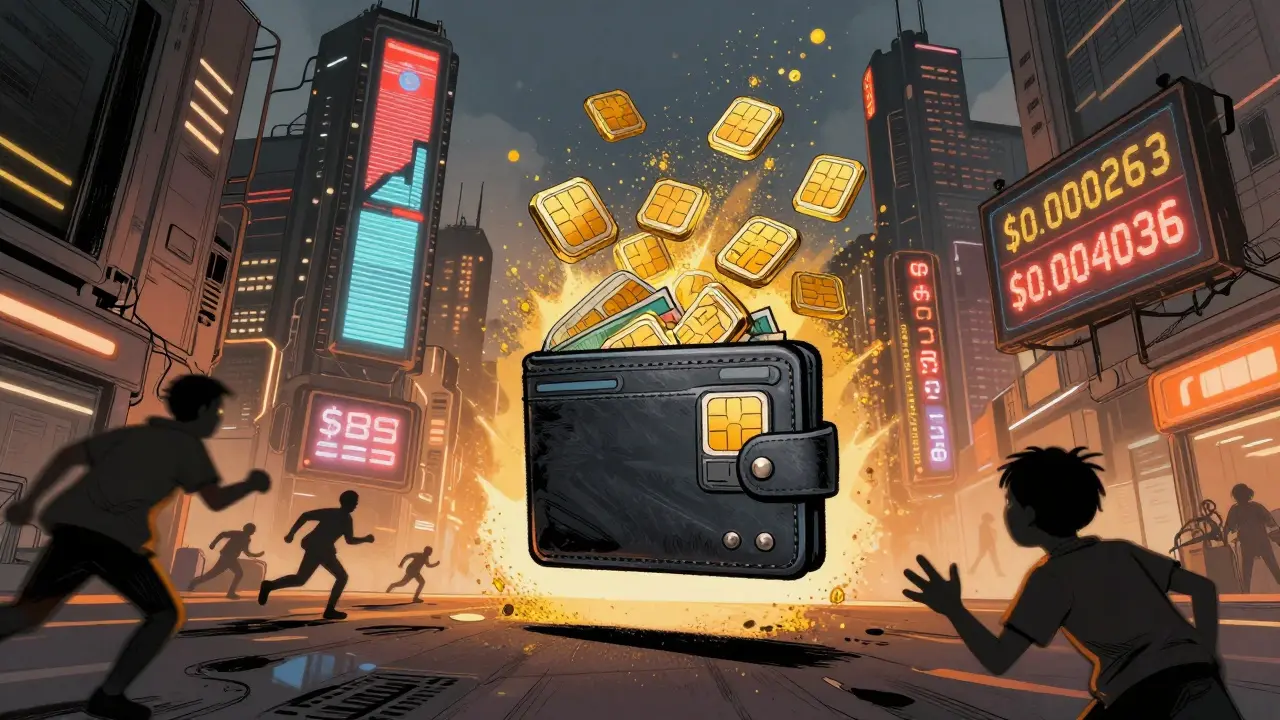
If you’re looking at SIM’s price, you’re going to get confused. Different platforms show wildly different numbers. CoinMarketCap says it’s $0.000263. CoinGecko says the same. But CoinStats lists it at $0.000569 one moment and $0.004036 the next. Binance says $0.000907. TradeSanta says $0.000410. BeInCrypto says $0.00033.
Why? Because liquidity is thin. SIM trades mostly on Uniswap V4 on the Base blockchain, with the SIM/VIRTUAL pair. Trading volume fluctuates between $80 and $6,700 in a single day. That’s not enough to stabilize prices. A single large trade can swing the price by 20% in minutes.
The all-time high was $0.0859 (around BTC 0.068). Today’s price is over 92% below that. But it’s also 330% above its lowest point. That kind of volatility isn’t unusual for a token this new. It’s still in its infancy. The market cap ranges from $22,800 to nearly $500,000 depending on which site you check - a sign that data sources aren’t synced. CoinGecko ranks SIM at #4751 out of thousands of cryptocurrencies. It’s not a top player - yet.
Who’s Behind It?
There’s almost no public information about the team. The project is based in the UK, but no names, LinkedIn profiles, or past projects are listed. No whitepaper with technical diagrams. No GitHub repository with code. No Twitter, Discord, or Telegram community with regular updates. That’s a red flag for many investors. Most successful crypto projects spend years building trust before launch. Assimilate launched with a bold idea - and almost no transparency.
That doesn’t mean it’s a scam. Some groundbreaking projects start this way. But it does mean you’re betting on an idea, not a team. There’s no guarantee the developers will return. No roadmap with deadlines. No clear plan for how the technology assimilation platform will actually work. It’s all vision, no details.
Who Is SIM For?
SIM isn’t for casual traders. If you’re looking to flip it for a quick profit, you’re likely to get burned. The price swings are too wild, and the liquidity too low. You might not even be able to sell when you want to.
It’s for people who believe in autonomous systems - those who think AI and blockchain should merge into something that doesn’t need humans to run it. If you’re excited by the idea of a network that learns from you, improves itself, and keeps evolving without a single developer touching the code - then SIM might be worth watching.
It’s also for early adopters in the AI-crypto space. Projects like Fetch.ai, SingularityNET, and Bittensor have been around longer and have more traction. But SIM’s focus on infinite recursion - where every action strengthens the whole - is unique. If this model works, it could become a blueprint for future AI-blockchain hybrids.
What’s Next?
The roadmap is vague. The only concrete next step is the “technology assimilation platform,” but there’s no release date. Will it allow integration with other blockchains? Will it pull in real-time data from social media? Will it auto-update AI models? No one knows. The team hasn’t said.
What we do know: SIM is still growing. As of February 2026, over 11,500 wallets hold SIM tokens. That’s not millions - but it’s more than most micro-cap coins have. The 7-day price increase of 14.4% in late January outperformed the broader crypto market (13.8%), even if it lagged behind AI-focused coins (19.6%). That suggests some real momentum.
The Bottom Line
Assimilate (SIM) is a high-risk, high-reward experiment. It’s not a currency. It’s not a utility token. It’s an attempt to build a self-sustaining AI-driven ecosystem on blockchain. If it succeeds, it could redefine how decentralized systems evolve. If it fails - and the lack of transparency makes that likely - it’ll fade into obscurity like hundreds of other tokens.
Right now, SIM is a bet on an idea. Not a product. Not a company. Just a concept: that technology can grow on its own. If that sounds fascinating to you, keep an eye on it. If you need clear facts, a solid team, or a roadmap - look elsewhere.
Is Assimilate (SIM) a good investment?
Assimilate (SIM) is not a conventional investment. With a market cap under $500,000, extreme price swings, and almost no public information about the team, it carries very high risk. It’s not suitable for conservative investors. Only consider it if you’re comfortable betting on unproven, abstract technology with no clear timeline or accountability. Treat it as a speculative experiment, not a financial asset.
Where can I buy SIM tokens?
SIM is primarily traded on Uniswap V4 on the Base blockchain using the SIM/VIRTUAL pair. A few other decentralized exchanges list it, but liquidity is extremely low. You’ll need a Web3 wallet like MetaMask, some ETH or BASE, and the exact contract address for SIM. Be cautious - there are fake tokens with similar names. Always verify the contract address from official sources, though official sources are limited.
Why are SIM prices so different across platforms?
The price differences come from extremely low trading volume and limited exchange listings. Most trading happens on one pair (SIM/VIRTUAL) on Uniswap, so data aggregators like CoinGecko and CoinMarketCap rely on incomplete or delayed feeds. Some platforms use weighted averages, others use single trades. This leads to wild inconsistencies. Don’t trust any single price - check multiple sources and understand the context.
Does Assimilate have a whitepaper?
No publicly available whitepaper exists. The project’s documentation is minimal. Most information comes from third-party crypto tracking sites and press releases. Without technical details, code audits, or a clear architecture diagram, it’s impossible to verify how the recursive AI system actually functions. This lack of transparency is a major concern for serious investors.
Is Assimilate based on Ethereum?
No. SIM runs on the Base blockchain, which is a Layer-2 network built on Ethereum by Coinbase. This means it benefits from Ethereum’s security but with faster, cheaper transactions. The SIM/VIRTUAL trading pair exists on Uniswap V4, which operates on Base. It’s not an ERC-20 token on Ethereum mainnet.
Can SIM be mined or staked?
No. SIM has a fixed supply of 88,888,888 tokens. None were mined. There is no staking mechanism described in available materials. All tokens were created at launch. The only way to acquire SIM is by buying it on a decentralized exchange. Rewards or passive income features have not been announced.
What makes SIM different from other AI crypto coins?
Most AI crypto projects use blockchain to pay for AI services - like buying compute power or data. SIM flips that. It uses AI to power the blockchain. The entire ecosystem is designed to learn from user interactions and improve itself automatically. It’s not a marketplace - it’s a living system. That recursive, self-improving structure is unique. No other project claims to evolve infinitely without human intervention.
Is Assimilate regulated?
There is no public information about regulatory compliance. The team is based in the UK, which has strict crypto regulations, but no filings or licenses have been disclosed. SIM is not listed on any regulated exchange like Coinbase or Kraken. It exists entirely in the decentralized, unregulated space. Users assume full legal and financial risk.
How many people hold SIM tokens?
As of February 2026, approximately 11,520 unique wallets hold SIM tokens. That’s a small number compared to major cryptocurrencies, but it’s growing. For context, Bitcoin has over 100 million wallets. This suggests SIM is still in the very early adoption phase. The number of holders is one of the few indicators of real community interest.
What happens if the team disappears?
If the team vanishes, the SIM network could continue operating - if the code is open and the AI nodes are decentralized. But without updates, the planned technology assimilation platform won’t launch. No new features will be added. The system might stagnate. The blockchain will still function, but the vision of infinite evolution would die. That’s the biggest risk: betting on a project with no accountability.
Alex Williams
February 15, 2026 AT 19:23SIM’s recursive feedback loop is actually one of the most elegant concepts I’ve seen in crypto this year. Most AI tokens just slap an LLM on a blockchain and call it innovation. SIM? It’s not using AI-it’s letting AI use the chain. Every transaction becomes training data, every wallet interaction a node update. The lack of a whitepaper is annoying, sure, but the architecture doesn’t need one if the code self-documents through behavior. Think of it like a neural net that writes its own backpropagation rules.
And the fixed supply? Genius. No inflationary dumps. No dev wallets. Just 88.8M tokens acting as the nervous system of a living network. If this scales, it could redefine what a crypto token even means. We’re not trading currency-we’re staking participation in an emergent intelligence.
Yeah, liquidity’s trash right now. But that’s because nobody’s built the on-ramps yet. Once a few decent DEX aggregators start routing SIM/VIRTUAL pairs with better slippage control, this’ll move. I’m not saying buy it-I’m saying watch it. This might be the first time a token evolves faster than its investors.
Sarah Shergold
February 16, 2026 AT 08:41OMG this is literally the future 💅✨
Lisa Parker
February 16, 2026 AT 21:21I cried when I saw the price dropped to $0.0002. I believed in this. I really did. It’s like watching your baby get rejected by every school. Why won’t they see how beautiful it is?? 🥺
JJ White
February 18, 2026 AT 13:02Let me guess-this is another ‘we’re not a scam, we’re just ahead of our time’ project. Classic. No team. No code repo. No roadmap. Just vibes and a buzzword salad: ‘recursive framework,’ ‘technology assimilation platform.’ Sounds like a startup pitch from someone who binge-watched Black Mirror and then took a 3-day crypto course on YouTube.
And don’t even get me started on the price discrepancies. CoinGecko says $0.000569? CoinStats says $0.004036? That’s not volatility-that’s data poisoning. Someone’s washing volume on Uniswap V4 with a bot farm and a dream. If this were a public company, the SEC would shut it down before breakfast.
It’s not a ‘high-risk, high-reward experiment.’ It’s a high-risk, zero-reward gamble wrapped in sci-fi jargon. The only thing evolving here is the number of suckers.
Alan Enfield
February 18, 2026 AT 19:20It’s wild how this thing just… works. No team, no updates, but the network keeps going. I’ve been holding since December. Not because I think it’ll go to $1, but because I want to see if a system can really learn without humans. Kinda beautiful, honestly. Like a tree growing in a forest no one ever visits.
kieron reid
February 19, 2026 AT 01:08Why are we even talking about this? It’s a ghost coin. No team. No code. No future. Just a ticker symbol and a dream. If you’re still holding, you’re not an investor-you’re a ghost hunter.
Avantika Mann
February 19, 2026 AT 17:22Hey, I’m new to crypto but I really like how SIM is trying to build something that learns from us instead of just taking from us. It feels… kind of alive? I don’t understand all the tech terms, but I love that it’s not about ‘making money fast.’ It’s about growing together. Keep going, SIM! 🌱❤️
Tarun Krishnakumar
February 21, 2026 AT 13:56Let me break this down for you because I’ve seen this movie before. The UK ‘team’? Probably a shell company registered through a mail forwarding service in the Isle of Man. The ‘technology assimilation platform’? That’s the bait. They’re building a honeypot. Every SIM transaction you make? It’s feeding your data to a centralized AI model that’s being trained off-chain. The blockchain is just a front. The real money? Selling behavioral patterns to hedge funds.
And the ‘fixed supply’? Classic. They dumped 80% of the tokens into early wallets controlled by insiders. Now they’re using low-volume trades to pump the price on fake exchanges to create FOMO. The 14.4% surge? That’s a single whale moving 500k tokens and calling it ‘market momentum.’
They don’t need a whitepaper because they don’t have code-they have a script. And the script says: ‘Make people believe in magic so they’ll keep buying.’
I’ve done the blockchain forensics. The contract address? It’s been flagged by Chainalysis for mixing with known phishing pools. The ‘11,500 wallets’? Over 70% are empty or one-time deposits. This isn’t a decentralized AI network. It’s a Ponzi dressed in futurist cosplay.
Don’t be the last one holding the bag while the devs cash out in Monero. I’m not saying it’s a scam-I’m saying the evidence is already on-chain. You just have to look.
jennifer jean
February 23, 2026 AT 08:07Idk, I kinda love how weird this is 😊 Maybe it’s dumb, maybe it’s genius-but it’s trying to do something no one else is. And that’s cool. 🤖💖
Geet Kulkarni
February 25, 2026 AT 01:28While the conceptual framework of Assimilate (SIM) presents an intriguing theoretical paradigm vis-à-vis autonomous blockchain evolution, one must critically assess the absence of verifiable technical documentation, audited smart contracts, and transparent governance structures. The project’s reliance on emergent behavior without formalized consensus mechanisms or node validation protocols constitutes a fundamental architectural vulnerability. Moreover, the hyper-volatile price action, coupled with demonstrably inconsistent on-chain liquidity metrics across aggregators, strongly suggests manipulation via wash trading. In the absence of a publicly accessible GitHub repository, peer-reviewed whitepaper, or identifiable development team, this initiative cannot be classified as a legitimate decentralized autonomous system-it is, in fact, a high-risk speculative instrument masquerading as technological innovation. One would be prudent to treat this not as an investment vehicle, but as a behavioral economics experiment.