What is Block (BL0CK) Crypto? Risks, Reality, and Red Flags
You see a new coin called Block (BL0CK) promising lightning-fast transactions and huge staking rewards. It looks shiny on the surface. But before you throw your money at it, you need to know what’s actually under the hood. Is this the next big thing in blockchain, or just another ghost town with a pretty website?
The Big Promise vs. The Tiny Reality
Block (bl0ck.gg) markets itself as a hybrid Layer 1 and Layer 2 blockchain. The pitch is simple: speed, low fees, and easy compatibility with Ethereum tools. They claim 5-second block times and transaction costs averaging $0.0001. Sounds great, right? Especially when compared to Ethereum’s occasional $50 gas fees. But here’s the catch. While the tech specs sound impressive on paper, the real-world usage tells a different story. As of early 2024, there were no major decentralized applications (dApps) running on Block. Unlike Polygon, which hosts over 19,000 dApps, Block has virtually zero developer activity. You can’t use it for gaming, finance, or social media because nobody has built anything there yet.
| Feature | Block (BL0CK) | Polygon (MATIC) | Ethereum (ETH) |
|---|---|---|---|
| Block Time | ~5 seconds (claimed) | ~2.1 seconds | ~12 seconds |
| Avg Transaction Fee | $0.0001 (claimed) | <$0.01 | $1.50 - $50+ |
| DApp Ecosystem | Negligible / None verified | 19,000+ | Thousands |
| 24h Trading Volume | <$150 (on some exchanges) | $400M+ | $10B+ |
Why the Price Looks So Weird
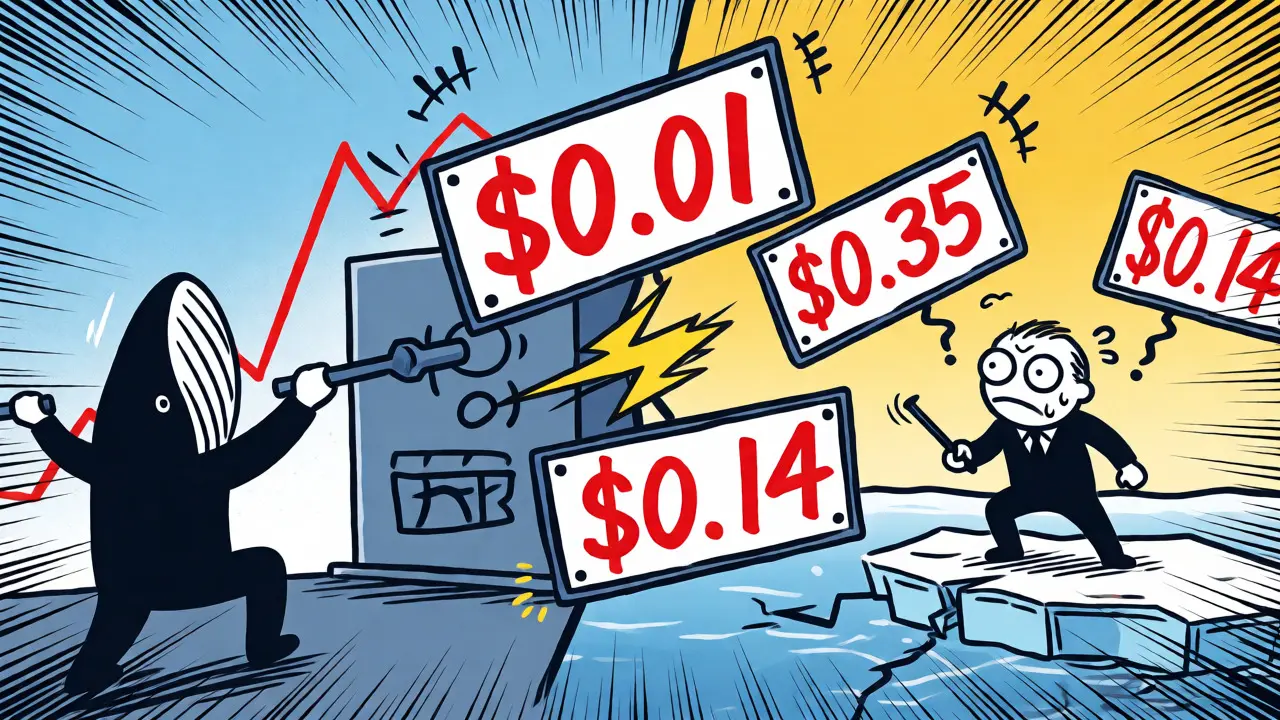
If you look up Block on different sites, you’ll get confused fast. One exchange says it’s worth $0.01. Another says $0.35. A third might say $0.14. How can one coin have three different prices at the same time? This happens because of liquidity. Liquidity is how easily you can buy or sell without moving the price. Block has almost none. On Binance, for example, the 24-hour trading volume was reported as just $114. That means if you tried to sell $500 worth of Block, you might crash the price by 40% instantly. It’s not a stable market; it’s a thin ice rink. Analysts call this "price discrepancy." When a token shows a +40% gain on one site and a -20% loss on another simultaneously, it’s a classic red flag. It usually means the market is being manipulated by a few large holders, often called "whales," who are pumping and dumping the price to attract small investors like you.
The Tokenomics Trap
Block has a fixed supply of 10 billion tokens. No inflation, which sounds good for scarcity. But look at where those tokens went. 70% of the entire supply is locked up for staking rewards and incentives. Who gets those rewards? Mostly early insiders and people willing to lock their coins away. The circulating supply-the amount actually available to trade-is tiny compared to the total supply. This creates a fake sense of value. If you see a high "Fully Diluted Market Cap" (the value if all 10 billion tokens were traded), don’t be fooled. The actual market cap is near zero because almost nobody is trading it. It’s like owning a mansion that no one wants to buy. The house is expensive on paper, but worthless in practice.

Can You Actually Use It?
Let’s talk about user experience. If you decide to buy Block, you’ll likely interact with their proprietary exchange, BLOCKSWAP. The promise is easy swapping and high staking APYs, sometimes advertised up to 25%. But users report headaches. Wallet connections fail frequently. Documentation is sparse-mostly just a single-page website with no technical deep dives. There’s no active GitHub community fixing bugs or adding features. If you run into a problem, support is non-existent. The official Twitter account hasn’t replied to anyone in months. Telegram groups are quiet graveyards with fewer than 500 members. Staking does work technically. Some users confirm they received their 25% APY. But ask yourself: What are you earning yield on? If the token price drops 90% while you’re staking, your 25% reward won’t cover your losses. You’re essentially getting paid in confetti while the cake disappears.
The Verdict: Investment or Gamble?
Is Block a legitimate project? Technically, yes. It exists. It has a contract address. It trades on some exchanges. But is it a safe investment? Probably not. Crypto research firms like Gartner and independent analysts warn that tokens with inconsistent pricing, low volume, and no developer ecosystem typically vanish within 6-12 months. Block fits this profile perfectly. There is no verifiable team behind it. No whitepaper with clear milestones. No major partnerships with brands like Adidas or Starbucks, which other scaling solutions boast. If you’re an experienced trader who likes gambling on micro-cap coins with strict stop-losses, you might try it. But for the average investor looking for growth, Block is risky. It lacks the three pillars of successful crypto: Technology adoption, Community strength, and Real utility.
Is Block (BL0CK) a scam?
It is not necessarily a hard scam (where they steal your money directly), but it exhibits many characteristics of a "pump and dump" scheme. The lack of transparency, extreme price volatility across exchanges, and negligible trading volume suggest high risk of manipulation. Treat it as highly speculative rather than a safe store of value.
Why do prices differ so much between exchanges?
Price discrepancies occur due to low liquidity. Because very few people are buying and selling Block, a single large order can drastically change the price on one exchange without affecting others. This makes arbitrage difficult and increases the risk of buying at an inflated price.
Can I withdraw my Block tokens from exchanges?
Reports vary. Some users successfully withdraw, while others face delays or failures. Always test with a small amount first. Due to low volume, withdrawals might be paused temporarily if the exchange deems the asset too volatile or illiquid.
Does Block have a working blockchain explorer?
Verification is difficult. While the token exists on-chain (often as an ERC-20 token on Ethereum or similar networks), finding a dedicated, reliable explorer specifically for Block's native layer is challenging. Most data comes from aggregators like CoinMarketCap or CoinGecko, which may lag or show conflicting data.
What is the future outlook for BL0CK?
Analyst predictions are negative. Without significant development updates, marketing pushes, or real-world adoption, the likelihood of long-term survival is low. Many similar projects disappear within a year if they fail to build a community and utility.