What is Crypton (CRP)? A Guide to Utopia’s Privacy Coin

You want total anonymity online. You want to send money without leaving a trace on a public ledger. That is exactly why Crypton (CRP) exists. It is not just another coin you buy on an exchange and forget about. It is the native currency of the Utopia a decentralized peer-to-peer network designed for private communication and file sharing. If you are looking for quick profits or easy trading, this might not be your cup of tea. But if you care deeply about data sovereignty and censorship resistance, CRP is worth understanding.
The Core Identity: More Than Just Money
Crypton operates differently from Bitcoin or Ethereum. Those networks rely on public blockchains where every transaction is visible to anyone who wants to look. CRP lives inside a closed ecosystem. When you send CRP, there is no blockchain explorer that can track it. The transaction happens instantly between peers, confirmed by the network nodes, and then disappears from view. This design makes it untraceable by third parties, including governments or corporations.
The project was launched on November 18, 2019, by a developer collective known as the 1984 Group. They built it specifically to support the Utopia platform’s goal of confidential interaction. Unlike many crypto projects that start with a token and build features later, Crypton was created to serve an existing utility: facilitating private economic activity within a secure messaging environment.
How the Technology Works Under the Hood
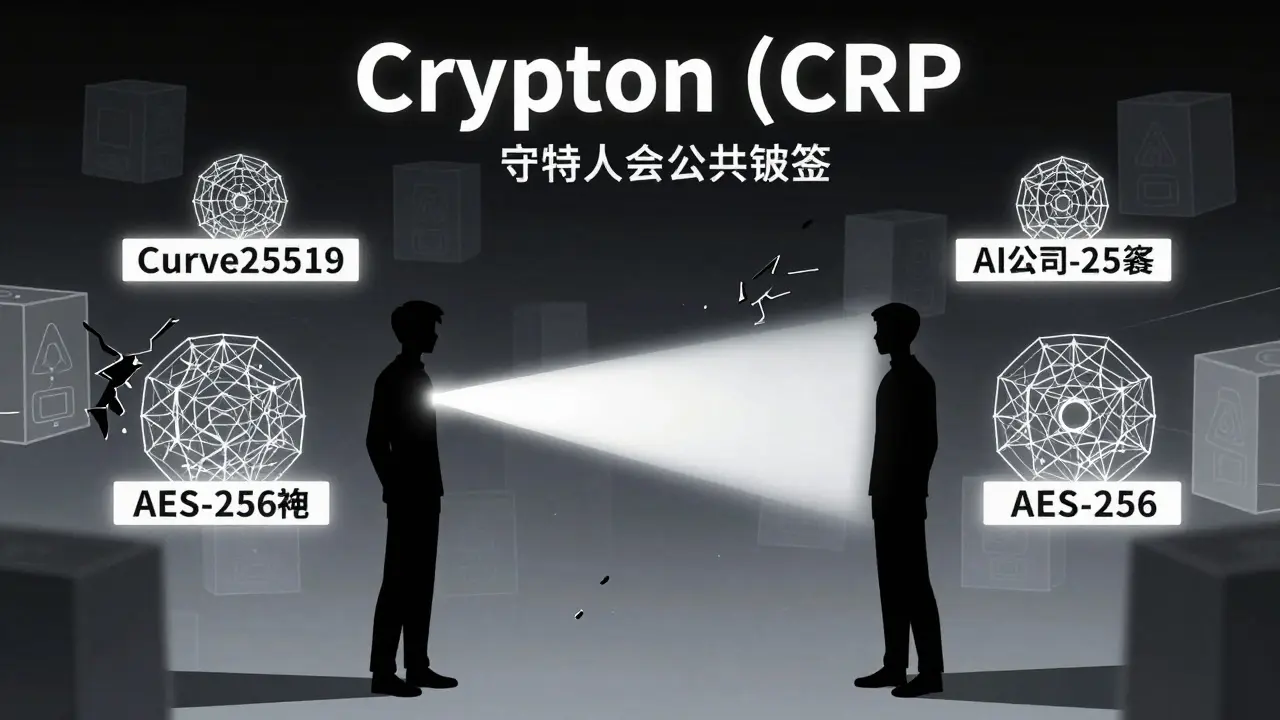
To understand CRP, you need to understand how Utopia protects your data. The system uses Curve25519 a high-speed elliptic curve cryptography standard used for secure key exchange for all data transmission. This ensures that information cannot be intercepted during transit. Your personal account data stays on your device, encrypted with AES-256 a symmetric encryption algorithm widely considered secure for sensitive data.
Here is what makes the transaction model unique:
- No Public Ledger: There is no immutable chain of blocks for outsiders to audit. Only the sender and receiver hold records.
- Instant Confirmation: Transactions are confirmed immediately by the peer-to-peer network. You do not wait for miners to process a block in the traditional sense.
- Node Rewards: Instead of pure proof-of-work like Bitcoin, the network rewards nodes that maintain stable routing connections. This promotes network stability rather than raw computational power.
This architecture means that if someone seizes your hardware, they cannot easily identify your balance or transaction history because that data does not exist on a centralized server or a public chain. However, it also means you bear full responsibility for securing your local storage.
Supply, Market Reality, and Price Performance
Let’s talk numbers. Crypton has a fixed total supply of 10.5 million tokens. As of early 2026, nearly all of these coins are in circulation-about 10.49 million. There is no inflationary mining schedule adding new coins rapidly. This scarcity usually supports value, but market demand tells a different story.
The price history is harsh. CRP hit an all-time high of around $1.45 to $1.77 in December 2021. By January 2026, it had fallen to roughly $0.15-$0.20. That represents an 86% to 91% decline from its peak. Its market capitalization sits between $1.48 million and $2.11 million. To put that in perspective, Monero (XMR), a leading privacy coin, has a market cap of nearly $3 billion. Crypton is operating in a completely different league.
| Feature | Crypton (CRP) | Monero (XMR) | Zcash (ZEC) |
|---|---|---|---|
| Privacy Model | Closed P2P Ecosystem | Public Blockchain (Ring Signatures) | Public Blockchain (zk-SNARKs) |
| Traceability | None (No Ledger) | Obsfuscated (Ledger Exists) | Optional (Shielded/Transparent) |
| Market Cap (Jan 2026) | ~$2 Million | ~$2.9 Billion | ~$1.1 Billion |
| Liquidity | Very Low | High | Moderate |
| Ecosystem Integration | Deep (Messaging/File Sharing) | Standalone Currency | Standalone Currency |
The low liquidity is a major factor. Trading volume is thin, often under $300k per day across all exchanges. This makes buying and selling difficult without moving the price significantly. Spreads on exchanges can range from 8% to 12%, which is huge compared to the 0.1% spread you see on major pairs like BTC/USDT.
Who Actually Uses Crypton?
If you are a casual investor, you likely won’t touch CRP. The user base is polarized. On one side, you have privacy advocates who love the seamless integration. They use Utopia for encrypted messaging and file sharing, and CRP becomes useful when they need to pay for services or transfer value within that trusted circle without external surveillance.
On the other side, users complain about usability. Setting up a wallet requires downloading the Utopia client software (version 2.1.0.0 or later), which needs Windows 10 or macOS 10.15+. New users report spending 45-60 minutes just to get started. Compare that to opening a mobile wallet app in five minutes, and you see the barrier to entry.
Community feedback highlights two main points:
- Privacy Works: Users confirm that messages are end-to-end encrypted and transactions leave no external footprint.
- Liquidity Sucks: Converting CRP back to fiat or other cryptocurrencies is slow and expensive. Withdrawal times on native platforms can average 72 hours.
Risks and Challenges You Must Know
Before you consider using or holding CRP, you need to face the risks head-on. First, the development activity is minimal. In the past year, the project’s GitHub repository showed only 12 commits. Compare that to Monero’s 1,450+ commits. This suggests the core team is focused more on maintaining the messaging app than evolving the cryptocurrency protocol.
Second, the anonymity of the 1984 Group raises trust issues. While decentralization aims to remove reliance on founders, complete opacity can scare away institutional interest or broader adoption. There is no corporate structure or verifiable identity behind the project, unlike Zcash’s Electric Coin Company.
Third, regulatory pressure on privacy coins is increasing globally. While CRP’s lack of a public ledger might make it harder to regulate directly, exchanges listing it could face scrutiny. Currently, it trades on niche platforms like HTX and Binance, but even there, volume is negligible. If major exchanges delist privacy-focused assets, CRP’s liquidity could dry up entirely.
Is Crypton Right For You?
Crypton is not a general-purpose currency. It is a specialized tool for a specific job: private value transfer within a private communication network. If you need to send money anonymously to someone who also uses Utopia, it is effective. If you want to invest in a privacy coin with growth potential, CRP currently lacks the momentum, liquidity, and development velocity to compete with established players.
Experts classify it as "high risk, limited utility" outside its native ecosystem. Dr. Elena Rodriguez from MIT’s Digital Currency Initiative noted that while the cryptography is sound, the closed-network approach creates adoption barriers. Unless you are already deep into the Utopia community, the friction of entering the ecosystem outweighs the benefits for most users.
Can I buy Crypton (CRP) on Coinbase or Binance?
Yes, CRP is listed on major exchanges like Binance and HTX, but availability varies by region due to privacy coin regulations. However, liquidity is very low, meaning you may face high spreads and slippage when trading. Always check current listings as delistings occur frequently.
Is Crypton safer than Bitcoin for privacy?
For privacy, yes. Bitcoin transactions are public and permanent. Crypton transactions are instant, irreversible, and leave no public record. However, Bitcoin is more secure against network failure due to its massive hash rate and open-source transparency. Crypton relies on a smaller, closed node network.
What happens if I lose my Utopia client data?
Because there is no central server or public blockchain to recover funds from, losing your local encrypted data means losing access to your CRP balance permanently. You must maintain regular backups of your wallet files in a secure location.
Why is the price of CRP so low compared to its ATH?
The price drop reflects low adoption, limited liquidity, and competition from more robust privacy coins like Monero. Additionally, the closed ecosystem limits utility to Utopia users, reducing external demand for the token.
Does Crypton have a roadmap for future development?
There is no official public roadmap specifically for Crypton protocol upgrades. Development focus appears to be on the Utopia messaging platform rather than the cryptocurrency itself, based on recent GitHub activity and release notes.