What Is Djed (DJED)? The ADA-Backed Stablecoin Explained

Ever wonder why some people are skeptical about "algorithmic" stablecoins? After the Terra crash in 2022, that skepticism is understandable. But there’s a different kind of stablecoin on the Cardano blockchain called Djed, or DJED for short. It’s not just another token promising stability; it’s an over-collateralized system designed to keep its value pegged to the U.S. dollar using a specific mathematical framework. If you’ve been curious about how this works without relying on off-chain bank reserves, you’re in the right place.
In this guide, we’ll break down what Djed actually is, how it keeps its price steady, and where it fits into the broader Cardano ecosystem. We’ll look at the numbers, the risks, and the practical uses so you can decide if it makes sense for your portfolio or DeFi strategies.
The Core Concept: An Autonomous Bank on Cardano
Djed is an over-collateralized, ADA-backed algorithmic stablecoin deployed as a smart contract on the Cardano layer-1 blockchain. Think of it less like a traditional currency and more like an autonomous bank. This protocol was developed by COTI in collaboration with Input Output Global (IOG), the core development company behind Cardano. It launched on the mainnet in January 2023 after being unveiled at the Cardano Summit in 2021.
The key difference here is the collateral. Unlike USDT or USDC, which hold physical dollars in banks, Djed holds Cardano (ADA) directly in a smart contract. To mint one DJED, you need to lock up a significant amount of ADA. Specifically, the protocol requires a collateralization ratio between 400% and 800%. That means for every $1 worth of DJED in circulation, there must be at least $4 worth of ADA backing it in the contract. This heavy buffer is designed to absorb volatility and prevent the kind of collapse seen in other algorithmic systems.
How the Mechanism Works: DJED and SHEN
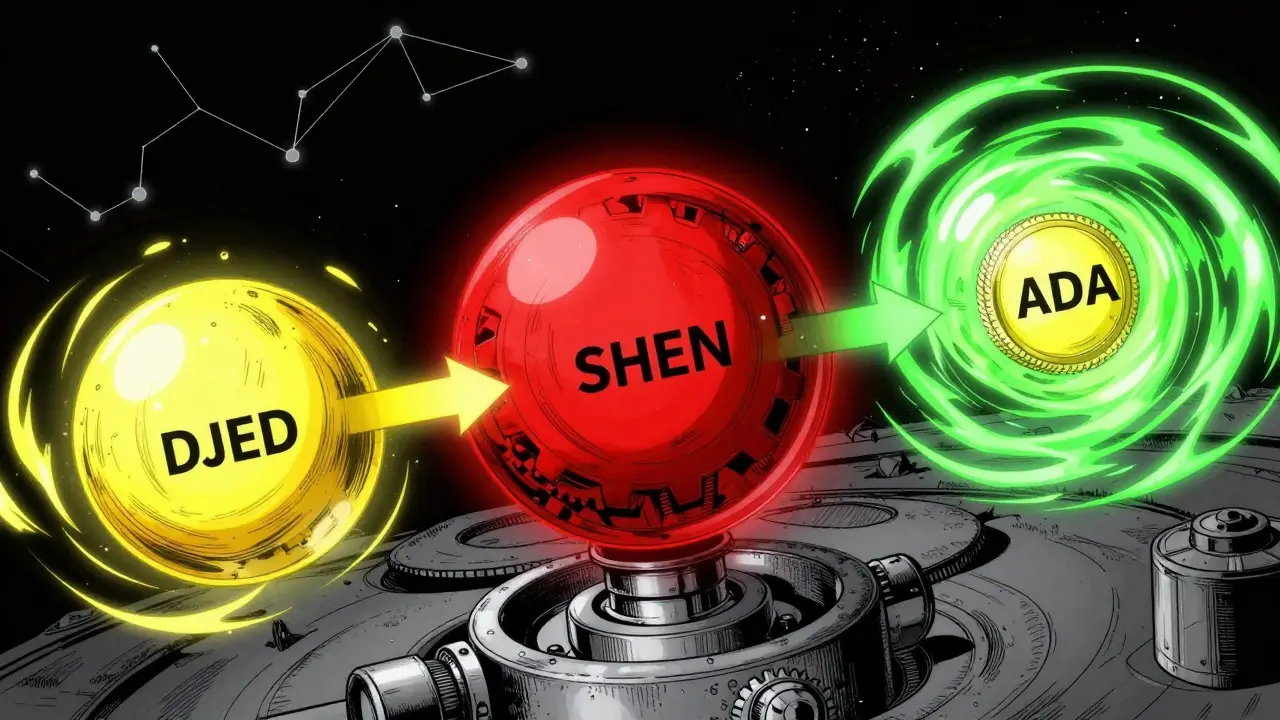
The Djed system involves two main tokens besides the base collateral: DJED itself and a reserve token called SHEN. Here’s how they interact:
- ADA (Base Collateral): The underlying asset locked in the smart contract. It provides the raw value that backs the stablecoin.
- DJED (Stablecoin): The token users want to hold. It targets a 1:1 peg with the U.S. dollar. You mint it by depositing ADA and burning it to get your ADA back.
- SHEN (Reserve Coin): This token absorbs volatility. When you mint DJED, you also receive SHEN. SHEN holders earn fees from the protocol, creating an incentive to provide the necessary collateral buffer.
The smart contract acts as an arbitrage machine. If the market price of DJED drops below $1, the contract offers to buy DJED back with ADA at a favorable rate. This demand pushes the price back up. Conversely, if DJED trades above $1, the contract mints new DJED and sells it, increasing supply and pushing the price down. Transaction fees collected during these operations accumulate in the reserve, further strengthening the safety net.
Why Over-Collateralization Matters
You might ask: why require 400% to 800% collateral when fiat-backed stablecoins only need 100%? It’s a trade-off between capital efficiency and security. By locking up four times the value, Djed creates a massive cushion against ADA price swings. If ADA were to drop by 50%, the collateral would still cover the DJED debt comfortably.
Moreover, the design claims to be formally verified. According to the project’s whitepaper and documentation from Cardano.org, the stability properties are mathematically proven to be immune to typical bank-run dynamics. This isn’t just marketing fluff; it’s based on peer-reviewed analysis suggesting that the specific algorithm prevents reserve-draining attacks. While no system is risk-free, this mathematical rigor sets Djed apart from earlier, less robust algorithmic attempts.
Djed vs. Other Stablecoins on Cardano
Cardano now hosts several native stablecoins, including USDCx, USDM, USDA, iUSD, and DJED. Each serves a different purpose. Let’s compare them to understand where Djed fits in.
| Feature | DJED | USDM (Moneta) | iUSD |
|---|---|---|---|
| Collateral Type | On-chain ADA + SHEN | Off-chain USD Reserves | Crypto-Collateralized |
| Backing Model | Over-collateralized (400-800%) | Fiat-backed (1:1) | Algorithmic/Crypto |
| Central Custodian | No (Smart Contract) | Yes (Custodian Company) | No |
| Key Advantage | Decentralization & Mathematical Proof | Regulatory Clarity & Fiat Access | Yield Generation |
| Main Risk | Capital Inefficiency & ADA Volatility | Custodial/Regulatory Risk | Protocol Complexity |
As you can see, if you prioritize decentralization and don’t trust off-chain custodians, DJED is the logical choice. However, if you need regulatory clarity for institutional use, USDM might be better. DJED shines in pure DeFi applications where on-chain transparency is paramount.
Current Status and Market Performance (2026)
It’s been over three years since Djed launched, and the data looks promising. As of August 2026, DJED continues to trade very close to its target price. Recent data points show prices oscillating between $0.98 and $1.007, staying within a tight band around the $1 peg. This consistency has held through various market conditions, including periods of high volatility in the broader crypto market.
However, scale remains a challenge. Compared to giants like Tether (USDT) or Circle (USDC), which handle billions in daily volume, DJED is still a niche player. Daily trading volumes on major Cardano DEXs like Minswap typically range in the thousands of dollars rather than millions. This suggests that while the technology is working, adoption is still growing. The circulating supply has fluctuated, with some reports indicating a substantial increase in units available, but the total market cap remains modest compared to top-tier stablecoins.

Practical Use Cases: Who Should Use DJED?
So, who actually benefits from using Djed? There are three main groups:
- DeFi Yield Farmers: You can provide liquidity in DJED/ADA or DJED/SHEN pools on exchanges like Minswap. This earns you trading fees, though you take on standard impermanent loss risks.
- Merchants and Payment Users: Through services like DjedPay, merchants can accept DJED for transactions. This offers low-volatility settlement without the fees associated with credit cards or cross-border transfers.
- Decentralization Purists: If you believe in fully on-chain finance and want to avoid counterparty risk from banks or custodians, DJED offers a way to hold a stable asset backed purely by code and ADA.
For institutions looking for large-scale fiat audits and regulatory compliance, DJED might not be the first choice due to its capital inefficiency. Locking up $4 in ADA to create $1 in stablecoin means you can’t use that ADA elsewhere, which limits scalability compared to 1:1 fiat models.
Risks and Limitations to Consider
No investment is without risk, and DJED is no exception. The primary risk is tied to the value of ADA. Since the collateral is ADA, if the Cardano ecosystem faces severe technical issues or a prolonged bear market that drains liquidity, the system could face stress. While the 400%+ buffer helps, it’s not infinite protection.
Additionally, the "formal verification" claim relies on specific model assumptions. Real-world markets can behave in ways that aren't captured by theoretical proofs. Although DJED has maintained its peg since launch, future black swan events could test the limits of the design. Finally, the lower liquidity compared to USDT means that exiting large positions quickly might result in slippage.
Frequently Asked Questions
Is DJED a safe stablecoin?
Djed is considered safer than many algorithmic stablecoins due to its 400-800% over-collateralization and formal verification. However, it carries the inherent risks of holding ADA as collateral. It has maintained its peg since January 2023, but all crypto assets carry some level of risk.
Who developed the Djed protocol?
The protocol was developed by COTI in collaboration with Input Output Global (IOG), the core team behind Cardano. It was unveiled at the Cardano Summit in 2021 and launched on mainnet in January 2023.
What is the role of the SHEN token?
SHEN is the reserve coin in the Djed system. It is minted alongside DJED and helps absorb volatility. SHEN holders earn transaction fees from the protocol, incentivizing them to maintain the over-collateralization buffer required for stability.
Where can I buy or trade DJED?
DJED is primarily traded on decentralized exchanges (DEXs) within the Cardano ecosystem. Minswap is currently the most popular venue for trading DJED pairs, such as DJED/ADA. You can also mint or burn DJED directly through the official smart contract interface.
How does Djed compare to USDT or USDC?
USDT and USDC are fiat-backed, meaning they hold dollars in banks. Djed is crypto-backed, holding ADA in a smart contract. Djed is more decentralized and censorship-resistant but less capital-efficient. USDT/USDC offer higher liquidity and regulatory familiarity but carry custodial risk.