What is Elephant Money (ELEPHANT) crypto coin? Full breakdown of tokenomics, risks, and real-world performance in 2026
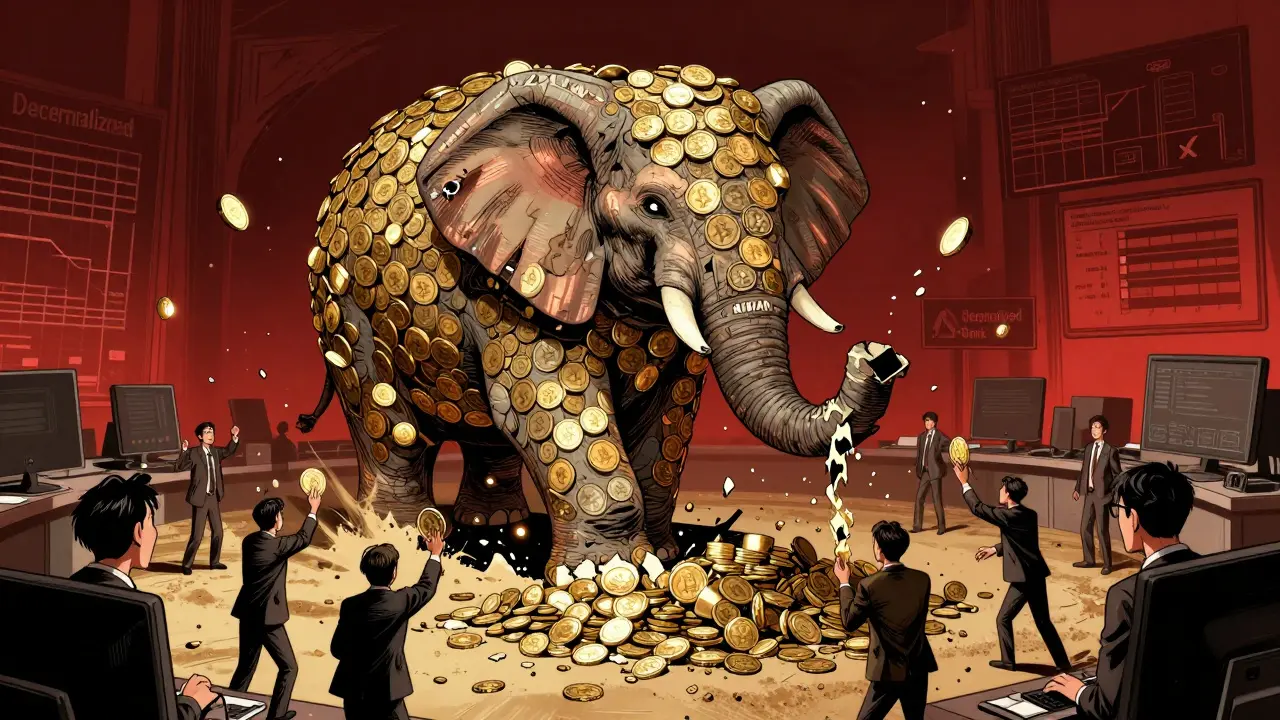
Elephant Money (ELEPHANT) is a decentralized finance project built on BNB Smart Chain that claims to be a "global decentralized community bank." But behind the grand label lies a crypto asset with a 496 trillion token supply, a 10% transfer fee, and trading volume so low it barely registers on the market. As of January 2026, ELEPHANT trades at $0.00000005412 - down over 90% from its all-time high in 2022 - with only $22,000 traded in the last 24 hours. This isn’t a startup trying to break through. It’s a project barely holding on.
How Elephant Money (ELEPHANT) actually works
Elephant Money isn’t just one token. It’s a two-token system: ELEPHANT and TRUNK. ELEPHANT is the reward token. TRUNK is its stablecoin, designed to hold a value of $1. The idea is simple: you lock up BUSD and ELEPHANT as collateral, mint TRUNK, and then earn rewards by staking ELEPHANT or providing liquidity. Every time someone transfers ELEPHANT, a 10% fee kicks in. Half of that (5%) gets distributed to all ELEPHANT holders as a reward. The other half (5%) gets locked into a liquidity pool on PancakeSwap. That’s meant to create passive income for holders and stabilize the token’s value. But in practice, it makes trading expensive. If you buy ELEPHANT and want to sell it a week later, you’re paying 20% in fees just to get out - 10% when you sell, and another 10% when the buyer sells it later. That kills turnover. TRUNK, the stablecoin, is 75% backed by BUSD and 25% by ELEPHANT. That’s unusual. Most stablecoins like USDT or USDC are 100% backed by cash or cash equivalents. TRUNK’s partial reliance on ELEPHANT - a token that’s lost 90% of its value - makes it risky. If ELEPHANT crashes further, TRUNK could lose its peg. The protocol charges a 1% fee every time you mint or redeem TRUNK, which is supposed to fund more BUSD backing. But with so little volume, that fee barely moves the needle.Tokenomics that don’t add up
The biggest red flag? The supply. Nearly 500 trillion ELEPHANT tokens exist. That’s more than the total number of grains of sand on Earth. It’s not just high - it’s absurd. When a token has that many units, each one is worth almost nothing. $0.00000005412 isn’t a price. It’s a decimal point exercise. Compare that to Bitcoin. There are 21 million BTC. Each one is worth tens of thousands of dollars. ELEPHANT’s market cap is $26 million, but you’d need to own over 480 billion tokens to make $26,000. No one thinks in those numbers. Retail investors don’t buy 480 billion of anything. They buy 10, 100, or 1,000 units. Elephant Money’s design pushes away the very people it claims to serve. The 10% transfer fee sounds like a way to reward holders. But it’s also a tax on movement. Real markets need liquidity. Liquidity needs easy trading. Elephant Money makes trading costly, slow, and frustrating. That’s why daily volume is under $25,000. For a project with a $26 million market cap, that’s a turnover rate of 0.08%. Healthy DeFi projects run at 5-10%. Elephant Money is barely breathing.Security claims vs. reality
The project says it’s been audited by Certik and PeckShield. That’s true. Those are reputable firms. But audits don’t guarantee success. They just check for code bugs. They don’t evaluate tokenomics, market demand, or whether a project can survive in the real world. You can have perfect code and still fail if no one wants to use it. That’s Elephant Money’s problem. The code may be clean. But the design is broken. The massive supply, the punishing fees, the weak liquidity - none of that was audited. Those are business decisions, not technical flaws. And the user base? Only 21,650 wallets hold ELEPHANT. That’s fewer than a small town. Most of those wallets are likely empty. On Reddit and Telegram, discussions are quiet. One user on r/BNBChain said the TRUNK collateral system is "interesting," but the 1% fee plus slippage makes arbitrage nearly impossible. Another user on CryptoSlate said they got stuck trying to redeem TRUNK for BUSD - and got no support for three days.
Who’s using it - and who’s avoiding it
There are three types of people involved with Elephant Money:- Early adopters who bought in 2021-2022 when hype was high. Most are underwater and holding, hoping for a rebound that never comes.
- Yield farmers looking for high APYs on staking. They’re chasing returns, but the rewards are tiny because the token price is so low. Even if you earn 50% APY on ELEPHANT, you’re still earning pennies.
- Speculators who buy when the price spikes 5-10% for a day, then sell. These are the only ones making money - and they’re leaving quickly.
Why Elephant Money is falling behind
The DeFi space moved on. MakerDAO’s DAI is backed by billions in collateral. Yearn Finance aggregates yields across dozens of protocols. Aave and Compound lend real money. Elephant Money? It’s stuck in a loop of its own design. It competes with projects that have:- Real user growth
- Clear value propositions
- Low friction
- Strong communities

Should you invest in ELEPHANT?
No - if you’re looking for growth, safety, or returns. Maybe - if you’re speculating on a lottery ticket. The price could spike 50% tomorrow. But it could also drop another 80%. There’s no fundamental reason to believe it will recover. No team updates. No new features. No marketing. Just a token with a broken model and a fading community. The only real use case for ELEPHANT right now is as a placeholder in a wallet - not as an investment.How to interact with Elephant Money (if you must)
If you still want to try it, here’s what you need:- Install MetaMask or another Web3 wallet.
- Add the BNB Smart Chain network (RPC: https://bsc-dataseed.binance.org/).
- Buy BNB to pay for gas.
- Go to the official Elephant Money dApp (double-check the URL - scams are common).
- Connect your wallet.
- Choose: stake ELEPHANT, mint TRUNK, or add liquidity to ELEPHANT/BUSD on PancakeSwap.
Nishakar Rath
January 17, 2026 AT 07:41bro this is just a meme coin with extra steps lmao 500 trillion tokens is not innovation its a joke
Hannah Campbell
January 19, 2026 AT 03:07so basically its the crypto version of a dead mall
Chris Evans
January 20, 2026 AT 06:20the tokenomics here are a masterclass in anti-economics. you're not building a bank you're building a tax trap with a liquidity sinkhole and a side of delusion. the 10% fee isn't a reward mechanism its a withdrawal tax on hope. and the stablecoin being 25% backed by a token that's down 90%? that's not risk management thats financial nihilism.
Anna Gringhuis
January 20, 2026 AT 08:09they call it a decentralized community bank but the only community here is the one that shows up to sell and never comes back. the website looks slick but the UX is a haunted house with no exit signs.
myrna stovel
January 20, 2026 AT 11:05i get that some people are clinging to hope but if you're holding this hoping for a rebound you're not investing you're just avoiding the emotional cost of admitting you made a bad call. there's no shame in cutting losses. the market doesn't care how long you've held it.
Alexis Dummar
January 21, 2026 AT 20:24the audited code thing is such a red herring. its like saying your car has great brakes but the engine is made of wet cardboard. you can have perfect code and still be a dumpster fire on the road.
Bryan Muñoz
January 23, 2026 AT 18:47theyre all in on this because the fed is printing money and this is the only thing that moves. its a distraction. the real plan is to get you addicted to the volatility so you forget about inflation. this isnt crypto its a casino with a whitepaper.
Shaun Beckford
January 24, 2026 AT 10:11the only thing more pathetic than the token supply is the fact that someone still thinks this is a viable project. its not a failure its a funeral with a live stream.
Anthony Ventresque
January 26, 2026 AT 00:08im surprised more people havent called this out. the 10% fee is so brutal it makes even the worst meme coins look reasonable. and the fact that no one is building tools or guides for it? thats not neglect thats abandonment.
Christina Shrader
January 26, 2026 AT 05:29if you're still holding this you're not a believer you're a martyr. and martyrs dont change the world they just make it sadder.
Pramod Sharma
January 26, 2026 AT 12:57the supply is absurd but the real issue is the lack of utility. no one needs another stablecoin that depends on a dying asset.
Rod Petrik
January 27, 2026 AT 18:20theyre using this to launder money through pancake swap. the low volume? its because the real players are moving it through shell wallets. this isnt a project its a front for something darker.
Alexandra Heller
January 28, 2026 AT 20:16we live in a world where you can mint a trillion tokens and call it a bank but you cant build a single functional onramp for new users. the arrogance is breathtaking. they're not trying to democratize finance they're trying to monetize desperation.
the real tragedy isnt the price drop its that someone thought this was worth the gas fees to even interact with.
the stablecoin is a house of cards built on a foundation of hope and half-baked math. when the wind blows it wont just fall it will implode and take the trust of everyone who believed in the narrative with it.
and yet we keep doing this. we keep giving our attention to projects that are mathematically doomed because the story sounds good. we are the problem.
we dont need more tokens. we need more honesty. we need more humility. we need to stop pretending that a big number on a chart is the same as value.
the market doesnt lie. it just waits for us to stop lying to ourselves.
Telleen Anderson-Lozano
January 30, 2026 AT 10:01imagine if you had a bank that charged you 10% every time you tried to withdraw your own money... and then told you that you were "earning rewards"... and then said "the system is working as intended"... this is not finance this is psychological manipulation dressed up as innovation.
and the fact that people still argue about it like its a legitimate asset class... i dont even know what to say anymore.
Michael Jones
February 1, 2026 AT 04:10the only thing worse than the tokenomics is the lack of accountability. no team updates. no roadmap. no transparency. just a static website and a prayer. this isn't DeFi. it's a digital ghost town.
Kelly Post
February 3, 2026 AT 03:13if you're still holding this, ask yourself: would you invest in a company that charges you 20% just to sell your shares? if the answer is no, then why are you doing it here?
Pat G
February 4, 2026 AT 20:40usa first. this is why we need to ban foreign crypto projects that dont follow american standards. this is a global scam hiding behind bnb chain.