What is Mei Solutions (MEI) Crypto Coin? Utility, Risks, and Tokenomics
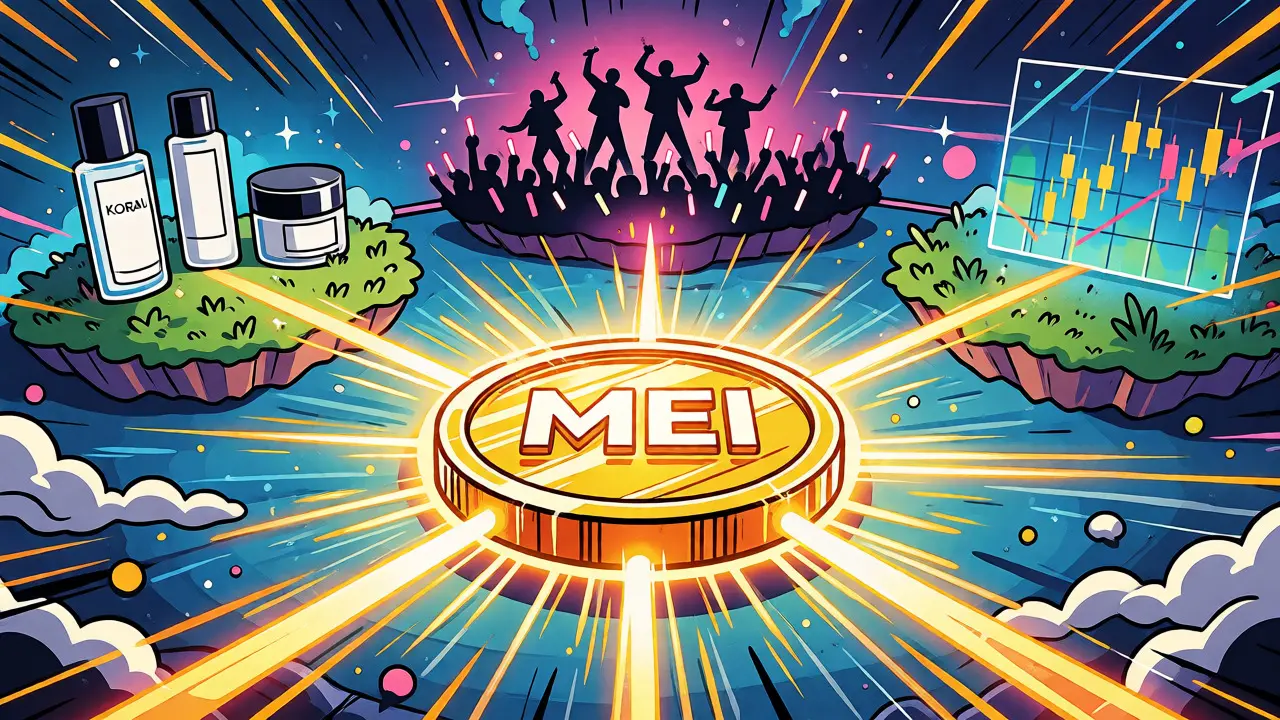
Imagine a single digital coin that lets you buy Korean skincare, vote on your favorite K-pop idol’s next music video, and pay for advanced forex trading courses. Sounds like a fan’s dream ecosystem, right? That is the pitch behind Mei Solutions ($MEI), a utility token built on the Solana blockchain. But here is the catch: while the concept sounds innovative, the reality of small-cap altcoins is often messy, volatile, and hard to verify.
If you are seeing $MEI pop up in your feed or considering it as a speculative play, you need more than just hype. You need facts. As of late October 2026, this token has seen massive price swings, dropping over 98% from its all-time high in early 2025. Is it a hidden gem waiting to explode, or a cautionary tale about unverified projects? Let’s break down exactly what Mei Solutions is, how its economy works, and why the lack of transparency matters for your wallet.
The Core Concept: A Multi-Sector Ecosystem
Mei Solutions is not a new Layer-1 blockchain; it is a utility token designed to connect three distinct industries: cosmetics, entertainment, and finance. The project claims to build a "digital ecosystem" where one token serves multiple purposes. This cross-sector approach is rare. Most tokens stick to one lane-either gaming, DeFi, or payments. Mei tries to do it all.
Here is how the utility is supposed to work in practice:
- Cosmetics: Users can purchase physical beauty products from the associated Mei brand using $MEI.
- K-Pop & Influencers: Fans earn rewards by engaging with content, voting in polls, or participating in virtual events featuring idols.
- Trading Education: The token pays for fees on a proprietary trading platform, covering courses and potentially trading costs.
The idea is clever because it taps into the passionate K-pop fanbase and the growing interest in retail trading. However, a big question remains: Are these services actually live and accessible? The official website promotes tracking links and branding, but independent evidence confirming that thousands of users are actively buying face cream with $MEI or taking verified trading classes is scarce. Without real-world adoption data, the utility remains largely theoretical.
Tokenomics: Supply, Circulation, and Dilution Risk
Understanding the numbers is critical before you buy any altcoin. For Mei Solutions, the tokenomics present a classic risk profile for small-cap assets: a large maximum supply with a relatively small circulating portion.
| Metric | Value | Implication |
|---|---|---|
| Maximum Supply | 1,000,000,000 MEI | Fixed cap prevents infinite inflation. |
| Circulating Supply | ~113.93 Million MEI | Self-reported; only ~11.4% of total supply is active. |
| Blockchain | Solana | Fast transactions, low fees, but dependent on SOL network health. |
| All-Time High | $0.6951 (Jan 2025) | Price has dropped ~98% since peak. |
The gap between the maximum supply (1 billion) and the circulating supply (approx. 114 million) is significant. This means roughly 88.6% of the tokens are currently locked, held by the team, treasury, or early investors. If these tokens enter the market without a controlled release schedule, they could dilute the value for current holders. Unfortunately, the project does not publicly disclose a detailed vesting schedule or allocation breakdown for these non-circulating tokens. This opacity is a major red flag for cautious investors.

Market Performance and Volatility
Let’s look at the cold, hard market data. Mei Solutions launched into the public eye around January 2025. It hit an all-time high of nearly $0.70 very quickly. Since then, the trajectory has been downward. By October 2026, TradingView reported a price hovering around $0.01. While percentage gains on specific days might look impressive (like a 138% jump in 24 hours), these spikes are common in low-liquidity markets.
Liquidity is thin. The 24-hour trading volume was reported at approximately $54,000 against a market cap of around $1.13 million. This low volume-to-market-cap ratio means that even small sell orders can crash the price significantly. It also makes it harder to exit a position without losing money to slippage. If you plan to trade $MEI, be prepared for wild swings. One day you might see double-digit gains, and the next week, the price could drop another 90%.
Transparency and Verification Challenges
In the crypto world, trust is earned through transparency. Does Mei Solutions provide it? Not entirely. Here is what is missing based on available public records:
- Team Identity: There is no widely known founder or development team attached to the project in mainstream media. No LinkedIn profiles or GitHub repositories have been prominently linked to verify developer activity.
- Audits: Independent security audits for the smart contract are not readily available. Without an audit, you cannot be sure if the mint authority (the ability to create more tokens) or freeze authority (the ability to stop transfers) has been revoked.
- Whitepaper: While there is a website, a comprehensive technical whitepaper detailing the economic model, legal structure, and roadmap is difficult to locate or verify.
- Exchange Listings: Major centralized exchanges like Binance do not list MEI. It trades primarily on smaller venues like MEXC and decentralized exchanges (DEXs) on Solana. This limits accessibility and institutional credibility.
Furthermore, there is confusion regarding the entity itself. Do not confuse Mei Solutions with industrial companies named "MEI Solutions" in Texas. They are unrelated. The crypto project operates in a digital space, but its corporate backing remains opaque. When a project lacks a verifiable team and third-party audits, the risk of rug pulls or abandoned development increases substantially.
How to Buy and Store MEI
If you still want to take the gamble, here is the practical path to owning some $MEI. Since it is a Solana SPL token, you need tools compatible with that network.
- Get a Wallet: Install a Solana-compatible wallet like Phantom or Solflare. These are browser extensions or mobile apps that let you manage private keys.
- Fund Your Wallet: Buy Solana (SOL) on a major exchange like Coinbase or Kraken, then withdraw it to your Phantom wallet address.
- Find the Right Token: This is crucial. Multiple tokens use the ticker "MEI." You must use the correct contract address. Verify the full mint address from the official project link or a trusted aggregator like CoinGecko before swapping. Never rely on the name alone.
- Swap on a DEX: Use a decentralized exchange like Raydium or Jupiter Aggregator. Connect your wallet, select SOL as the input and MEI as the output, and execute the swap. Be mindful of slippage settings due to low liquidity.
- Store Safely: Keep your tokens in your self-custody wallet. Remember, if you lose your seed phrase, you lose your funds. There is no customer support hotline for lost passwords.
Risks vs. Rewards: Who Should Consider MEI?
So, is Mei Solutions a good investment? That depends on your risk tolerance. It is not for someone looking for steady growth or passive income. It is a high-risk, high-reward speculation asset.
The Bull Case: If the project successfully launches its cosmetics line, partners with major K-pop agencies, and integrates deeply with a popular trading platform, demand for the token could spike. The Solana ecosystem is growing, and if Mei captures even a niche segment of fans, the price could rebound from its lows.
The Bear Case: The lack of transparency, thin liquidity, and extreme volatility suggest many risks. If the team stops updating the project, or if the promised services never materialize, the token could fade into obscurity. The 98% drop from ATH is a stark reminder of how quickly sentiment can shift in micro-cap crypto.
For most people, Mei Solutions represents a speculative bet rather than a fundamental holding. Only invest money you can afford to lose completely. Keep an eye on their social channels for updates on product launches, but remain skeptical until you see verifiable user activity.
Is Mei Solutions a scam?
There is no definitive proof that Mei Solutions is a scam, but it carries high risk due to limited transparency. Key factors include the lack of a publicly verified team, absence of independent smart-contract audits, and inconsistent supply reporting. While it is listed on trackers like CoinMarketCap, these listings do not guarantee legitimacy. Treat it as a speculative venture rather than an established financial instrument.
Which blockchain does MEI use?
Mei Solutions ($MEI) is a utility token built on the Solana blockchain. This means transactions are fast and cheap compared to Ethereum, but you must use Solana-compatible wallets like Phantom or Solflare to store and trade the token. Always verify the specific contract address on Solscan to ensure you are interacting with the correct token, as other projects may use similar names.
Can I buy MEI on Binance?
No, as of late 2026, Mei Solutions is not listed on Binance. It is primarily traded on smaller centralized exchanges like MEXC and on decentralized exchanges (DEXs) within the Solana ecosystem, such as Raydium. To buy it, you typically need to convert Solana (SOL) into MEI via a DEX aggregator like Jupiter.
What is the total supply of MEI?
The maximum supply of Mei Solutions is fixed at 1 billion MEI. However, the circulating supply is much lower, reported at approximately 113.93 million tokens. This means less than 12% of the total supply is currently in circulation. The remaining tokens are likely held by the team, treasury, or reserved for future incentives, which poses a potential dilution risk if released gradually.
What can I use MEI for?
According to project descriptions, MEI is intended to be used for purchasing Mei-branded cosmetic products, earning rewards through K-pop and influencer engagement platforms, and paying fees for trading education or proprietary trading services. However, users should verify that these services are fully operational and accessible before assuming the token has immediate utility.