What is Ontology Gas (ONG)? Understanding the Utility Token
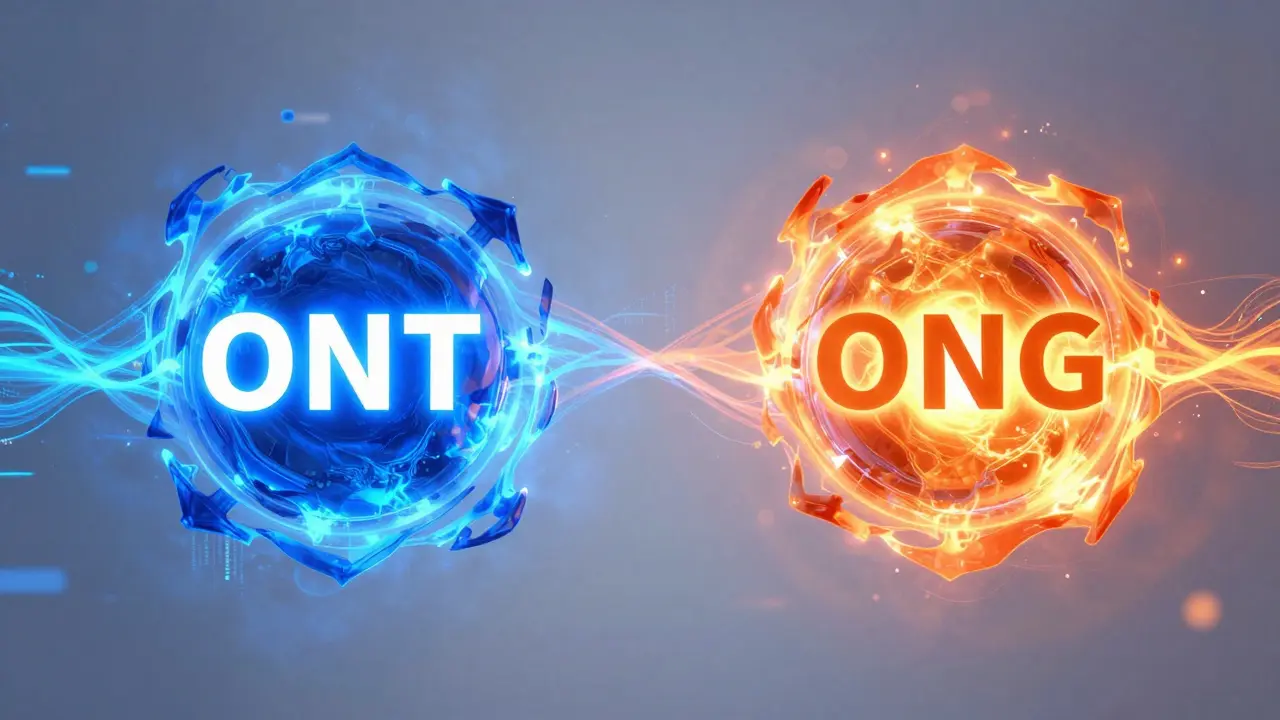
Most people entering the crypto world are used to coins that do everything: they act as currency, give you voting rights, and pay for transaction fees. But imagine a system where those roles are split to prevent a price spike in one area from breaking the entire network. That is exactly why Ontology Gas is a utility token designed to power the transactions and resource management of the Ontology blockchain. Commonly known as ONG, this token ensures that the network stays stable even when the market gets wild.
The Dual-Token Engine: ONT vs ONG
To understand ONG, you first have to understand that the Ontology blockchain doesn't rely on a single asset. It uses a dual-token model. Think of it like a company that has voting shares for the board of directors and a separate set of credits used to keep the lights on and the machines running.
ONT is the governance token. If you hold ONT, you have a say in how the network is run and you can stake it to help secure the blockchain. On the other side, ONG is the fuel. Every time a developer deploys a smart contract or a user sends data across the network, they pay for that action using ONG.
Why bother with two tokens? In single-token networks, if the price of the coin skyrockets, the cost of sending a simple transaction (the gas fee) becomes prohibitively expensive for regular users. By separating governance (ONT) from utility (ONG), Ontology keeps the costs of using the network predictable and stable, regardless of how much the main governance token is fluctuating in value.
| Feature | ONT (Governance) | ONG (Utility) |
|---|---|---|
| Primary Purpose | Staking, Voting, Governance | Transaction Fees, Resource Use |
| Economic Role | Value Anchor & Security | Network Fuel (Gas) |
| Acquisition | Purchased on Exchanges | Generated via ONT Staking/Exchanges |
| Impact of Price Rise | Increases Holder Wealth | Affects On-chain Operation Costs |
How ONG Actually Works in the Ecosystem
If you've ever used Ethereum, you know that "gas" is the fee required to conduct a transaction. ONG performs the same role for Ontology. Whenever you interact with the network's digital identity solutions or data sharing tools, the system requires ONG to execute the command. This creates a constant, organic demand for the token.
Under the hood, this is all managed by a consensus mechanism called VBFT (Verifiable Byzantine Fault Tolerance). This system allows the network to handle a massive amount of data quickly while staying secure. ONG is the lubricant that keeps this high-speed engine running smoothly. Without it, the network would have no way to prioritize transactions or prevent spam from clogging the pipes.
Because the Ontology Blockchain focuses heavily on digital identity and trust layers for Web3, ONG is often used by businesses building customized enterprise solutions. These companies need to know that their transaction costs won't double overnight, which is exactly what the ONG utility model provides.

The "Passive Mining" Mystery: How ONG is Created
You won't find a rig of expensive GPUs mining ONG. Unlike Bitcoin, ONG isn't created through computational puzzles. Instead, it's generated through a process that feels more like a reward program for ONT holders.
When you stake your ONT tokens, the network rewards you with ONG. This creates a symbiotic relationship: ONT provides the security and governance, and in return, the holders receive the "gas" needed to actually use the network. It's essentially a form of passive income for those who support the blockchain's infrastructure.
However, there is a catch. This ONG doesn't just appear in your spendable balance automatically. You have to manually claim your generated rewards through a compatible wallet. If you forget to claim them, they just sit there waiting for you. The total supply of ONG is capped at 1 billion tokens, and they are being released slowly over a 22-year period to prevent inflation from crashing the token's value.
Market Performance and Real-World Trading
Looking at the numbers, ONG is a volatile asset, which is typical for utility tokens. As of April 2026, the price generally hovers around $0.08 to $0.09, though different exchanges show slight variations. For instance, you might see it at $0.087 on Binance but closer to $0.095 on Kraken.
The trading volume varies wildly. On some days, millions of dollars move through the ONG pairs, while on other days it's much quieter. This tells us that ONG is primarily used as a tool for the network rather than a speculative vehicle for day traders. Its value is tied directly to how many people are actually using the Ontology network for identity and data services.
If you are looking to trade or hold ONG, you'll find it on most major platforms, including Binance and Kraken. Just keep in mind that since it is a utility token, its price movements usually reflect the health and adoption of the Ontology ecosystem as a whole.
Common Pitfalls and Pro Tips for Users
If you're planning to dive into the Ontology ecosystem, avoid these common mistakes:
- Ignoring the Claim Button: Many new ONT holders wait months wondering why they aren't "making money." Remember, you must manually claim your ONG rewards in your wallet.
- Confusing the Tokens: Don't try to stake ONG to get governance rights. Only ONT gives you a vote. ONG is for spending.
- Overlooking Network Fees: Even though ONG is designed for stability, always keep a small buffer of ONG in your wallet. There is nothing worse than trying to move a large amount of assets and realizing you don't have $0.10 worth of gas to complete the transaction.
Is ONG a governance token?
No, ONG is strictly a utility token. If you want to participate in governance or vote on network proposals, you need to hold and stake ONT tokens.
Can I mine ONG with a computer?
No, ONG cannot be mined using hardware. It is generated as a reward for users who stake ONT tokens. This is often called "passive mining" because it requires no electricity or hardware, just the ownership of ONT.
Why does Ontology have two different tokens?
The dual-token system separates governance from utility. This prevents the cost of network transactions (gas) from becoming too expensive if the governance token's price spikes, ensuring stable costs for developers and users.
What happens to the total supply of ONG?
The total supply is capped at 1 billion tokens. These tokens are released gradually over a period of approximately 22 years to maintain a healthy economic balance.
Where can I buy ONG crypto?
ONG is available on several major cryptocurrency exchanges, including Binance, Kraken, and HitBTC, typically paired with USDT.
Lela Singh
April 14, 2026 AT 08:44This dual-token setup is absolute magic for stability! Just a sparkling reminder to all the newcomers: don't let your rewards gather dust, hit that claim button and let your assets bloom!
Prasanna Shembekar
April 16, 2026 AT 01:51omg i literally forgot to claim my rewards for months i am actually devastated right now why does it have to be manual it is just too much for my heart
Emily H
April 16, 2026 AT 05:08The distinction between governance and utility tokens is a sophisticated approach to network scalability. By decoupling these functions, the Ontology ecosystem effectively mitigates the risk of prohibitive transaction costs during periods of high market volatility, which is an exemplary model for other blockchain projects to consider.
Tracie and Matthew Hartley
April 16, 2026 AT 17:55dwel on the 'stability' all u want but this just adds more layers of confution for the average joe who just wants to buy some crypto and go back to sleep lol
Stanly Hayes
April 18, 2026 AT 02:04Typical corporate blockchain nonsense. Who actually cares about 'identity layers' when the real world just wants fast payments? This stuff is way too over-engineered!
Omotola Balogun
April 18, 2026 AT 04:45Actually, if u look at the VBFT mechanism, it's far more eficient then standard PoS. Most people dont realize that the 22 year emission schedul is what prevints the hyper-inflationary spiral seen in other alt-coins. Its basic economics, really.
Surender Kumar
April 19, 2026 AT 04:31nice explaination. the passive mining part is rly cool, feels like a nice lil bonus for just holding onto the main coin
Terrance Hausmann
April 20, 2026 AT 09:13I appreciate the detailed breakdown. It's always helpful to have these concepts simplified so that everyone can feel confident in their investment journey, and while the dual-token system might seem complex at first glance, once you realize it's basically just a way to keep the 'gas' prices from exploding while the 'shares' go up, it all starts to make a lot of sense for the long-term health of the network.
Amanda Faust
April 21, 2026 AT 16:19the 1 billion cap is the only part that actually matters here since liquidity is everything in this market
Rob Mitchell
April 22, 2026 AT 15:57Spot on. Keeping a small ONG buffer is a lifesaver.
Jason Davis
April 23, 2026 AT 09:46I've seen some people struggle with the wallet compatiblity when claiming. Make sure you're using a laetst version of the wallet or the claim button wont even show up properly on some browsers.