What is Treasure (MAGIC) Crypto Coin? A Simple Guide to the Interoperable Gaming Token

Treasure (MAGIC) Earnings Calculator
Calculate Your Treasure Game Earnings
Based on article data: 1,000-1,500 MAGIC/month with regular play
How It Works
Based on article data: 1,000-1,500 MAGIC/month with regular play
Calculate your estimated monthly earnings and staking rewards
Key Features
- Deflationary Model - Some tokens burned in-game
- AI Agents - Potential for passive earnings
- Interoperability - Use tokens across all games
Estimated Monthly Earnings
1 MonthBase Earnings
0
Staking Rewards
0
Treasure (MAGIC) isn’t just another crypto coin. It’s the heartbeat of a growing network of blockchain games that talk to each other, share assets, and let players take their hard-earned rewards from one game to another - without needing to cash out or switch platforms. Think of it like a universal currency for video games built on blockchain, where your dragon from one game can show up in another, and you earn the same token no matter which game you play.
What Exactly Is MAGIC?
MAGIC is the native token of the Treasure ecosystem, launched in September 2021. Unlike coins that exist only to be traded, MAGIC has a clear job: it connects games. It’s built on Arbitrum, a fast and cheap layer-2 network that runs on top of Ethereum. This means transactions are quick, fees are low, and it’s easier for players to interact with games without getting stuck in slow or expensive blockchain traffic.
The total supply of MAGIC is capped at 347,714,007 coins. As of late 2025, around 317 million are already in circulation. Its market cap hovers around $31 million, which makes it a mid-sized player in the crypto space - not as big as The Sandbox or Decentraland, but growing steadily because of its unique focus.
How Does Treasure Work?
Treasure doesn’t run one game. It runs a platform where developers can plug in their own games and instantly tap into a ready-made economy. Instead of building a new token, wallet system, and marketplace from scratch, a game creator can just use MAGIC and the Treasure infrastructure. That’s the big idea: composability.
Imagine you’re playing a fantasy RPG and you earn a rare sword as an NFT. Normally, that sword only works in that one game. With Treasure, you can take that same sword into a different game - maybe a strategy game or even a Tamagotchi-style pet simulator - and use it there too. The sword doesn’t disappear. It doesn’t lose value. It just moves.
This is possible because Treasure provides shared tools: a common language for NFTs, a shared wallet system, and a unified marketplace. All games built on Treasure speak the same language. That’s why it’s called a metaverse - not because it’s one big virtual world, but because many worlds can connect.
How Do You Get MAGIC?
You don’t buy MAGIC just to hold it. You earn it by playing. The main ways to get MAGIC are:
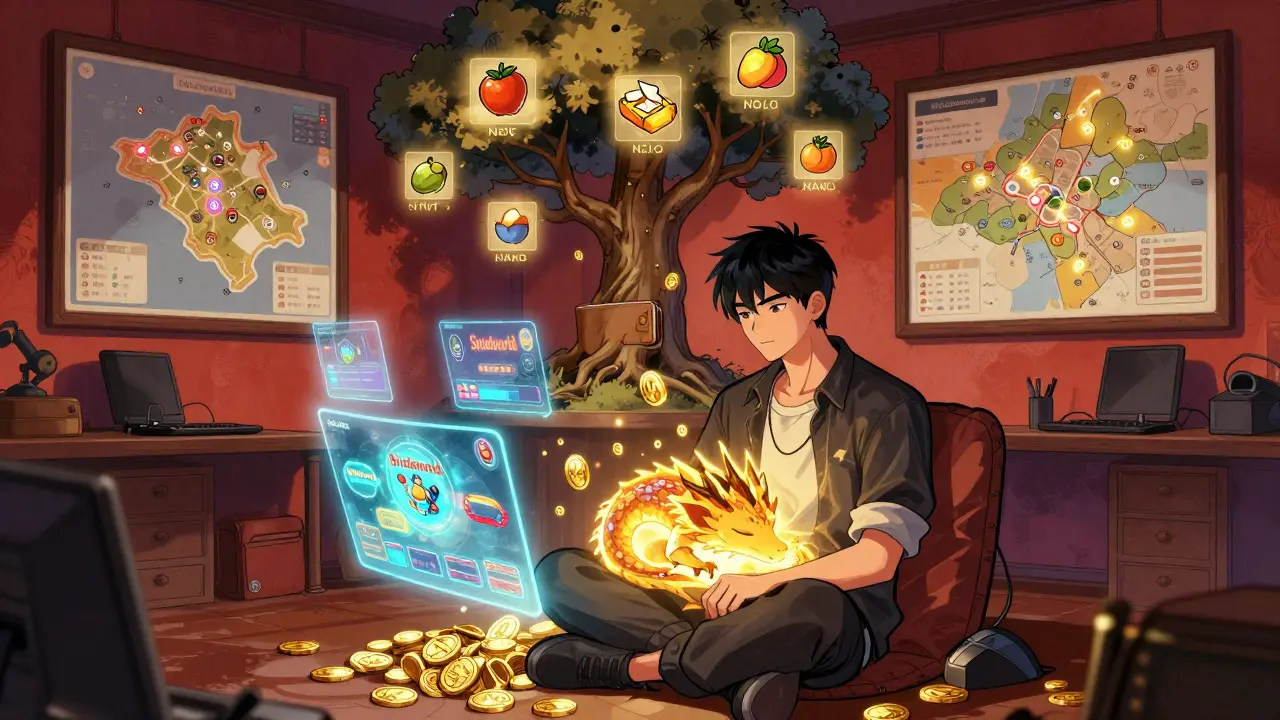
- Playing games - Like Bridgeworld, the flagship game, where you complete quests, fight monsters, and build your kingdom. Players report earning 1,000-1,500 MAGIC per month with regular play.
- Staking in the Atlas Mine - You lock up your MAGIC tokens to help secure the network and earn more as rewards. This also gives you voting power in the Treasure DAO, where the community decides what features get built next.
- Buying on exchanges - You can trade for MAGIC on platforms like Gate.io, KuCoin, and Uniswap if you want to skip the gameplay.
There’s also a deflationary twist: some MAGIC tokens are burned when used in-game or for certain transactions. That means over time, fewer coins are out there - which could make each one more valuable if demand grows.
What Makes Treasure Different?
Most blockchain games - like The Sandbox or Decentraland - are like single-player theme parks. You walk around, buy land, build stuff, and that’s it. Treasure is different. It’s like a library where every book can be read by any reader, and every reader can write new chapters that show up in other books.
Its biggest edge? Interoperability. Treasure doesn’t try to be the whole world. It lets others build their own worlds and connects them. Developers love this because they don’t have to start from zero. Players love it because they don’t have to choose just one game.
Compare that to Decentraland, which has over a million wallet addresses but only one main platform. Treasure has about 420,000 holders - smaller, but more active. Its 24-hour trading volume is 27% of its market cap, which is high for a token this size. That means people aren’t just holding - they’re using it.
The AI Revolution in Treasure
What’s new in 2025? AI. Treasure isn’t just about games - it’s about AI agents that live inside them. Their project Neurochimp lets NFTs become smart agents. For example, your NFT dragon isn’t just a picture. It’s an AI character that can chat with you, remember your past battles, trade items on your behalf, and even play games autonomously.
Smolworld, a Tamagotchi-style game, lets you raise an AI pet that evolves based on how you interact with it. These pets can go to other Treasure games, earn MAGIC, and even make decisions without you watching. It’s like having a digital creature that grows with you - and can earn money for you while you sleep.
This isn’t sci-fi. It’s live. The AI Agent Marketplace lets users rent out their agents to other players or games. If your AI pet is good at trading, someone else might pay you in MAGIC to use it.
Who Uses Treasure?
Treasure’s users are mostly crypto-savvy gamers. About 78% of its wallet holders also own tokens from Axie Infinity, Illuvium, or other blockchain games. These aren’t casual players. They’re people who already believe in owning their in-game items and want to move them freely.
It’s not for beginners. Setting up a MetaMask wallet, connecting to Arbitrum, understanding NFT marketplaces, and navigating multiple games takes time. Most new users say it takes 2-3 weeks to feel comfortable. But once they do, they rarely leave.
Community is strong. The Treasure Discord has over 65,000 members. People share tips, trade NFTs, and help each other learn. The DAO has had over 40 governance votes, with about 38% of token holders participating - a high rate for crypto projects.
Challenges and Risks
Treasure isn’t perfect. Network congestion on Arbitrum can slow things down during peak hours. Some games are still in early stages, and not all are polished. The learning curve is steep for non-crypto users. If you don’t know what a wallet or an NFT is, Treasure can feel overwhelming.
There’s also the risk of over-reliance on a single token. If MAGIC’s price drops, game developers might struggle to reward players. And while the deflationary model sounds good, if not enough people play, burning tokens won’t matter.
Still, the trend is clear. Gartner predicts that by 2026, 30% of blockchain games will support cross-game asset sharing - up from just 8% in 2023. Treasure is already doing that. It’s not waiting for the future. It’s building it.
What’s Next for Treasure?
The roadmap is focused on three things: more AI agents, more games, and smoother tools for developers. The AI Agent Marketplace will expand, letting users create and sell AI helpers for anything - from farming resources to negotiating trades.
Bridgeworld Canopy, a new strategy game, is rolling out with swarm-AI mechanics, where hundreds of agents work together like a colony. More indie studios are signing on to build “game cartridges” on Treasure, meaning the ecosystem will keep growing.
Long-term, Treasure’s success depends on one thing: developers keep building. If 10 new games join next year, and each brings 5,000 players, the MAGIC token becomes more useful. And if those players keep earning and spending it, the value follows.
Treasure isn’t trying to beat Fortnite. It’s trying to change how we think about games - not as closed boxes, but as open worlds that can grow together. MAGIC is the thread that ties them all.
Is MAGIC a good investment?
MAGIC isn’t a traditional investment like Bitcoin or Ethereum. Its value comes from usage - not speculation. If you play Treasure games, earn tokens, and use them across platforms, it has real utility. But if you’re buying it hoping for a quick price spike, you’re taking a risk. The market is small, and prices can swing based on game updates or developer news.
Can I use MAGIC outside of Treasure games?
Right now, MAGIC is mostly used within the Treasure ecosystem. You can trade it on exchanges like Uniswap or KuCoin, but outside of Treasure games and NFT marketplaces, its real use is limited. It’s not accepted for payments in stores or apps. Its value is tied to the games and tools built on Treasure.
How do I start playing Treasure games?
First, get a MetaMask wallet and switch it to the Arbitrum network. Then, buy a small amount of ETH to pay for gas. Go to treasure.xyz, connect your wallet, and start with Bridgeworld - it’s the easiest entry point. You’ll need to understand NFTs and staking, but the community guides are very helpful.
Is Treasure safe?
The Treasure platform itself hasn’t had any major hacks. It runs on Arbitrum, which is secured by Ethereum. But like all crypto, your safety depends on you. Never share your private key. Watch out for fake websites or phishing links. Only use official links from treasure.xyz or verified Discord channels.
What’s the difference between MAGIC and other gaming tokens like AXS or SAND?
AXS (Axie Infinity) and SAND (The Sandbox) are tied to single games or platforms. MAGIC is designed to work across dozens of games. You can’t take your AXS into Decentraland. But you can take your MAGIC NFT sword from Bridgeworld into Smolworld or a future game. Treasure’s goal is to be the connector, not the game.
Shruti Sinha
December 15, 2025 AT 04:48MAGIC is just another token trying to solve a problem no one asked for. I’ve played 3 blockchain games this year and still use Steam for everything. This feels like solving a broken faucet by building a new planet.
Dionne Wilkinson
December 16, 2025 AT 23:48I like how this isn’t about hype. It’s about letting your digital stuff live beyond one game. Like, if my NFT cat can visit my friend’s world and make friends there… that’s kinda beautiful. Not flashy, but real.
Emma Sherwood
December 17, 2025 AT 22:04As someone who grew up in a country where gaming was seen as a waste of time, seeing this kind of interoperability is honestly moving. It’s not just tech-it’s giving players ownership, dignity, and continuity. We don’t need more loot boxes. We need more connection.
Elvis Lam
December 18, 2025 AT 23:02Anyone who says MAGIC is just another crypto token hasn’t looked at the actual tech stack. Arbitrum + composability + AI agents = real utility. Most projects are just NFT art with a token attached. This is infrastructure. You’re not buying a coin-you’re buying access to a shared economy.
Kelsey Stephens
December 20, 2025 AT 12:39For people new to this: start small. Buy 0.1 ETH, connect to Arbitrum, hop into Bridgeworld, and just play for 20 minutes. Don’t stress about staking or prices. Just see how the sword you earn feels different because you can imagine it in another game later. That’s the magic.
Kayla Murphy
December 22, 2025 AT 03:07If you’re still stuck thinking crypto = get rich quick, you’re missing the point. This is about building something that lasts. Your dragon doesn’t vanish when the game updates. Your progress isn’t erased. That’s not just tech-that’s hope.
Florence Maail
December 23, 2025 AT 06:45AI agents that play for you? 😏 Yeah right. Next they’ll say your NFT cat is filing your taxes. This is just a way to get suckers to pay for digital pets that don’t even exist yet. And don’t get me started on the DAO votes-probably just the same 20 whales voting over and over.
Chevy Guy
December 24, 2025 AT 12:13Arbitrum? That’s just Ethereum’s little brother that the Fed secretly controls. You think they let you move assets freely? Nah. This is a honeypot. They want your wallet data, your play patterns, your NFT collection… then they’ll freeze it all when the next ‘regulatory update’ drops. Wake up.
SeTSUnA Kevin
December 25, 2025 AT 13:43The architectural elegance of composability in Treasure’s ecosystem is nontrivial. Unlike monolithic platforms, it enables emergent utility through orthogonal interoperability-a paradigm shift in digital asset ontology.
Rebecca Kotnik
December 25, 2025 AT 22:27While the technical underpinnings of MAGIC are undeniably innovative, one must consider the broader sociotechnical implications. The notion of transferring digital assets across disparate virtual environments introduces unprecedented questions regarding identity, ownership, and cultural continuity. Are we creating a new form of digital inheritance? Or merely replicating capitalist extraction under a decentralized veneer? The DAO’s participation rate, while statistically impressive, still centers power among those with capital-raising concerns about equitable governance. Furthermore, the integration of AI agents as autonomous economic actors blurs the line between tool and entity. If an AI pet earns MAGIC and trades it autonomously, who owns the labor? Who bears the liability? These are not trivial questions. They are foundational.
Tom Joyner
December 27, 2025 AT 15:49Interesting. I wonder how many of these games will still be running in five years. Most blockchain games die after the airdrop.
George Cheetham
December 28, 2025 AT 12:15That’s the thing-most games die because they’re built for speculation. Treasure’s built for persistence. If your NFT dragon is still useful in three new games by then, it’s not a dead asset. It’s a living part of a network. That’s different.
Amy Copeland
December 28, 2025 AT 19:47Oh wow, so now we’re supposed to believe that a ‘Tamagotchi AI pet’ is the future of gaming? Cute. I’ll stick with my real cat who doesn’t need 3 gas fees to purr.
Sue Bumgarner
December 29, 2025 AT 02:19And you think your cat is better? My NFT dragon fought a goblin in Bridgeworld, then flew into Smolworld and taught a baby AI pet how to farm MAGIC while I slept. Your cat purrs and knocks over a glass. Which one is actually contributing to the economy? 🤔
Jesse Messiah
December 30, 2025 AT 14:41Man I just tried to connect my wallet to Arbitrum last week and my brain exploded. But after watching a 10-minute YouTube guide, I got it. Now I’m earning MAGIC just by playing Bridgeworld on my phone during lunch. It’s not hard. Just different. And honestly? Kinda cool.
Abby Daguindal
December 31, 2025 AT 20:18So you’re telling me I should trust a token that’s worth $31 million with 420k holders… but not trust the guy who says it’s a scam? I’ll pass. I’ve seen this movie before.
Patricia Amarante
January 1, 2026 AT 09:59Just started playing Bridgeworld. Got my first sword. It’s just a picture… but I already want to see it in another game. That’s the hook.
Heather Turnbow
January 2, 2026 AT 18:57The most profound aspect of Treasure isn’t the token or the AI agents-it’s the quiet normalization of digital ownership. For the first time, a generation is growing up believing their virtual possessions have lasting value. That shift in mindset may be more revolutionary than any smart contract.